Bir/Beer
The warrior died defending his people. Death did not end his duty. He still patrols the village boundary — and what he does to trespassers has not softened with the centuries.

- What Is a Bir/Beer?
- Why the Bir Is Terrifying
- Origin — How It Came to Exist
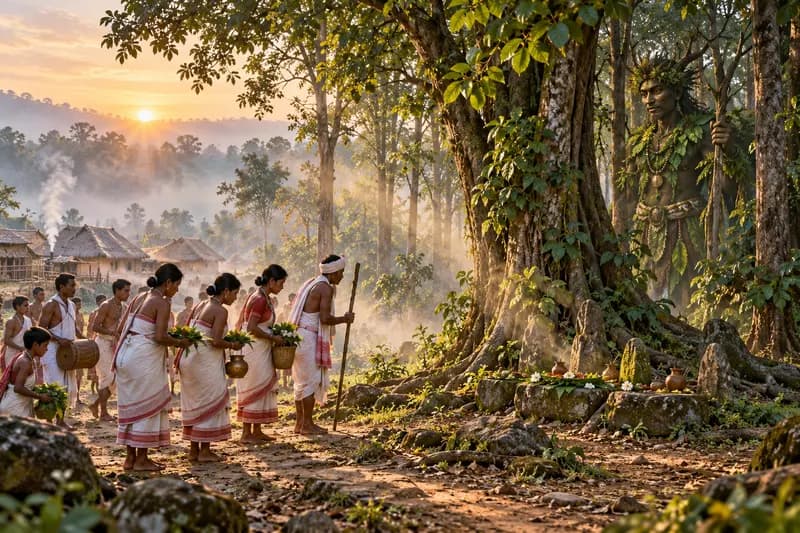
- Appearance & Manifestation
- The Surveyor of Dumka
- The Rules — How to Survive
- What They Don't Tell You
- What Does the Bir Want?
- You're Most at Risk If...
- Offerings & Appeasement
- The Healer
- What If You Dream of a Bir?
- The Bir in Art History
- Cross-Regional Patterns
- In Culture — Movies, Books, Games
- Is the Bir Still Real?
- Expert & Academic Context
- If You Encounter a Bir
- Frequently Asked Questions
- Explore More
| Bir/Beer | |
|---|---|
| Also Known As | Bir Bonga, Beer Bonga, Bir spirit |
| Script | बीर (Devanagari) |
| Pronunciation | BEER (बीर) |
| Region | Jharkhand, Odisha, West Bengal — Santhal and Munda tribal territories |
| Category | Ancestral Warrior Spirit / Tribal Protector |
| Danger Level | Guarded |
| Fear Method | Territorial aggression toward outsiders, illness as punishment for boundary violation |
| Warning Sign | Unexplained illness after entering tribal forest without permission; a feeling of being watched in sacred groves |
| First Documented | Santhal and Munda oral traditions; earliest written accounts by colonial ethnographers (W.G. Archer, P.O. Bodding) in the 19th–20th century |
| Still Believed? | Yes — Bir spirits are actively venerated in Santhal and Munda villages; sacred groves (Jaher) are maintained as their dwelling places |
| Related | Bonga · Churel · Bhoot · Raktabija Spirit · Chenga · Dakini |
What Is a Bir/Beer?
The Bir (बीर), also known as Beer or Bir Bonga, is an ancestral warrior spirit venerated by the Santhal, Munda, and related Adivasi (indigenous) communities of eastern India. The Bir is not a ghost in the conventional sense — it is the elevated spirit of a tribal warrior or leader who died defending the community and has been consecrated as a permanent guardian of the village, its boundaries, its sacred groves, and its people.
What distinguishes the Bir from other spirit categories in Indian folklore is its unambiguously protective nature. The Bir does not haunt. It does not terrorize its own people. It guards. It patrols the boundary between the village and the outside world — the forest, the neighboring settlement, the unknown. Its danger is directed outward: toward those who trespass without permission, who damage sacred groves, or who threaten the community it was consecrated to protect. At danger level 2, the Bir is not a threat to those who respect its territory — but a serious one to those who do not.
Why the Bir Is Terrifying
INSTINCT EXPLOITED: THE OUTSIDER'S ARROGANCE
You are a surveyor. A contractor. A government official with a clipboard and a mandate. You have been sent to assess a tract of forest in rural Jharkhand for a mining project. The forest is classified as government land. Your paperwork is in order. You have every legal right to be here.
Except the forest has its own law.
The villagers at the edge of the settlement told you not to enter the Jaher — the sacred grove — without performing an offering. You smiled. You were polite. You did not perform the offering. You entered the grove with your measuring tape and your GPS device and your confidence that maps determine ownership.
The first sign is a headache. Not a normal headache — a pressure behind the eyes that feels like something pressing from the outside in. Then nausea. Then a fever that arrives within the hour, sudden and steep, as if your body has decided to reject the ground you are standing on.
You leave the forest. You return to the district office. The fever breaks in two days, but you dream of the grove every night for a week — and in the dreams, someone is standing at the tree line, watching you. Not threatening. Watching. Making sure you do not return.
The Bir does not kill outsiders. It does not need to. It makes the territory itself reject you. The forest becomes hostile — not with teeth and claws but with illness, disorientation, and a psychological certainty that you are not welcome. You will not come back. Nobody does.
Origin — How It Came to Exist
The Warrior's Consecration
When a Santhal or Munda warrior dies in defense of the community — whether in battle, in protection against wild animals, or in resistance against colonial or state incursion — the village may consecrate their spirit as a Bir. This is not automatic. It requires a specific ritual performed by the village Naike (priest) or Ojha (spiritual specialist). The warrior's spirit is invited to remain as a permanent guardian, bound not to the living world but to the community's territory.
The Sacred Grove (Jaher)
Every traditional Santhal and Munda village maintains a Jaher — a sacred grove of trees at the village edge that serves as the dwelling place of the Bonga (spirits), including the Bir. The Jaher is not a temple. It is a forest — left uncut, unfenced, maintained through centuries of deliberate non-interference. This is where the Bir resides, where offerings are made, and where the boundary between human space and spirit space is maintained.
The Bonga System
The Bir is part of a larger cosmology called the Bonga system — the Santhal understanding of the spirit world. Bongas include ancestor spirits, nature spirits, household spirits, and village protector spirits. The Bir is a specific subcategory: the warrior Bonga, the protector Bonga, the one whose function is defense. Other Bongas may be benevolent, neutral, or hostile. The Bir is exclusively protective — but protection, when directed at intruders, looks a lot like aggression.
Historical Context
The Bir tradition gained particular intensity during the colonial period, when Santhal and Munda communities faced systematic dispossession of their forests and lands. The Santhal Rebellion of 1855 and the Munda Ulgulan (Great Tumult) under Birsa Munda (1899–1900) produced warrior spirits that were consecrated as Bir by their communities. These are not ancient, distant entities — they are the spirits of people who died fighting colonial exploitation within the last two centuries.
Birsa Munda's Legacy
Birsa Munda, who led the Munda rebellion and is considered the most important Adivasi freedom fighter, is not classified as a Bir in the traditional sense — he is venerated as a deity (Birsa Bhagwan). But his movement explicitly drew on Bir traditions: the idea that warriors who die for the community become its permanent guardians. The Bir concept is inseparable from the Adivasi history of resistance.
Appearance & Manifestation
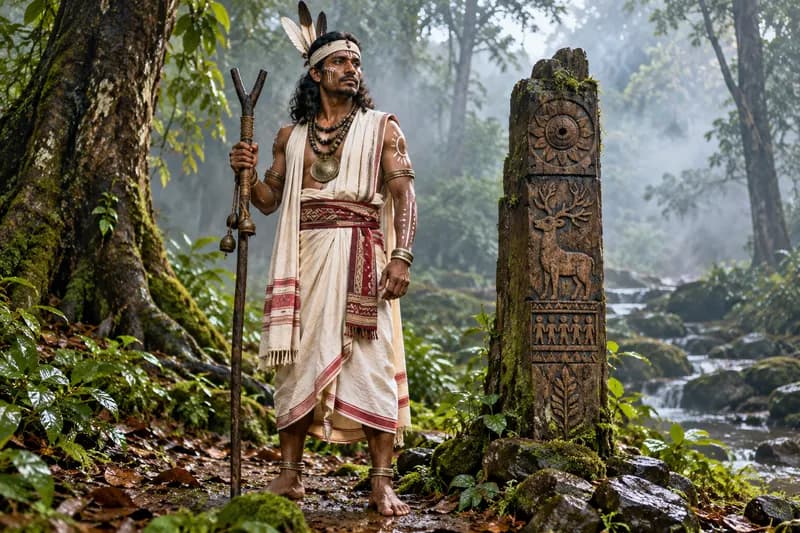
| 👁 Sight | The Bir is rarely seen directly. Its presence is inferred from effects: trees moving without wind, shadows at the edge of the grove, a figure glimpsed between trunks and gone when looked at directly. In rare direct manifestations, described as a tall, dark-skinned warrior in traditional Santhal dress, carrying a bow or an axe. |
| 🔊 Sound | Silence — a specific, heavy silence that falls over the Jaher when the Bir is active. Birds stop calling. Insects go quiet. The forest holds its breath. In some accounts, the sound of footsteps on dry leaves when no one is visible, patrolling the boundary. |
| 🍃 Smell | The smell of sal forest — resinous, green, earthy. When the Bir is active, the natural forest smell intensifies, as if the grove is asserting itself. Some report the smell of mahua flowers, which are used in traditional Bir offerings. |
| ❄ Temperature | Sacred groves are noticeably cooler than surrounding areas — but this is attributed to the dense, uncut canopy rather than supernatural cold. When the Bir is actively warning an intruder, however, the cold takes on a different quality: sharp, directed, personal. |
| 🌑 Time | Active at all times but most potent during the transitional hours — dawn and dusk. The Bir patrols boundaries, and boundaries are most permeable at the edges of day. Festival days — Sohrae, Baha, Karam — are when the Bir's presence is most deliberately invoked through ritual. |
| 🏚 Habitat | The Jaher (sacred grove), village boundaries, forested areas within the community's traditional territory. The Bir does not wander. It is bound to the territory it protects. Its range is the community's range — no further. |
The Surveyor of Dumka
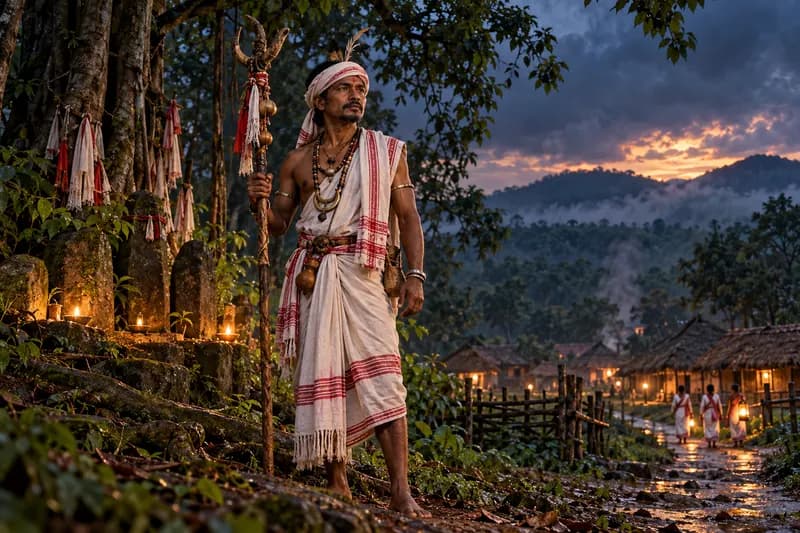
In the early 2000s, a surveying team arrived in a Santhal village outside Dumka district, Jharkhand. They were mapping forest land for a road-widening project. The government had approved the project. The paperwork was complete. The trees that needed to be felled had been identified by number on a map drawn in an office in Ranchi.
The village Majhi (headman) met the surveyors at the village entrance. He was polite. He offered water. Then he told them that the road project's route passed through the Jaher — the sacred grove — and that the grove could not be touched. The surveyors explained that the project had government approval. The Majhi nodded. He said he understood the government's authority. But the Jaher had its own authority, and it was older.
The surveyors entered the grove the next morning. They brought their equipment. A young Santhal man — the Majhi's nephew — followed at a distance and sat at the edge of the grove, watching. He did not interfere. He did not protest. He simply sat.
By midday, the lead surveyor — a man from Ranchi who had done this work for fifteen years — developed a sudden, violent headache. He attributed it to the heat. By afternoon, his assistant was vomiting. By evening, all three members of the surveying team were running fevers. The fevers were identical: sudden onset, high temperature, no other symptoms. They left the grove and returned to their vehicle.
The fevers broke within twenty-four hours of leaving the village. No medical explanation was found. The road project was rerouted to avoid the Jaher — not because of the surveyors' illness but because of a subsequent environmental review that identified the grove as ecologically sensitive. The Santhal villagers did not comment on the coincidence.
The Majhi's nephew, when asked later by an anthropologist whether he believed the Bir had caused the illness, said: 'The Bir does not cause illness. The forest causes illness when you enter without permission. The Bir is just the forest's way of saying no.'
The Rules — How to Survive
☠ WARNING ☠
Seven rules for respecting Bir territory
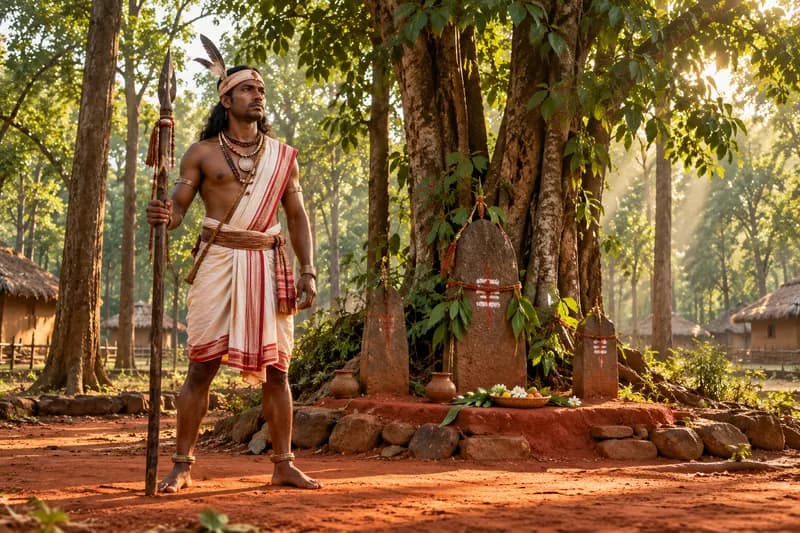
- Never enter a Jaher (sacred grove) without permission from the village Naike or Majhi. — The Jaher is the Bir's domain. Entering without permission is trespassing on territory guarded by a warrior spirit. Permission must come from the community's spiritual authority, not from government paperwork.
- Make an offering before entering tribal forest. — Even if you have permission, an offering — rice, mahua flowers, a coin — acknowledges the Bir's presence and establishes that you come with respect, not entitlement.
- Do not cut trees in the sacred grove. — The trees in the Jaher are the Bir's dwelling. Cutting them is not deforestation in the Bir's understanding — it is demolishing its home. The response is proportional.
- Do not photograph or record in the Jaher without community consent. — The Jaher is a sacred space. Recording its contents — visually or acoustically — without consent is a violation of the Bir's territory and the community's sovereignty over their spiritual landscape.
- If you feel suddenly ill in or near a sacred grove, leave immediately. — Illness is the Bir's primary warning mechanism. It does not escalate from warning to harm instantly — illness is the first signal. Leaving honors the warning and ends the encounter.
- Attend village festivals when invited — the Bir is honored through communal celebration. — The Bir is a community spirit. Its strength is renewed through communal ritual — especially Sohrae (harvest festival) and Baha (flower festival). Participation strengthens the community's relationship with its protector.
- Do not mock or dismiss the Bir tradition in the presence of the community. — Dismissal is the deepest form of disrespect in Adivasi spiritual practice. The Bir protects a community that has faced centuries of dispossession. Mocking the protector is mocking the resistance itself.
What They Don't Tell You
The Bir tradition is one of the most effective forest conservation mechanisms in India. Sacred groves protected by Bir spirits contain some of the last remaining old-growth forests in eastern India — trees that survive not because of government protection but because a community's warrior dead will not allow them to fall. Ecologists have documented that Jaher groves maintain higher biodiversity than surrounding managed forests. The Bir, in this light, is not merely a spiritual concept — it is an environmental strategy. A forest guarded by the dead is a forest that survives. The outsider who sees superstition is looking at something far more practical: a conservation system that has outlasted every government policy aimed at the same goal.
What Does the Bir Want?
The Bir wants what it wanted in life: the survival of its people. This is the simplest and most powerful motivation in the entire entity database. No riddles. No philosophical complexity. No ambiguity. The Bir was a warrior. The warrior died for the community. The community consecrated the warrior as a permanent guardian. The Bir guards.
Its methods are proportional. An outsider who enters the Jaher without permission gets a warning — illness, disorientation, unease. An outsider who damages the grove or threatens the community gets a stronger response. The Bir does not pursue beyond its territory. It does not seek vengeance outside its jurisdiction. It is a sentry, not a hunter.
What makes the Bir poignant is what it does not want: rest. The Bir is a spirit that has explicitly chosen duty over peace. Other spirits in Indian folklore are trapped — the Churel by injustice, the Vetala by sorcery. The Bir is not trapped. It was invited to stay. It accepted. This is a spirit that found its purpose in life and continued it in death.
The Bir's only vulnerability is neglect. If the community stops maintaining the Jaher, stops performing the rituals, stops remembering the warrior's name — the Bir's power fades. Not because the spirit departs, but because the contract between community and protector relies on both parties honoring it. A forgotten Bir is a weakened guardian. A weakened guardian means an unprotected people.
You're Most at Risk If...
- You enter a Jaher (sacred grove) without permission from the community
- You are involved in projects that threaten tribal forest land
- You damage or cut trees in or near a sacred grove
- You dismiss or mock Adivasi spiritual traditions in their presence
- You take photographs or recordings in sacred spaces without consent
- You are an outsider who ignores village authority and operates solely on government mandate
Offerings & Appeasement
| Offering | Purpose |
|---|---|
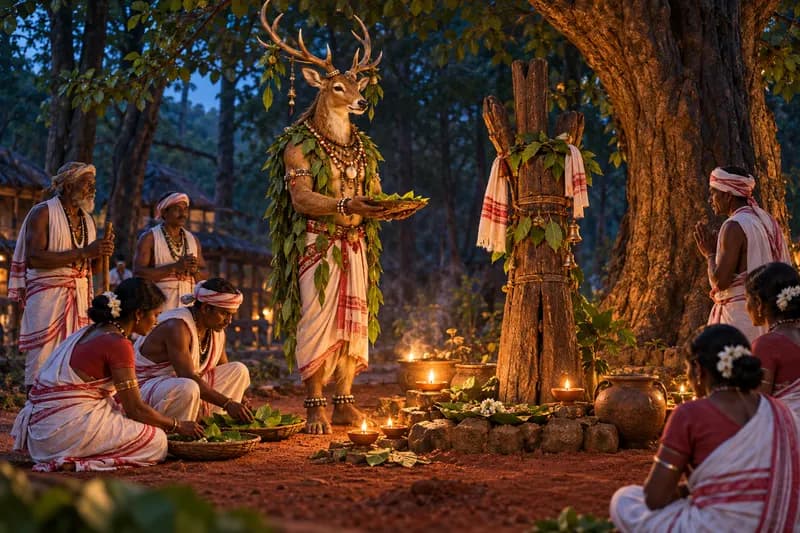
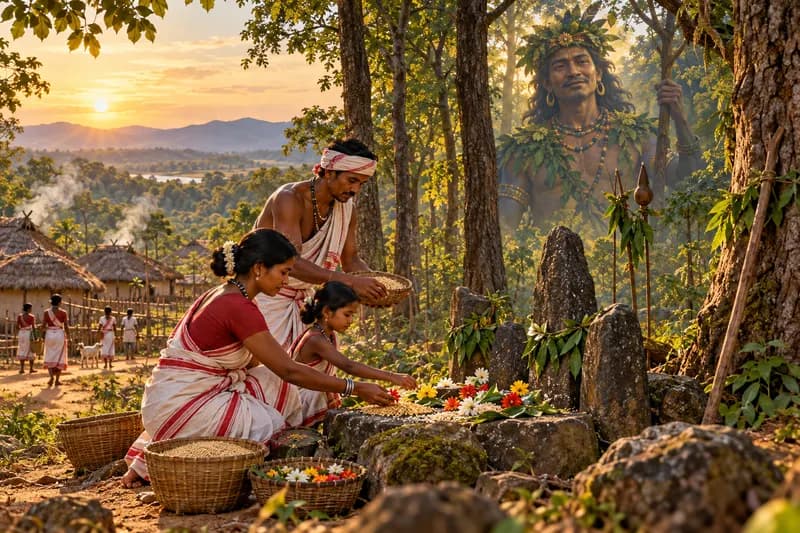
| Standard Jaher Offering | Rice, mahua flowers, a small amount of rice beer (handia), and vermilion placed at the base of the primary tree in the sacred grove. This offering is made by the Naike during regular ritual occasions and by community members seeking the Bir's favor. |
| Festival Offerings | During Sohrae (harvest) and Baha (flower festival), communal offerings are made to all Bongas including the Bir. These include animal sacrifices (chicken or goat), cooked food, and newly brewed handia. The entire village participates. |
| Outsider's Offering | A visitor entering tribal territory can make a simple offering at the grove's edge: a handful of rice, a few flowers, and spoken words of respect. The offering does not need to be elaborate. It needs to be sincere. The Bir distinguishes between performance and genuine acknowledgment. |
| The Ongoing Offering | The most important offering is the maintenance of the Jaher itself. Not cutting the trees. Not selling the land. Not allowing the grove to be absorbed by development. The community's ongoing resistance to dispossession is itself the greatest offering to the Bir — a continuing act of loyalty to the warrior who died for the same cause. |

The Healer
Naike (Village Priest) — The Naike is the hereditary spiritual leader of the Santhal village, responsible for all rituals involving the Bongas. The Naike communicates with the Bir during festivals, resolves spiritual grievances, and can intercede on behalf of someone who has angered the Bir through ignorance rather than malice.
Ojha (Tribal Healer) — The Ojha is a specialist in identifying and treating spirit-caused illness. If someone falls ill after entering the Jaher, the Ojha determines which Bonga is responsible and prescribes the appropriate offering or ritual to restore balance.
Majhi (Village Headman) — While not a spiritual specialist, the Majhi mediates between the community and outsiders. The Majhi can grant permission to enter tribal territory and can advise outsiders on proper conduct — effectively acting as a translator between the modern world and the Bir's jurisdiction.
The Key Difference — The Bir is not exorcised. It is *thanked.* If someone has offended the Bir, the remedy is not removal of the spirit but restoration of the relationship. An apology offering, performed through the Naike, acknowledges the trespass and reaffirms the outsider's respect for the Bir's authority.
What If You Dream of a Bir?
| Symbol | Meaning | |
|---|---|---|
| 🌳 | A Forest You Cannot Enter | A boundary in your life that you are testing. Something — a relationship, a space, a community — that has rules you have not respected. The dream is telling you: ask permission before proceeding. |
| ⚔ | A Warrior Standing Guard | Your own protective instinct. Something you love — a person, a place, a principle — is under threat, and you have the capacity to defend it. The Bir in your dream is the version of you that does not back down. |
| 🏡 | A Village Seen from the Outside | Belonging. You are on the outside of a community you wish to be part of. The dream is not rejection — it is an invitation to earn entry through respect, patience, and genuine engagement. |
| 🍂 | A Grove of Falling Leaves | Loss of protection. Something that has been shielding you — a tradition, a relationship, a home — is weakening. The falling leaves are a call to maintain what you have before it is lost. |
The Bir in Art History
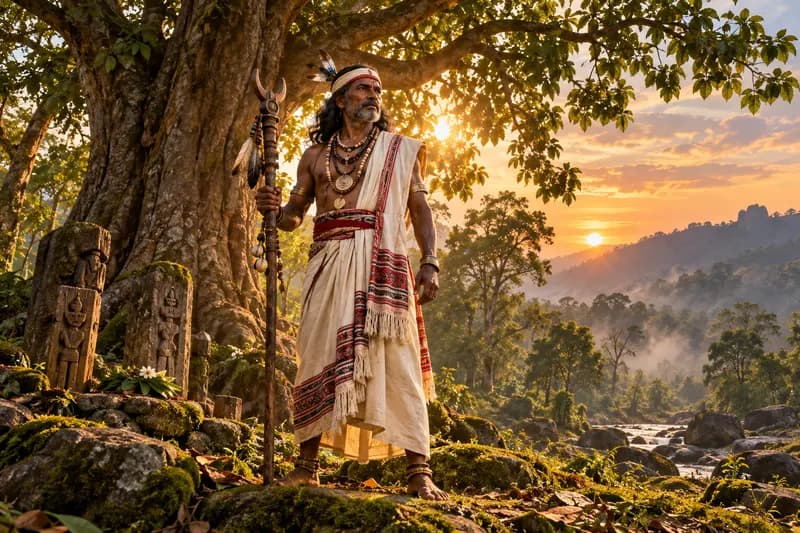
Santhal Parganas — Stone Memorials: Traditional Santhal villages maintain stone memorials (sasandiri) for their honored dead, including Bir spirits. These are rough-hewn stones, often arranged in rows at the village edge, representing generations of ancestors who continue to guard the community.
Munda Megalithic Traditions: The Munda tradition of erecting large stones (sasandiri) for the dead predates and parallels megalithic traditions found across South and Southeast Asia. These stones are the physical anchor of the Bir — the point where the warrior's spirit is fixed to the territory it protects.
Santhal Scroll Paintings (Jadu Patua): The Jadu Patua (magic painters) of the Santhal tradition create scroll paintings depicting the journey of the dead. These scrolls include images of warrior spirits who become Bir — shown with weapons, standing at forest edges, facing outward toward potential threats.
Contemporary Adivasi Art: Modern Adivasi artists — particularly those working in the Santhal and Munda traditions — have begun depicting Bir spirits in contemporary media. These works serve a dual purpose: artistic expression and political assertion of indigenous spiritual sovereignty.
Cross-Regional Patterns
Bonga · Churel · Bhoot · Raktabija Spirit · Chenga · Dakini · Rakshasi · Yogini
| Dawn as hard limit | No |
| Iron weakness | No |
| Tree-dwelling | Sacred grove |
| Territorial | Strongly |
| Backward feet | No |
Global Equivalent: The closest global parallels are the ancestor warrior spirits of various indigenous traditions worldwide: the aumakua of Hawaiian tradition (ancestor spirits that protect family lineages), the muertos of Mesoamerican practice (honored dead who maintain connection with the living), and the einherjar of Norse mythology (warriors who continue to fight after death). The Bir shares with all these traditions the core idea: a warrior's duty does not end at death.
In Culture — Movies, Books, Games
| Type | Title | Description |
|---|---|---|
| Literature | Mahasweta Devi — Aranyer Adhikar | This landmark Bengali novel about Birsa Munda's rebellion draws extensively on the Bir tradition and the Munda understanding of ancestral warrior spirits as active participants in contemporary resistance. |
| Film | Birsa Munda Biopics | Multiple films depicting Birsa Munda's life and rebellion reference the Bir tradition as context for Munda spiritual beliefs about warrior spirits and ancestral protection. |
| Academic | W.G. Archer — The Hill of Flutes | Archer's ethnographic work on Santhal culture includes detailed documentation of the Bonga system, including the Bir category, based on fieldwork in the Santhal Parganas. |
| Academic | P.O. Bodding — Santhal Traditions | Norwegian missionary Bodding's extensive documentation of Santhal folklore and spiritual practice remains one of the most comprehensive sources on the Bir tradition in English. |
| Documentary | Sacred Grove Documentaries | Several environmental documentaries have featured the Jaher sacred groves as examples of community-based conservation, inadvertently documenting the Bir tradition as an ecological strategy. |
ACCURACY RATING: STRONG IN ETHNOGRAPHIC SOURCES · RARELY DEPICTED IN MAINSTREAM MEDIA
Is the Bir Still Real?
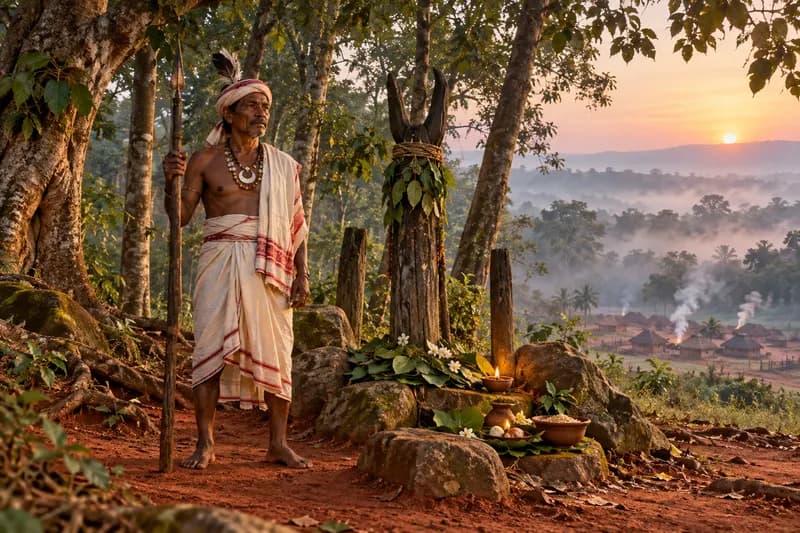
- Sacred groves (Jaher) remain actively maintained in Santhal and Munda villages across Jharkhand, Odisha, and West Bengal. These are living ecological and spiritual spaces, not heritage sites.
- The Naike (village priest) continues to perform Bir-related rituals during seasonal festivals. These rituals are community events with full participation, not nostalgic reenactments.
- Adivasi political movements explicitly invoke the Bir tradition when resisting land acquisition, mining, and deforestation — framing environmental resistance as spiritual duty. The Bir is not merely believed in; it is mobilized.
- Reports of illness among outsiders who enter sacred groves without permission continue into the present day. These are documented in ethnographic literature and reported by forest department officials who have worked in tribal areas.
- The Indian Forest Rights Act (2006), which recognizes Adivasi communities' rights to their traditional forests, has given legal backing to the same territorial sovereignty that the Bir has been enforcing spiritually for centuries.
Expert & Academic Context
- W.G. Archer — The Hill of Flutes: Life, Love and Poetry in Tribal India — Comprehensive ethnography of Santhal culture including detailed documentation of the Bonga system and the Bir tradition.
- P.O. Bodding — Studies in Santhal Medicine and Connected Folklore — Norwegian missionary's extensive documentation of Santhal spiritual practices, including the role of the Ojha in diagnosing and treating Bir-related illness.
- K.S. Singh — The Scheduled Tribes (Anthropological Survey of India) — Government of India's comprehensive documentation of tribal communities, including descriptions of Santhal and Munda spiritual practices.
- Sacred Grove Studies (Various ecologists) — Multiple ecological studies documenting the biodiversity of Jaher groves compared to surrounding managed forests — providing empirical evidence for the conservation effectiveness of the Bir tradition.
- Mahasweta Devi — Fiction as Ethnography — Devi's literary works on Adivasi communities, while fictional, draw on deep ethnographic knowledge and provide vivid depictions of the Bir tradition in its social and political context.
The Bir tradition represents something rare in Indian folklore: a spirit category that is unambiguously positive for its community. While most Indian supernatural entities exist in moral ambiguity — helpful under some conditions, harmful under others — the Bir is purely protective. This simplicity is itself significant: in a tradition that produced the philosophically complex Vetala and the morally nuanced Yakshi, the Bir is a warrior. It fights. It guards. It does not equivocate. This reflects the Adivasi communities' historical reality: when your land is being taken, your forests are being felled, and your people are being displaced, you do not need a spirit that poses riddles. You need one that stands at the boundary and says no.
If You Encounter a Bir
Frequently Asked Questions
▶What is a Bir/Beer?
A Bir (also Beer or Bir Bonga) is an ancestral warrior spirit in the Santhal and Munda tribal traditions of eastern India. It is the consecrated spirit of a warrior who died defending the community and has been bound as a permanent guardian of the village and its sacred groves.
▶Is the Bir dangerous?
To the community it protects, no. The Bir is entirely protective toward its own people. The danger is directed at outsiders who trespass on sacred territory, damage sacred groves, or threaten the community. Even then, the Bir typically warns (through illness or unease) before inflicting serious harm.
▶What is a Jaher?
A Jaher is a sacred grove maintained by Santhal and Munda villages as the dwelling place of the Bongas (spirits), including the Bir. These are uncut patches of forest — some centuries old — that serve as both spiritual sanctuaries and ecological reserves.
▶Can you visit a Jaher?
With permission from the village Majhi or Naike, yes. You should make a simple offering (rice, flowers) and follow any instructions given. Do not take photographs without consent. Do not damage or remove anything from the grove.
▶How is the Bir connected to Birsa Munda?
Birsa Munda led the Munda rebellion against colonial rule (1899–1900) and is venerated as a deity. While not classified as a Bir himself, his movement drew directly on the Bir tradition — the idea that warriors who die for the community become its permanent guardians.
▶Is the Bir tradition still practiced?
Yes, actively. Sacred groves are maintained, festivals are observed, and the Naike continues to perform rituals. The tradition has also been mobilized by Adivasi political movements as a framework for resisting land dispossession.
Explore More
Stories Are Being Summoned
One ghost story per week. Every Tuesday at midnight.