Bonga
It does not possess you. It does not chase you. The forest simply stops letting you leave.
- What Is a Bonga?
- Why the Bonga Is Feared
- Origin — How It Came to Exist
- Appearance & Manifestation
- The Charcoal Maker of Rajmahal
- The Rules — How to Coexist
- What They Don't Tell You
- What Does the Bonga Want?
- You're Most at Risk If...
- Offerings & Restoration
- The Healer
- What If You Dream of a Bonga?
- The Bonga in Art & Material Culture
- Cross-Regional Patterns
- In Culture — Literature, Film, Music
- Is the Bonga Still Real?
- Expert & Academic Context
- If You Enter Bonga Territory
- Frequently Asked Questions
- Explore More
| Bonga | |
|---|---|
| Also Known As | Bonga Buru, Marang Buru, Jaher Era, Gosain Era |
| Script | ᱵᱚᱝᱜᱟ (Ol Chiki / Santali script) |
| Pronunciation | BOHN-gah (बोंगा) |
| Region | Jharkhand, Chhattisgarh, Odisha, West Bengal — Santhal Parganas, Chota Nagpur Plateau, and tribal belt regions |
| Category | Nature Spirit / Sacred Elemental — Sarna (Adivasi) Tradition |
| Danger Level | Guarded |
| Fear Method | Environmental displacement, disorientation, illness through ecological violation |
| Warning Sign | Sudden silence in a forest; animals leaving an area without cause; unexplained fever after disturbing a sacred grove |
| First Documented | Oral tradition predating written record; earliest colonial ethnographic accounts by E.T. Dalton (1872) and W.J. Culshaw (1949) |
| Still Believed? | Yes — actively central to Sarna religion; sacred groves (Jaher) maintained across Jharkhand and Chhattisgarh; Sarna faith seeking constitutional recognition as a distinct religion |
| Related | Bhoot · Yaksha · Raktabija Spirit · Chenga · Dakini · Rakshasi |
What Is a Bonga?
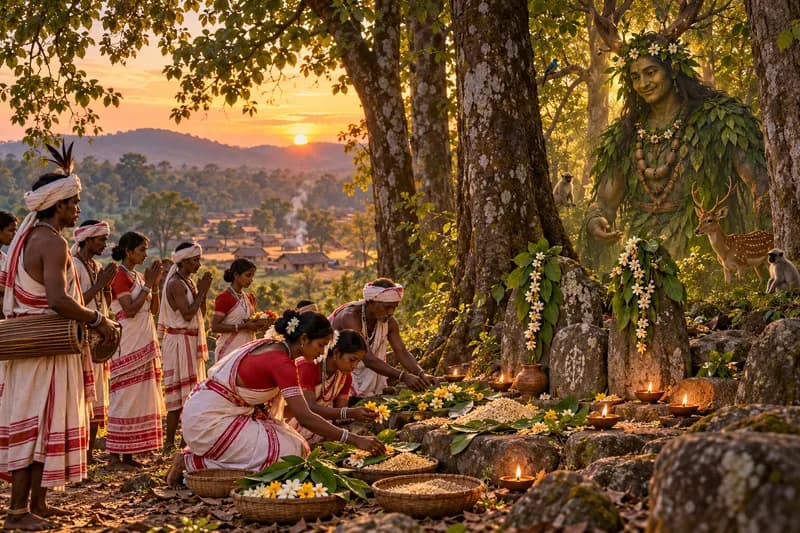
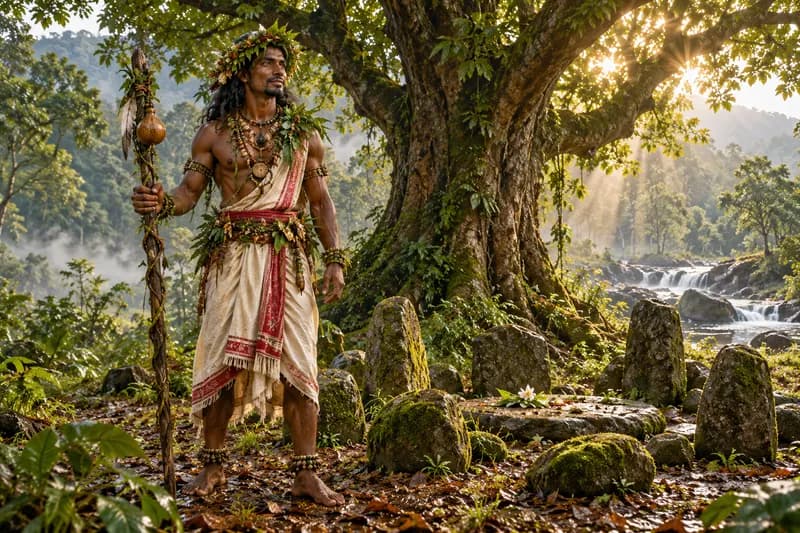
The Bonga (ᱵᱚᱝᱜᱟ) is a nature spirit in the Santali and broader Adivasi tribal tradition of eastern and central India. It inhabits trees, rivers, hills, and stones — not as a metaphor, but as a living presence that the land itself holds. The Bonga is not a ghost. It is not a demon. It is a spirit of place — an intelligence that belongs to the natural world and governs the relationship between human communities and the ecosystems they depend on. Found across the Chota Nagpur Plateau and the Santhal Parganas, the Bonga is central to the Sarna religion, the indigenous faith of the Santhal, Munda, Ho, Oraon, and other Adivasi peoples.
This is critically important: the Bonga belongs to the Sarna tradition, NOT to Hinduism. The Sarna religion is an indigenous Adivasi belief system with its own cosmology, its own rituals, its own priesthood (the Naike), and its own sacred spaces — the Jaher, or sacred grove. Attempts to fold the Bonga into the Hindu pantheon erase the distinct identity of Adivasi spiritual life. The Bonga is worshipped in open groves, not temples. It requires no idols, no scriptures, no Brahminical priesthood. It is the land speaking back.
Why the Bonga Is Feared
INSTINCT EXPLOITED: THE LAND REJECTING YOU
You do not see the Bonga. You feel its absence — or rather, you feel yourself becoming absent from a place that no longer wants you there.
You walked into the forest an hour ago. The path was clear. The sal trees stood in rows you recognized. You had come this way a hundred times before — to collect firewood, to check traps, to reach the stream where the water runs clean over black stone. But something is different today. You cut a branch from a tree at the edge of the Jaher. You did not mean to. You did not think about it. It was just a branch.
Now the path is wrong. Not gone — wrong. The trees look the same but the distances between them have changed. The stream should be to your left but you can hear it behind you. The sun is in the wrong part of the sky. You are not lost. You know this forest. But the forest no longer knows you.
By evening, you are walking in circles. By nightfall, the fever starts. A heat behind your eyes, a weight in your limbs. You sit against a tree and you cannot stand again. In the village, your family will know what happened before any doctor does. They will call the Naike. The Naike will ask: "What did you take from the Jaher?"
The Bonga does not attack. It withdraws. It takes the legibility of the land away from you — the paths, the landmarks, the sense of direction that your body learned before your mind did. You are not being hunted. You are being excluded. The forest has decided you do not belong in it anymore.
That is what makes the Bonga different from every other entity in this database. It does not come to you. It makes you unable to come to it. And the land it governs is the land you need to survive.
Origin — How It Came to Exist
The Sarna Cosmology
In Sarna belief, the world was not created for humans. The earth, forests, rivers, and hills existed first, and they were inhabited by spirits — the Bongas. When human beings arrived, they entered into a relationship with these spirits: a covenant of respect. Humans could use the forest, drink from the rivers, farm the land, but only within limits set by the Bongas. The Jaher — the sacred grove at the center of every Santali village — is the physical expression of this covenant. It is never cut, never farmed, never built upon. It belongs to the Bonga.
The Hierarchy of Bongas
The Bonga is not a single entity but a category. The Santali tradition recognizes several types: Marang Buru (the great mountain spirit, the highest Bonga), Jaher Era (the spirit of the sacred grove), Manjhi Haram Bonga (ancestral spirits of the village headman's lineage), Gosain Era (spirits of rivers and water bodies), and Kal Bongas (malevolent Bongas associated with disease and death). Each has its own domain, its own requirements, and its own rituals.
Not Hindu, Not Buddhist, Not Anything Else
The Sarna religion predates the arrival of Hinduism, Buddhism, Islam, and Christianity in the tribal regions of central and eastern India. It has no scripture, no temple architecture, no caste hierarchy. Worship happens in the open — under specific trees, beside specific stones, at the edge of specific rivers. The Naike (village priest) conducts rituals not because of Brahminical authority but because the role was passed to them by the community. Colonial administrators and Hindu reformers repeatedly tried to classify Sarna beliefs as 'animism' or fold them into Hinduism. Both are distortions. The Bonga is part of a complete, self-contained religious system.
The Jaher — Sacred Grove
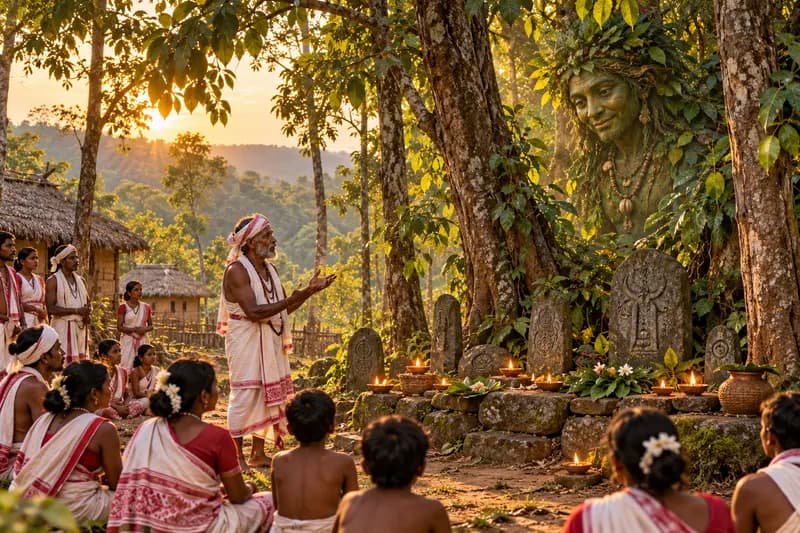
Every traditional Santali village has a Jaher — a grove of sal trees (Shorea robusta) set aside as sacred ground. No one may cut a tree in the Jaher. No one may hunt in it. No one may relieve themselves near it. The annual Baha festival (flower festival) is performed in the Jaher, where the Naike offers flowers, rice beer, and the blood of a sacrificed fowl to the Bonga. This is not primitive nature worship — it is an ecological contract encoded in ritual. The Jaher is a protected ecosystem, and the Bonga is the enforcement mechanism.
Colonial and Modern Threats
British colonial forestry laws, post-independence mining operations, and Hindu nationalist census reclassification have all threatened the Bonga tradition. When forests are felled for coal mining — as has happened extensively across Jharkhand — the Jaher is destroyed, and with it the physical anchor of the Bonga. The ongoing movement for Sarna to be recognized as a separate religion in the Indian census (currently, Adivasis are often classified as Hindu) is directly tied to the survival of the Bonga tradition.
Appearance & Manifestation
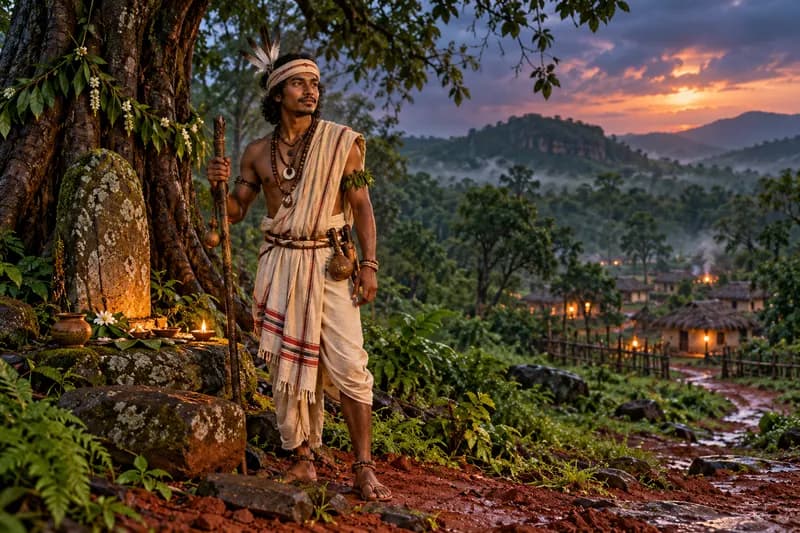
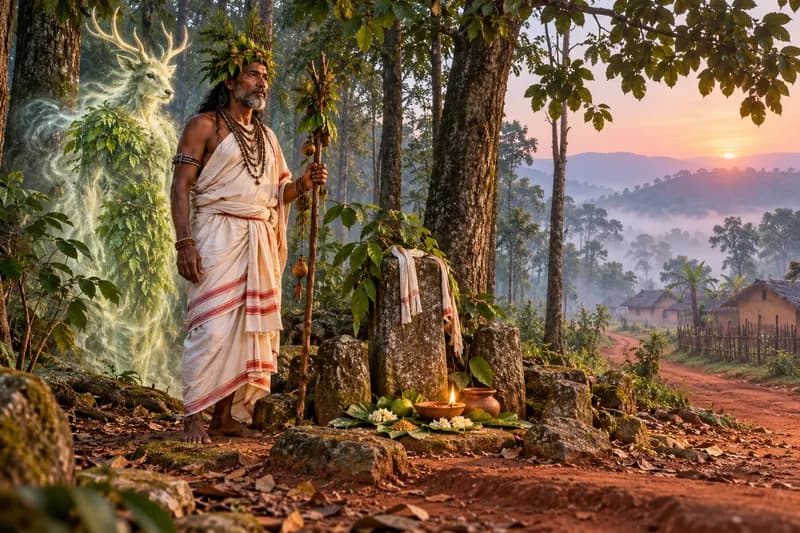
| 👁 Sight | The Bonga is rarely seen. When it manifests visually, it may appear as a fleeting shape between trees — a shimmer of green-gold light at the edge of the Jaher, a shadow that moves against the wind. More often, its presence is marked by what you see happening around it: leaves trembling with no breeze, water rippling upstream, a sal tree that seems to lean toward you as you pass. |
| 🔊 Sound | The primary sign of a Bonga's attention is silence. Forest sounds — birds, insects, the rustle of leaf litter — stop. Not gradually. All at once. In Santali tradition, this sudden silence is called the Bonga listening. If the silence holds for more than a few breaths, you have been noticed. If sound returns, you have been permitted to continue. |
| 🍃 Smell | The smell of sal resin — warm, woody, faintly sweet — intensifies near a Bonga's dwelling. After rain, the Jaher smells different from the rest of the forest: richer, more concentrated, as if the earth itself is breathing more deeply. Some accounts describe a sudden smell of mahua flowers (Madhuca longifolia) when the Bonga is pleased. |
| ❄ Temperature | Not cold. The Jaher is warmer than the surrounding forest — a contained warmth, like standing near a living body. If the temperature drops suddenly inside the grove, something is wrong. The Bonga withdraws its warmth when angered, and the chill that replaces it is the first sign of trouble. |
| 🌑 Time | The Bonga is not nocturnal. It is always present. But certain times carry more weight: dawn and dusk (the transitions), the new moon, and the days of the Baha and Sohrai festivals. The most dangerous time to disturb a Jaher is during the dry season, when the forest is stressed and the Bonga is most protective of its resources. |
| 🏚 Habitat | Sacred groves (Jaher), old-growth sal forests, hilltops with exposed rock, river confluences, and specific ancient trees. The Bonga does not wander — it is rooted. Its territory is defined, and it does not leave it. You must enter its space for an encounter to occur. It will never come to yours. |
The Charcoal Maker of Rajmahal
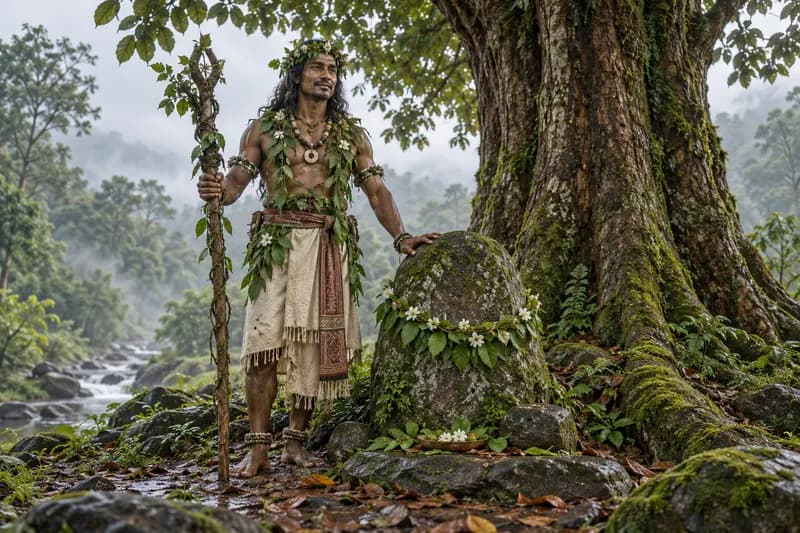
In the hills south of Rajmahal, where the Santhal Parganas begin and the plains of Bihar end, there was a man named Soren who made charcoal. He had learned the trade from his father, who had learned it from his father — three generations of turning sal wood into black fuel for the towns. The work was hard but honest. You felled a tree, you stacked the wood in a mound, you covered it with earth and leaves, you lit it and waited. In three days, you had charcoal. In a week, you had enough to sell at the Dumka market.
Soren knew the rules. Every Santali child knew the rules. You did not cut trees in the Jaher. You did not take wood from the grove where the Naike performed the Baha puja. You did not even pick up fallen branches from that ground. The Jaher was not yours. It belonged to the Bonga, and the Bonga did not share.
But the summer of that year was brutal. The rains had failed. The forests on the lower slopes — the ones where cutting was permitted — had been thinned to almost nothing by other charcoal makers, by the timber merchants who came from Bhagalpur with their trucks, by the mining company that had begun blasting on the eastern ridge. Soren walked further each day to find trees worth cutting. By June, the only dense, untouched stand of sal within a day's walk was the Jaher.
He told himself he would take only one tree. A small one, at the edge of the grove, barely inside the boundary. The Naike would not notice. The Bonga — if the Bonga was real, and Soren was a modern man who had been to the school in Dumka — the Bonga would not care about one small tree.
He went at dawn, before the village woke. The axe bit into the trunk and the sound rang through the grove like a bell struck underwater. Three strokes in, the birds stopped singing. Soren paused. The silence was total — not the silence of early morning, but a held silence, as if the forest had taken a breath and not released it. He looked around. Nothing moved. He swung the axe again.
The tree fell. It was a good tree — straight-grained, dense, perfect for charcoal. He sectioned it quickly, loaded what he could onto his back, and walked home. The silence followed him to the edge of the Jaher and stopped there, as if it could not leave the grove.
That evening, Soren's youngest daughter developed a fever. By morning, his wife had it too. By the third day, Soren himself could not stand. The fever was not like malaria — it came with a heaviness, as if the body was being pressed into the earth. The government doctor in Dumka gave them paracetamol and told them to drink water. The fever did not break.
Soren's mother, who had never gone to the school in Dumka and had no interest in modern thinking, walked to the Naike's house. She told him what Soren had done. The Naike did not seem surprised. He said he had felt it — a disturbance in the Jaher, a coldness where there should be warmth. He came to Soren's house that afternoon.
The ritual was simple. The Naike brought rice beer, three white mahua flowers, and a young rooster. He went to the stump where the tree had been cut — the wound was still fresh, the wood still pale — and he made the offering there. He poured the rice beer onto the roots. He placed the flowers at the base. He sacrificed the rooster and let the blood soak into the earth. Then he spoke to the Bonga. Not a prayer. Not a chant. A conversation. He explained what had happened. He acknowledged the violation. He asked for the fever to be lifted.
By evening, Soren's daughter was sitting up and asking for food. By morning, all three fevers had broken. Soren never went near the Jaher again. He left the charcoal trade the following year and took work at a brick kiln near Deoghar.
When researchers from the Anthropological Survey of India visited the village in the 1990s, the story was told to them by three different families, independently, with no significant variation. The stump was still there. The grove was still untouched. The Bonga, the villagers said, does not hold grudges. It enforces consequences. There is a difference.
The Rules — How to Coexist
⚠ CAUTION ⚠
Seven rules for living alongside a Bonga
- Never cut, damage, or take anything from a Jaher (sacred grove). — The Jaher is the Bonga's territory. Any removal — wood, fruit, leaves, even fallen branches — is a violation of the covenant between village and spirit. Illness follows.
- Do not urinate, defecate, or spill waste near a sacred grove, hill, or river dwelling. — Pollution of the Bonga's space is a direct insult. The response is not anger — it is withdrawal. The Bonga removes its protection, and the consequences are ecological and personal.
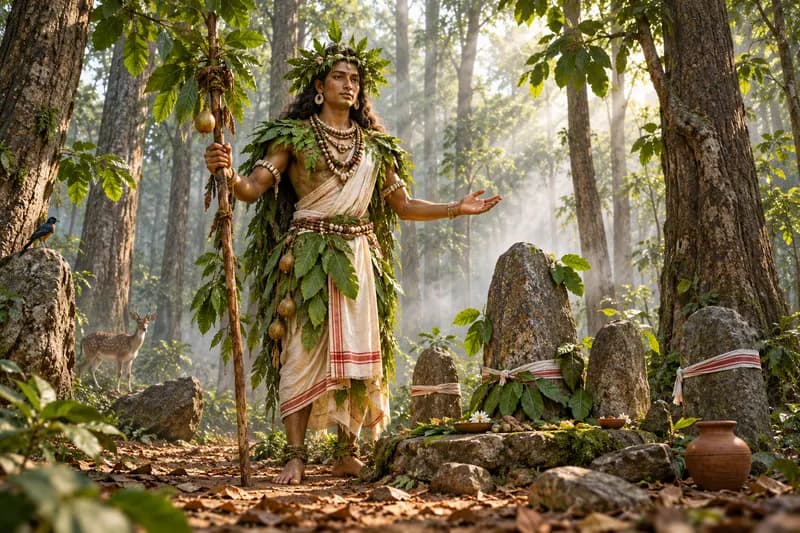
- If you must pass through a Bonga's territory, announce yourself. — Speak aloud as you enter. Not a prayer — a statement. 'I am passing through. I take nothing. I mean no harm.' The Bonga recognizes intention. Silent intrusion is read as stealth, and stealth is read as threat.
- Observe the festivals — especially Baha and Sohrai. — The Baha (flower festival) and Sohrai (harvest festival) are the annual renewal of the covenant. Offerings are made, the Jaher is honored, and the Bonga is acknowledged. Skipping the festivals does not anger the Bonga — it weakens the relationship, and a weakened relationship means weakened protection.
- Do not bring outsiders to the Jaher without the Naike's permission. — The Bonga knows the people of its village. Strangers are not automatically hostile, but they are unknown. The Naike mediates introductions. Bringing outsiders without permission — researchers, tourists, government officials — risks a reaction.
- If illness follows a forest visit, consult the Naike before a doctor. — Not because modern medicine is wrong, but because the Naike can identify whether the illness is a Bonga's response. If it is, no amount of paracetamol will help. The cause must be addressed — and the cause is spiritual, not bacterial.
- Never mock, deny, or disrespect the Bonga — even in private. — The Bonga is not a god that demands worship. It is a presence that demands respect. Mockery and denial are forms of erasure, and the Bonga's response to erasure is the same as its response to ecological violation: withdrawal, disorientation, illness.
What They Don't Tell You
The Bonga is not supernatural. It is pre-natural — it was here before the categories of 'natural' and 'supernatural' were invented by people who had already separated themselves from the land. For the Santali and other Adivasi peoples, the Bonga is simply part of what the world is. Asking whether the Bonga is 'real' is like asking whether gravity is real — it is the operating principle of a world you are standing in. The sacred grove is not preserved because of superstition. It is preserved because the Bonga tradition encodes thousands of years of ecological knowledge: which trees hold the soil, which rivers must not be dammed, which hills must not be mined. Every Jaher that survives is a seed bank, a watershed protector, a biodiversity reserve — maintained not by government policy but by a spirit that the land itself seems to endorse.
What Does the Bonga Want?
The Bonga does not want anything from you. It wants you to want less from it.
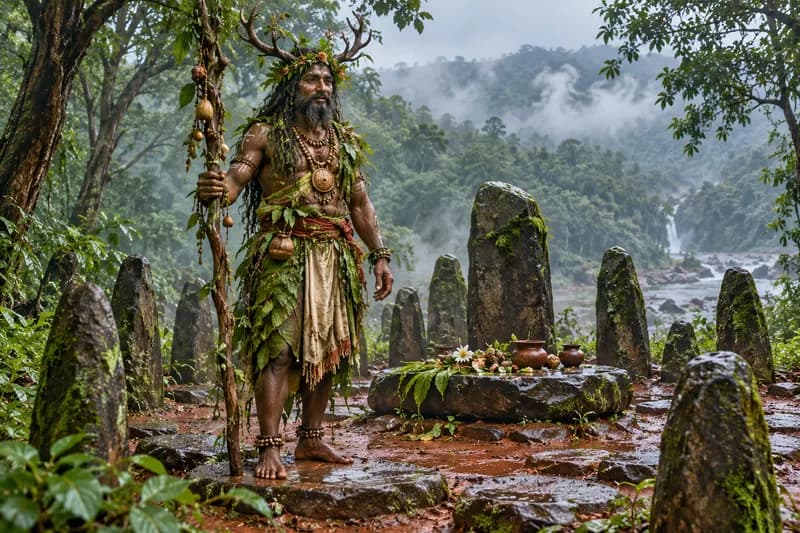
The Bonga's operating logic is reciprocity. The forest gives you firewood, food, medicine, water, shade, and soil. In return, you give the forest limits — places you will not cut, rivers you will not poison, groves you will not enter. The Bonga is the enforcement mechanism for this contract. It does not need your prayers. It does not need your devotion. It needs you to leave a part of the world alone.
This is radically different from the motivation of every other entity in this database. The Churel wants justice. The Vetala wants conversation. The Yakshi wants blood or devotion. The Bonga wants restraint. It wants the human instinct for extraction to stop at a boundary — and it will enforce that boundary with fever, disorientation, crop failure, and the slow, grinding misfortune that follows ecological destruction.
The deepest truth about the Bonga: it is not protecting itself. It is protecting the system. The forest, the river, the hill, the village, and the people in it — the Bonga holds all of these in balance. When you violate the Jaher, you are not offending a spirit. You are pulling a thread in a web that holds your own life together.
You're Most at Risk If...
- You enter or damage a Jaher (sacred grove) — deliberately or accidentally
- You are involved in mining, logging, or industrial activity near tribal forest land
- You are an outsider who enters tribal territory without local guidance or permission
- You mock, dismiss, or publicly deny the Bonga tradition in a community where it is practiced
- You take 'souvenirs' — stones, branches, flowers, soil — from sacred sites
- You pollute a river, stream, or water body that a community considers Bonga-protected
Offerings & Restoration
| Offering | Purpose |
|---|---|
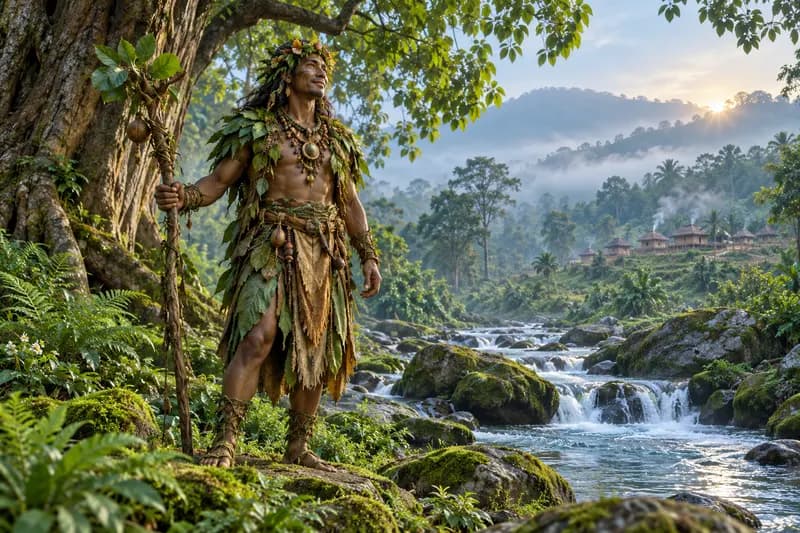
| Baha Festival Offering | During the spring Baha (Sal Flower Festival), the Naike offers sal flowers, rice beer (handi), and the sacrifice of a fowl at the Jaher. The flowers represent renewal, the rice beer is a gift of labor, and the blood feeds the earth. This is the most important annual offering — the renewal of the covenant. |
| Sohrai Festival Offering | During Sohrai (harvest festival), cattle are washed and decorated, and offerings of new grain are made at the Jaher and at household thresholds. This acknowledges the Bonga's role in the harvest — the rain that fell, the soil that held, the pests that stayed away. |
| Restoration After Violation | If a tree is cut or the Jaher is polluted, the Naike performs a specific restoration ritual: rice beer poured on the violated ground, white flowers placed at the site, a fowl sacrificed, and a direct spoken acknowledgment of the wrong. This is not atonement — it is repair. The Bonga does not forgive. It accepts restoration. |
| Daily Acknowledgment | No elaborate daily ritual is required. Passing the Jaher with a nod, a spoken word, or a moment of stillness is sufficient. The Bonga does not demand worship — it demands awareness. Knowing it is there is the offering. |
The Healer
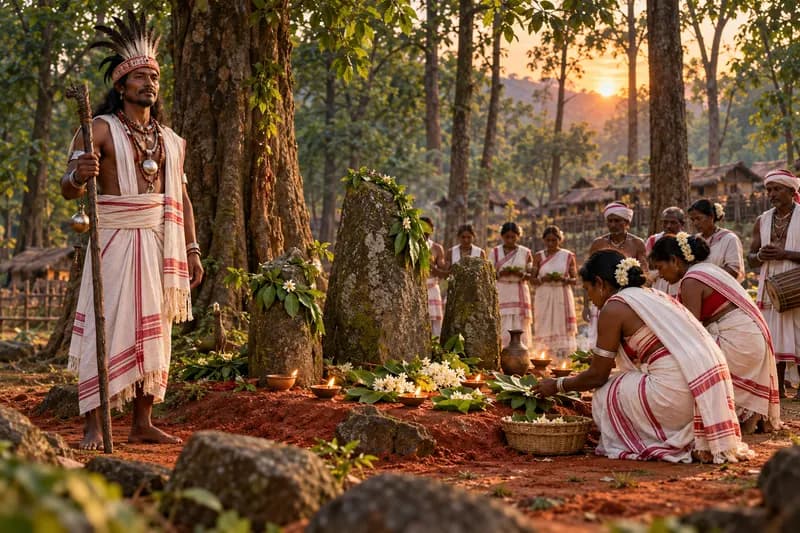
Naike (Village Priest) — The Naike is the primary intermediary between the village and the Bonga. Chosen by community consensus, not by birth caste, the Naike maintains the Jaher, performs seasonal rituals, and diagnoses Bonga-related illness. The Naike speaks to the Bonga directly — not through scripture, not through chant, but through spoken conversation at the grove.
Ojha (Tribal Healer) — The Ojha combines spiritual diagnosis with herbal medicine. When illness follows a forest violation, the Ojha can identify which Bonga was disturbed and prescribe both the physical remedy (herbal treatment) and the spiritual remedy (specific offering at the specific site). The Ojha's knowledge is oral, passed through apprenticeship, not text.
Manjhi (Village Headman) — The Manjhi holds secular authority but also mediates disputes that involve the Jaher — land encroachment, outsider access, mining company negotiations. When the threat to the Bonga is institutional (a mining lease, a road project), the Manjhi leads the community response.
The Key Difference — You do not exorcise a Bonga. You do not bind it, banish it, or negotiate with it the way you would a Vetala or a Churel. You restore the relationship. The illness or misfortune is not punishment — it is a symptom. The cause is the broken covenant, and the cure is repair.
What If You Dream of a Bonga?
| Symbol | Meaning | |
|---|---|---|
| 🌳 | A Sacred Grove You Cannot Enter | A boundary in your life that you are trying to cross but should not. Something that is not yours — a role, a relationship, a resource — and your subconscious is telling you that taking it will cost more than it gives. |
| 🤫 | Forest Silence | You are being watched — not by a threat, but by a consequence. Something you have done or are about to do has been noticed. The silence is not danger. It is attention. Reconsider your next step. |
| 🌸 | Sal Flowers Blooming | Renewal. A relationship or situation that seemed dead is regenerating. The Bonga in your dream is the land telling you that the covenant still holds — that restoration is possible if you are willing to make the offering. |
| 🔥 | A Burning Grove | Destruction of something sacred — a value, a principle, a community bond — that you are witnessing or participating in. The burning Jaher is your conscience telling you that what is being lost cannot be replanted. Act now or lose it permanently. |
The Bonga in Art & Material Culture
Prehistoric — Chota Nagpur Rock Paintings: Rock shelters in the Chota Nagpur Plateau contain paintings of human figures in ritual postures surrounded by trees and animals. While not labeled 'Bonga,' these images align with Sarna worship practices — open-air ritual, tree-centered, communal. Some scholars date these to 5,000 BCE or earlier.
Sacred Groves — Living Architecture: The Jaher itself is the Bonga's art. These groves — some containing sal trees over 200 years old — are shaped by centuries of deliberate non-intervention. They are the oldest continuously maintained sacred landscapes in South Asia. No carved idol exists. The grove is the representation.
Santali Painting Tradition (Pargana Art): Traditional Santali wall paintings (found on mud houses in the Santhal Parganas) depict the Jaher, the Baha festival, and stylized trees that represent the Bonga's presence. Geometric patterns surround the tree motifs — a visual language for the boundary between human space and Bonga space.
Contemporary — Adivasi Resistance Art: Modern Adivasi artists — including those in the Jharkhand cultural renaissance — depict the Bonga in paintings, prints, and murals that frame the spirit as both ecological and political. The Bonga appears in anti-mining protest art, in Sarna recognition campaign materials, and in contemporary tribal literature as a symbol of indigenous sovereignty over land.
Cross-Regional Patterns
Bhoot · Yaksha · Raktabija Spirit · Chenga · Dakini · Rakshasi · Yogini · Brahmadaitya
| Dawn as hard limit | No — always present |
| Iron weakness | No |
| Tree-dwelling | Yes — central |
| Counting compulsion | No |
| Backward feet | No |
Global Equivalent: The closest global parallels are the Kodama of Japanese Shinto tradition (tree spirits that sicken those who cut their trees), the Huldufólk of Icelandic belief (hidden people who cause misfortune when their rocks and hills are disturbed by construction), and the various nature spirits of Indigenous Australian Dreaming traditions. All share the same logic: the land has intelligence, that intelligence has rules, and violating those rules has consequences that no human authority can prevent.
In Culture — Literature, Film, Music
| Type | Title | Description |
|---|---|---|
| Literature | Marang Buru — Raghunath Murmu | The father of Ol Chiki script wrote extensively about Santali spirituality, including the Bonga tradition. His works are foundational texts for understanding Sarna cosmology from an insider's perspective. |
| Literature | The Adivasi Will Not Dance — Hansda Sowvendra Shekhar (2015) | A collection of stories set in Jharkhand's tribal communities, where the Bonga tradition is woven into narratives of land displacement, mining resistance, and cultural survival. The Bonga appears not as a character but as a condition — the world the stories inhabit. |
| Film | Chaka Bakal — Santali-language Cinema | Santali-language films frequently feature the Bonga as a narrative presence — not as a horror element but as the moral framework of the story. Characters who violate the Jaher face consequences; characters who respect it are protected. The Bonga functions as both plot device and worldview. |
| Music | Santali Folk Songs (Dong and Pata) | Traditional Santali songs performed during Baha and Sohrai festivals directly address the Bonga — inviting the spirit to witness the celebration, acknowledging its role in the harvest, and renewing the community's commitment to the covenant. These are not devotional hymns. They are conversations set to music. |
| Activism | Sarna Religion Recognition Movement | The ongoing campaign for Sarna to be listed as a separate religion in the Indian census has brought the Bonga tradition into national political discourse. Campaign materials, protest songs, and social media content reference the Bonga as evidence of a distinct, pre-Hindu religious identity that deserves constitutional recognition. |
ACCURACY RATING: HIGH IN ETHNOGRAPHIC SOURCES · LARGELY ABSENT FROM MAINSTREAM MEDIA
Is the Bonga Still Real?
- The Bonga is not a historical curiosity — it is an active, living belief system practiced by millions of Adivasi people across Jharkhand, Chhattisgarh, Odisha, and West Bengal. Sacred groves are maintained, festivals are performed, and the Naike conducts rituals at the Jaher as they have for centuries.
- The Sarna religion recognition movement — which seeks a separate code for Sarna in the Indian census — is one of the largest indigenous rights campaigns in India. The Bonga tradition is at its center. The Jharkhand state assembly passed a resolution in 2020 supporting separate Sarna code recognition.
- Mining and deforestation are the greatest modern threats. When a Jaher is destroyed for a coal mine or a highway, the entire spiritual infrastructure of a village is destroyed with it. Communities have physically blocked bulldozers to protect sacred groves — the Bonga tradition is not passive belief but active resistance.
- Anthropologists and ecologists have documented that sacred groves maintained by the Bonga tradition contain significantly higher biodiversity than surrounding unprotected forest. The Bonga, whether understood as spirit or as cultural practice, is an effective conservation mechanism — one that has operated for thousands of years without government funding or NGO support.
- Young Adivasi activists, writers, and artists are reclaiming the Bonga tradition as a marker of identity — pushing back against both Hindu assimilation and Christian missionary conversion. The Bonga is increasingly framed not just as a spiritual belief but as an assertion of indigenous sovereignty over land, culture, and self-definition.
Expert & Academic Context
- E.T. Dalton — Descriptive Ethnology of Bengal (1872) — One of the earliest colonial ethnographic accounts of Santali and Munda spiritual practices, including descriptions of the Jaher, the Naike's role, and the Bonga hierarchy. Valuable as a primary source but must be read critically — Dalton's framing reflects colonial 'animism' categorization.
- W.J. Culshaw — Tribal Heritage: A Study of the Santals (1949) — Detailed study of Santali social and religious life, including extensive documentation of Bonga types, festival rituals, and the relationship between the sacred grove and village governance. One of the most cited works in Sarna studies.
- P.O. Bodding — Santal Folk Tales (1925–1929) — A three-volume collection of Santali oral narratives, many featuring Bonga encounters. Bodding, a Norwegian missionary, transcribed these stories in original Santali with English translations. Despite the missionary context, the collection preserves narratives that might otherwise have been lost.
- Raghunath Murmu — Santali Language and Culture Works — Creator of the Ol Chiki script for the Santali language and author of foundational texts on Sarna cosmology. Murmu's work represents the Bonga tradition from within — not as an outsider observing 'natives' but as a Santali intellectual articulating his own people's worldview.
- Archana Prasad — Against Ecological Romanticism (2003) — Academic analysis of how Adivasi ecological practices, including sacred grove maintenance, function as both spiritual expression and practical conservation. Challenges the tendency to either romanticize tribal ecological knowledge or dismiss it as superstition.
The Bonga represents something fundamentally different from every other entity in the Indian supernatural tradition. It is not a ghost, not a demon, not a deity. It is an environmental intelligence — a spirit that governs the relationship between a community and the land it lives on. The Bonga tradition is also a political statement: it asserts that Adivasi people have their own religious identity, their own cosmology, their own relationship with the sacred, and that this identity is not a subset of Hinduism. The ecological dimension is inseparable from the spiritual one — every Jaher that survives is both a place of worship and a functioning ecosystem. The Bonga challenges the fundamental categories that the rest of this database operates on: it is not 'supernatural' because for the people who know it, there is no separation between nature and spirit. The forest is alive. The Bonga is how it speaks.
If You Enter Bonga Territory
Frequently Asked Questions
▶What is a Bonga?
A Bonga is a nature spirit in the Santali and broader Adivasi tribal tradition of eastern and central India. It inhabits trees, rivers, hills, and stones, and governs the relationship between human communities and the natural world. The Bonga is central to the Sarna religion — an indigenous faith distinct from Hinduism.
▶Is the Bonga a Hindu spirit?
No. The Bonga belongs to the Sarna religion, the indigenous faith of the Santhal, Munda, Ho, Oraon, and other Adivasi peoples. Sarna predates Hinduism in these regions and has its own cosmology, priesthood, rituals, and sacred spaces. Classifying the Bonga as Hindu erases Adivasi religious identity.
▶What is a Jaher?
A Jaher is a sacred grove — typically a stand of sal trees — maintained at the center or edge of a traditional Santali village. It is the Bonga's primary dwelling place and the site of major community rituals. No one may cut trees, hunt, or pollute within the Jaher. It is both a spiritual site and a functioning ecosystem.
▶What happens if you anger a Bonga?
The most common consequence is illness — fever, disorientation, and physical weakness — typically affecting the person who committed the violation and sometimes their family. Crop failure, livestock death, and a general sense of misfortune may also follow. The symptoms resolve when the violation is acknowledged and the Naike performs a restoration ritual.
▶How dangerous is a Bonga?
The Bonga's danger level is 2 out of 5 — 'Guarded.' It does not hunt, attack, or pursue. Its responses are proportional: violate the grove, and illness follows. Respect the boundaries, and the Bonga is a protector, not a threat. The danger is almost entirely avoidable through basic respect and awareness.
▶Can outsiders visit a Jaher?
With the Naike's permission and proper introduction, yes. Many sacred groves are accessible to respectful visitors. The key is to go with a community member, announce your presence and intention, take nothing, and leave nothing. Unauthorized entry — especially by researchers, tourists, or officials without local consent — risks a Bonga response and is considered deeply disrespectful.
Explore More
Related Spirits
Bhoot · Yaksha · Raktabija Spirit · Chenga · Dakini · Rakshasi · Yogini · Brahmadaitya
Stories Are Being Summoned
One ghost story per week. Every Tuesday at midnight.