Aleya
It doesn't chase you. It floats ahead of you — patient, gentle, beautiful — until the water is above your mouth.
- What Is an Aleya?
- Why the Aleya Is Terrifying
- Origin — How It Came to Exist
- Appearance & Manifestation
- The Lights of Gosaba
- The Rules — How to Survive
- What They Don't Tell You
- What Does the Aleya Want?
- You're Most at Risk If...
- Offerings & Appeasement
- The Healer
- What If You Dream of an Aleya?
- The Aleya in Art History
- Cross-Regional Patterns
- In Culture — Movies, Books, Games
- Is the Aleya Still Real?
- Expert & Academic Context
- If You Encounter an Aleya
- Frequently Asked Questions
- Explore More
| Aleya | |
|---|---|
| Also Known As | Marsh Ghost Light, Will-o'-the-Wisp of Bengal, Aleya Aalo, Swamp Fire |
| Script | আলেয়া (Bengali) |
| Pronunciation | ah-LAY-ah (আ-লে-য়া) |
| Region | Bengal — primarily the Sundarbans mangrove delta, and tidal marshes of southern West Bengal and Bangladesh |
| Category | Ghost Light / Marsh Phenomenon |
| Danger Level | Fatal |
| Fear Method | Mimicry of human light sources; silent luring into deep water; disorientation in trackless swamps |
| Warning Sign | A pale light moving low over the water where no boat should be; a lantern that does not flicker in the wind |
| First Documented | Bengali oral tradition (pre-colonial); documented in colonial-era gazettes of the Sundarbans (19th century); referenced in Bankimchandra Chattopadhyay's writings |
| Still Believed? | Yes — fishermen in the Sundarbans actively avoid certain channels after dark; specific routes are considered aleya territory |
| Related | Nishi · Kapala Spirit · Polong · Vetali · Ban Jhankri · Begho Bhoot |
What Is an Aleya?
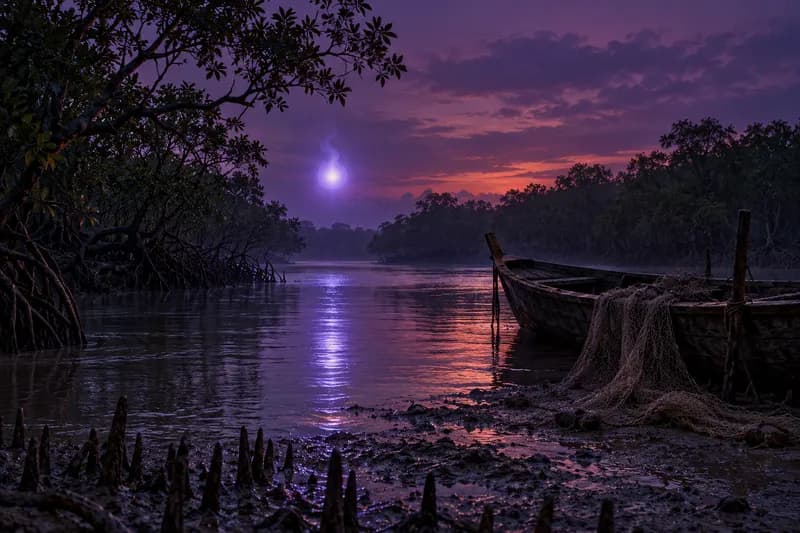
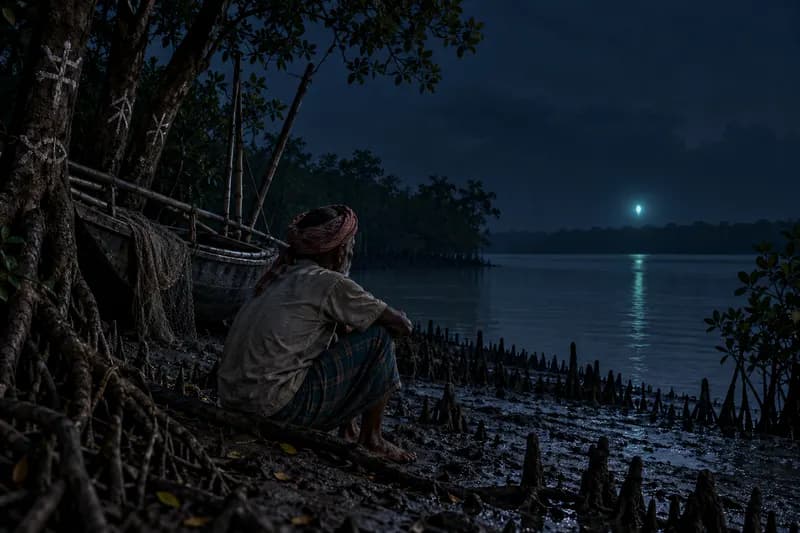
The Aleya (আলেয়া) is a spectral light phenomenon reported in the marshes, swamps, and tidal waterways of Bengal — most intensely in the Sundarbans, the largest mangrove forest in the world. The lights appear as pale, floating orbs hovering just above the water's surface, drifting slowly through the darkness. To a fisherman alone in a boat at night, an aleya looks exactly like the lantern of another boat — a comforting sign that someone else is nearby. Fishermen follow the light, believing it will lead them to safer channels or better fishing grounds. Instead, it leads them into deep water, tangled mangrove roots, or quicksand-like mud from which there is no return.
What makes the aleya uniquely terrifying is its patience. It does not rush. It does not flicker aggressively or make threatening sounds. It simply floats ahead of you — always just far enough that you keep rowing, always just bright enough that you believe it is real. Fishermen who survive describe losing all sense of direction, finding themselves in channels they have never seen despite knowing the Sundarbans their entire lives. Those who do not survive are found days later — drowned in water barely deep enough to stand in — or they are never found at all.
Why the Aleya Is Terrifying
INSTINCT EXPLOITED: TRUST IN LIGHT
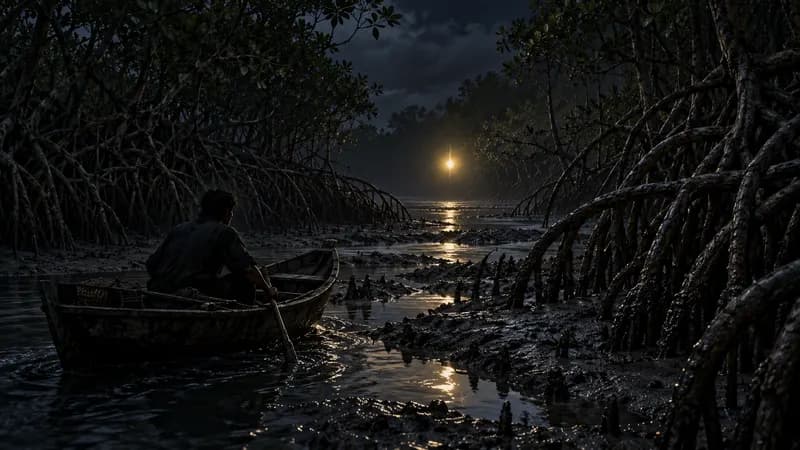
You are alone in your boat. It is past midnight in the Sundarbans and the tide has turned. The mangroves on either side are so dense that the sky is only visible as a narrow strip directly above you, and even the stars seem dimmer here. The water is black. You cannot see the bottom. You cannot see the banks. Your lantern shows you three feet of brown water in every direction, and beyond that — nothing.
Then you see it. A light. Perhaps two hundred meters ahead, low over the water. Yellowish, steady. Another fisherman's lantern. You feel relief flood your body because being alone in the Sundarbans at night is a specific kind of fear that no one who hasn't experienced it can understand. Tigers swim these channels. Crocodiles lie beneath your hull. And the mangroves themselves seem to close behind you, erasing the path you came by.
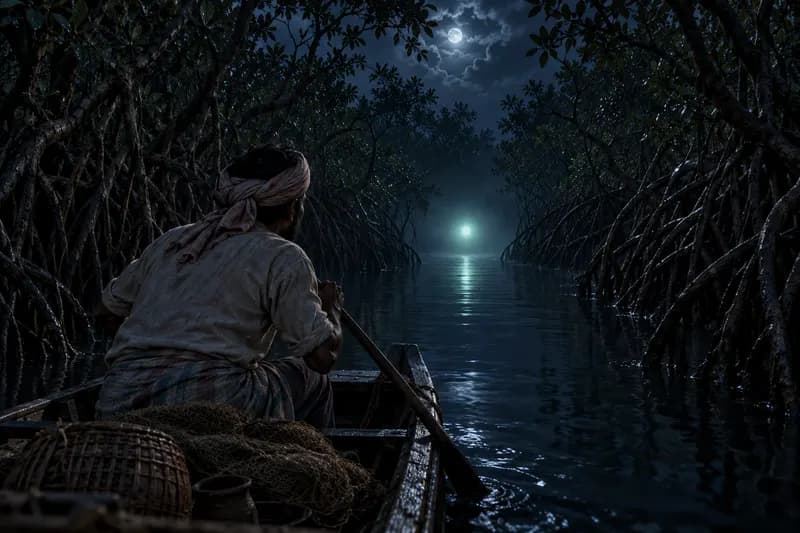
You row toward the light. It moves. Not quickly — just drifting, the way a boat drifts on a slow current. You row faster. The light stays the same distance ahead. You call out. No answer. But the light is there, steady, real, and you follow it because what else would you do?
Twenty minutes pass. You do not recognize this channel. The mangroves are thicker here — roots arching out of the water like the ribs of something enormous and dead. The water is shallower. Your oar touches mud. You look back, and your own wake has vanished. The channel behind you looks nothing like the one you came through.
The light ahead stops moving. It hovers. And then — slowly, like an eye closing — it goes out.
You are alone. You do not know where you are. Your lantern shows you water and roots and darkness, and somewhere in the mud beneath your boat, the tide is pulling out, and the water is dropping, and soon your boat will be grounded in a place no one will think to look for you.
This is the aleya. It does not attack. It does not possess. It simply shows you a light, and you follow it, and you die. The most human thing about us — our instinct to move toward light — is the thing it uses to kill.
Origin — How It Came to Exist
The Drowned Dead
The most widespread Bengali folk belief holds that aleya are the spirits of fishermen who drowned in the Sundarbans. Unable to leave the waters that killed them, they repeat the last thing they knew — the sight of a distant lantern, the hope of rescue. But the light they project is inverted: instead of guiding others to safety, it pulls them into the same death. The aleya is not malicious in this telling. It is confused. It is a dead man still trying to signal for help, not understanding that his signal has become the danger.
Trapped Souls
A darker tradition holds that the Sundarbans — a place where bodies are rarely recovered, where the dead are consumed by crocodiles and crabs before they can be cremated — is full of souls that never received proper funeral rites. These souls manifest as light because fire is what they were denied. They burn above the water as a perpetual, incomplete cremation — a flame without a pyre, a rite that never ends and never completes. Following an aleya, in this telling, is walking into someone else's unfinished death.
The Bonbibi Connection
In the Sundarbans, the forest goddess Bonbibi is the supreme protector of those who enter the mangroves. Some traditions hold that the aleya exist where Bonbibi's protection does not reach — the deepest channels, the places where even the goddess does not go. The aleya marks the boundary of the sacred and the abandoned. If you see one, you have gone too far. You are beyond the reach of any protection, human or divine.
Scientific Explanations
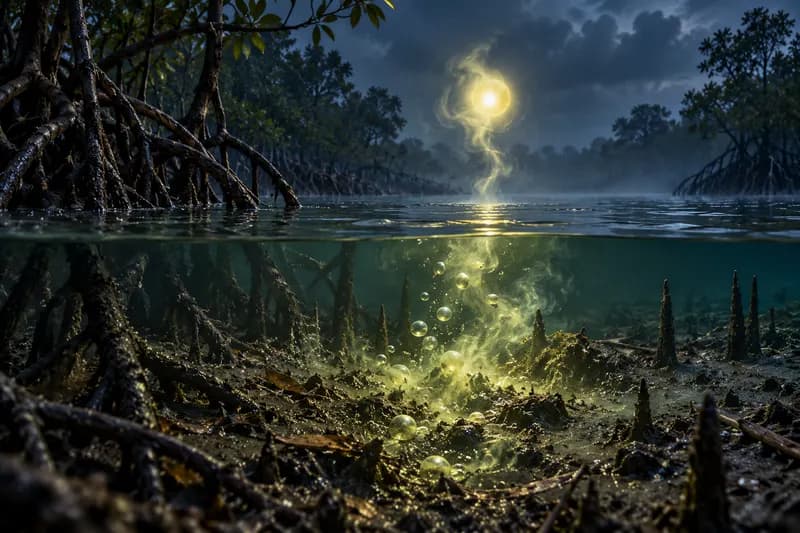
Modern science attributes the lights to oxidation of phosphine and methane generated by organic decomposition in marshland — gases rising from decaying matter in swamp beds, igniting spontaneously on contact with air. This explanation satisfies the question of what the light is. It does not satisfy the question of why the lights seem to move in response to human movement, or why they appear to lead rather than simply exist. Fishermen who have followed an aleya will tell you that the scientific explanation describes the mechanism but not the behavior.
Appearance & Manifestation
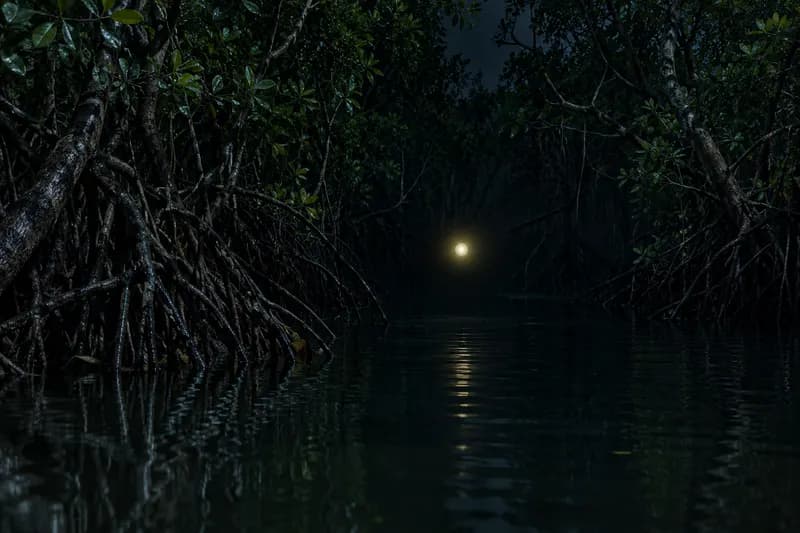
| 👁 Sight | A pale orb of light — yellowish-white or bluish-white — hovering one to three feet above the water surface. No visible source. No flame structure. It moves slowly and steadily, mimicking the drift of a boat-mounted lantern. Sometimes a single light; sometimes multiple lights moving in formation, suggesting a fleet of boats that does not exist. |
| 🔊 Sound | Complete silence. This is the most disturbing element. A real boat would produce oar-sounds, water-splash, the creak of wood. The aleya produces nothing. The light moves through perfect quiet. Some fishermen report that the ambient sounds of the Sundarbans — insects, birds, water — seem to dampen near an aleya, as if the silence is itself a property of the light. |
| 🍃 Smell | A faint smell of rot and methane — the smell of the swamp itself, but concentrated. Some accounts mention a sweetish, sickly odor that intensifies the closer you get to the light. The smell of organic decay, of bodies the river never gave back. |
| ❄ Temperature | No temperature change — unlike most Indian entities, the aleya does not bring cold. The air remains the warm, humid, suffocating air of the Sundarbans. This absence of cold is itself disorienting: your body receives no warning signal. Everything feels normal except the light that should not be there. |
| 🌑 Time | Exclusively nocturnal. Appears most frequently on moonless nights and during the monsoon season (June to September) when the swamps are at their fullest and navigation is most difficult. Most common between midnight and 3 AM — the hours when fishermen are most tired, most disoriented, and most likely to follow a light without questioning it. |
| 🏚 Habitat | The Sundarbans mangrove delta — the tidal channels, creeks, and marshes that make up the world's largest mangrove forest. Also reported in the marshlands of the Bengal plains, the Terai wetlands, and low-lying paddy fields after heavy rains. Anywhere water, decay, and darkness converge. |
The Lights of Gosaba
Kartik Mandal was a fisherman from Gosaba, an island in the Sundarbans accessible only by boat. His family had fished these waters for four generations. He knew the channels the way a reader knows the alphabet — instinctively, without thought. He could navigate the mangrove labyrinth on a moonless night by the feel of the current against his hull, by the sound of water moving through different widths of channel, by the smell of particular mud banks that told him exactly where he was.
On a night in late September, with the monsoon dying but the water still high, Kartik went out alone. This was not unusual. The best catches came to solitary boats — a single man, a single net, no noise. He paddled south from Gosaba into the narrower channels where the mangroves pressed close and the tiger-warning signs were nailed to the trees.
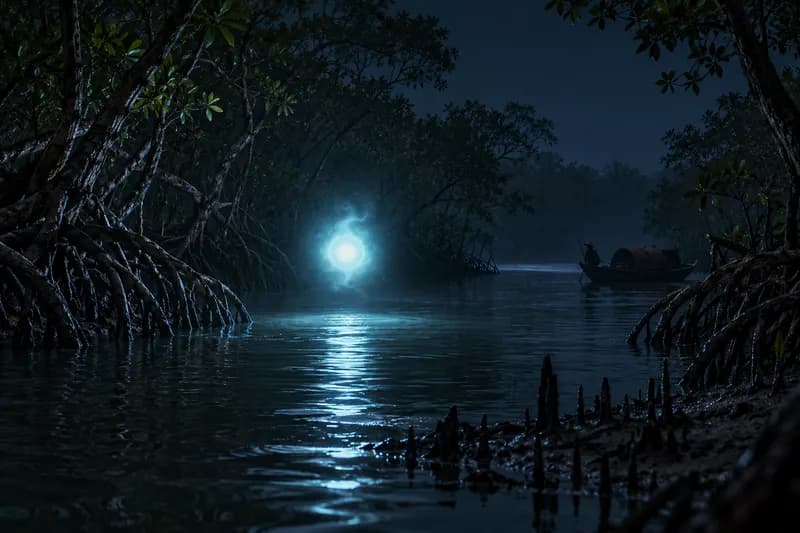
He saw the first light at perhaps one in the morning. It was ahead of him, low over the water, the color of a kerosene lamp. His first thought was that it was Bishu — another fisherman from the village who often worked the same channels. He called out. No answer. The light drifted slowly eastward.
Kartik followed. Not anxiously — casually, the way you follow someone you expect to catch up with. He paddled at his normal pace. The light stayed ahead. After ten minutes he noticed that the channel had narrowed. The mangrove roots were closer to his boat. He did not recognize this particular passage, but the Sundarbans had thousands of channels that shifted with every tide cycle, so unfamiliarity was not alarming.
He called out again. Nothing. The light moved on.
Twenty minutes later, Kartik stopped paddling. Something was wrong. He could not hear the open-water sound that should have been to his west. The channel had become very narrow — barely wider than his boat. Mangrove roots scraped both sides. The mud beneath his hull was soft — his oar sank deep into it when he pushed. And the light ahead had stopped moving. It hung there, motionless, perhaps fifty meters away.
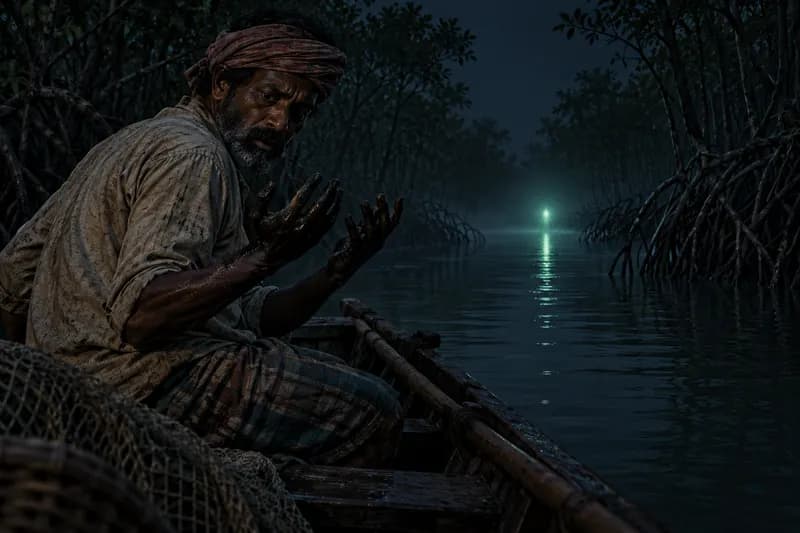
Kartik later told his family that what happened next was the thing that saved him. His father had told him — as his father's father had told his father — that if you see a light in the Sundarbans and it stops moving, you must not go toward it. You must look at your own hands. If you can see your own hands clearly, the light is natural. If your hands are dark but the light ahead is bright, it is an aleya. Kartik looked at his hands. They were invisible in the darkness. The light fifty meters ahead was the only illumination in the world.
He turned his boat around. It took him forty minutes to back out of the channel — the roots were so close that he had to push off them with his hands, and twice the boat grounded on the mud and he had to rock it free. When he finally reached a channel he recognized, the light behind him had gone out. He reached Gosaba at dawn, and he did not fish at night for the rest of that monsoon season.
The Rules — How to Survive
☠ WARNING ☠
Six rules for surviving an aleya encounter
- Never follow a light you cannot hear. — A real boat makes sound — oars, water, voices. The aleya is silent. If a light moves without any accompanying sound, it is not a boat. Do not follow it under any circumstances.
- Look at your own hands. If the distant light is bright but your hands are dark, it is an aleya. — A real lantern close enough to be visible would also illuminate your surroundings at least faintly. The aleya produces light that does not spread — it illuminates nothing around it. This is the diagnostic test passed down through Sundarbans fishing families.
- If an aleya appears, stop your boat immediately. Do not row in any direction. — The aleya kills by luring you into unfamiliar water. If you stay where you are, you remain in a channel you chose — one you presumably know. Movement is the danger. Stillness is survival.
- Never fish alone in the Sundarbans after midnight during monsoon season. — The conditions that produce aleya — warm, waterlogged, decomposing marshland on moonless monsoon nights — are also the conditions that make rescue impossible. Two boats can verify each other's lights. One boat cannot verify anything.
- Pray to Bonbibi before entering the forest. Carry her image in the boat. — The forest goddess Bonbibi is the supreme protector of those who enter the Sundarbans. Fishermen believe that the aleya cannot approach a boat under Bonbibi's protection. The prayer is not superstition — it is the most important piece of equipment you carry.
- If you are lost and multiple lights appear, close your eyes and wait for dawn. — Multiple aleya appearing together is the most dangerous scenario — they create the illusion of a village or a fleet, making the urge to follow almost irresistible. Closing your eyes removes the temptation. The tide will carry you, but at least you will not row into your own death.
What They Don't Tell You
The aleya is the Sundarbans' way of saying: you do not belong here after dark. The mangrove forest is not a human place. It belongs to the tigers, the crocodiles, and the dead. Every fisherman who enters the Sundarbans at night knows this — and goes anyway, because poverty does not care about ghosts. The aleya is not the most dangerous thing in the Sundarbans. The tigers kill more people. The crocodiles kill more people. The tides kill more people. But the aleya is the only killer that uses your own hope against you. It shows you the one thing you want most — evidence that you are not alone — and that want is what destroys you.
What Does the Aleya Want?
The aleya does not want anything. That is the horror of it.
Unlike the Vetala, which has intelligence and a code, or the Churel, which has rage and a grievance, the aleya has no personality, no agenda, no negotiating position. It is a light. It floats. You follow. You drown. There is no bargain to be struck, no riddle to answer, no offering that will make it stop.
If the drowned-fisherman origin is true, then the aleya wants rescue — but it has forgotten what rescue looks like. It signals because signaling is the last thing the living fisherman did. The signal has become the trap. The cry for help has become the thing that kills.
This is the deepest fear the aleya embodies: that the dead do not hate us. They do not even know we are here. They repeat themselves endlessly, and we walk into their repetition, and we die, and then we become the repetition too. The aleya is not evil. It is not even conscious. It is an echo — and echoes do not care who hears them.
You're Most at Risk If...
- You are a fisherman working the Sundarbans channels alone at night
- You are navigating unfamiliar waterways during the monsoon season
- You are exhausted, sleep-deprived, or disoriented — conditions that make you more likely to follow light without questioning it
- You are in the Sundarbans on a moonless night when no other reference points exist
- You are a newcomer to the region who does not know the local warnings
- You have not prayed to Bonbibi or carried her image — you are considered unprotected
Offerings & Appeasement
| Offering | Purpose |
|---|---|
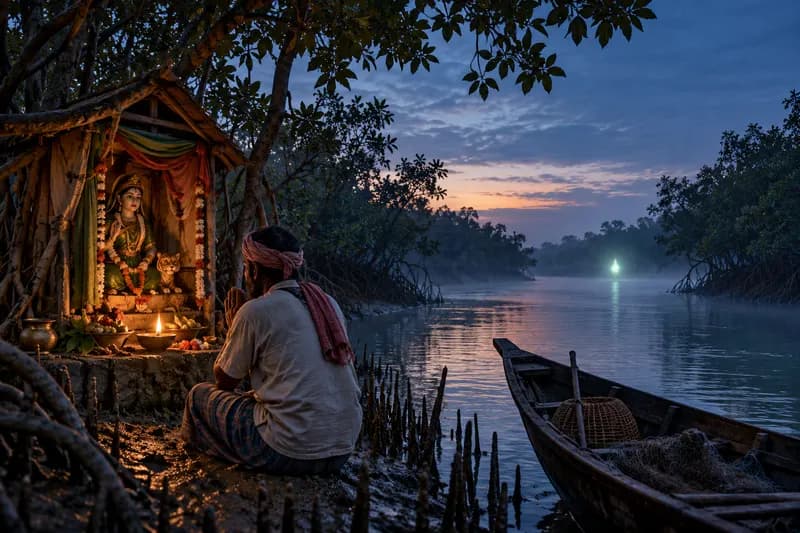
| To Bonbibi | The primary protection against the aleya is not made to the aleya itself — it is made to Bonbibi, the forest goddess of the Sundarbans. Offerings of flowers, sweets, and incense at Bonbibi shrines before entering the forest. The prayer is simple: protect me from what waits in the water. |
| Lamp on the Water | Some fishermen place a small clay lamp on a leaf and set it adrift before entering deep channels at night. The belief is that the aleya will follow the drifting lamp instead of the fisherman — giving it the light it seeks, drawing its attention away from the living. |
| For the Drowned Dead | Families of fishermen who drowned in the Sundarbans and whose bodies were never recovered perform ritual offerings at the water's edge — flowers, rice, and a lit lamp placed on the bank. The purpose is to give the dead the funeral rites they were denied, in hopes that their spirit will stop manifesting as an aleya. |
| Salt and Turmeric | A folk practice in the Sundarbans villages: before a night fishing trip, the fisherman's wife places a line of salt and turmeric across the threshold of the house. This is not directly for the aleya — it is to ensure the fisherman returns. The protective line holds the home open for his return. |
The Healer
Bonbibi Fakir — The Sundarbans have their own tradition of folk healers — often Muslim fakirs or Hindu priests who specialize in Bonbibi worship. They perform rituals for fishermen who have encountered an aleya and survived but remain psychologically shattered — unable to go on the water, plagued by nightmares of lights, convinced the aleya is waiting for them specifically.
Gunin (Bengali Folk Healer) — The gunin is a village-level healer found across Bengal who deals with spirit-related afflictions. For aleya encounters, the gunin performs a cleansing ritual using mustard oil, neem leaves, and specific mantras. The treatment addresses the disorientation and terror that survivors experience — a kind of spiritual PTSD.
Ojha (Tribal Exorcist) — Among the tribal communities of the Sundarbans — Munda, Santhal, and others — the ojha handles encounters with marsh spirits. The ojha's approach is more direct: the spirit of the drowned fisherman must be identified by name and told that it is dead. Only when the spirit accepts its own death will the aleya manifestation stop.
What If You Dream of an Aleya?
| Symbol | Meaning | |
|---|---|---|
| 💡 | A Light Over Water | You are following something you believe will lead to safety — a job, a relationship, a plan — but it is leading you further from solid ground. The dream is a warning: examine whether the thing you are pursuing is real or a projection of your own hope. |
| 🚣 | Rowing Toward a Light That Moves Away | A goal that recedes the closer you get. Something you are chasing that you will never catch — not because you are too slow, but because it was never reachable. The dream asks: is this pursuit worth what it is costing you? |
| 🌊 | Drowning in Shallow Water | A situation that should not be dangerous but has become lethal. Something small — a minor decision, a casual commitment — that has pulled you under. The aleya kills in water you could stand in. Your danger is not dramatic. It is quiet. |
| 🔇 | Silent Light in Darkness | Isolation. You are surrounded by darkness and the only signal you can see is one you cannot trust. The dream reflects a moment in your life where you have no reliable guidance — no mentor, no map, no clear path — and the temptation to follow anything that looks like direction. |
The Aleya in Art History
Colonial-Era Illustrations — 19th Century: British colonial administrators and naturalists documented the Sundarbans extensively, and several accounts include descriptions and sketches of the marsh lights. These appear in district gazettes and natural history journals — clinical descriptions that nonetheless betray the unease of the observers. The lights were filed under 'phosphorescent phenomena' but the accounts read like ghost stories.
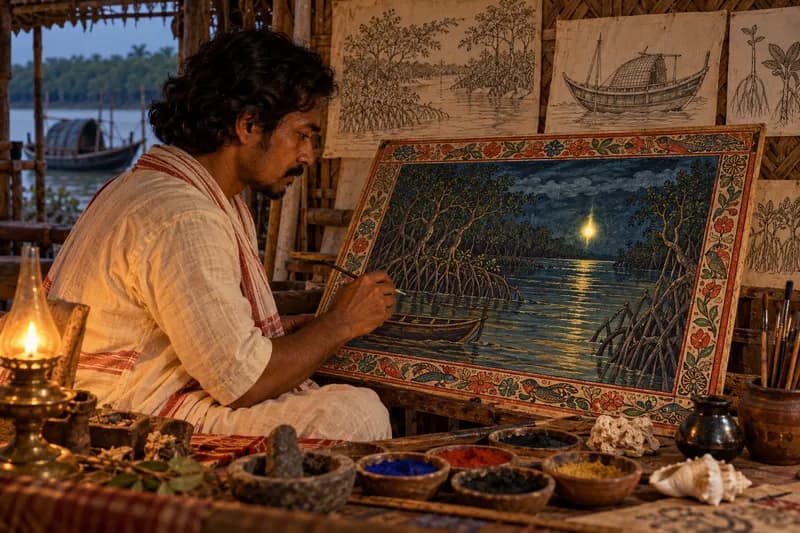
Bengali Folk Art — Patachitra Tradition: The scroll-painting tradition of Bengal occasionally depicts the Sundarbans as a place of supernatural danger, with pale lights floating above dark water. These images appear in the context of Bonbibi narratives — the goddess protecting devotees from the terrors of the forest, including the lights that lead fishermen astray.
Modern Bengali Cinema and Literature: The Sundarbans as a landscape of horror is a recurring motif in Bengali creative work. Films and novels set in the mangroves frequently reference the aleya — sometimes as a plot device, sometimes as atmospheric detail. The lights have become visual shorthand for the Sundarbans' danger, appearing in everything from art-house films to popular fiction.
Cross-Regional Patterns
Nishi · Kapala Spirit · Polong · Vetali · Ban Jhankri · Begho Bhoot · Karna Pisachini · Nagini Spirit
| Dawn as hard limit | Yes |
| Iron weakness | No |
| Tree-dwelling | No |
| Counting compulsion | No |
| Backward feet | No |
Global Equivalent: The Aleya belongs to a global family of ghost-light phenomena: the Will-o'-the-Wisp of European marshes, the Hitodama of Japanese tradition, the Min Min lights of the Australian outback, and the Chir Batti of the Rann of Kutch in Rajasthan. All share the same core behavior — lights in desolate places that lure travelers off safe paths. But the Aleya is uniquely lethal because of its environment: the Sundarbans is not a moor or a field you can stumble across. It is a labyrinth of tidal channels where losing your way means death by drowning, exposure, tigers, or crocodiles. The Will-o'-the-Wisp leads you into a bog. The Aleya leads you into one of the most dangerous ecosystems on Earth.
In Culture — Movies, Books, Games
| Type | Title | Description |
|---|---|---|
| Literature | Amitav Ghosh — The Hungry Tide (2004) | Ghosh's novel is set in the Sundarbans and captures the landscape's supernatural atmosphere — the tidal rhythms, the constant presence of death, and the folklore of the fishing communities. The aleya is part of the fabric of this world, not as spectacle but as fact. |
| Film | Sundarbans-set Bengali Cinema | Multiple Bengali films have used the Sundarbans as a setting for supernatural horror. The aleya appears as atmospheric element — lights over water in night-fishing sequences — blurring the line between natural danger and supernatural threat in a landscape where the distinction barely exists. |
| Documentary | Sundarbans Nature Documentaries | Several nature documentaries about the Sundarbans mention the aleya in the context of local belief, often alongside scientific explanations involving marsh gas. The documentaries invariably note that fishermen find the scientific explanation unconvincing. |
| Literature | Bengali Ghost Story Anthologies | The aleya appears in virtually every Bengali collection of ghost stories — from Rabindranath Tagore's supernatural fiction to modern horror anthologies. It occupies a unique position: too scientifically explicable to be purely supernatural, too behaviorally strange to be purely natural. |
| Reference Book | Ghosts, Monsters and Demons of India — Rakesh Khanna | Documents the aleya within the broader taxonomy of Indian supernatural entities, noting its unusual status as a phenomenon that exists at the exact boundary between folklore and atmospheric science. |
ACCURACY RATING: SCIENTIFICALLY DEBATED · CULTURALLY ACTIVE · REPORTED ONGOING
Is the Aleya Still Real?
- Fishermen in the Sundarbans report seeing the lights regularly — this is not historical folklore but an ongoing, contemporary phenomenon. Sightings are treated as routine hazards, discussed alongside weather and tides.
- The scientific explanation (marsh gas ignition) is known to local communities and explicitly rejected by most fishermen. They acknowledge that gas exists in the swamps but insist the lights behave with apparent intention — moving in response to boats, stopping when followed, disappearing when approached.
- Bonbibi worship, which includes protection from the aleya, is the dominant spiritual practice in the Sundarbans. Shrines are maintained, rituals performed before every forest entry, and the goddess is considered the only reliable defense against both natural and supernatural dangers.
- Deaths attributed to aleya-following still occur. Fishermen who go missing on moonless nights are spoken of in the community with a specific phrase — "the light took him" — which is not metaphorical. It is a literal description of what they believe happened.
- The Indian government's Sundarbans development programs have included efforts to provide better navigation equipment to fishermen — in part to reduce deaths attributed to disorientation and light-following in the mangrove channels. The aleya problem is, in effect, acknowledged at a policy level without being named.
- Young fishermen are still taught the rules — don't follow silent lights, check your hands, stay still, wait for dawn — as part of their practical education in Sundarbans survival. The aleya is not a bedtime story. It is a workplace hazard.
Expert & Academic Context
- Colonial-era Bengal District Gazetteers (19th century) — British administrative records documenting the Sundarbans include multiple references to mysterious lights in the marshes. These are variously attributed to 'phosphorescent exhalations' and 'native superstition' — but the descriptions are detailed enough to confirm that the phenomenon was regularly observed by both local and colonial populations.
- Amitav Ghosh — The Hungry Tide (2004) — While a novel, Ghosh's work is built on extensive ethnographic research in the Sundarbans and provides one of the most detailed English-language accounts of the region's folklore, including the aleya tradition and Bonbibi worship.
- Studies on Marsh Gas and Phosphorescence — Scientific literature on ignis fatuus (fool's fire) documents the spontaneous ignition of phosphine and methane in marshland environments. The Sundarbans — with its massive organic decomposition — is identified as a prime environment for such phenomena. However, the behavioral aspects reported by witnesses (responsive movement, apparent intention) remain unexplained by this mechanism.
- Ghosts, Monsters and Demons of India — Rakesh Khanna — Comprehensive documentation of the aleya as a distinct entity in Indian supernatural taxonomy, including regional variants, the relationship to Bonbibi worship, and comparison with global ghost-light traditions.
- Sundarbans Ethnographic Research — Multiple ethnographic studies of Sundarbans fishing communities document the aleya as a living belief — not a declining superstition but an active, functional element of how communities understand and navigate their environment. The lights are discussed alongside tidal patterns, tiger behavior, and seasonal fish migration as practical knowledge.
- Anindita Ghosh — Studies in Bengali Folklore — Academic analysis of Bengali folk traditions including marsh-spirit beliefs, their relationship to environmental dangers, and how oral tradition functions as a survival manual in communities that live at the edge of hostile ecosystems.
The aleya occupies a unique position in Indian supernatural folklore: it is the entity most likely to have a purely scientific explanation, and simultaneously one of the most actively believed. This paradox reveals something important about the function of supernatural belief in communities that live in genuinely dangerous environments. The aleya is not a story told to frighten children. It is a warning system — a way of encoding survival knowledge (do not follow unfamiliar lights, do not navigate alone at night, do not enter unknown channels) in a form that is emotionally compelling enough to be obeyed. The ghost story is more effective than the safety manual. The drowned fisherman's spirit is a better teacher than the district gazette. The aleya persists not because people are superstitious but because the danger it describes is real, and the rules it teaches genuinely save lives.
If You Encounter an Aleya
Frequently Asked Questions
▶What is an Aleya?
An Aleya is a ghost light — a mysterious floating orb of light that appears over the marshes and tidal waterways of Bengal, particularly in the Sundarbans mangrove forest. It mimics the lanterns of fishing boats, luring fishermen into deep water, unfamiliar channels, or quicksand. The name comes from Bengali and literally describes an unexplainable light.
▶Is the Aleya real?
The lights themselves are real — fishermen see them regularly, and the phenomenon is documented in colonial-era records and modern accounts alike. Whether they are ghosts of drowned fishermen or spontaneously igniting marsh gas is the question. Science explains the light source; it does not fully explain the reported behavior. Fishermen in the Sundarbans consider them an active, present danger.
▶What causes Aleya lights?
The scientific explanation is ignis fatuus — the spontaneous combustion of phosphine and methane gases produced by decomposing organic matter in the swamp. The Sundarbans, with its enormous volume of decaying plant and animal matter, is an ideal environment for this. However, witnesses consistently report that the lights move in response to human presence, which marsh gas does not explain.
▶How do you protect yourself from an Aleya?
Do not follow any light you cannot hear. A real boat makes noise; the aleya is silent. If you see a light, check your hands — if your hands are dark but the light is bright, it is not natural. Stop your boat and do not row. Wait for dawn. Pray to Bonbibi and carry her image. Never fish alone on moonless nights during monsoon season.
▶Where are Aleya lights seen?
Primarily in the Sundarbans mangrove delta of West Bengal and Bangladesh. Also reported in the marshlands of the Bengal plains, the Terai wetlands of northern Bengal, and low-lying paddy fields after heavy monsoon rains. Anywhere in Bengal where water, organic decay, and darkness converge.
▶Is the Aleya the same as Will-o'-the-Wisp?
They are cousins. Both are ghost lights in marshland, both lure travelers off safe paths, and both have similar scientific explanations involving marsh gas. The crucial difference is the environment: the European Will-o'-the-Wisp leads you into a bog. The Aleya leads you into the Sundarbans — a tidal mangrove labyrinth with tigers, crocodiles, and channels that erase themselves with every tide. The Aleya's kill rate is higher because its landscape is deadlier.
Explore More
Related Spirits
Nishi · Kapala Spirit · Polong · Vetali · Ban Jhankri · Begho Bhoot · Karna Pisachini · Nagini Spirit
Comparisons
Stories Are Being Summoned
One ghost story per week. Every Tuesday at midnight.