Ban Jhankri
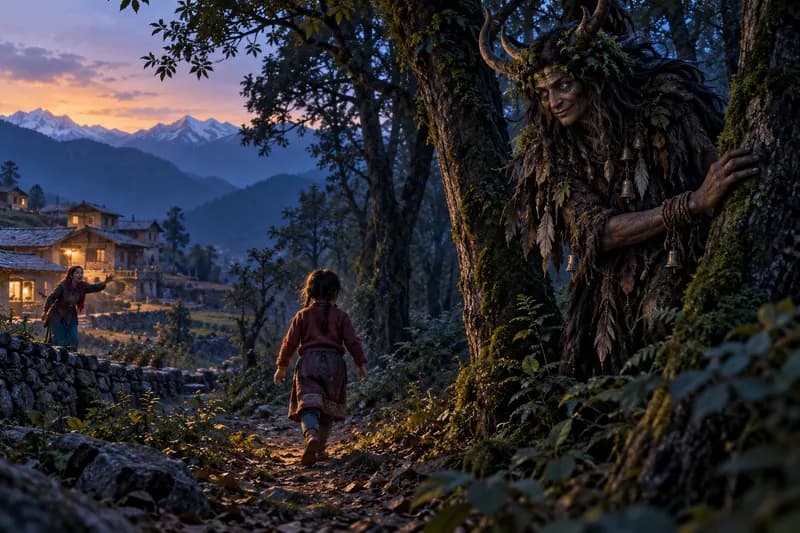
It doesn't kill the children it takes. It teaches them. They come back changed — speaking to things you cannot see.
- What Is a Ban Jhankri?
- Why the Ban Jhankri Is Terrifying
- Origin — How It Came to Exist
- Appearance & Manifestation
- The Boy from Taplejung
- The Rules — How to Protect Your Children
- What They Don't Tell You
- What Does the Ban Jhankri Want?
- Your Child Is Most at Risk If...
- Offerings & Appeasement
- The Healer
- What If You Dream of a Ban Jhankri?
- The Ban Jhankri in Art & Material Culture
- Cross-Regional Patterns
- In Culture — Books, Film, Music
- Is the Ban Jhankri Still Real?
- Expert & Academic Context
- If Your Child Encounters a Ban Jhankri
- Frequently Asked Questions
- Explore More
| Ban Jhankri | |
|---|---|
| Also Known As | Van Jhankri, Ban Jhakri, Sunuwar Jhankri, Kangchenjunga Spirit |
| Script | बन झाँक्री (Devanagari) |
| Pronunciation | BAHN JHAN-kree (बन झाँक्री) |
| Region | Nepal (central and eastern hills), Sikkim, Darjeeling (West Bengal), Himalayan foothills |
| Category | Shamanic Spirit / Forest Teacher Entity |
| Danger Level | Moderate |
| Fear Method | Child abduction, forest disorientation, forced shamanic initiation |
| Warning Sign | A golden-furred figure at the treeline; a child wandering toward the forest in a trance; drums heard from deep inside the woods where no one lives |
| First Documented | Oral tradition among Rai, Limbu, Tamang, and Sunuwar communities (pre-literate; estimated centuries old); documented in ethnographic studies from the 19th century onward |
| Still Believed? | Yes — actively believed across rural Nepal, Sikkim, and Darjeeling; many practicing jhankris (shamans) attribute their calling to a Ban Jhankri abduction in childhood |
| Related | Banjhakri · Aleya · Kapala Spirit · Nishi · Polong · Vetali |
What Is a Ban Jhankri?
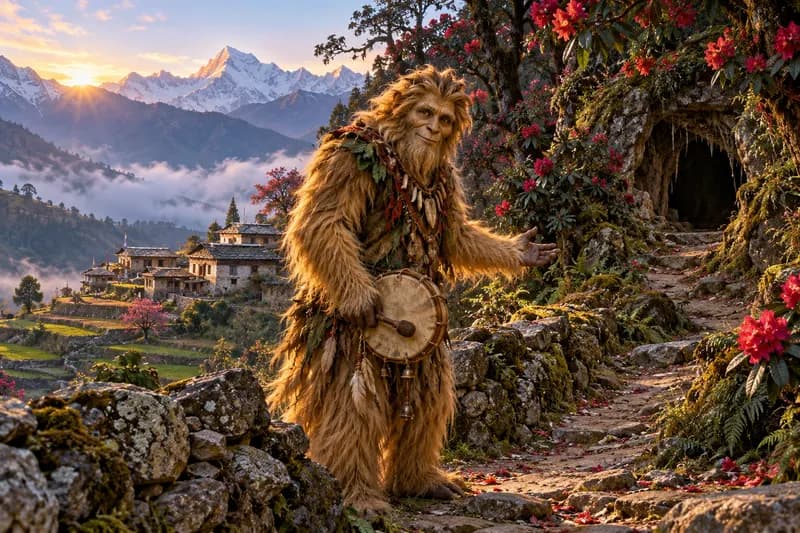
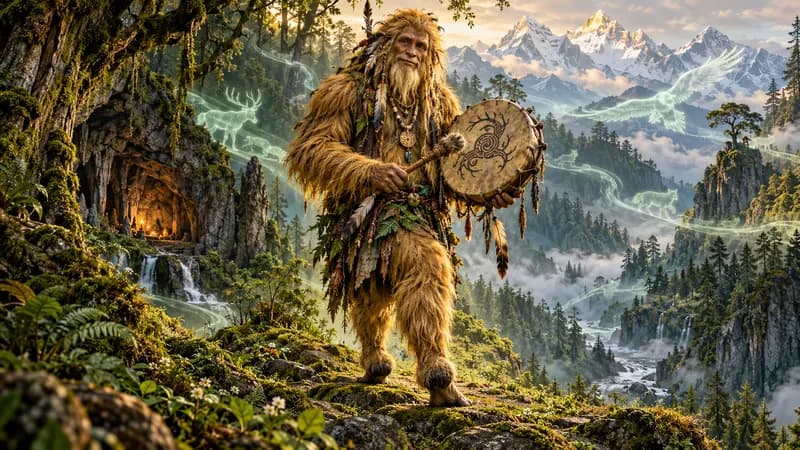
The Ban Jhankri (बन झाँक्री) is a forest-dwelling shamanic spirit from the Himalayan tradition of Nepal, Sikkim, and Darjeeling. Standing roughly three feet tall, covered in thick golden fur, with feet turned backward and long matted hair that sweeps the ground, the Ban Jhankri is a wild shaman of the forest — an entity that kidnaps children, takes them deep into caves or hollows in the wilderness, and teaches them the arts of healing, drumming, and spirit communication. The children are returned days, weeks, or sometimes months later, often disoriented but possessing knowledge they did not have before.
What makes the Ban Jhankri unique among supernatural entities worldwide is its dual nature — it is feared as a kidnapper but revered as the origin of shamanic power. In Himalayan shamanic tradition, a jhankri (healer-shaman) who was taken by the Ban Jhankri in childhood is considered more powerful than one who learned from a human teacher. The abduction is traumatic, but the gift is real. This is not a monster. It is a teacher that uses terror as its classroom.
Why the Ban Jhankri Is Terrifying
INSTINCT EXPLOITED: PARENTAL HELPLESSNESS
Your child is playing at the edge of the village. The forest begins where the last terrace ends — rhododendron and oak, thick enough that sunlight dies ten steps in. You look away for a moment. When you look back, the child is walking toward the trees. Not running. Walking, with purpose, as if someone called their name.
You shout. The child does not turn.
By the time you reach the treeline, the child is gone. Not lost — taken. The forest has closed behind them like a door. You search for hours. Days. The village searches with you. Nothing. No tracks. No sound. The forest gives back nothing.
Then, three days later — or seven, or thirty — the child walks out of the trees. Barefoot. Scratched. Eyes strange. They do not cry. They tell you about a small golden creature that fed them flowers and roots, that made them sit in a dark cave and listen to drums, that taught them to see things that aren't visible to ordinary eyes. They tell you about healing. About plants. About the names of spirits.
Your child is back. But your child is different. They know things no child should know. They hear things you cannot hear. And when they grow up, the villagers will come to them for healing — because the Ban Jhankri chose them, and a child chosen by the Ban Jhankri becomes a jhankri themselves.
The terror is not that the Ban Jhankri kills. It doesn't. The terror is that it takes your child and returns someone else — someone who belongs partly to the forest now, and always will.
Origin — How It Came to Exist
The Wild Shaman
The Ban Jhankri is not a ghost, not a demon, not a cursed human. It is a forest spirit — the original shaman, the first healer, the one who existed before humans learned the practice. In Himalayan cosmology, shamanic knowledge does not originate from human teachers. It comes from the wild — from the forest itself. The Ban Jhankri is the forest's agent of transmission, the entity that bridges the gap between the spirit world's knowledge and human capacity to receive it.
Why Children
The Ban Jhankri takes children — specifically children between the ages of seven and twelve — because children's minds are open. Adults are too rigid, too filled with the structures of ordinary life, to receive shamanic knowledge directly. A child can be reshaped. A child can learn to see differently. This is not cruelty in the tradition's logic — it is selection. The Ban Jhankri chooses children who have the capacity to become healers, and it takes only those who are meant to carry the gift.
The Ban Jhankri and the Ban Jhankri-ni
The Ban Jhankri has a female counterpart — the Ban Jhankri-ni (sometimes called Ban Jhankri's wife). She is considered far more dangerous. While the Ban Jhankri teaches and returns children, the Ban Jhankri-ni is said to be jealous and hostile. In some accounts, she tries to kill or permanently keep the children the Ban Jhankri has taken. The Ban Jhankri must sometimes protect the child from his own mate. This dynamic adds a layer of genuine danger to the abduction — the child is not just being taught, but surviving a conflict between two forest powers.
The Shamanic Lineage
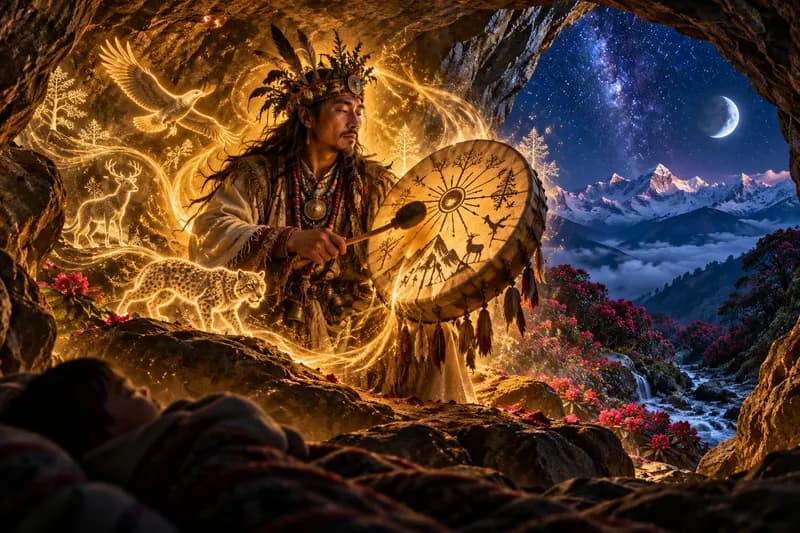
Across the Rai, Limbu, Tamang, Gurung, and Sunuwar communities of Nepal and Sikkim, many practicing jhankris trace their power directly to a Ban Jhankri abduction. The experience follows a remarkably consistent pattern: the child is taken, kept in a cave, fed forest plants, taught to drum, taught healing mantras, and taught to communicate with spirits. When they are returned, the community recognizes the signs and the child begins their path as a healer. The abduction is the initiation.
The Himalayan Context
The Ban Jhankri exists within a broader Himalayan shamanic tradition that sees the forest as a living, intentional force. The mountains, rivers, and forests of Nepal and Sikkim are not backdrop — they are active participants in the spiritual life of communities. The Ban Jhankri is one of many forest entities, but it is the most important because it is the one that creates healers. Without the Ban Jhankri, the shamanic lineage would have no origin point.
Appearance & Manifestation
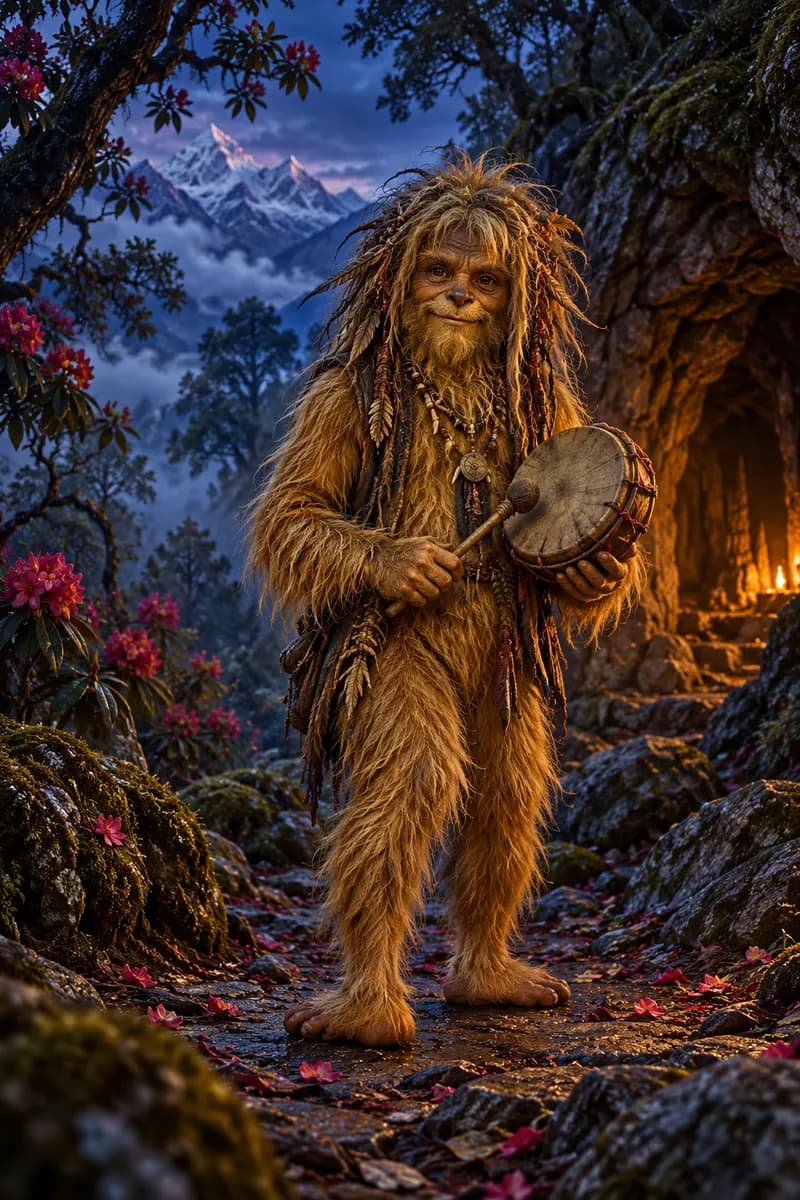
| 👁 Sight | Approximately three feet tall. Covered entirely in thick golden or tawny fur. Long matted hair that drags on the ground. Feet turned backward — a common marker of supernatural entities across South Asian folklore. Face partially human, partially animal — wide-set eyes, a flat nose, sometimes described as monkey-like or ape-like. Wears no clothing. Carries a golden dhyangro (shaman's drum). |
| 🔊 Sound | The sound of drumming deep in the forest — rhythmic, steady, coming from a direction you cannot locate. The Ban Jhankri's dhyangro is said to produce a sound that induces trance in those who hear it. Also: the sound of chanting in a language that is not quite any human tongue. Children who have been taken report hearing the drumming for days before the abduction. |
| 🍃 Smell | Damp earth, crushed rhododendron petals, moss, and something musky and animal — the scent of a creature that lives deep in the forest and has never been near human habitation. A wild smell, not unpleasant but unmistakably non-human. |
| ❄ Temperature | The cave where the Ban Jhankri teaches is said to be cold — Himalayan cold, the kind that seeps into bone. But the children do not freeze. They report being warm despite the cold, as though the Ban Jhankri's presence generates its own heat. Outside the cave, the forest around a Ban Jhankri sighting grows unnaturally still — no wind, no birdsong. |
| 🌑 Time | Can appear at any time but most commonly at twilight — the hour between daylight and darkness when the forest changes character. Also active at dawn. The abductions typically begin during the day, when children are playing outside, but the teaching happens in the timeless dark of caves where day and night have no meaning. |
| 🏚 Habitat | Dense Himalayan forests — oak, rhododendron, pine. Caves deep in the mountains. Rocky overhangs where the forest canopy is so thick that the ground is in permanent shadow. Always away from human habitation, always deeper in the forest than anyone normally goes. The Ban Jhankri is the forest's innermost resident. |
The Boy from Taplejung
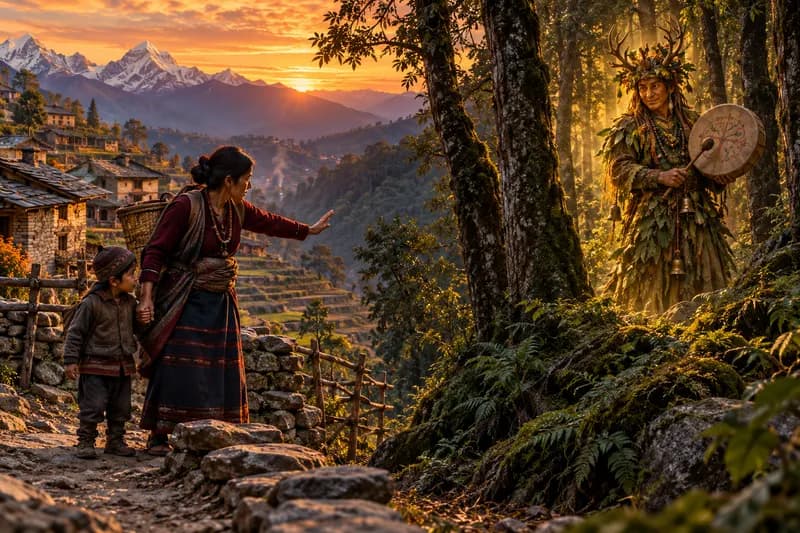
In a village above Taplejung, in the far east of Nepal where the mountains begin their climb toward Kangchenjunga, there lived a boy named Dawa. He was nine years old, the youngest of four brothers, and he was the quiet one — the one who sat at the edge of the group, the one who stared at the forest longer than the others, the one the village women said had 'open eyes.'
One afternoon in late autumn, when the rhododendrons had finished blooming and the forest was preparing for winter, Dawa walked past the last terrace and sat on a rock at the treeline. He did this often. His mother had told him not to go further, and he never did. But that day he heard something — a drumming, far away, muffled by the trees, steady as a heartbeat.
He stood up and walked into the forest.
His mother found his sandals at the rock. Nothing else. The village searched for three days. They checked every cave, every ravine, every stream crossing within two hours' walk. The jhankri of the neighboring village came, burned juniper, and chanted. He told Dawa's mother: 'The Ban Jhankri has taken him. He will come back. Do not search anymore.'
She did not stop searching. But on the seventh day, she didn't have to. Dawa walked out of the forest at dawn, barefoot, his clothes torn, his hair matted with something that smelled like crushed leaves and earth. He was not crying. He was not afraid. He sat down at the same rock where his sandals still lay and waited for someone to find him.
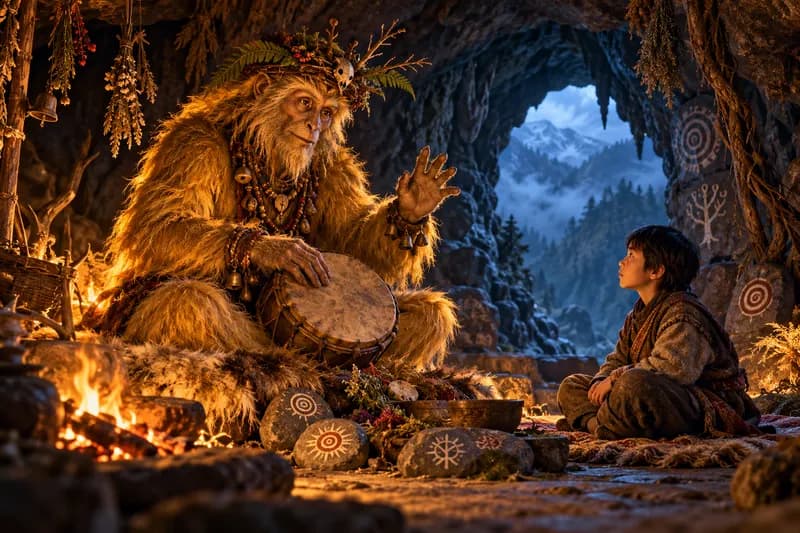
When they brought him home, he told them what had happened. A small golden creature — 'like a person but covered in fur, with hair longer than its body' — had taken his hand and led him deeper into the forest than he had ever been. They had gone into a cave. The cave was dark and cold but Dawa said he was not afraid. The creature had fed him roots and the petals of flowers he did not recognize. It had shown him a drum — small, golden, with skin stretched over both sides — and played it. The sound filled the cave.
For seven days, the creature taught him. It taught him the names of plants that heal fever. It taught him which spirits live in which trees. It taught him a chant — he could not repeat it fully, but parts of it came to him when he was quiet. It taught him to listen to the forest, not with his ears, but with something behind his ears.
The village jhankri came to see the boy. He asked Dawa to show him the chant. Dawa hummed a fragment. The jhankri closed his eyes and nodded. 'This is the Ban Jhankri's teaching,' he said. 'The boy has been chosen.'
Dawa grew up to become the jhankri of three villages. People walked two days through the mountains to see him. He healed fevers, settled spirit disturbances, and performed the rituals that kept the forest and the village in balance. When asked about his training, he said very little. Only this: 'The forest taught me. The small golden one taught me. Everything I know, I learned in the dark.'
He kept a small golden drum his entire life. Nobody knew where he got it.
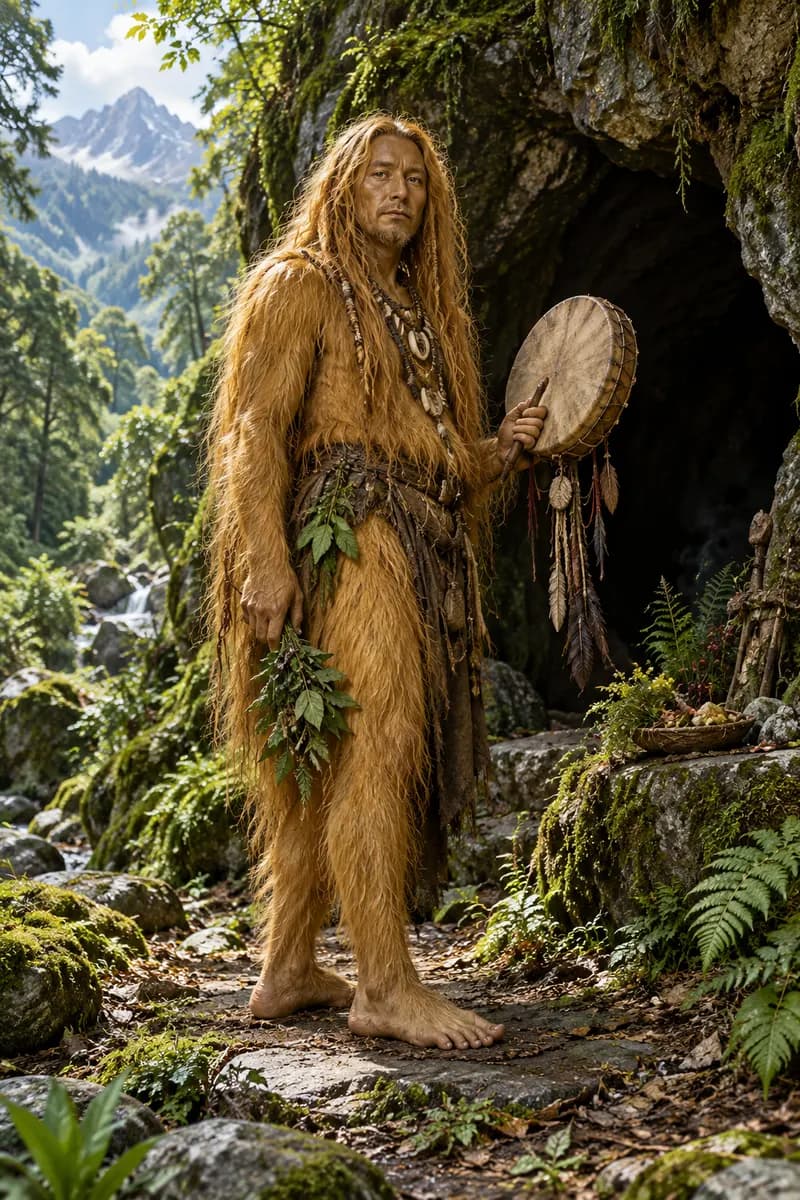
The Rules — How to Protect Your Children
⚠ WARNING ⚠
Seven rules for preventing Ban Jhankri abduction
- Do not let children play alone at the forest edge at twilight. — Twilight is the Ban Jhankri's hour. Children near the treeline at dusk are visible to it. The transition between day and night mirrors the transition between the human world and the forest world — and the Ban Jhankri moves through that gap.
- Keep iron near children — a nail, a pin, a small blade. — Iron repels the Ban Jhankri. A child carrying an iron object cannot be taken. Many Himalayan families pin a small iron nail inside a child's clothing as permanent protection.
- If a child hears drumming from the forest, bring them inside immediately. — The Ban Jhankri's drum is its calling tool. A child who hears the drumming and follows the sound is already being selected. The sound induces a trance-like pull. Once the child crosses the treeline following the drum, retrieval becomes nearly impossible.
- Burn juniper smoke at the threshold of your home. — Juniper is the Himalayan purifier. Its smoke creates a boundary the Ban Jhankri will not cross. Regular burning, especially at twilight, keeps the home marked as human territory.
- Do not cut down trees in deep forest without offering. — The Ban Jhankri protects the deep forest. Cutting trees without acknowledgment provokes it. Provoked, it may take a child from the offending household as compensation — or as punishment.
- If a child is taken, do not chase into the forest after dark. — The forest at night belongs to the Ban Jhankri. A parent entering the deep forest at night risks disorientation, spirit interference, and — in some accounts — being taken themselves. Wait. The Ban Jhankri returns the children. It always returns them.
- If a child returns from a Ban Jhankri abduction, call the village jhankri immediately. — The returning child carries residual spirit-contact. Without proper ritual cleansing and recognition by an experienced jhankri, the child may remain in a state between worlds — confused, withdrawn, hearing things others cannot. The jhankri recognizes the signs and begins the integration.
What They Don't Tell You
The Ban Jhankri is not the enemy. In Himalayan shamanic tradition, it is the origin of all healing. Every jhankri who heals the sick, who settles spirit disturbances, who keeps the balance between the village and the wild — their power ultimately traces back to the Ban Jhankri. The abduction is not an attack. It is a calling. The terror is real — a child disappears into the forest, and the parents can do nothing but wait. But the terror serves a purpose. It strips the child of the ordinary world and rebuilds them as someone who can move between worlds. The Ban Jhankri is feared because the gift it gives is too large for a child to choose willingly. So it chooses for them.
What Does the Ban Jhankri Want?
The Ban Jhankri wants to perpetuate the shamanic lineage. It wants there to be healers.
It is not predatory. It is not malicious. It is performing a function that, in the Himalayan worldview, is essential — selecting and training the next generation of jhankris. Without the Ban Jhankri, the shamanic tradition would have no supernatural origin, and a jhankri without supernatural origin is just a person who knows plants. The Ban Jhankri's abduction gives the jhankri their authority: they were chosen by the forest itself.
There is something almost parental in the Ban Jhankri's behavior — fierce, terrifying, non-negotiable parenting. It takes children who are 'open,' who have the capacity to see what others cannot. It feeds them. It protects them from the Ban Jhankri-ni, its own dangerous mate. It teaches them patiently, in the dark, for days. And then it sends them home.
The Ban Jhankri does not want worship. It does not want offerings. It does not want fear. It wants continuation. It wants the knowledge of the forest to pass into human hands — one child at a time, one terrifying initiation at a time — so that the link between the wild and the village is never broken.
Your Child Is Most at Risk If...
- They are between the ages of seven and twelve
- They are quiet, solitary, and drawn to the forest
- They sit at the edge of the village near the treeline, especially at twilight
- They have shown signs of sensitivity — seeing things others do not, hearing sounds others cannot
- Your family has a history of shamanic practice
- You have recently disturbed the deep forest — cutting trees, building near sacred groves, or disrespecting forest spirits
Offerings & Appeasement
| Offering | Purpose |
|---|---|
| Preventive Offerings | Juniper burned at the household threshold, especially during twilight. Small offerings of rice and flowers left at the treeline. These are boundary markers — signals to the Ban Jhankri that this household acknowledges the forest's presence and asks to be left in peace. |
| After an Abduction | When a child returns, the village jhankri performs a reintegration ritual — drumming, chanting, juniper smoke, and offerings of food and flowers at the forest edge. This is not to appease the Ban Jhankri but to safely transition the child back into the human world. The child has been in the spirit world. They need a bridge back. |
| Forest Offerings | Before entering deep forest — for wood, for herbs, for grazing — Himalayan communities leave small offerings at the treeline. Rice, flowers, a spoken acknowledgment. This is not specific to the Ban Jhankri but to the forest as a whole, of which the Ban Jhankri is the most prominent resident. |
| Gratitude Offerings | Jhankris who trace their power to a Ban Jhankri abduction often return offerings to the forest throughout their lives. This is not obligation — it is gratitude. The Ban Jhankri gave them their life's purpose. The offerings are repayment for a gift that cannot be repaid. |
The Healer
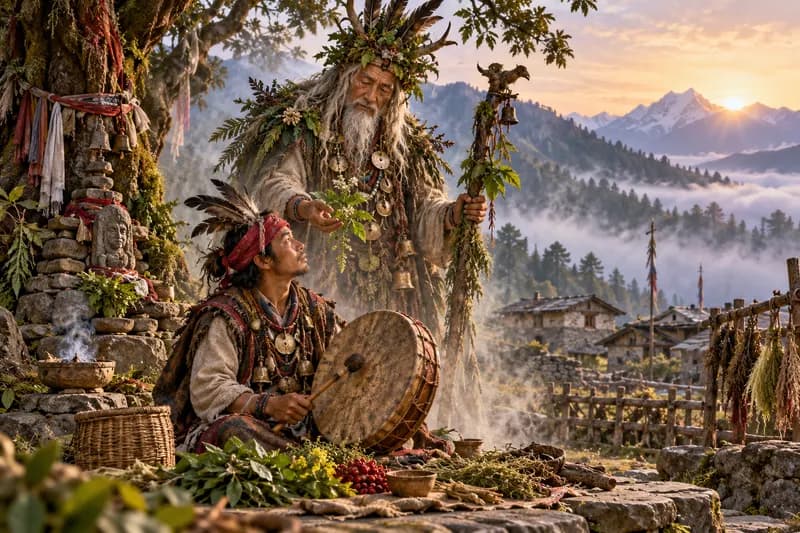
Jhankri (Village Shaman) — The first and most important response to a Ban Jhankri encounter. The jhankri understands the abduction because many jhankris have experienced it themselves. They can read the signs in a returned child, perform reintegration rituals, and begin the child's training if the Ban Jhankri's teaching has taken root.
Senior Jhankri / Guru Jhankri — For complex cases — a child who does not return, a child who returns but cannot readjust — a senior jhankri with decades of practice is called. They can negotiate with forest spirits, enter trance states to locate a missing child in the spirit world, and perform advanced rituals that a village-level jhankri cannot.
Lama (Buddhist Practitioner) — In Sikkim and parts of Nepal where Buddhism and shamanic tradition overlap, a lama may be called alongside or instead of a jhankri. The lama provides protective mantras and blessings, though the shamanic specifics of Ban Jhankri encounters are outside Buddhist practice.
The Key Difference — You do not 'defeat' the Ban Jhankri. You do not exorcise it. If it has taken a child, you wait. If the child returns, you help them integrate. The jhankri's role is not to fight the Ban Jhankri but to complete the process it started — to turn the abduction into an initiation, the trauma into a calling.
What If You Dream of a Ban Jhankri?
| Symbol | Meaning | |
|---|---|---|
| 🌲 | A Golden Figure at the Treeline | A calling you have been ignoring. Something wild and important is waiting at the edge of your comfortable life, asking you to step into the unknown. The Ban Jhankri in your dream represents a teacher or a truth that you are afraid of but need. |
| 🥁 | Hearing Drums in the Forest | A rhythm pulling you toward change. The drumming represents a purpose or vocation trying to reach you. You may be resisting a calling — a career change, a creative pursuit, a way of life that feels too strange or frightening to embrace. |
| 🕳 | Being Taken into a Cave | Forced introspection. Something is pulling you into your own depths — a depression, a crisis, a dark night of the soul. The cave is not punishment. It is where the teaching happens. The dream suggests that what feels like loss is actually preparation. |
| 🌿 | A Child Walking into a Forest | Innocence or potential being drawn toward transformation. If the child is yours, the dream may reflect anxiety about a child outgrowing your protection. If the child is you, the dream is about a part of yourself that is being called to grow beyond what you currently are. |
The Ban Jhankri in Art & Material Culture
Traditional Jhankri Drums (Dhyangro): The single most important material artifact connected to the Ban Jhankri is the dhyangro — the double-headed frame drum used by Himalayan shamans. Many dhyangros feature carved or painted depictions of the Ban Jhankri on their frames. The drum itself is believed to be the Ban Jhankri's primary tool of teaching and power transmission.
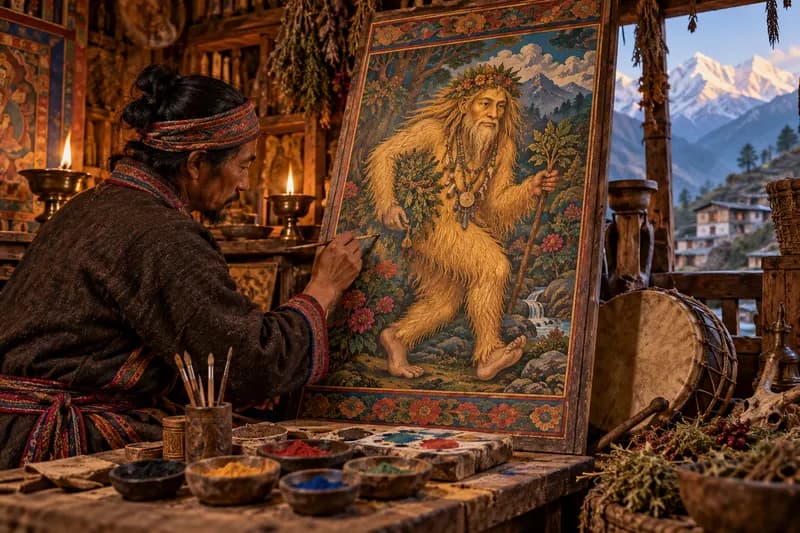
Thangka-style Paintings: In Sikkimese and Nepali Buddhist-shamanic art, the Ban Jhankri occasionally appears in painted scroll compositions alongside other forest spirits and mountain deities. These depictions show a small, hairy, golden figure with a drum, often positioned in dense forest settings with Himalayan peaks in the background.
Modern Nepali Folk Art: Contemporary Nepali artists have depicted the Ban Jhankri in paintings, murals, and illustrations — often for children's books and cultural publications. These modern interpretations tend to soften the entity, making it more whimsical than terrifying, though the core elements — golden fur, backward feet, the drum — remain consistent.
Ritual Masks: In some jhankri traditions, ritual masks representing forest spirits including the Ban Jhankri are used during healing ceremonies. These masks are carved from wood, painted in bright colors, and feature exaggerated features — wide eyes, bared teeth, wild hair. They serve as invocations, calling the spirit's power into the ceremony.
Cross-Regional Patterns
Banjhakri · Aleya · Kapala Spirit · Nishi · Polong · Vetali · Begho Bhoot · Karna Pisachini
| Dawn as hard limit | No |
| Iron weakness | Yes |
| Tree-dwelling | Forest-dwelling |
| Counting compulsion | No |
| Backward feet | Yes |
Global Equivalent: The closest global parallel is the European fairy abduction tradition — the Sidhe of Irish folklore who take children into fairy mounds and return them changed. The Changeling myth carries similar DNA: a child taken by supernatural forces, returned as something other. But the Ban Jhankri is more specific and more purposeful than any fairy — it does not take children for amusement or malice. It takes them to create healers. The South American curandero tradition also echoes this — shamans who receive their calling through traumatic supernatural encounters in the wilderness.
In Culture — Books, Film, Music
| Type | Title | Description |
|---|---|---|
| Ethnography | Shamanism and Tantra in the Himalayas — Claudia Müller-Ebeling, Christian Rätsch, Surendra Bahadur Shahi | The most comprehensive academic documentation of Ban Jhankri beliefs within Himalayan shamanic practice. Includes firsthand accounts from jhankris who claim to have been abducted as children. |
| Documentary | Various ethnographic films on Himalayan shamanism | Multiple documentary projects have captured jhankri rituals and interviews with practitioners who describe Ban Jhankri encounters. These are typically academic productions rather than mainstream releases. |
| Literature | Nepali folk tale collections | The Ban Jhankri features prominently in Nepali folk tale anthologies, particularly those compiled from Rai, Limbu, and Tamang oral traditions. These collections preserve the narrative in its closest-to-original form. |
| Music | Jhankri drumming traditions | The rhythmic patterns taught by the Ban Jhankri survive in living musical tradition — the drumming of practicing jhankris follows patterns that are said to originate with the Ban Jhankri itself. This is not performance music. It is ritual sound, preserved through an unbroken chain of teacher-to-student transmission. |
| Contemporary Art | Nepali and Sikkimese visual artists | A growing number of contemporary Himalayan artists are incorporating Ban Jhankri imagery into modern art — paintings, illustrations, and graphic narratives that bring the entity to wider audiences while respecting its cultural weight. |
ACCURACY RATING: HIGH IN ETHNOGRAPHIC SOURCES · LIMITED MAINSTREAM REPRESENTATION
Is the Ban Jhankri Still Real?
- Actively and widely believed across rural Nepal, Sikkim, and Darjeeling. This is not a fading belief — it is a living, practiced one. Jhankris are active community healers in thousands of villages.
- Practicing jhankris in Nepal regularly attribute their calling to a Ban Jhankri abduction in childhood. These are not historical claims — they are made by living practitioners about events within their own lifetimes.
- Iron protection for children is still practiced. Families pin iron nails or needles into children's clothing as a routine protective measure, especially in communities near dense forest.
- Reports of children going missing and returning with 'shamanic knowledge' continue to surface in Himalayan communities. Whether these are Ban Jhankri encounters or other phenomena, they are interpreted through the Ban Jhankri framework by the communities involved.
- The belief has survived urbanization, education, and modernity in ways that surprised ethnographers. Even Nepalis living in cities acknowledge the Ban Jhankri as real — a marker of how deeply embedded the tradition is in Himalayan cultural identity.
Expert & Academic Context
- Shamanism and Tantra in the Himalayas — Müller-Ebeling, Rätsch, Shahi (2002) — The most thorough academic treatment of Ban Jhankri within the Himalayan shamanic system. Includes field interviews, ritual descriptions, and analysis of the Ban Jhankri's role in shamanic initiation.
- Larry Peters — Tamang Shamanism Studies — Peters' fieldwork with Tamang shamans in Nepal produced some of the earliest English-language documentation of Ban Jhankri beliefs, including detailed accounts of abduction narratives and their role in jhankri identity formation.
- John T. Hitchcock — Himalayan Ethnography — Hitchcock's mid-20th-century ethnographic work in Nepal documented the Ban Jhankri tradition within the broader context of Himalayan spirit beliefs and community healing practices.
- Gregory Maskarinec — The Rulings of the Night — Maskarinec's study of Nepali shamanic oral texts includes references to the Ban Jhankri as a source of shamanic authority, positioning the entity within the textual and performative traditions of jhankri practice.
- Nepali Folklore Collections — Various Compilers — Multiple collections of Nepali folk narratives, particularly those focused on Rai, Limbu, Tamang, and Sunuwar traditions, preserve Ban Jhankri stories in forms close to the oral originals.
The Ban Jhankri occupies a unique position in the global catalogue of supernatural entities: it is simultaneously feared and necessary. Unlike entities that are purely threatening (the Churel, the Vetala in its hostile form) or purely benevolent (protective household spirits), the Ban Jhankri is a teacher whose methods are terrifying. This mirrors a deep truth in Himalayan culture — that real knowledge comes through ordeal, that the forest is both dangerous and sacred, and that the most powerful healers are those who have been broken open by the wild and reassembled with new vision. The Ban Jhankri is not separate from the shamanic tradition. It is the shamanic tradition's founding myth, walking around in golden fur.
If Your Child Encounters a Ban Jhankri
Frequently Asked Questions
▶What is a Ban Jhankri?
A Ban Jhankri is a forest-dwelling shamanic spirit from Himalayan tradition (Nepal, Sikkim, Darjeeling). About three feet tall, covered in golden fur, with backward feet and long matted hair. It kidnaps children and takes them into the forest to teach them healing, drumming, and spirit communication. The children are returned days or weeks later with shamanic abilities.
▶Does the Ban Jhankri kill children?
No. The Ban Jhankri is not considered lethal. It takes children, teaches them, and returns them. However, the Ban Jhankri-ni (its female counterpart) is considered genuinely dangerous — she may try to harm or permanently keep the children. The Ban Jhankri is feared for the abduction itself, not for killing.
▶Is the Ban Jhankri the same as the Yeti?
No, though they share some physical similarities (short, hairy, forest/mountain-dwelling). The Yeti is a cryptid — a possible undiscovered animal. The Ban Jhankri is a spirit entity with a specific cultural function: selecting and training shamans. They belong to different categories of belief entirely.
▶How do you protect a child from the Ban Jhankri?
Iron is the primary protection — a small nail or pin carried on the child's body or clothing. Juniper smoke burned at the household threshold. Keeping children away from the forest edge at twilight. And not disturbing the deep forest unnecessarily — cutting trees without offering or showing disrespect to forest spirits can provoke the Ban Jhankri.
▶Are Ban Jhankri encounters still reported?
Yes. Practicing jhankris in Nepal and Sikkim continue to report childhood abduction experiences that they attribute to the Ban Jhankri. These are not historical legends — they are accounts from living people about events in their own lifetimes. The tradition is active and ongoing.
▶What happens to children who are taken?
According to consistent accounts across multiple communities: the child is led deep into the forest, taken to a cave, fed roots and flower petals, and taught healing knowledge, spirit names, and drumming over a period of days to weeks. They are then returned to the village edge. Many grow up to become jhankris (shamans) themselves.
Explore More
Related Spirits
Banjhakri · Aleya · Kapala Spirit · Nishi · Polong · Vetali · Begho Bhoot · Karna Pisachini
Stories Are Being Summoned
One ghost story per week. Every Tuesday at midnight.