Banjhakri
He comes for the children. Not to harm them — to teach them. But the forest he takes them to is not a place anyone returns from unchanged.
- What Is a Banjhakri?
- Why the Banjhakri Is Terrifying
- Origin — How It Came to Exist
- Appearance & Manifestation
- The Boy from Yuksom
- The Rules — How to Survive
- What They Don't Tell You
- What Does the Banjhakri Want?
- You're Most at Risk If...
- Offerings & Appeasement
- The Healer
- What If You Dream of a Banjhakri?
- The Banjhakri in Art & Tradition
- Cross-Regional Patterns
- In Culture — Movies, Books, Games
- Is the Banjhakri Still Real?
- Expert & Academic Context
- If You Encounter a Banjhakri
- Frequently Asked Questions
- Explore More
| Banjhakri | |
|---|---|
| Also Known As | Ban Jhakri, Bon Jhankri, Forest Jhankri, Wild Shaman |
| Script | बनझाक्री (Devanagari) |
| Pronunciation | bun-JHAA-kree (बन-झाक्री) |
| Region | Nepal-India border; strongest in Sikkim, Darjeeling hills, eastern Nepal, and Bhutan foothills |
| Category | Forest Spirit / Shamanic Initiator |
| Danger Level | Dangerous |
| Fear Method | Child abduction, forced shamanic initiation, wilderness isolation |
| Warning Sign | A child suddenly drawn to the forest edge; golden fur glimpsed between trees; the sound of a dhyangro drum with no drummer |
| First Documented | Oral tradition of the Limbu, Rai, Tamang, and Lepcha peoples; no single written source — transmitted through jhankri lineages for centuries |
| Still Believed? | Yes — actively believed across Nepal, Sikkim, and Darjeeling. Jhankri healers in practice today trace their powers to Banjhakri abduction |
| Related | Banjhakrini · Ban Jhankri · Devchar · Vanara Spirit · Rakshasa · Acheri |
What Is a Banjhakri?
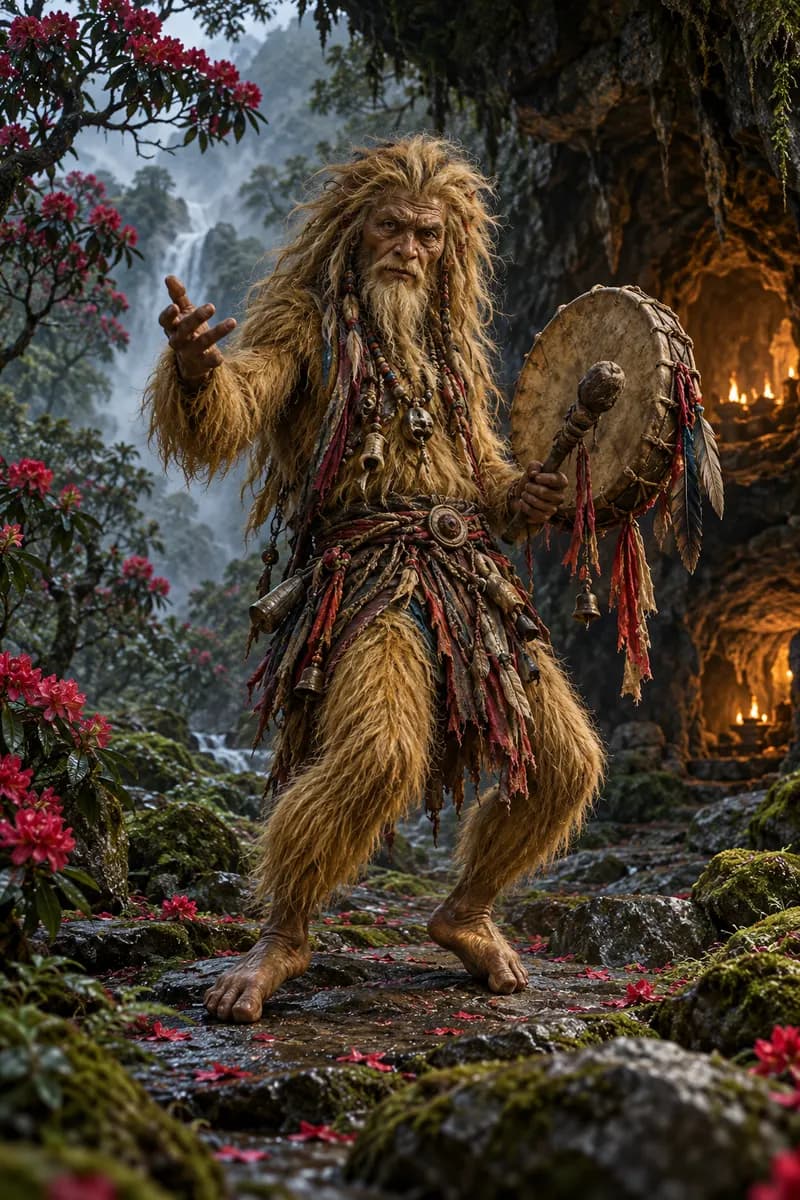
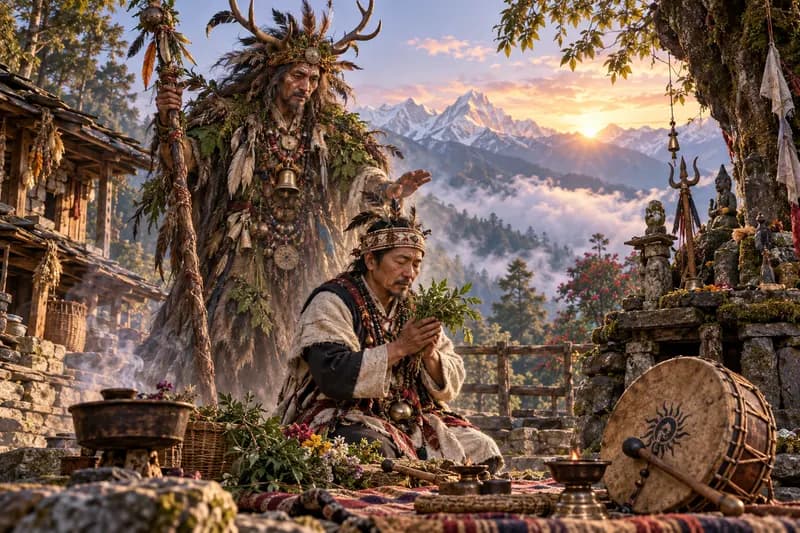
The Banjhakri (बनझाक्री) is a wild forest shaman from the folklore of Nepal and the northeastern Indian borderlands — particularly Sikkim, Darjeeling, and the Bhutan foothills. 'Ban' means forest; 'Jhakri' means shaman. He is described as a small, powerful being covered entirely in thick golden hair, with his face partially visible — sometimes described as ape-like, sometimes as an ancient man. He walks upright but belongs to no human community. He lives deep in the forest, in caves and hollow trees, far from any village.
What makes the Banjhakri unique in all of South Asian folklore is his purpose: he kidnaps children — typically between the ages of seven and fourteen — and takes them into the wilderness to teach them the arts of healing, herbalism, and shamanic practice. The children who survive this initiation return to their villages as jhankri — healers, spirit-mediums, and the primary interface between the human and supernatural worlds in Himalayan communities. The Banjhakri is not a demon. He is a teacher. But his classroom is the deep forest, and not every student survives.
Why the Banjhakri Is Terrifying
INSTINCT EXPLOITED: PARENTAL HELPLESSNESS
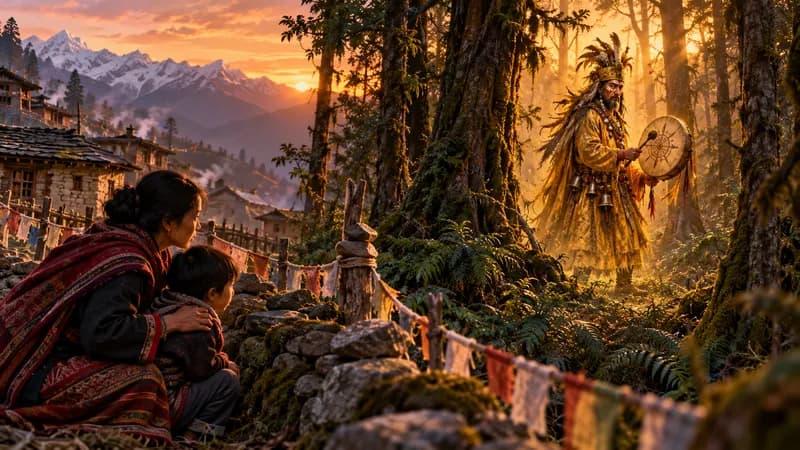
Your child has been playing near the tree line all morning. You called them in for rice. They didn't come. You walk to the edge of the clearing and see nothing — no movement, no tracks, no sound. The forest is silent in that particular way that means something large has recently passed through it.
You search for three days. The village helps. The forest gives nothing back.
On the seventh day, the child walks out of the trees. They are thinner. Their eyes are different — not traumatized, but older. They smell of herbs you cannot identify and woodsmoke from no fire you built. They do not cry. They sit quietly and begin sorting leaves into piles with a precision no seven-year-old should possess.
When you ask where they were, they say: "With the golden one. He taught me."
This is the terror of the Banjhakri. It is not the terror of violence — it is the terror of having your child taken and returned as someone else. The child is alive. The child is unharmed. The child now knows things you do not understand. And the child will never fully belong to your world again.
Every parent in the Himalayan foothills knows this fear. It is not abstract. Children do disappear. Some come back. The ones who come back become healers. And the parents must accept that their child was chosen by something older and wilder than any human authority.
Origin — How It Came to Exist
The First Shaman
In Himalayan tradition, the Banjhakri is not a ghost or a demon — he is the original shaman. Before humans learned to heal, before they knew which plants cured fever and which roots stopped bleeding, the Banjhakri already knew. He is the source of all shamanic knowledge in the region. Every jhankri healer traces their lineage of knowledge back to him — either directly (through abduction) or through a chain of teachers who were themselves abducted.
Why Children?
The Banjhakri specifically targets children because they are unformed — their minds have not yet hardened into adult patterns. An adult cannot learn what the Banjhakri teaches because an adult's understanding is already fixed. The child's mind is soft enough to hold the knowledge of plants, spirits, drumming patterns, and the geography of the spirit world. The Banjhakri does not choose randomly — he selects children who show specific signs: sensitivity to natural patterns, unusual quietness, a tendency to wander toward the forest edge.
The Selection Criteria
Across communities, the signs are consistent. The chosen child is often described as 'different' before the abduction — dreamy, prone to talking to things that aren't there, uncomfortable in crowds, drawn to plants and animals. The Banjhakri, in this reading, does not create shamans. He recognizes them. The abduction is not random predation — it is recruitment.
The Teaching
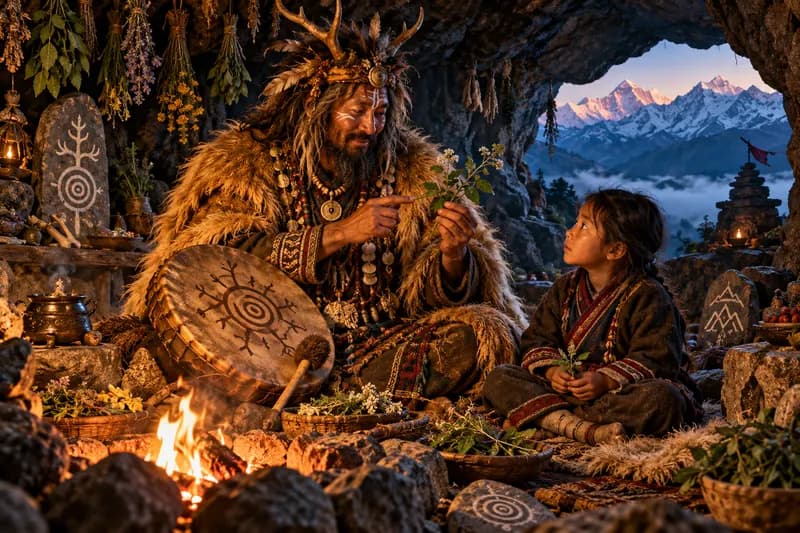
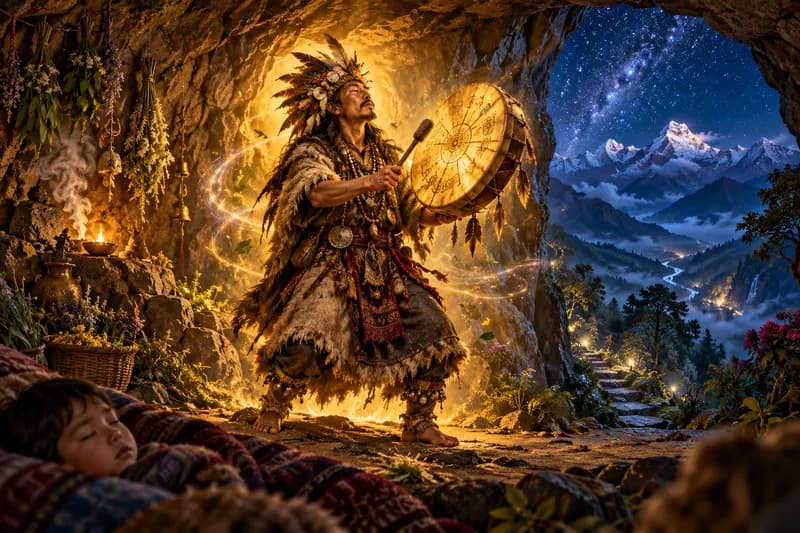
During the abduction period — which lasts from a few days to several weeks — the Banjhakri teaches the child a complete shamanic curriculum: the names and properties of medicinal plants, the rhythms of the dhyangro drum, the songs that summon and dismiss spirits, the geography of the upper and lower worlds, and the techniques of trance and possession. The child learns through practice, repetition, and direct experience. There are no books. The forest is the classroom.
The Danger
Not every child survives. The forest is genuinely dangerous — cold, predators, starvation, exposure. And the Banjhakri's wife — the Banjhakrini — is actively hostile to the children. Where the Banjhakri wants to teach, the Banjhakrini wants to eat. The child must survive both the curriculum and the Banjhakrini's hunger. This is considered part of the initiation: the shaman must learn to survive malevolence before they can heal others.
Appearance & Manifestation
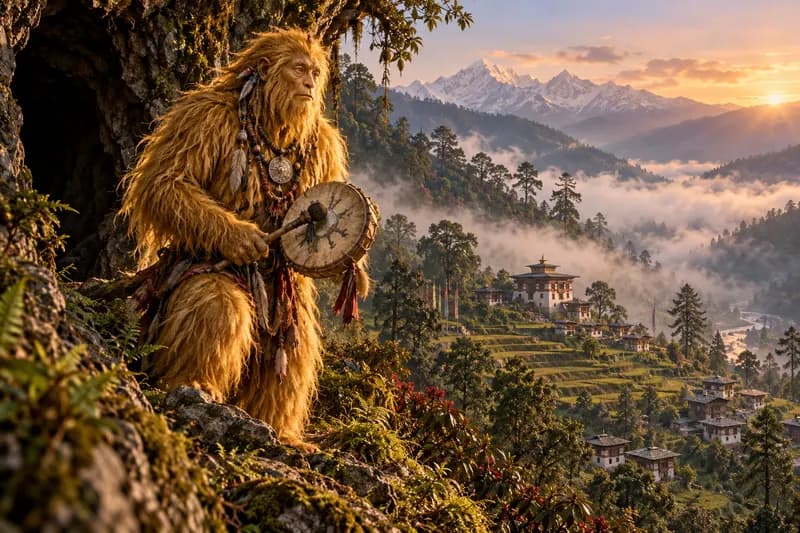
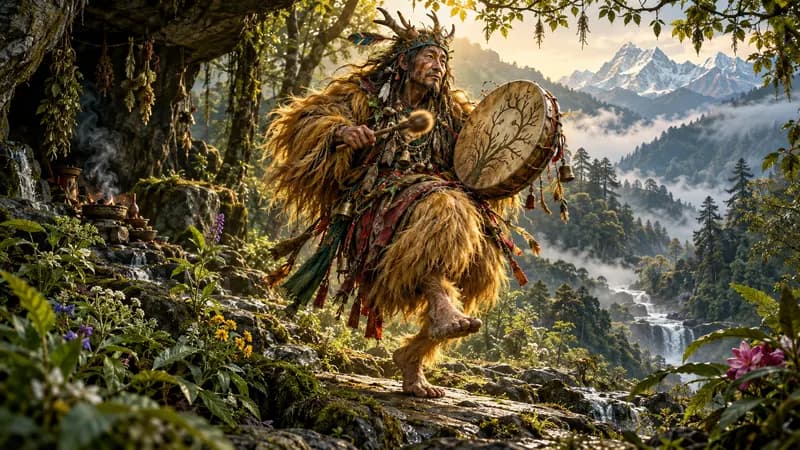
| 👁 Sight | Short — typically described as three to four feet tall. Entire body covered in thick golden or tawny hair. Face partially visible: broad nose, deep-set eyes that gleam with animal intelligence. Walks upright like a man but moves through forest with the ease of something that has never known walls. Sometimes carries a dhyangro drum. |
| 🔊 Sound | The sound of a dhyangro drum beating in the deep forest where no human drummer could be. Rhythmic, steady, hypnotic. Children who hear it are drawn toward it. Adults who hear it feel dread. Also: rustling that tracks you through undergrowth, footsteps that match your pace. |
| 🍃 Smell | Intensely herbal — crushed leaves, medicinal roots, wet bark, moss, and something animal underneath. A smell that is wild in the most literal sense: the smell of a body that has never been indoors. |
| ❄ Temperature | The deep forest cold of the Himalayan foothills. Not supernatural cold — real cold. The cold of altitude, canopy shade, and wet earth. The Banjhakri's domain is the zone where the temperature drops and the sunlight thins. |
| 🌑 Time | Not strictly nocturnal. The Banjhakri operates at the margins of the day — dawn, dusk, the hours when light is uncertain. Children are most often taken during the transition hours, when supervision is loosest and the forest edge blurs. |
| 🏚 Habitat | Deep forest, caves, hollow trees, rocky overhangs in the Himalayan foothills. Never in villages. Never in clearings. The Banjhakri exists only where human settlement ends and wilderness begins. His territory is the boundary itself. |
The Boy from Yuksom
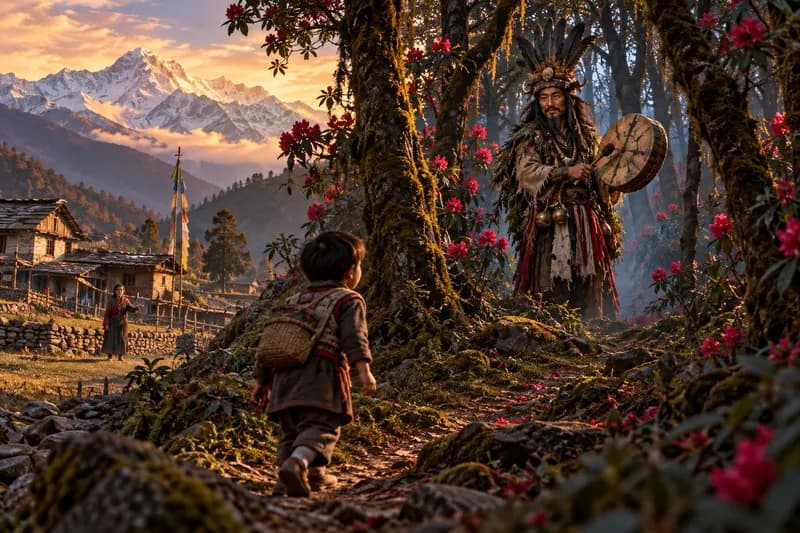
In a village near Yuksom, in western Sikkim, there was a boy named Thendup who spoke to plants. Not in the way children play — he would crouch beside a fern and whisper to it, then wait, ear tilted, as if listening for a reply. His mother found this embarrassing. His father found it worrying. The other children found it funny. Thendup was nine years old and had no friends his own age.
One morning in early autumn, when the mist was still thick on the hillside, Thendup walked to the forest edge to collect firewood. His mother watched him go. He was carrying a basket that was too large for his body, and she thought about calling him back to give him the smaller one. She didn't.
He did not return that evening. The basket was found at the tree line, empty, standing upright as if carefully placed. No drag marks. No signs of struggle. The village organized a search. Dogs were brought. The forest, as it always does in these stories, gave nothing back.
On the ninth day, Thendup walked out of the forest at dawn. He was barefoot — his shoes were gone. His clothes were torn but he was not injured. His hands were stained green and brown with plant matter ground deep into the skin. He was carrying, in both arms, a bundle of herbs wrapped in broad leaves — species that the village herbalist later confirmed were medicinal plants found only at much higher altitudes, plants a nine-year-old should not have been able to identify, let alone gather.
Thendup would not say much about where he had been. He said there was a golden man in a cave. The golden man had shown him things. He said there was also a woman who was angry, who had tried to grab him, and the golden man had stopped her. He said the golden man made him memorize songs. He could not repeat the songs yet, but he knew he would remember them later.
Within two years, Thendup was apprenticed to the village jhankri. Within five, he was conducting healing ceremonies himself. He became one of the most respected healers in western Sikkim. When asked about his training, he always said the same thing: "The forest taught me first. The jhankri only reminded me."
His mother never fully recovered from those nine days. She supported his calling. She was proud of his healing. But she never stopped being the woman whose child walked into the trees and came back as someone she didn't entirely recognize.
The Rules — How to Survive
☠ WARNING ☠
Six rules for protecting children from Banjhakri abduction
- Do not let sensitive or 'different' children wander near the forest edge alone. — The Banjhakri specifically selects children who show shamanic potential — quiet, dreamy, drawn to nature. These children are at highest risk during transition hours (dawn and dusk).
- Iron worn on the body provides protection. — Iron disrupts the Banjhakri's ability to approach. A small iron ring, bracelet, or amulet on the child is considered effective across all Himalayan communities.
- If a child is taken, do not pursue into the deep forest at night. — The Banjhakri's territory is the deep forest. Pursuing at night puts the searcher at risk from the Banjhakrini, who is genuinely malevolent and will attack adults. Search in daylight, in groups.
- Leave offerings at the forest edge — milk, rice, flowers. — Offerings acknowledge the Banjhakri's authority and may persuade him to release a child earlier. They signal respect for the boundary between village and forest.
- If the child returns, do not reject what they have learned. — A child returned from the Banjhakri carries shamanic knowledge. Rejecting or suppressing this causes illness and psychological harm. The child must be allowed to develop as a healer.
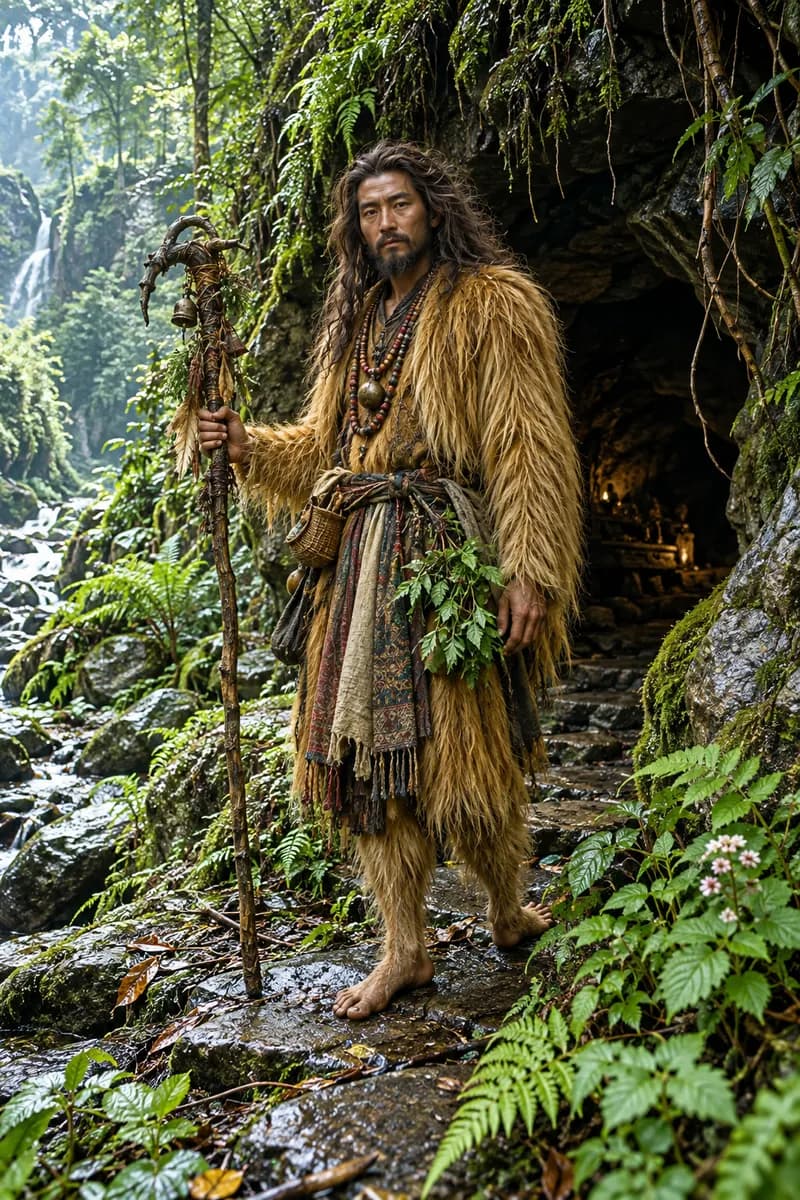
- A jhankri who was trained by the Banjhakri can negotiate for a child's return. — Only someone who has undergone the same initiation can communicate with the Banjhakri as an equal. The jhankri can enter the forest and request — not demand — the child's release.
What They Don't Tell You
The Banjhakri is not the villain of this story — and that is what makes the story so uncomfortable. He is the origin of healing knowledge in an entire region. Every jhankri who sets broken bones, who identifies the herb that stops a fever, who mediates between the living and the dead, traces their ability back to a golden creature in the forest who took a child and taught them. The parents' grief is real. The child's transformation is real. Both things are true simultaneously, and neither cancels the other. The Banjhakri represents the oldest and most disturbing bargain in human culture: that wisdom costs something, and the price is often paid by those who did not choose to pay it.
What Does the Banjhakri Want?
The Banjhakri wants continuity. He wants the knowledge to survive.
He is not cruel. He is not kind. He is purposeful. The shamanic tradition of the Himalayas — the healing, the spirit-work, the plant knowledge accumulated over millennia — must be passed to new carriers. The Banjhakri is the mechanism of that transmission. He identifies the children who can hold the knowledge, takes them into the environment where the knowledge lives, and forces it into them through experience.
The abduction is not punishment. It is not predation. It is education at a cost that no modern sensibility can justify but no traditional community can refuse. Because the alternative is a village without a healer. A community that cannot treat its sick, cannot mediate with its dead, cannot read the forest that surrounds it.
The Banjhakri wants what every teacher wants: a student who will carry the work forward. His methods are monstrous by any standard. His purpose is not.
You're Most at Risk If...
- You are a child between the ages of seven and fourteen
- You show signs of shamanic sensitivity — quietness, dreaminess, connection to nature
- You wander near the forest edge during dawn or dusk hours
- You are in the Himalayan foothills of Nepal, Sikkim, or Darjeeling
- You are not wearing iron
- You hear drumming from the forest with no visible source
Offerings & Appeasement
| Offering | Purpose |
|---|---|
| Forest Edge Offerings | Milk, rice, and flowers placed at the boundary between village and forest. These acknowledge the Banjhakri's domain and maintain the unspoken agreement between human settlement and wilderness. |
| Dhyangro Drumming | The jhankri's drum — the dhyangro — is itself an offering. Playing it correctly honors the Banjhakri's teaching. Every healing ceremony is, in a sense, an offering to the one who made the healing possible. |
| Herb Gathering Rituals | Before collecting medicinal plants, jhankri healers offer prayers and small gifts to the forest. This is direct acknowledgment that the knowledge of these plants came from the Banjhakri, not from human discovery. |
| First Harvest | In some communities, a portion of the first harvest is left at the forest edge — payment for the fact that the village's healer, the person who keeps the community alive, was trained by the wild shaman. |
The Healer
Jhankri (Shamanic Healer) — The jhankri is the primary healer in Himalayan communities — a spirit-medium, herbalist, and ritual specialist. A jhankri who was themselves taken by the Banjhakri is the only person who can negotiate for a child's return, because they have undergone the same initiation.
Village Elder — Elders who understand the tradition can guide a family through the experience — advising patience, preparing offerings, and ensuring the child is properly supported when they return.
Lama (Buddhist Monk) — In areas where Buddhism and shamanism overlap (much of Sikkim and Nepal), a lama may be consulted to perform protective rituals. However, the lama's authority is limited — the Banjhakri operates outside Buddhist cosmology.
The Key Difference — You don't exorcise the Banjhakri. You wait. You prepare. You accept that the child has been chosen for something larger than your family. The healer's role is not to fight the Banjhakri but to ensure the child survives the process and integrates the knowledge properly.
What If You Dream of a Banjhakri?
| Symbol | Meaning | |
|---|---|---|
| 🌿 | A Golden Figure in the Forest | You are being called to a path of learning or healing. Something in you — a skill, an intuition, a sensitivity — is ready to be developed. The dream is not a threat. It is an invitation, though not a gentle one. |
| 🥁 | Drumming from the Trees | A rhythm in your life that you are ignoring — something that is calling you repeatedly and you are not answering. The drum is the Banjhakri's primary tool. In your dream, it represents a calling you have not yet accepted. |
| 👦 | A Child Being Led into the Forest | An innocent part of yourself — creativity, curiosity, openness — is being taken into unfamiliar territory. This may feel like loss, but the dream suggests it is transformation. What disappears will return changed. |
| 🌄 | Returning from the Forest with Knowledge | Integration. You have been through something difficult — not pleasant, not chosen — and you are emerging with something valuable. The dream tells you: what you learned in the dark place is real, and it will serve you. |
The Banjhakri in Art & Tradition
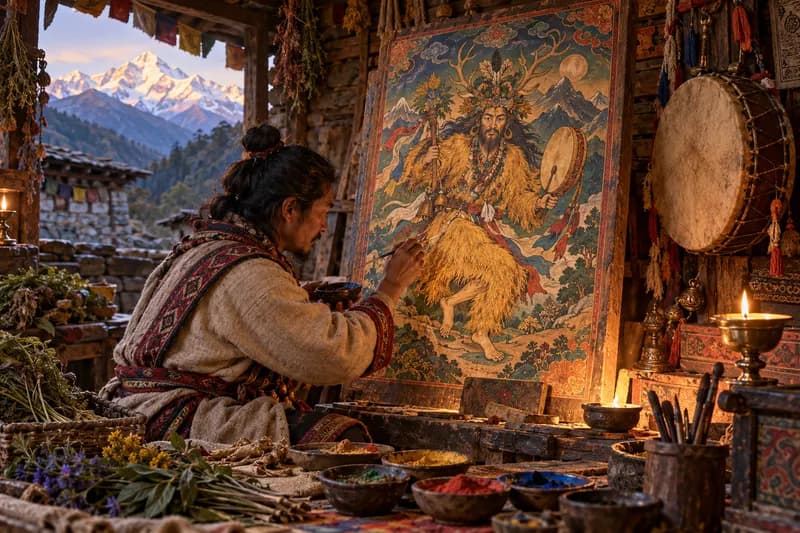
Traditional Jhankri Paintings — Nepal: Thangka-style paintings depicting the Banjhakri as a small golden-haired figure in forest settings, often shown with a dhyangro drum. These are found in jhankri households and training spaces, serving as visual lineage markers connecting the human healer to the wild original.
Mask Traditions — Sikkim and Darjeeling: Ritual masks representing the Banjhakri are used in some shamanic ceremonies. The masks show a broad face with thick golden hair surrounding it — simultaneously human and animal. These masks are not worn casually; they are sacred objects handled only by initiated jhankri.
Contemporary Nepali Art: Modern Nepali artists have depicted the Banjhakri in painting, sculpture, and illustration — often exploring the tension between the figure's role as teacher and abductor. These works appear in galleries in Kathmandu and Darjeeling, bridging folk tradition and contemporary art.
Physical Evidence: The Banjhakri tradition is not preserved primarily in stone or paint — it is preserved in living practice. The jhankri healers themselves are the evidence. Every working jhankri in the Himalayan foothills is a walking record of the Banjhakri tradition, carrying knowledge they attribute to the golden shaman of the forest.
Cross-Regional Patterns
Banjhakrini · Ban Jhankri · Devchar · Vanara Spirit · Rakshasa · Acheri · Kichkandi · Tsen
| Dawn as hard limit | No — operates at transition hours |
| Iron weakness | Yes |
| Tree-dwelling | Yes — caves, hollow trees |
| Counting compulsion | No |
| Backward feet | No |
Global Equivalent: The closest global parallel is the European fairy abduction tradition — particularly the Irish 'fairy blast' where children are taken to fairy mounds and returned changed. The Aboriginal Australian 'Clever Man' initiation also parallels: a wild spiritual being takes a candidate into the wilderness and returns them as a healer. But the Banjhakri is more specific and more embodied than either — a physical creature with golden hair, a drum, and a wife who wants to eat the students.
In Culture — Movies, Books, Games
| Type | Title | Description |
|---|---|---|
| Literature | Nepali Folk Tale Collections | The Banjhakri appears in numerous Nepali folk tale anthologies. These preserve the oral narratives that jhankri communities have passed down for generations, including accounts of specific abductions and returns. |
| Documentary | Shamans of the Himalayas (Various) | Several ethnographic documentaries feature jhankri healers discussing their training, some directly describing Banjhakri encounters. These are not dramatizations — they are interviews with people who believe they were taken. |
| Academic | Larry Peters — Tamang Shamans | Anthropologist Larry Peters's work on Tamang shamanism documents the Banjhakri tradition in academic detail, including first-person accounts of abduction and training experiences. |
| Art | Modern Nepali Visual Art | Contemporary artists like those exhibited at the Kathmandu Biennale have explored the Banjhakri as a subject — examining the intersection of folklore, ecology, and the transmission of indigenous knowledge. |
| Music | Dhyangro Drumming Recordings | Field recordings of jhankri drumming preserve the rhythmic patterns attributed to Banjhakri teaching. These recordings serve as both ethnographic documents and, for practitioners, as sacred transmissions. |
ACCURACY RATING: HIGH IN ETHNOGRAPHIC SOURCES · LIMITED IN POPULAR MEDIA
Is the Banjhakri Still Real?
- Actively believed across Nepal, Sikkim, and Darjeeling. The Banjhakri is not a historical curiosity — he is a present reality for Himalayan communities with active shamanic traditions.
- Working jhankri healers today describe their initiation in terms that include Banjhakri encounters. These are not metaphors — they are literal accounts of being taken into the forest by a golden-haired being and taught.
- Parents in Himalayan villages still take specific precautions to protect children from Banjhakri abduction — iron amulets, supervision at the forest edge, avoidance of transition hours.
- The tradition is under pressure from modernization, urbanization, and the spread of biomedical healthcare. Younger generations in cities may not believe, but rural communities maintain the full belief system.
- Anthropologists and ethnographers who have spent years in these communities consistently report that Banjhakri belief is sincere, detailed, and integrated into the practical functioning of village life — not performed for outsiders.
Expert & Academic Context
- Larry Peters — Tamang Shamans: An Ethnopsychiatric Study — Foundational academic study of Himalayan shamanism, including detailed documentation of the Banjhakri tradition and its role in shamanic initiation.
- Gregory Maskarinec — The Rulings of the Night — Ethnographic study of Nepali jhankri practice, including the role of the Banjhakri in the origin stories and training narratives of practicing shamans.
- Michael Oppitz — Shamans of the Blind Country — Landmark documentary and ethnographic work on Himalayan shamanism in western Nepal, documenting the living tradition in extraordinary detail.
- Casper Miller — Faith Healers in the Himalayas — Study of healing traditions in the Nepal-India borderlands, including documentation of Banjhakri beliefs and their relationship to community health practices.
- Oral tradition — Limbu, Rai, Tamang, and Lepcha communities — The primary source for Banjhakri knowledge is oral tradition maintained by Himalayan ethnic communities. This tradition is living, actively transmitted, and constitutes the most authoritative record of the Banjhakri.
The Banjhakri represents one of the most complex figures in South Asian folklore because he cannot be reduced to good or evil. He is the source of healing knowledge — without him, communities would have no shamanic healers. But he acquires his students through abduction, subjecting children to genuine danger. He embodies the ancient and uncomfortable truth that initiation into sacred knowledge often involves suffering, isolation, and the loss of ordinary life. The tradition also encodes ecological wisdom: the shaman must understand the forest because the forest is where the knowledge lives. The Banjhakri is, ultimately, a story about the cost of wisdom and the debt that healers owe to the wild places that taught them.
If You Encounter a Banjhakri
Frequently Asked Questions
▶What is a Banjhakri?
A Banjhakri is a wild forest shaman from Himalayan folklore — a small, golden-haired being who lives in the deep forest and kidnaps children to teach them shamanic healing arts. He is considered the original source of all shamanic knowledge in the Nepal-Sikkim-Darjeeling region.
▶Is the Banjhakri dangerous?
The Banjhakri himself is a teacher, not a predator — but the experience of being taken is genuinely dangerous. Children face exposure, starvation, and attacks from the Banjhakrini (his malevolent wife). Not every child returns. Those who do become healers.
▶What does the Banjhakri look like?
He is described as three to four feet tall, covered entirely in thick golden or tawny hair, with a broad face and deep-set eyes. He walks upright like a human but moves through the forest with animal ease. He often carries a dhyangro drum.
▶How do you protect a child from the Banjhakri?
Iron worn on the body (rings, bracelets, amulets) is the primary protection. Keep children away from the forest edge during dawn and dusk. Leave offerings of milk, rice, and flowers at the boundary between village and forest.
▶Is the Banjhakri related to the Yeti?
Some researchers have noted parallels — both are hairy, bipedal forest-dwellers in the Himalayas. However, the Banjhakri has a specific cultural role (shamanic initiator) that the Yeti lacks. They may share a common origin in Himalayan wilderness traditions, but they serve different narrative functions.
▶Do people still believe in the Banjhakri?
Yes. Active jhankri healers in Nepal, Sikkim, and Darjeeling today attribute their training to Banjhakri encounters. This is not historical nostalgia — it is living belief integrated into community healthcare and spiritual practice.
Explore More
Related Spirits
Banjhakrini · Ban Jhankri · Devchar · Vanara Spirit · Rakshasa · Acheri · Kichkandi · Tsen
Explore Further
Spirits of The HimalayasAll Nature Spirits & Forest Entities
Stories Are Being Summoned
One ghost story per week. Every Tuesday at midnight.