Banjhakrini
While her husband teaches the stolen child, she waits. Patient. Hungry. Because the child is not a student to her — it is a meal.
- What Is a Banjhakrini?
- Why the Banjhakrini Is Terrifying
- Origin — How It Came to Exist
- Appearance & Manifestation
- The Girl Who Refused to Eat
- The Rules — How to Survive
- What They Don't Tell You
- What Does the Banjhakrini Want?
- You're Most at Risk If...
- Offerings & Appeasement
- The Healer
- What If You Dream of a Banjhakrini?
- The Banjhakrini in Art & Tradition
- Cross-Regional Patterns
- In Culture — Movies, Books, Games
- Is the Banjhakrini Still Real?
- Expert & Academic Context
- If You Encounter a Banjhakrini
- Frequently Asked Questions
- Explore More
| Banjhakrini | |
|---|---|
| Also Known As | Ban Jhankri's Wife, Lemlemey, Forest Witch-Wife |
| Script | बनझाक्रीनी (Devanagari) |
| Pronunciation | bun-JHAA-kree-nee (बन-झाक्रीनी) |
| Region | Nepal-India border; Sikkim, Darjeeling hills, eastern Nepal, Bhutan foothills |
| Category | Malevolent Forest Spirit / Shamanic Antagonist |
| Danger Level | Severe |
| Fear Method | Attempted child-eating, ambush, deception, sabotage of shamanic initiation |
| Warning Sign | A woman's voice calling from deep forest; the smell of rotting meat near cave openings; scratching sounds at night during a child's absence |
| First Documented | Oral tradition of the Limbu, Rai, Tamang, and Lepcha peoples; inseparable from the Banjhakri narrative — wherever he appears, she appears |
| Still Believed? | Yes — feared as the primary danger during Banjhakri abductions; jhankri initiates describe surviving her as part of their training |
| Related | Banjhakri · Churel · Dakini · Rakshasi · Rakshasa · Acheri |
What Is a Banjhakrini?
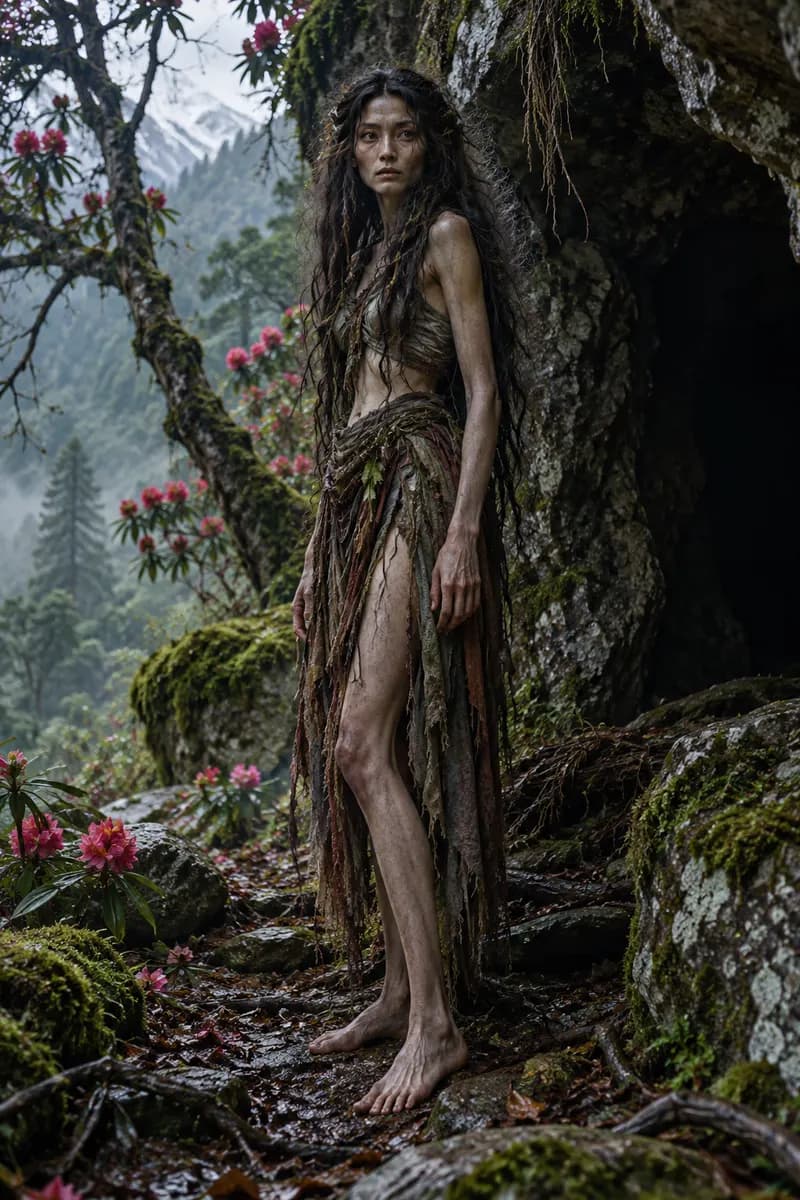
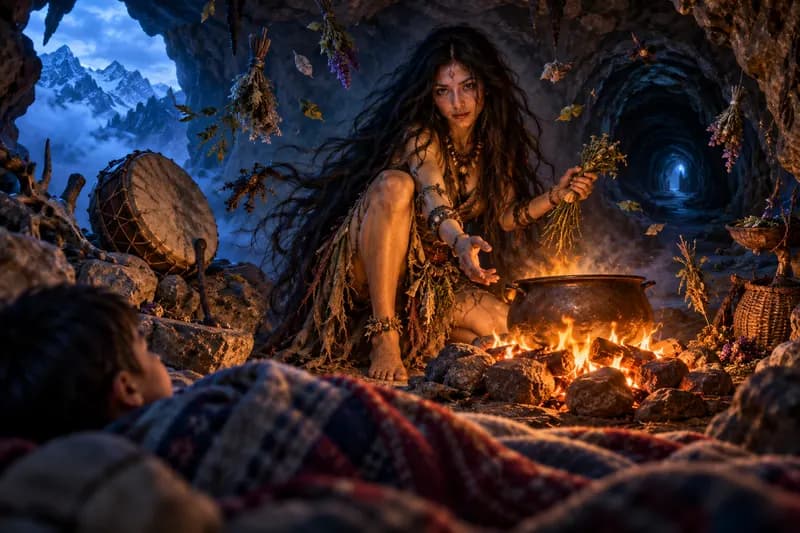
The Banjhakrini (बनझाक्रीनी) is the wife of the Banjhakri — the wild forest shaman of Himalayan folklore. Where the Banjhakri kidnaps children to teach them healing arts and shamanic knowledge, the Banjhakrini exists as his terrifying counterpart: she wants to eat them. She is described as tall and gaunt, with long matted hair, sunken eyes, and a mouth that is always hungry. She is the shadow side of the shamanic initiation — the genuine mortal danger that the child-candidate must survive.
In the folklore of Nepal, Sikkim, and the Darjeeling hills, the Banjhakrini is not a separate entity encountered independently. She is always part of the Banjhakri story. When the golden shaman takes a child into the forest, the child must contend not only with the rigors of shamanic training but with a creature that views them as food. The Banjhakri protects his students from her — but not always successfully. She is the reason not every child returns. She is the cost of the initiation that no one speaks about directly.
Why the Banjhakrini Is Terrifying
INSTINCT EXPLOITED: THE PREDATOR INSIDE THE HOME
The golden one has brought you to a cave. You are seven years old and you have been here for three days. He has shown you plants. He has made you memorize drum rhythms until your palms ache. He is patient with you — never cruel, never gentle, just purposeful — and you are beginning to understand that you are here because something about you was recognized.
But there is the other one.
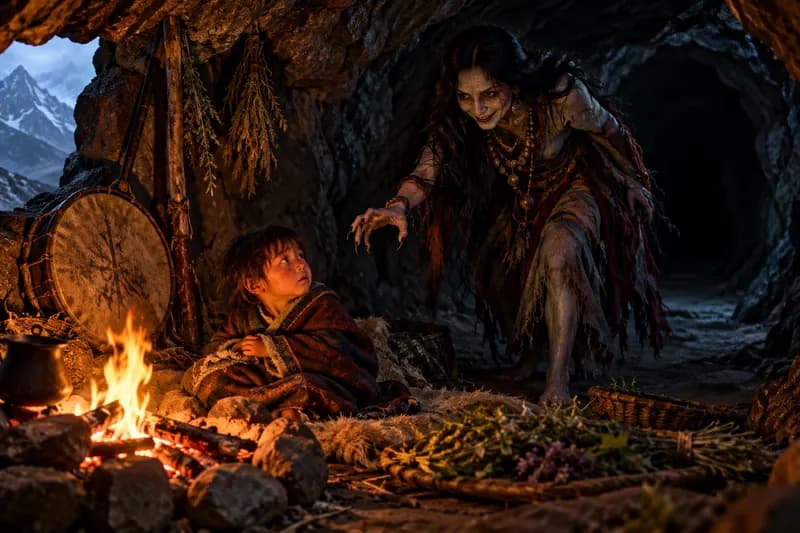
She stays in the back of the cave. You can hear her breathing — wet, heavy, the breath of something large and unsatisfied. When the golden one leaves to gather herbs, she moves closer. You can feel her watching you. The cave gets darker when she moves. The air smells like meat that has been left in the sun too long.
She speaks to you. Her voice is not like the golden one's voice. His voice is steady and instructive. Her voice is sweet. She says she has food for you. She says come closer. She says the golden one is too hard on you, that you must be tired, that she has something warm for you to eat.
You know — you know with every cell in your small body — that you are the something warm she has in mind.
The golden one returns. She retreats. This happens every time he leaves. Every time, she gets a little closer. Every time, you learn a little more about what it means to survive something that wants to consume you. And later, when you are a healer, when you sit with the sick and the dying, you will realize: this was the lesson. Not the herbs. Not the drums. The lesson was the cave, and the breathing in the dark, and the knowledge that the thing trying to eat you was married to the thing trying to save you.
Origin — How It Came to Exist
The Other Half
The Banjhakrini exists because the Banjhakri narrative requires a genuine threat. If the forest initiation were merely difficult — cold, hunger, hard learning — it would be ordeal, not transformation. The Banjhakrini provides the element of mortal danger. She is the reason the initiation produces shamans and not merely herbalists. The child who survives her has learned to sit in the presence of something that wants to destroy them and remain calm. That skill is the foundation of all healing work.
The Domestic Horror
What makes the Banjhakrini uniquely disturbing is her domestic role. She is a wife. She lives in the same cave, shares the same space. The golden shaman who teaches the child healing arts goes home every night to a creature that eats children. This is not a bug in the mythology — it is the point. The healer's world contains both the teacher and the devourer. Wisdom and destruction share a hearth.
Physical Description
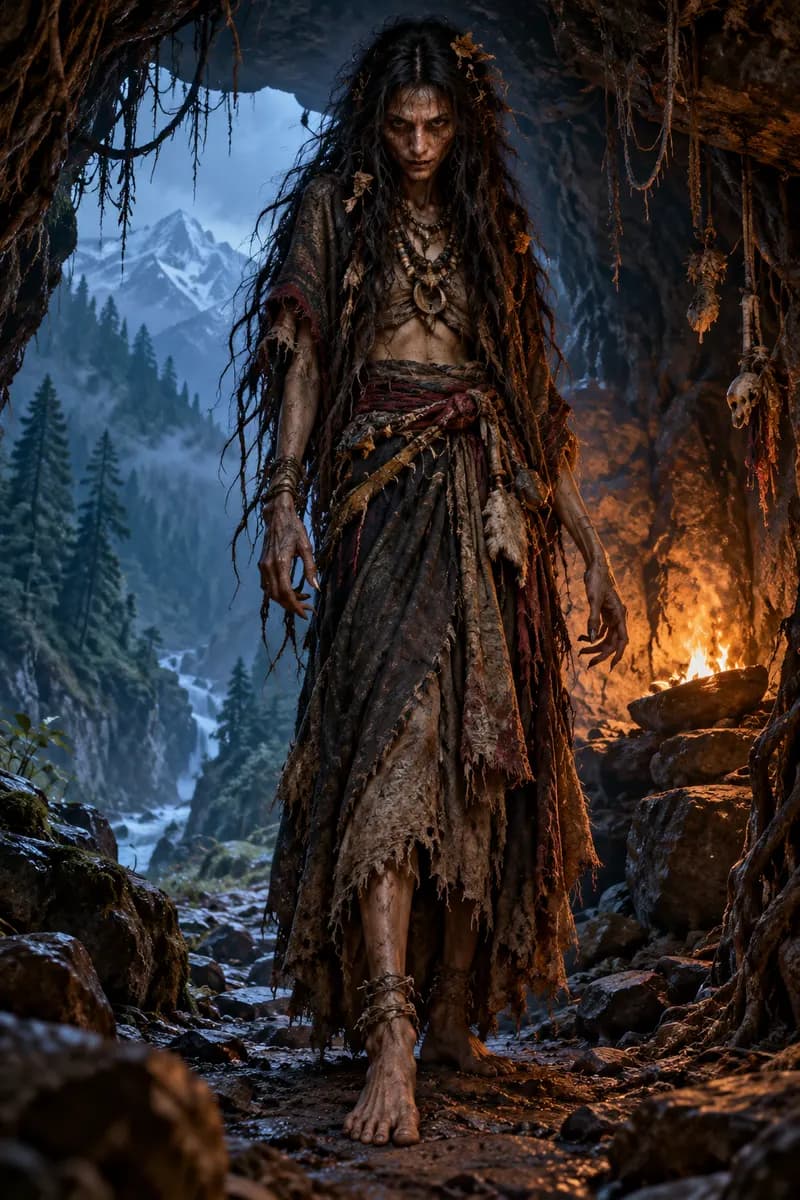
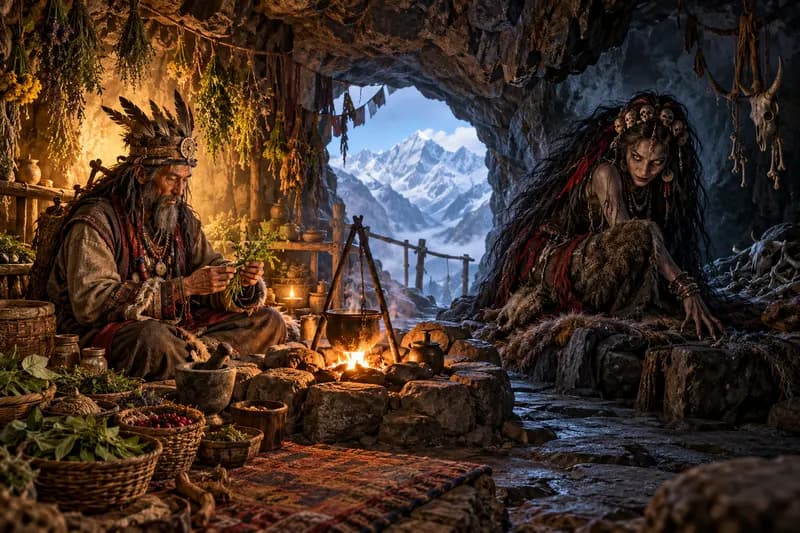
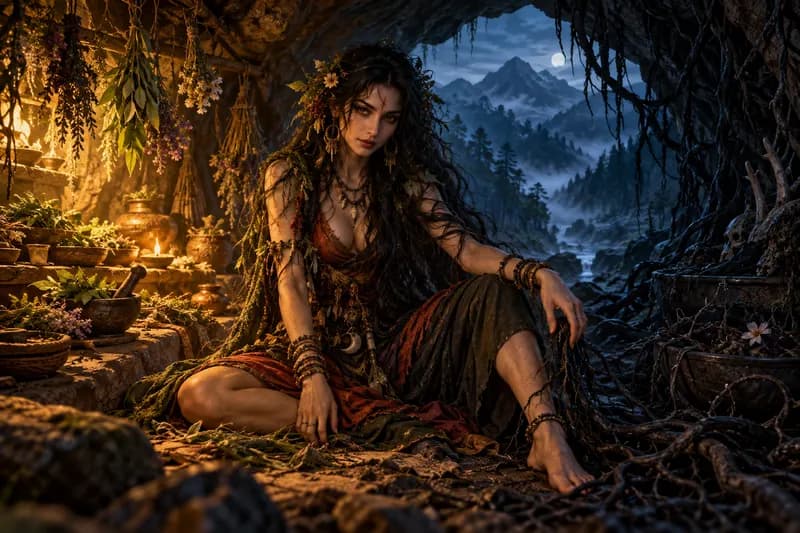
Across traditions, the Banjhakrini is described as the Banjhakri's opposite. Where he is short and golden, she is tall and dark. Where his hair shines, hers is matted and tangled. Where he is muscular and solid, she is gaunt and angular. Her eyes are sunken. Her teeth are prominent. Her fingers are long. She is hunger given a shape — a body built around the single drive to feed.
Why She Cannot Be Appeased
Unlike many entities in South Asian folklore, the Banjhakrini cannot be bought off with offerings. She does not respond to rituals, prayers, or negotiation. She is appetite without compromise. The only thing that keeps her from the child is the Banjhakri himself — his physical presence, his authority, his willingness to stand between his wife and his student.
The Gendered Reading
Some scholars read the Banjhakri-Banjhakrini pair as an expression of the shamanic tradition's anxiety about gendered power. The male figure creates and teaches; the female figure destroys and consumes. This is reductive but not irrelevant. The tradition encodes a fear of female appetite — a hunger that cannot be reasoned with, that exists outside the structures of teaching and purpose that the male figure represents.
Appearance & Manifestation
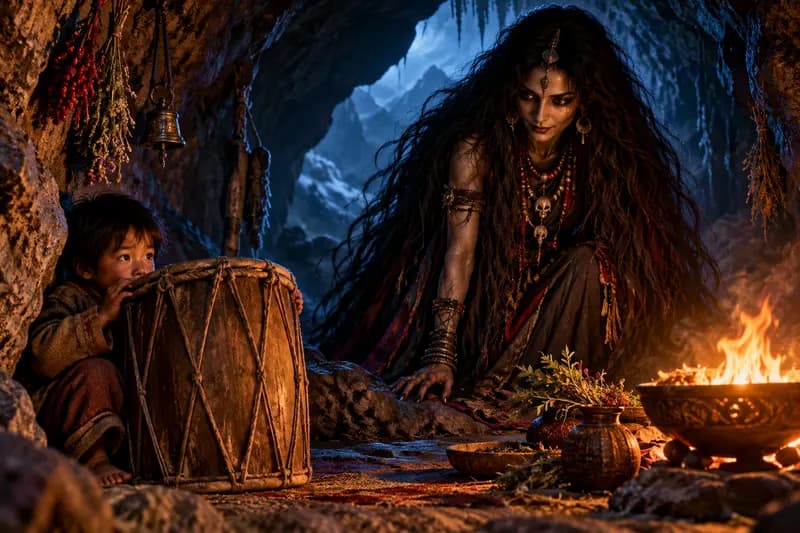
| 👁 Sight | Tall and emaciated — the opposite of the Banjhakri's compact solidity. Long, matted black hair hanging to her waist or below. Sunken eyes that catch light in the dark. Skin that is dark and rough, like bark. Fingers disproportionately long. Mouth wide, teeth visible. She moves with a predatory economy — no wasted motion. |
| 🔊 Sound | A sweet, coaxing voice — the voice of a mother offering food to a hungry child. This is her weapon. She sounds caring. She sounds warm. The disconnect between the voice and the intent is what makes children lower their guard. Also: heavy breathing in the dark, the sound of something large shifting in the back of a cave. |
| 🍃 Smell | Rotting meat. Not the clean smell of the forest that accompanies the Banjhakri, but the smell of something dead and partially consumed. The smell intensifies when she is close and hungry — which is always. |
| ❄ Temperature | Where the Banjhakri's presence is cool and fresh like the forest, the Banjhakrini radiates a clammy, sick warmth — the heat of a body running a fever, of decomposition, of something metabolically desperate. |
| 🌑 Time | Most active when the Banjhakri is absent — when he leaves to gather herbs, to drum, or to tend to the forest. She exploits the gaps in his attention. The child is most vulnerable when the teacher steps away. |
| 🏚 Habitat | The back of the cave. The deep shadow. She occupies the Banjhakri's domestic space but exists in its darkest corner. She does not roam the forest — she waits where the children are brought. |
The Girl Who Refused to Eat
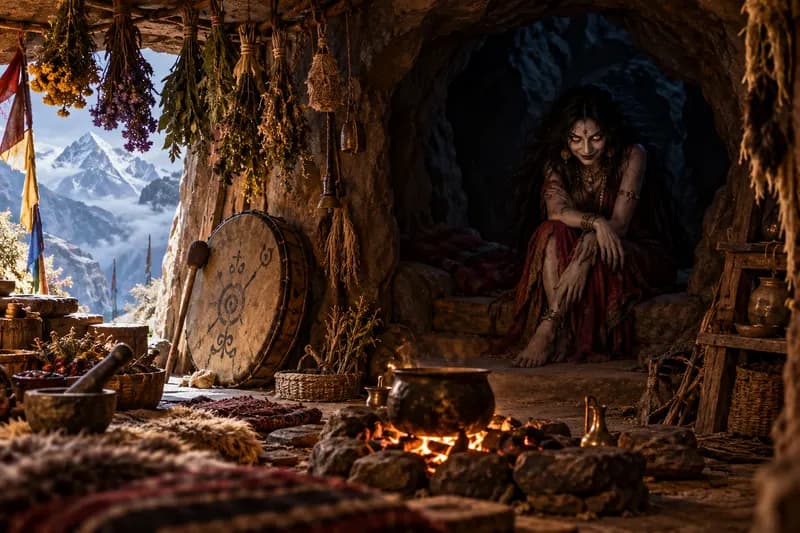
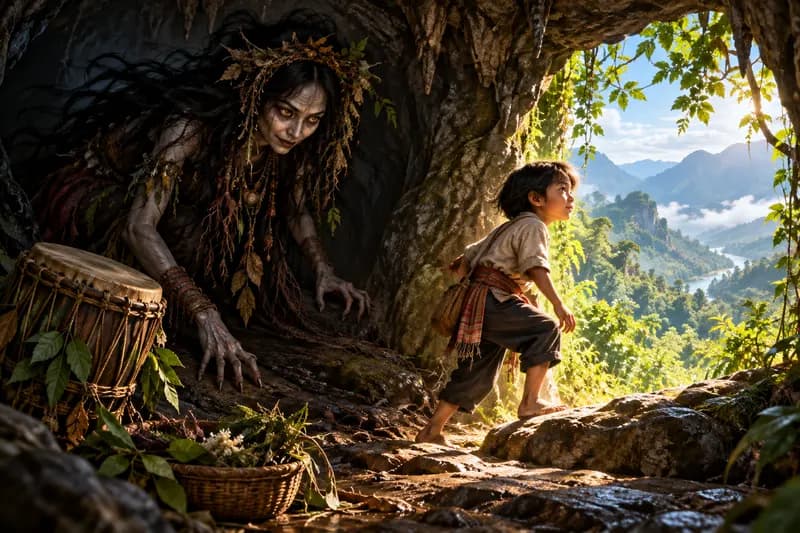
There was a girl in a village near Ilam, in eastern Nepal, who was taken by the Banjhakri at the age of eight. Her name was Devi, and she had always been the quiet one — the child who sat at the edge of the group, watching ants carry grain across the path, counting the petals on marigolds. Her mother said she was slow. The jhankri of the neighboring village said she was ready.
The Banjhakri took her from the edge of a tea garden on a foggy morning. She was gone for eleven days.
What Devi told the jhankri after her return — and what the jhankri later told those who asked — was this:
The golden one was kind. He taught her the names of twenty-seven plants in the first three days. He made her repeat the drumming patterns until she could do them in her sleep. He fed her roots and berries and water from a spring inside the cave. He was not warm, but he was steady. She was not afraid of him.
She was afraid of the wife.
The wife stayed in the shadows. Devi could hear her breathing — always breathing, always present. On the second day, when the golden one went to gather herbs, the wife came closer. She was tall, much taller than the golden one. Her hair hung like wet rope. She smelled like the pile behind the butcher's stall in the market.
The wife offered Devi food. A bowl of something. The wife's voice was soft and sweet, like Devi's grandmother's voice when she was trying to coax a sick child to eat. 'You must be hungry,' the wife said. 'He works you too hard. Here. Eat.'
Devi looked at the bowl. She could not see what was in it. Something told her — not a voice, not a thought, but a knowledge in her body — that if she ate from that bowl, she would never leave the cave.
She said no. The wife came closer. Devi said no again. The wife's face changed — the sweetness dropped away like a mask falling, and underneath was something ancient and furious and starving. Devi closed her eyes and recited the drumming pattern the golden one had taught her. One-two-three, one-two, one-two-three, one-two. She said the pattern with her mouth and tapped it with her fingers on the cave floor.
The wife retreated.
This happened every day for nine more days. Every time the golden one left, the wife approached. Every time, Devi refused. Every time, she used the drumming pattern like a wall. By the eleventh day, the wife no longer came close. She stayed in her shadow and breathed.
Devi came home with knowledge of healing that no eight-year-old should possess, and a profound, lifelong wariness of sweet voices offering things she had not asked for.
The Rules — How to Survive
☠ WARNING ☠
Six rules for surviving the Banjhakrini
- Never accept food from the Banjhakrini. — She offers food as a lure. Accepting it binds you to her — you become prey rather than student. Every account of children who did not return involves eating what she offered.
- Use the Banjhakri's teachings as protection. — The drumming patterns and chants taught by the Banjhakri are not just lessons — they are shields. Reciting them keeps the Banjhakrini at a distance. The training itself is the defense.
- Do not look directly into her eyes. — Her gaze is a trap — it paralyzes, confuses, makes the victim compliant. Children who meet her eyes describe losing the ability to resist.
- Stay close to the Banjhakri. — The Banjhakrini cannot act while her husband is present. He is the only authority she respects — or fears. The child's safety is directly proportional to the Banjhakri's proximity.
- Iron disrupts her approach. — Like the Banjhakri himself, the Banjhakrini is repelled by iron. A child wearing iron has an additional layer of protection — though iron alone is not sufficient.
- Do not show fear. — She feeds on fear before she feeds on flesh. A calm child is harder for her to approach. The shamanic training is, in part, training in remaining calm when terror is standing three feet away.
What They Don't Tell You
The Banjhakrini may be the most important part of the shamanic initiation — more important than the herbs, the drums, or the spirit-lore. Because the Banjhakrini teaches the child the one thing a healer must know above all else: how to sit in the presence of death and not be consumed by it. Every sick person a jhankri heals is, in some sense, the cave again. The illness is the Banjhakrini — sweet-voiced, offering comfort, trying to pull the patient under. The healer who survived the Banjhakrini knows what death sounds like when it is being kind. And that knowledge is what allows them to say: *no. Not this one. Not today.*
What Does the Banjhakrini Want?
The Banjhakrini wants to eat. That's it. There is no philosophy, no code, no negotiable position.
She is hunger. Pure, unmediated, animal hunger directed at the most vulnerable thing available — the child her husband has brought home. She does not hate the child. She does not resent the Banjhakri's teaching. She is simply and permanently starving, and the child is food.
This simplicity is what makes her so terrifying and so essential to the mythology. The Banjhakri represents purpose — structured, intentional, aimed at transmission of knowledge. The Banjhakrini represents appetite — formless, relentless, aimed at consumption. Together they create the fundamental tension of the shamanic world: creation and destruction live in the same cave.
The shaman who emerges from this understands something most people never learn: that the universe is not divided into safe places and dangerous places. The danger sleeps next to the safety. The destroyer is married to the teacher. And the only thing between you and being consumed is what you have learned.
You're Most at Risk If...
- You are a child currently undergoing Banjhakri abduction
- You are alone in the cave while the Banjhakri is gathering herbs
- You are hungry, cold, or weakened — vulnerability attracts her
- You have not yet learned the protective drumming patterns
- You are inclined to trust sweet voices and offers of comfort
- You are not wearing iron
Offerings & Appeasement
| Offering | Purpose |
|---|---|
| She Cannot Be Appeased | The Banjhakrini does not respond to offerings. Unlike most entities in South Asian folklore, she has no transactional dimension. You cannot buy her off, negotiate with her, or satisfy her hunger. She is appetite without limit. |
| Offerings to the Banjhakri | The only indirect way to manage the Banjhakrini is through her husband. Offerings to the Banjhakri — milk, rice, flowers at the forest edge — may strengthen his protective presence. A well-honored Banjhakri is a more attentive guardian. |
| Post-Return Rituals | When a child returns from abduction, cleansing rituals are performed that address both the Banjhakri's teaching and the Banjhakrini's threat. These rituals acknowledge that the child survived both — and that both are part of what made them a healer. |
| The Jhankri's Ongoing Acknowledgment | Working jhankri healers include acknowledgment of the Banjhakrini in their practice — not as worship, but as recognition. She is part of the story. Denying her existence would be like a soldier denying the existence of the enemy that trained them to fight. |
The Healer
The Banjhakri Himself — The primary protector against the Banjhakrini is her own husband. He stands between her and the child. This is not always sufficient — but it is the first and most important line of defense.
Experienced Jhankri — A jhankri who survived their own Banjhakrini encounter can advise a child currently undergoing initiation — through spiritual means if not physical. Their drumming patterns, chanted from the village, are believed to reach the child in the cave.
Community Ritual — The village can perform collective protective rituals during a child's absence — drumming circles, prayer gatherings, offerings at the forest edge. These do not directly reach the Banjhakrini but strengthen the spiritual environment around the child.
The Key Difference — You cannot fight the Banjhakrini. You cannot appease her. You can only survive her — through the training the Banjhakri provides, through iron, through calm, and through the absolute refusal to accept what she offers. She is the test that cannot be circumvented.
What If You Dream of a Banjhakrini?
| Symbol | Meaning | |
|---|---|---|
| 🍖 | A Gaunt Woman Offering Food | Something in your waking life is being presented as nourishment but is actually consumption. A relationship, an opportunity, or a comfort that will devour you if you accept it. The dream is warning you: not everything that feeds you is food. |
| 🕳 | Darkness in the Back of a Cave | Something you are not looking at. A threat that exists in the domestic space — your home, your relationship, your daily life — that you have pushed into the shadows. The Banjhakrini does not chase. She waits. |
| 😊 | A Sweet Voice with Wrong Intent | Deception dressed as care. Someone is being kind to you in a way that serves their hunger, not your wellbeing. The dream asks you to listen beneath the sweetness and hear what is actually being said. |
| 🛡 | Surviving an Attack | You have already faced the Banjhakrini — metaphorically. Something tried to consume you and you resisted. The dream is confirmation: you survived. The knowledge you carry from that experience is real, and it will serve you. |
The Banjhakrini in Art & Tradition
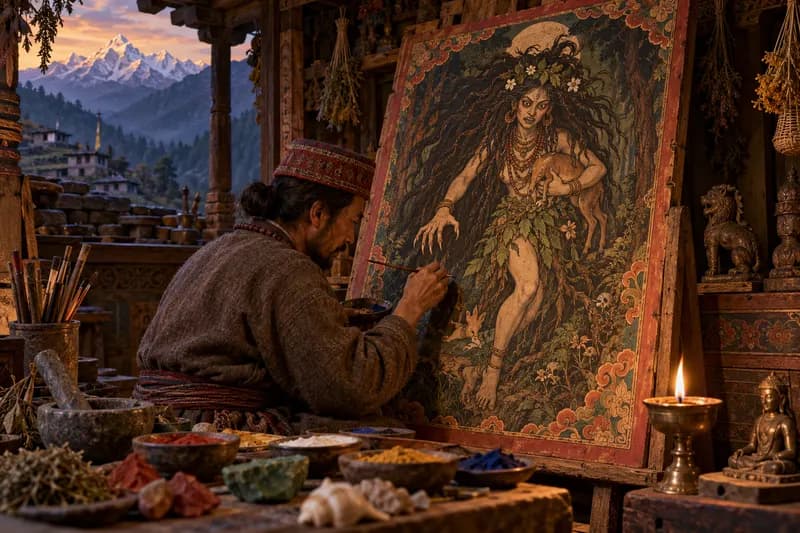
Jhankri Oral Tradition — Nepal and Sikkim: The Banjhakrini appears in every jhankri initiation narrative. She is not depicted separately — she is always part of the Banjhakri story. But she is described with such consistent detail across communities that she constitutes a distinct iconographic tradition within the oral literature.
Ritual Mask Traditions: Some shamanic mask traditions include a Banjhakrini mask — typically taller and darker than the Banjhakri mask, with exaggerated mouth and teeth. These masks are used in initiation ceremonies and healing rituals to represent the devouring force that the shaman has overcome.
Contemporary Illustration: Modern Nepali illustrators have depicted the Banjhakrini in children's books and folk art collections — often softened for younger audiences but retaining the essential elements: the height, the hair, the hunger. These illustrations make the tradition accessible to urban audiences.
Living Testimony: The most powerful 'art' of the Banjhakrini tradition is the testimony of surviving jhankri. Their accounts — detailed, consistent, emotionally vivid — constitute a form of narrative art that has been performed for generations. The story of surviving the Banjhakrini is itself a healing instrument.
Cross-Regional Patterns
Banjhakri · Churel · Dakini · Rakshasi · Rakshasa · Acheri · Kichkandi · Tsen
| Dawn as hard limit | No |
| Iron weakness | Yes |
| Tree-dwelling | No — cave-dwelling |
| Counting compulsion | No |
| Backward feet | No |
Global Equivalent: The closest global parallel is the witch of European fairy tales — specifically the witch in 'Hansel and Gretel,' who lures children with food and intends to eat them. The Baba Yaga of Slavic folklore also parallels: a female forest entity who may help or devour children depending on their behavior. But the Banjhakrini is less ambiguous than either — she is pure appetite, with no teaching function and no negotiable dimension.
In Culture — Movies, Books, Games
| Type | Title | Description |
|---|---|---|
| Literature | Nepali Folk Collections | The Banjhakrini appears in every folk collection that includes the Banjhakri. She is never the protagonist — always the antagonist within his story — but her presence is essential and her descriptions are vivid. |
| Academic | Larry Peters — Tamang Shamans | Peters's ethnographic work includes first-person accounts of Banjhakrini encounters from practicing jhankri. These are among the most detailed and disturbing descriptions of the entity in any published source. |
| Documentary | Himalayan Shamanism Films | Ethnographic documentaries on jhankri practice consistently include discussion of the Banjhakrini — interviewees describe her with a specificity and emotional intensity that distinguishes these accounts from rehearsed folklore. |
| Art | Ritual Objects | Shamanic ritual objects — masks, drums, altar pieces — sometimes encode the Banjhakrini's presence through specific symbols: teeth marks, claw patterns, representations of hunger. These objects are sacred and rarely displayed publicly. |
| Oral Performance | Jhankri Initiation Narratives | The most powerful cultural expression of the Banjhakrini is the initiation narrative — the story a jhankri tells of surviving their encounter. These narratives are performed with drumming and chanting and constitute a living literary tradition. |
ACCURACY RATING: HIGH IN ETHNOGRAPHIC SOURCES · ABSENT FROM POPULAR MEDIA
Is the Banjhakrini Still Real?
- Actively feared across the same communities that believe in the Banjhakri. She is not a historical figure but a present danger — spoken of in the present tense by people who believe children are currently at risk.
- Jhankri healers who describe their initiation consistently include the Banjhakrini as a central element. Their accounts are detailed, emotional, and specific — not the hallmarks of rehearsed folklore but of lived experience (or deeply internalized cultural narrative).
- Parents in Himalayan communities fear the Banjhakrini more than the Banjhakri. The golden shaman may take your child and return them as a healer. The wife may simply eat them.
- The belief encodes a real danger: children do go missing in the Himalayan forests. Exposure, predators, and accidents are genuine threats. The Banjhakrini gives this real danger a name and a face.
- Modernization has not eliminated the belief. Even in communities with access to modern healthcare, the Banjhakrini remains part of the explanatory framework for why children disappear — and why some do not return.
Expert & Academic Context
- Larry Peters — Tamang Shamans: An Ethnopsychiatric Study — Contains the most detailed academic documentation of the Banjhakrini, including first-person accounts from jhankri who describe surviving her during their initiation.
- Gregory Maskarinec — The Rulings of the Night — Ethnographic study that situates the Banjhakrini within the broader structure of Nepali shamanic cosmology, analyzing her role as the necessary antagonist in the initiation narrative.
- Andras Hofer — Tamang Ritual Texts — Documentation of ritual texts that reference the Banjhakrini, including protective chants and descriptions of her attributes within the formal shamanic liturgy.
- Diana Riboli — Shamanic Practice in the Nepal Himalayas — Comparative study of shamanic traditions that includes analysis of the Banjhakrini figure across different ethnic communities, noting consistencies and variations.
- Oral tradition — Limbu, Rai, Tamang, and Lepcha communities — The primary and most authoritative source. The Banjhakrini is documented most fully in the living oral tradition, transmitted through jhankri lineages and community storytelling.
The Banjhakrini encodes one of folklore's most uncomfortable truths: that the path to healing passes through genuine danger, and that danger is not always external. She lives in the same cave as the teacher. She sleeps beside the source of wisdom. She is the darkness that is domestic, familiar, intimate — not the monster in the distant forest but the monster in the home. For the child-initiate, she represents the foundational shamanic lesson: that the healer's world is not safe, that the forces of destruction are always present, and that the difference between being consumed and being transformed is nothing more than the discipline to refuse what is being offered.
If You Encounter a Banjhakrini
Frequently Asked Questions
▶What is a Banjhakrini?
The Banjhakrini is the wife of the Banjhakri, the wild forest shaman of Himalayan folklore. While the Banjhakri kidnaps children to teach them shamanic arts, the Banjhakrini tries to eat them. She is the primary danger during the shamanic initiation — the threat the child must survive.
▶Why does the Banjhakrini want to eat children?
She is pure appetite. The folklore does not provide a complex motivation — she is hunger embodied. This simplicity is part of her function: she represents the raw, unreasoning force of destruction that exists alongside creation.
▶Can the Banjhakrini be appeased?
No. Unlike most entities in South Asian folklore, she does not respond to offerings, rituals, or negotiation. The only protection is the Banjhakri's presence, iron, and the child's own training and refusal.
▶What does the Banjhakrini look like?
She is described as tall, gaunt, with long matted black hair, sunken eyes, and prominent teeth. She is the visual opposite of the Banjhakri — where he is golden and compact, she is dark and elongated. She smells of rotting meat.
▶Is the Banjhakrini related to the Churel?
Both are dangerous female supernatural entities in South Asian folklore, but they serve different functions. The Churel arises from female suffering and injustice. The Banjhakrini has no origin story — she simply is. The Churel haunts; the Banjhakrini hunts.
▶Do people still believe in the Banjhakrini?
Yes. In communities across Nepal, Sikkim, and Darjeeling where shamanic practice is active, the Banjhakrini is feared as a present reality. Jhankri healers describe her with the specificity and emotion of genuine experience.
Explore More
Explore Further
Spirits of The HimalayasAll Nature Spirits & Forest Entities
Stories Are Being Summoned
One ghost story per week. Every Tuesday at midnight.