Begho Bhoot
The tiger took his body. The jungle kept his soul. Now he walks the mangrove roots — leading the next one to the kill.

- What Is a Begho Bhoot?
- Why the Begho Bhoot Is Terrifying
- Origin — How It Came to Exist
- Appearance & Manifestation
- The Honey Collector's Account
- The Rules — How to Survive
- What They Don't Tell You
- What Does the Begho Bhoot Want?
- You're Most at Risk If...
- Offerings & Appeasement
- The Healer
- What If You Dream of a Begho Bhoot?
- The Begho Bhoot in Art History
- Cross-Regional Patterns
- In Culture — Movies, Books, Games
- Is the Begho Bhoot Still Real?
- Expert & Academic Context
- If You Encounter a Begho Bhoot
- Frequently Asked Questions
- Explore More
| Begho Bhoot | |
|---|---|
| Also Known As | Bagh Bhoot, Byaghra Bhoot, Tiger Ghost |
| Script | বেঘো ভূত (Bengali) |
| Pronunciation | BAY-gho BHOOT (বে-ঘো ভূত) |
| Region | Bengal — specifically the Sundarbans mangrove delta (India and Bangladesh) |
| Category | Animal Ghost / Vengeful Spirit |
| Danger Level | Dangerous |
| Fear Method | Luring victims deeper into the jungle; guiding tigers toward human prey |
| Warning Sign | A human figure standing motionless among mangrove roots at dusk; the feeling of being watched from inside the forest; tigers behaving with unusual boldness |
| First Documented | Oral tradition of Sundarbans honey collectors and woodcutters; referenced in colonial-era Bengal ethnographies (late 19th century); connected to Bonbibi worship traditions |
| Still Believed? | Yes — actively believed by honey collectors (mouli), woodcutters (bawali), and fishermen who enter the Sundarbans; Bonbibi worship remains a living practice |
| Related | Masaan · Shakchunni · Petni · Nishi · Aleya · Kapala Spirit |
What Is a Begho Bhoot?
The Begho Bhoot (বেঘো ভূত) is a ghost unique to the Sundarbans — the vast mangrove delta spanning West Bengal and Bangladesh where the Royal Bengal Tiger still kills humans with regularity. "Begho" (or "bagh") means tiger in Bengali. A Begho Bhoot is the restless spirit of a person killed by a tiger, a ghost that does not leave the jungle but becomes part of it — fused with the waterways, the roots, the tidal mud, and the predator that took its life.
What makes the Begho Bhoot uniquely terrifying is its role: it does not simply haunt. It actively guides tigers toward new human victims. The ghost of the killed becomes an agent of future killing — standing in the tree line, appearing on the water's edge, luring honey collectors and woodcutters deeper into the mangrove where the next tiger waits. It is a ghost born from a real and ongoing danger: tiger attacks in the Sundarbans are not mythology. They are statistics. And every victim, the belief holds, joins the jungle's invisible workforce of the dead.
Why the Begho Bhoot Is Terrifying
INSTINCT EXPLOITED: THE JUNGLE KNOWS YOU ARE HERE
You are a honey collector. You have entered the Sundarbans at dawn with five other men, paddling a narrow boat through channels barely wider than your shoulders. The mangrove roots arch above and below the waterline like the ribs of something enormous. You are here for wild honey. You will be here for three days.
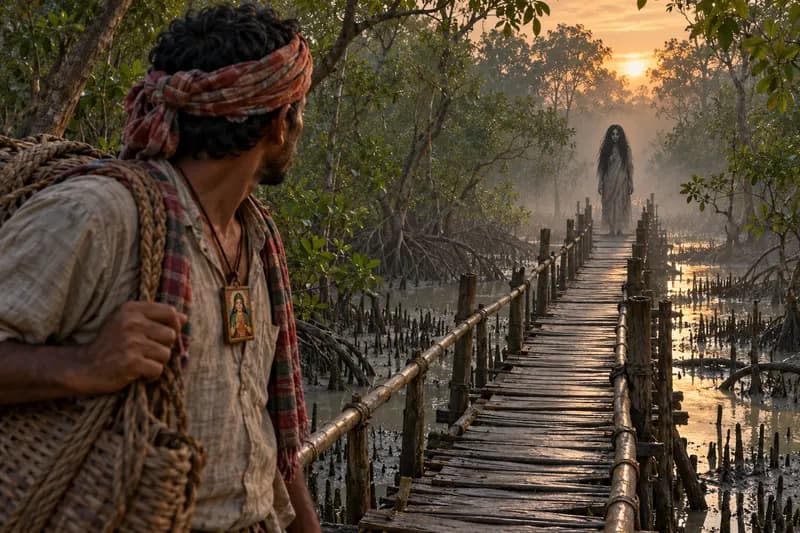
On the second day, you are waist-deep in mud, smoking out a hive from a sundari tree, when you see him. A man. Standing perfectly still about forty meters ahead, half-hidden by the aerial roots. He is watching you. He does not move. He does not wave. He does not call out.
You do not recognize him. But you recognize what he is.
Your grandfather told you: if you see a figure standing alone in the deep mangrove — a figure that watches but does not speak, that stands where no person should be standing — you do not walk toward it. You turn around. You get back in the boat. You leave that channel. Because the figure is not lost. The figure is not waiting for help. The figure is positioning you.
Between you and the figure, somewhere in the tangle of roots and mud and shadow, there is a tiger. The Begho Bhoot is not the danger. The Begho Bhoot is the bait. It draws your attention, draws your feet, draws you forward into the exact spot where the kill happens. And when the tiger takes you — when the jaws close on the back of your neck and you are dragged into the water — you will become what it is. Another figure. Another ghost standing in the mangrove. Another lure.
The Sundarbans does not run out of ghosts. It makes new ones.
Origin — How It Came to Exist
The Creation
A Begho Bhoot is created every time a tiger kills a human in the Sundarbans. The spirit of the victim does not pass on — it cannot. The violence of the death, the remoteness of the location, and the fact that the body is often dragged away and consumed means there are no proper funeral rites. No fire. No prayers. No closure. The spirit remains trapped in the jungle, bound to the place where it died, and over time it merges with the forest itself — becoming an extension of the predator that killed it.
The Tiger Connection
In Sundarbans belief, the relationship between tiger and ghost is not metaphorical. The Begho Bhoot literally serves the tiger — guiding it, herding prey toward it, acting as the predator's supernatural scout. This belief reflects a real ecological truth: tigers in the Sundarbans are uniquely aggressive toward humans compared to tigers anywhere else in India. The mangrove terrain, the tidal flooding, the isolation — everything conspires to make human-tiger encounters lethal. The Begho Bhoot is the folklore's explanation for why the Sundarbans tiger seems to hunt humans with intent.
Bonbibi — The Protector
The counter-force to the Begho Bhoot is Bonbibi (বনবিবি), the Lady of the Forest — a syncretic deity worshipped by both Hindu and Muslim communities in the Sundarbans. Bonbibi is believed to protect those who enter the forest with honest intentions. Before any expedition into the mangrove — for honey, wood, or fish — workers perform Bonbibi puja, asking her protection against both tigers and the ghosts of their victims. The entire Bonbibi tradition exists because of the Begho Bhoot: she is the answer to the question of how you survive a jungle that is actively trying to kill you.
Dakkhin Rai — The Tiger Demon
In the Bonbibi Jahurnama (the sacred text of Bonbibi worship), the antagonist is Dakkhin Rai — a demon lord who commands the tigers of the Sundarbans. The Begho Bhoot serves Dakkhin Rai's purpose: every human killed by a tiger becomes another ghost in his army, another lure in his jungle. Bonbibi defeated Dakkhin Rai and established a pact — the forest would be shared between humans and tigers, with neither taking more than their share. The Begho Bhoot is what happens when that pact is broken.
Why Only the Sundarbans
The Begho Bhoot exists nowhere else in Indian folklore because the conditions that create it exist nowhere else. The Sundarbans is the only place in India where tigers still regularly kill humans in a wild mangrove environment. The combination of extreme isolation, impossible terrain, absent funeral rites, and ongoing predation creates a self-perpetuating cycle of ghost creation. Every year, the Sundarbans adds to its population of the dead.

Appearance & Manifestation
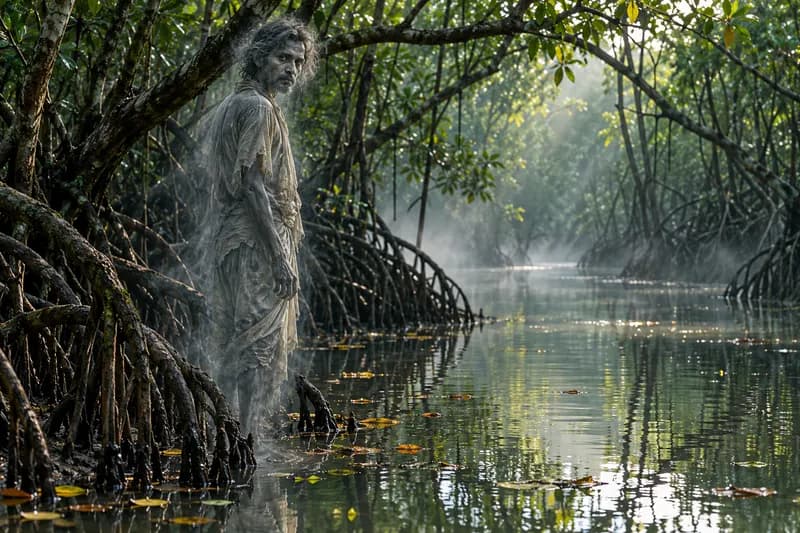
| 👁 Sight | Appears as a human figure — often recognizable as someone who was known to have been taken by a tiger. Stands motionless among mangrove roots, partially obscured, always at a distance that invites approach. The figure may appear waterlogged, mud-stained, with torn clothing. Sometimes only a silhouette visible through the dense canopy. It never approaches you. It waits for you to approach it. |
| 🔊 Sound | Silence is its primary weapon. The Begho Bhoot does not call out, scream, or moan. Occasionally, witnesses report hearing a low murmur — like someone trying to speak through water. Some honey collectors describe hearing their own name whispered from the direction of the figure. The absence of normal jungle sounds — birdsong, insect noise — near the ghost is the most reliable sign. |
| 🍃 Smell | The smell of the Sundarbans itself — brackish water, decomposing leaves, tidal mud. But intensified. An overwhelming organic decay, like the forest floor after monsoon flooding. Some accounts mention the faint metallic scent of blood, though this may be the nearby tiger rather than the ghost. |
| ❄ Temperature | No temperature drop — unusual for Indian ghosts. The Sundarbans is perpetually humid and warm. Instead, what people report is a heaviness in the air, a density, as if the atmosphere itself is pressing you toward the ground. A physical weight that makes movement slower and decision-making harder. |
| 🌑 Time | Unlike most Indian ghosts, the Begho Bhoot is not strictly nocturnal. Tiger attacks in the Sundarbans happen during daylight — and so do sightings of the ghost. Most common at dawn and dusk, the hours when tigers are most active. The ghost follows the tiger's schedule, not the ghost's. |
| 🏚 Habitat | Deep Sundarbans mangrove — the interior channels where honey collectors and woodcutters work. Never near villages or the forest edge. Always in the zones where tigers hunt. Found near tidal mudflats, in the shadow of sundari and gewa trees, at the water's edge where boats must pass. |
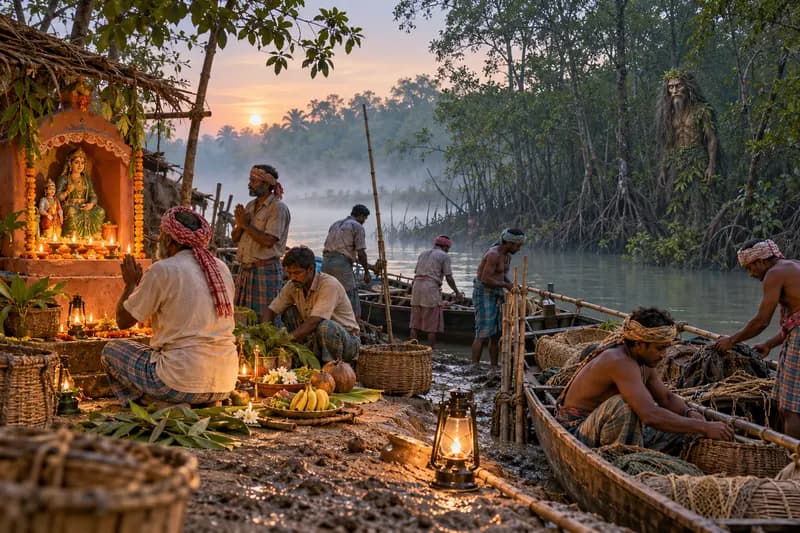
The Honey Collector's Account
Rafiq Mondal was a mouli — a honey collector — from Satjelia Island, one of the inhabited islands at the edge of the Sundarbans. He had been entering the mangrove forest since he was fourteen years old, first with his father, then with his own crew. By the time he was forty, he had collected honey from trees deep enough in the forest that no tourist boat would ever reach them. He knew the tides, the channels, the trees where the bees built. He also knew which channels to avoid.
In April — the honey season — Rafiq's crew of six men paddled into the interior. They had performed the Bonbibi puja at the forest entrance, as they always did. They had brought the clay mask — a face worn on the back of the head, because Sundarbans tigers attack from behind, and the mask makes the tiger think you are watching. Rafiq had been doing this for twenty-six years. He was not careless.
On the second day, they found a good hive in a khalsi tree along a narrow creek. The creek was shallow — barely enough water to float the boat. Three men went to smoke the hive while Rafiq and two others waited in the boat. That was when Rafiq saw the figure.
It was standing on the opposite bank, maybe thirty meters away. A man. Knee-deep in the tidal mud, not moving. Rafiq could see the outline clearly — a thin man in a lungi, no shirt, the way woodcutters dress. The man was facing them but not reacting. Not waving, not calling, not doing anything a living person would do.
Rafiq recognized the lungi. Green checked pattern. He had seen it before. It belonged to Harun — a woodcutter from the neighboring village who had been taken by a tiger seven months earlier. They had found pieces of his clothing on the bank of the Raimangal river but never the body.
"Do not look," Rafiq told the two men beside him. "Keep your eyes on the water. We are leaving this channel."
The younger man — new to the crew — turned to look. "There is someone there. He needs help—"
"He does not need help. He is dead. Call the others back from the tree."
They left the honey. They backed the boat out of the creek and paddled to a wider channel. Rafiq did not look back. The next crew that went into that channel — a group from Gosaba, a week later — lost a man. Tiger. Attacked from the bank while the man was waist-deep in mud, collecting honey from a low branch. The tiger came from the exact spot where the figure had been standing.
Rafiq told this story matter-of-factly, the way you would describe a weather pattern or a tidal schedule. The Begho Bhoot was not supernatural to him. It was a feature of the environment. "The jungle keeps its dead," he said. "And the dead work for the jungle."
The Rules — How to Survive
☠ WARNING ☠
Seven rules for surviving a Begho Bhoot encounter
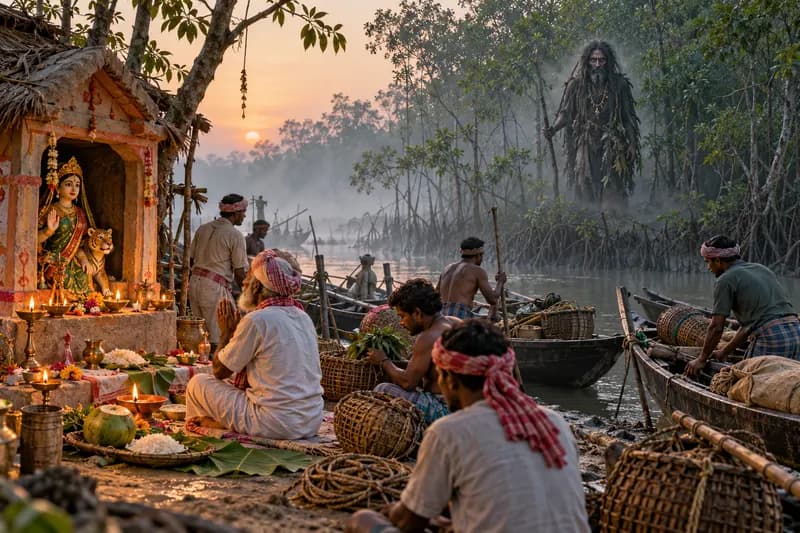
- Perform Bonbibi puja before entering the Sundarbans. — Bonbibi is the only protective force recognized in the Sundarbans. Without her blessing, you enter the jungle without a contract. The Begho Bhoot can approach anyone who has not been claimed by the goddess.
- If you see a figure standing alone in the deep mangrove — do not approach. — The figure is a lure. Between you and it, a tiger is waiting. The Begho Bhoot positions itself to draw your attention and your feet into the kill zone. Distance is survival.
- Wear the backward-facing clay mask at all times in tiger territory. — The mask confuses both tiger and ghost. Tigers attack from behind — the mask makes them hesitate. The Begho Bhoot, which directs the tiger, cannot position you correctly if the tiger is uncertain which direction you face.
- Never enter the forest alone. Never separate from your group. — The Begho Bhoot targets isolated individuals. A person alone in the mangrove is already positioned for the kill. Groups are harder to lure and harder for a tiger to ambush.
- Do not collect honey or wood from channels where someone has been killed. — The ghost of the victim remains in the channel where they died. That channel is now permanently marked — the Begho Bhoot is anchored there, and the tiger will return to the same hunting ground. Respect the death by avoiding the site.
- If the jungle goes silent — no birds, no insects — leave immediately. — The presence of the Begho Bhoot suppresses natural sound. When the mangrove goes quiet, the ghost is active and a tiger is near. Silence in the Sundarbans is not peace. It is a warning.
- If a member of your crew is taken, do not search for the body after dark. — The body will not be found intact, and searching for it in the dark exposes you to both the tiger and the newly created Begho Bhoot. The person you lost is already becoming part of the jungle. Wait until daylight. Bring more people. Accept what you find.
What They Don't Tell You
The Begho Bhoot is not the enemy. The tiger is not the enemy. The Sundarbans itself is the system, and the Begho Bhoot is how that system communicates. In the deepest layer of Sundarbans belief, the ghosts of the tiger-killed are not victims — they have been recruited. They have been absorbed into something older and larger than any individual life. The Bonbibi tradition holds that the forest has a right to its share of human life, just as humans have a right to its honey and wood. The Begho Bhoot is the forest collecting what it is owed. This is not cruelty. This is the contract. The people of the Sundarbans do not hate the ghosts or the tigers. They negotiate with them — through Bonbibi, through ritual, through the simple act of wearing a mask on the back of their head. The relationship is ancient, pragmatic, and ongoing. It is the most honest human-nature relationship left in India.
What Does the Begho Bhoot Want?
The Begho Bhoot does not want revenge. It does not want peace. It wants company.
This is the most disturbing aspect of the belief: the ghost of the tiger-killed does not rage against its fate. It accepts it. It merges with the jungle. And then it does the only thing it knows how to do — it brings others to the same end. Not out of malice, but out of a kind of gravitational pull. The dead of the Sundarbans are lonely. The forest is vast and the channels are endless and the tidal mud swallows everything. The Begho Bhoot lures because luring is the only connection it has left to the living world.
There is a terrible logic to it. The honey collector who sees the ghost of his neighbor standing in the mangrove is seeing a man who stood in the same spot, doing the same work, one season ago. The ghost is not a stranger. It is a mirror. It is what you will become if you stay too long.
The Begho Bhoot is the Sundarbans telling you, in the only language it has: this is what happens here. This is what has always happened here. You are welcome to take the honey, but the jungle will take its share.

You're Most at Risk If...
- You are a mouli (honey collector), bawali (woodcutter), or fisherman who enters the deep Sundarbans
- You enter the forest without performing Bonbibi puja
- You are working in a channel where a previous tiger attack occurred
- You separate from your group or wander alone through the mangrove
- You are drawn toward a figure or sound in the deep forest instead of retreating
- You enter the Sundarbans during peak tiger-activity months (April–May, the honey season)
Offerings & Appeasement
| Offering | Purpose |
|---|---|
| Bonbibi Puja | The primary protection. Before entering the forest, a puja is performed at the Bonbibi shrine near the forest entrance. Offerings include fruits, sweets, incense, and flowers. Both Hindu and Muslim honey collectors perform this — Bonbibi transcends religious lines in the Sundarbans. This is not optional tradition. This is workplace safety. |
| The Clay Mask (Backward Face) | Not technically an offering, but a ritual object. A human face mask worn on the back of the head to confuse the tiger into thinking it is being watched. This innovation was introduced by the forest department in the 1980s, but it was adopted because it aligned with existing Begho Bhoot beliefs — the ghost cannot position you for the kill if the tiger cannot determine which way you face. |
| Offering to the Dead | When a person is killed by a tiger, the family sometimes performs rites at the nearest Bonbibi shrine rather than at the site of death. The body is rarely recovered. The ritual serves as a substitute funeral — an attempt to give the dead some form of closure so they do not become a Begho Bhoot. Whether it works is a matter of faith. |
| Leaving the First Honey | Some mouli crews leave a portion of the first honey collected on a season's trip at the base of the tree where they found it — an offering to the forest, to the ghosts, to Bonbibi. The logic is the same as the Bonbibi pact: take your share, leave the forest its share, and both sides honor the agreement. |

The Healer
Bonbibi Fakir / Pujari — The keeper of the Bonbibi shrine. Both Hindu priests and Muslim fakirs serve in this role — the Sundarbans does not separate its faiths when survival is the issue. The Bonbibi officiant conducts pre-entry pujas, performs substitute funeral rites for tiger victims, and mediates between the community and the forest.
Gunin (Folk Healer) — The local folk healer of the Sundarbans villages — part herbalist, part spirit worker. A gunin may be called when someone returns from the forest behaving strangely after a Begho Bhoot sighting. The treatment involves specific mantras, herbal preparations, and sometimes a ritual re-enactment of the Bonbibi story to reinforce the protective contract.
The Crew Leader (Senior Mouli) — In practice, the most important protector is the senior honey collector — a man with decades of experience who knows which channels are safe, which are haunted, and when to leave. This is not a spiritual role. It is an ecological one. The crew leader reads the jungle the way a sailor reads the sea. He is the first line of defense against both tiger and ghost.
The Critical Difference — There is no exorcism for a Begho Bhoot. You cannot remove it from the jungle because it is the jungle. The only response is prevention — the puja, the mask, the rules, the experienced guide. Once the ghost has positioned you and the tiger is near, no prayer will stop what happens next. The Sundarbans does not negotiate in the moment of the kill.
What If You Dream of a Begho Bhoot?
| Symbol | Meaning | |
|---|---|---|
| 🐯 | A Tiger in the Mangrove | A real threat that you are ignoring in waking life. Something predatory in your environment — a person, a situation, a pattern — that you have been treating as scenery when it is actually watching you. The dream is a warning: look behind you. |
| 🌿 | A Figure Standing in the Trees | Someone you have lost is still influencing your decisions. A dead relationship, a past failure, a person who is gone but whose presence still shapes how you move through the world. The figure does not need to speak. Its position tells you everything — it is between you and something you want. |
| 🍯 | Collecting Honey in a Dark Forest | You are taking risks for a reward that may not be worth the cost. The honey is real, but so is the danger. The dream is asking: do you know the price of what you are reaching for? Have you made the proper offerings — done the preparation, earned the right to take? |
| 🌊 | Tidal Water Rising in the Mangrove | Something in your life is changing on a schedule you do not control. The tides of the Sundarbans wait for no one. The dream means a deadline is approaching — not one you set, but one the environment has set for you. Move before the water decides for you. |
The Begho Bhoot in Art History
Bonbibi Pata Paintings — Folk Tradition: The Sundarbans folk painting tradition (patachitra) depicts Bonbibi's battle with Dakkhin Rai and the tigers. These scroll paintings, carried by itinerant storytellers, show the mangrove as a living entity — and within the trees, the ghostly figures of the tiger-killed are sometimes visible, watching from the edges of the narrative. These paintings are still produced and performed in the Sundarbans today.
Bonbibi Shrine Sculptures: Shrines to Bonbibi across the Sundarbans feature clay and painted sculptures of the goddess standing over Dakkhin Rai's tiger. In some shrines, smaller figures can be seen in the background — representations of the dead who populate the forest. These are not horror images. They are acknowledgments of the full ecosystem the goddess protects against.
Colonial-Era Illustrations: British colonial accounts of the Sundarbans from the 19th century occasionally include illustrations of tiger attacks and the 'ghost beliefs' of local woodcutters. These illustrations, while filtered through colonial skepticism, document that the Begho Bhoot belief was well-established at least 150 years ago.
Contemporary Art: Modern Bengali artists — particularly those working in the ecological art space — have depicted the Begho Bhoot as part of broader narratives about Sundarbans conservation and climate change. The ghost becomes a metaphor for what the forest loses when its ecosystem is disrupted: not just trees and tigers, but the entire spiritual relationship between people and place.

Cross-Regional Patterns
Masaan · Shakchunni · Petni · Nishi · Aleya · Kapala Spirit · Polong · Vetali
| Dawn as hard limit | No — active in daylight |
| Iron weakness | No known iron protection |
| Tree-dwelling | Yes — mangrove-bound |
| Counting compulsion | No |
| Backward feet | No |
Global Equivalent: The closest parallel in world folklore is the Wendigo of Algonquian tradition — a spirit tied to the wilderness that transforms victims into versions of itself, creating an ever-growing population of predatory dead. But the Begho Bhoot is more specific: it is not the predator. It is the predator's accomplice. The tiger kills, the ghost recruits. No other tradition has this exact dynamic — a ghost that serves a living animal.
In Culture — Movies, Books, Games
| Type | Title | Description |
|---|---|---|
| Literature | The Hungry Tide — Amitav Ghosh (2004) | The definitive novel of the Sundarbans. While not directly about the Begho Bhoot, Ghosh captures the world that produces the belief — the tidal flooding, the tiger attacks, the Bonbibi worship, the impossible negotiation between human survival and the forest's demands. Essential reading for understanding the landscape that created this ghost. |
| Film | Mandaar (Bengali, 2023) | Recent Bengali cinema exploring the Sundarbans as a space where the boundary between living and dead collapses. The mangrove environment is treated as a character — sentient, demanding, and populated by presences that are never fully explained. |
| Documentary | Man-Eating Tigers of the Sundarbans (National Geographic) | Documents the real tiger attacks that underpin the entire Begho Bhoot tradition. Interviews with honey collectors and their families make clear that the ghost belief is inseparable from the ecological reality. This is not superstition layered on top of nature. It is nature narrated through belief. |
| Literature | Bonbibi Jahurnama (Sacred Text) | The foundational text of Bonbibi worship — part Islamic, part Hindu, entirely Sundarbans. Recounts Bonbibi's arrival in the forest, her defeat of Dakkhin Rai, and the pact that governs human-tiger relations. The Begho Bhoot is the consequence described when the pact fails. |
| Reference Book | Ghosts, Monsters and Demons of India — Rakesh Khanna | Includes documentation of the Begho Bhoot within its catalog of regional spirits, noting the unique ecological specificity of the belief and its connection to the Bonbibi tradition. |
ACCURACY RATING: DEEPLY ROOTED IN LIVED REALITY · UNDER-REPRESENTED IN POPULAR MEDIA

Is the Begho Bhoot Still Real?
- Tiger attacks in the Sundarbans are not historical. They are current. Between 50 and 100 people are estimated to be killed by tigers in the Sundarbans each decade. Every death is a potential new Begho Bhoot in the belief system.
- Bonbibi puja is performed before every commercial entry into the forest — by honey collectors, woodcutters, and fishermen. The forest department recognizes this practice and does not interfere. It is as standard as a safety briefing.
- The backward-facing clay mask — introduced by the forest department in the 1980s — was accepted precisely because it fit the existing ghost logic. Officials presented it as tiger deterrence. Communities adopted it as ghost deterrence. Both explanations coexist without conflict.
- Honey collectors report Begho Bhoot sightings as factual events, with the same tone they use to report weather conditions or tiger pugmarks. These are not campfire stories. They are field reports from people whose daily work requires entering the kill zone.
- Climate change is intensifying the belief. As the Sundarbans shrinks due to rising sea levels, human-tiger encounters are increasing. More encounters mean more deaths. More deaths mean more ghosts. The Begho Bhoot population is growing because the forest is shrinking.
Expert & Academic Context
- Annu Jalais — Forest of Tigers: People, Politics, Environment in the Sundarbans (2010) — Academic study of human-tiger conflict in the Sundarbans, including detailed documentation of Bonbibi worship and the Begho Bhoot belief as integral to community survival strategies.
- Amitav Ghosh — The Hungry Tide (2004) — Literary fiction grounded in extensive Sundarbans research. Ghosh's portrayal of the forest's spiritual landscape is informed by years of fieldwork and interviews with island communities.
- Bonbibi Jahurnama (traditional text, multiple versions) — The sacred narrative of Bonbibi — transmitted orally and in manuscript form across the Sundarbans. Documents the foundational pact between humans and forest that the Begho Bhoot belief is built upon.
- Ghosts, Monsters and Demons of India — Rakesh Khanna — Includes the Begho Bhoot in its comprehensive documentation of Indian supernatural entities, noting its unique ecological basis and regional specificity.
- Colonial-era Bengal ethnographies (19th–20th century) — British administrators and ethnographers documented 'tiger ghost' beliefs among Sundarbans woodcutters, providing the earliest written records of a tradition that was already ancient when they encountered it.
The Begho Bhoot is the most ecologically specific ghost in Indian folklore. It cannot exist without the tiger, the mangrove, and the human who enters both. It reflects a worldview in which nature is not backdrop but participant — the forest has agency, the tiger has purpose, and the dead have employment. The Bonbibi tradition that contains and manages the Begho Bhoot is a remarkable syncretic achievement: Hindu and Muslim communities sharing a single protective deity because the forest does not check your religion before it kills you. The ghost also encodes a crucial survival truth — that certain places in the Sundarbans are more dangerous than others, that tiger attack sites should be avoided, that solitude in the mangrove is lethal. The Begho Bhoot is simultaneously a spiritual belief and a risk assessment protocol.
If You Encounter a Begho Bhoot
Frequently Asked Questions
▶What is a Begho Bhoot?
A Begho Bhoot is the ghost of a person killed by a tiger in the Sundarbans mangrove forest. 'Begho' means tiger in Bengali. The spirit remains trapped in the jungle and is believed to guide tigers toward new human victims, serving as a supernatural lure that draws people deeper into the mangrove.
▶Is the Begho Bhoot still believed in?
Yes — actively. Honey collectors, woodcutters, and fishermen who enter the Sundarbans treat the Begho Bhoot as a real occupational hazard. Bonbibi puja is performed before every forest entry, and sightings are reported with the same factual tone as weather observations. The belief persists because the tiger attacks that create the ghosts continue to occur.
▶What is the connection between Begho Bhoot and Bonbibi?
Bonbibi is the protective goddess of the Sundarbans — the counter-force to both tigers and their ghosts. The Bonbibi tradition holds that the forest and humans have a pact: each takes their share and no more. The Begho Bhoot is what happens when that pact is broken. Bonbibi puja is the primary defense against encountering a Begho Bhoot.
▶Can a Begho Bhoot be exorcised?
No. The Begho Bhoot is part of the jungle itself — it cannot be separated from the environment. The only responses are prevention (puja, masks, group travel, avoiding known attack sites) and avoidance. If you see the ghost, you leave. There is no ritual that removes it from the forest.
▶Why is the Begho Bhoot unique to the Sundarbans?
Because the conditions that create it exist nowhere else: a vast mangrove where tigers regularly kill humans, where bodies are rarely recovered, where proper funeral rites cannot be performed, and where the terrain makes every encounter potentially lethal. The ghost is a product of a specific ecosystem.
▶How does the backward-facing mask protect against the Begho Bhoot?
The mask disrupts the ghost's primary function — positioning you for a tiger attack from behind. If the tiger cannot determine which direction you face, it hesitates. If the ghost cannot orient the kill, its role breaks down. The mask was introduced by the forest department for practical reasons, but communities adopted it because it made spiritual sense within existing Begho Bhoot beliefs.
Explore More
Related Spirits
Masaan · Shakchunni · Petni · Nishi · Aleya · Kapala Spirit · Polong · Vetali
Stories Are Being Summoned
One ghost story per week. Every Tuesday at midnight.