Wendigo
It isn't born. It's made — by the single act an Algonquian winter could never forgive. And once made, the hunger it carries can never, ever be satisfied, no matter how much it eats.
- What Is a Wendigo?
- Why the Wendigo Is Terrifying
- Origin — A Taboo Given a Body
- Appearance & Manifestation
- The Winter the Food Ran Out
- The Rules — Recognizing and Responding to Windigo Transformation
- What They Don't Tell You
- What Does a Wendigo Want?
- Who Traditional Accounts Say Is Most at Risk
- How Communities Historically Responded
- Who Historically Responded
- What If You Dream of a Wendigo?
- The Wendigo in Culture — Honestly Assessed
- Cross-Cultural Patterns
- In Culture — Books, Film, Academic Debate
- Is the Wendigo Still Believed In?
- Expert & Academic Context
- Frequently Asked Questions
- Explore More
| Wendigo | |
|---|---|
| Also Known As | Windigo, Witiko, Weendigo (regional Algonquian-language spelling variants) |
| Script | wiindigoo (Anishinaabemowin / Ojibwe) |
| Pronunciation | WEN-dih-go |
| Region | Algonquian Nations — the Great Lakes region and boreal forests of Canada and the northern United States (Ojibwe, Cree, Innu, and related nations) |
| Category | Cannibal Spirit / Possessing Entity |
| Danger Level | Severe |
| Fear Method | Possession through the act — or even the sustained thought — of cannibalism, an insatiable hunger that grows with every victim consumed, and the terror of winter starvation itself |
| Warning Sign | A gaunt, emaciated figure far taller than any human, moving through deep snow without sinking; a person who begins speaking seriously about eating their companions during famine; an overwhelming, growing craving for human flesh |
| First Documented | Oral tradition among Algonquian-speaking peoples predating European contact; first substantial outside documentation in 19th-century ethnographic and legal records, later shaped heavily by Algernon Blackwood's 1910 novella and 20th-century anthropological debate |
| Still Believed? | Yes, as a serious moral and spiritual concept within Algonquian communities. The 'windigo psychosis' clinical diagnosis popularized by outside anthropologists in the early-to-mid 20th century has since been substantially discredited by later scholarship as a colonial-era overstatement |
| Deep Dives | Folk StoriesOrigin & HistoryIs It Real?In Pop CultureHow to SurviveDream Meaning |
| Related | Skinwalker · Chupacabra · Mothman · Jersey Devil · Flatwoods Monster |
What Is a Wendigo?
The Wendigo (wiindigoo) is a possessing spirit from Algonquian tradition — the spiritual and physical consequence of committing cannibalism, or in some accounts, of even sustaining the thought of it during desperate winter famine. It is not a monster that exists independently in the forest waiting to be found. In the core tradition, a Wendigo is made: an ordinary person who crosses the single most unforgivable line their society recognized, and in doing so transforms into something that can never stop being hungry.
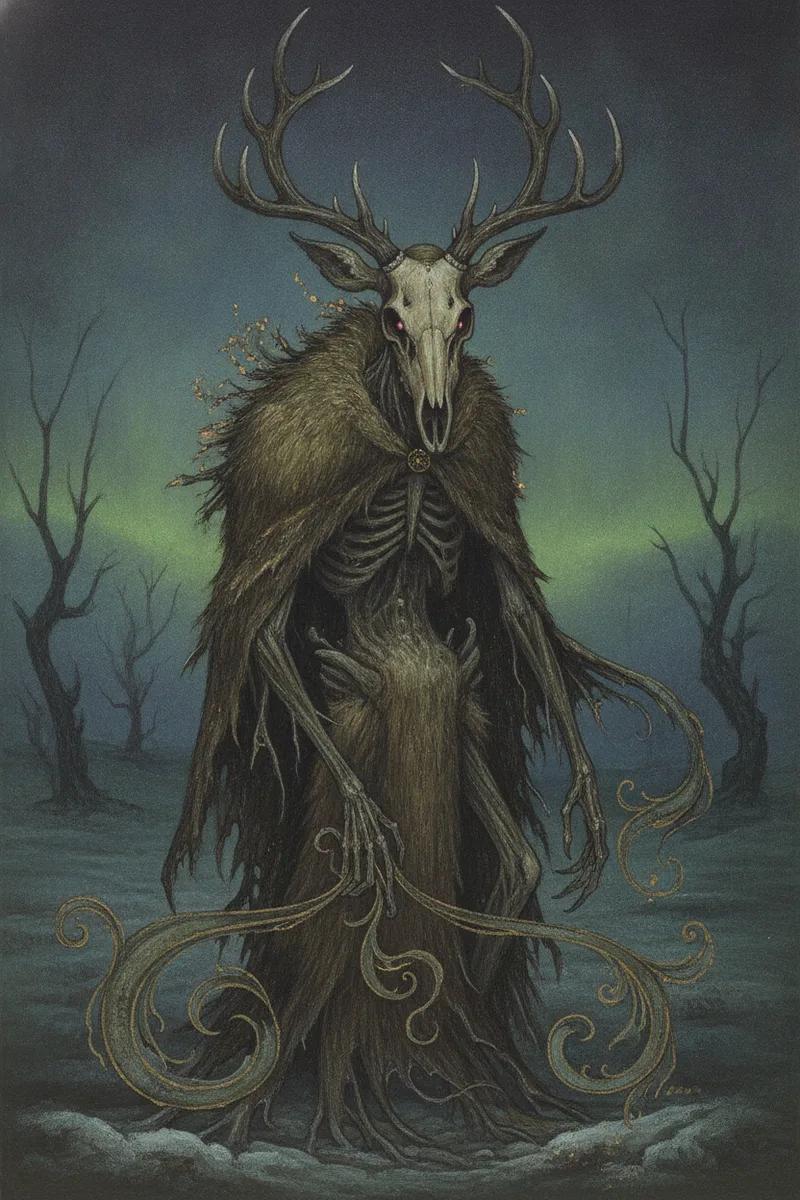
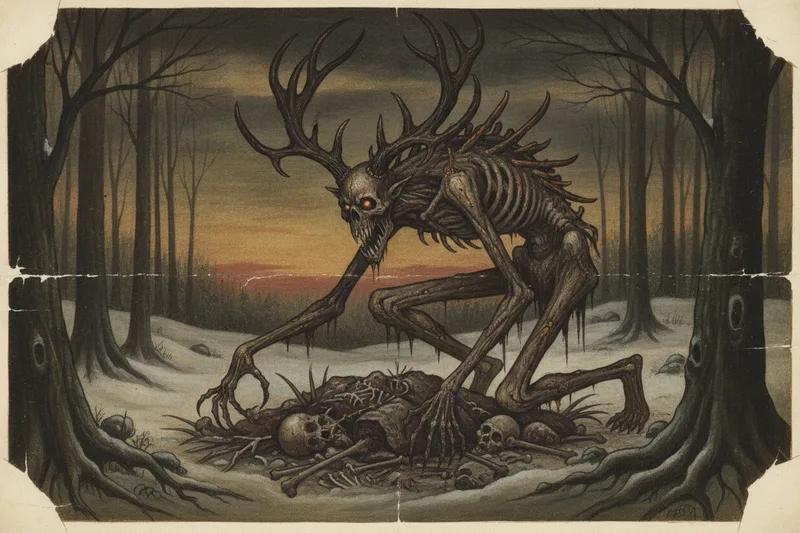
This is the detail that pop culture consistently erases, and it is the detail that gives the Wendigo its real weight: the tradition is not primarily about a creature in the woods. It is about what desperation does to people, and about a community's need for an absolute, non-negotiable boundary around the one act that could not be forgiven even when starvation made it conceivable. The antlered, deer-skull monster of modern horror movies and video games is a 21st-century invention with no basis in the original tradition — the real Wendigo is a starving human shape, not a horned beast.
Why the Wendigo Is Terrifying
INSTINCT EXPLOITED: STARVATION AND THE BREAKING OF THE LAST TABOO
It is the hardest part of winter. The hunting has failed for weeks. The stores are gone. Your family is thin in a way that frightens you to look at directly, and the cold outside is the kind that kills in an hour if you're caught in it unprepared.
You know, somewhere in the exhausted back of your mind, that there is one solution left that would keep everyone alive. You do not let yourself finish the thought. You have heard what happens to people who finish that thought — not a punishment handed down by others, not at first, but a change that starts from the inside. The heart turns to ice. The hunger becomes a different kind of hunger, one that no amount of ordinary food will ever touch again. You have heard of people who gave in, who are not people anymore.
Outside, the wind through the pines sounds, for just a moment, like it is saying a name. Your name. You do not answer it. You hold the thought you refused to finish a little further away from yourself, and you wait for morning, because morning is the only thing standing between your family and the kind of decision that does not let you come back from it.
Origin — A Taboo Given a Body
The Single Unforgivable Act
In the subsistence economies of the northern Algonquian nations, winter famine was a real and recurring threat, and cannibalism was, in the most desperate circumstances, a conceivable last resort. Precisely because it was conceivable, it had to be made absolutely unthinkable — and the Wendigo is the mechanism that did that. It made the consequence of crossing that line not social punishment alone, but total transformation into something that has stopped being a person at all.
Becoming Windigo
In the tradition, a person who commits cannibalism — or in some accounts, who dwells too long and too seriously on the idea of it — begins to change. The heart is often described as turning to ice. The body grows gaunt no matter how much is eaten, because the hunger it now carries can never be satisfied; every victim consumed only makes the Wendigo larger, and therefore hungrier, than before. This growing-with-feeding detail is central: there is no point of fullness, no end state where the hunger stops. That is the actual horror the tradition is encoding — appetite with no ceiling.
Basil Johnston's Framework
Ojibwe scholar Basil Johnston (1929–2015), in his book The Manitous: The Spiritual World of the Ojibway, described the Wendigo as a figure born of excess — a being that 'encouraged moderation' precisely by embodying its absence. In this framing, the Wendigo is not simply about literal cannibalism alone but about the broader danger of need curdling into insatiable greed, with cannibalism as the most extreme possible expression of that failure.
The Windigo Psychosis Controversy
In the early-to-mid 20th century, outside anthropologists popularized the idea of 'windigo psychosis' — a supposed clinical mental illness in which a person became convinced they were turning into a Wendigo and acted on cannibalistic urges. This framing has since been substantially challenged. Anthropologist Lou Marano published a detailed critique in the journal Current Anthropology (1982), titled 'Windigo Psychosis: The Anatomy of an Emic-Etic Confusion,' based on five years of fieldwork among the Northern Ojibwa and Cree plus extensive archival research. Marano argued that no actual, clinically documented case of 'windigo psychosis' as a standalone mental illness has ever been substantiated, and that the diagnosis largely reflects colonial-era researchers imposing a Western psychiatric frame onto a spiritual and legal concept that worked differently within its own culture.
Algernon Blackwood's Appropriation
The English-language popularity of the word 'Wendigo' owes a great deal to Algernon Blackwood's 1910 novella The Wendigo, which introduced the figure to a wide non-Native readership. Academic analysis of the novella (including recent scholarship on Blackwood's 'Canadian Gothic' writing) describes it as transforming the Wendigo from a taboo-enforcement figure tied to a specific, serious cultural crime into a vehicle for a white protagonist's psychological dissolution in the wilderness — stripping out the cannibalism taboo that gave the original concept its actual cultural weight. This pattern — a sacred or legally serious Indigenous concept flattened into generic horror atmosphere for an outside audience — is the same pattern raised about Skinwalker on this site, and it's worth naming plainly rather than treating Blackwood's story as a neutral classic.
Appearance & Manifestation
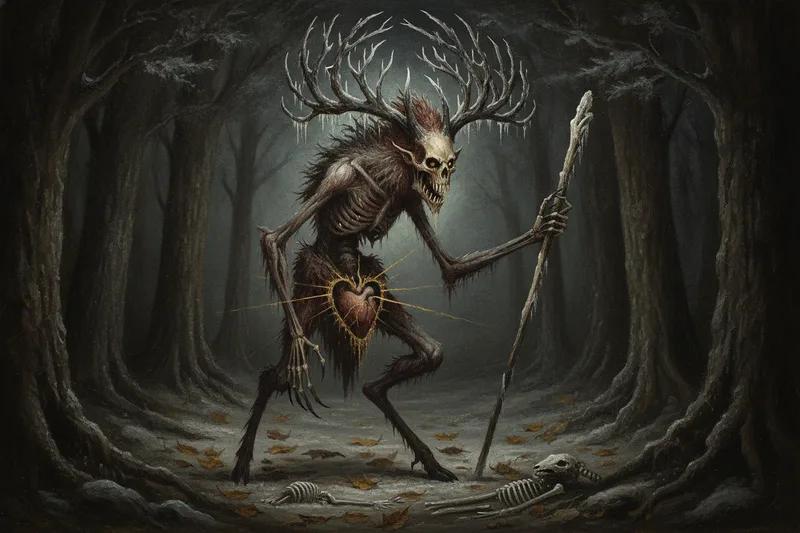
| 👁 Sight | In the original tradition: an emaciated, unnaturally tall humanoid figure, skin stretched tight over bone, often described as ash-grey or withered, with sunken eyes and sometimes a smell of decay. The antlers and deer-skull face seen in modern horror films, TV shows, and video games are a 21st-century invention — not part of the traditional description. |
| ❄ The Ice Heart | A recurring and distinctive traditional detail: the Wendigo's heart is made of ice, a physical marker of the total loss of human warmth and compassion that accompanied the transformation. |
| 🔊 Sound | Accounts describe an unnatural, wind-like howling, and — consistent with a pattern found across many North American traditions — a voice that can call a person's name to lure them away from safety. |
| 🐾 Movement | Despite its gaunt, starved frame, the Wendigo is described as unnaturally fast and silent, and in some accounts able to move across deep snow without sinking or leaving tracks. |
| 🌨 Time | Overwhelmingly associated with deep winter and famine conditions — the season in which the underlying survival pressure the legend encodes was historically most acute. |
| 🌲 Habitat | The boreal forests and northern wilderness of the Great Lakes region and sub-Arctic Canada — remote, snowbound terrain far from settlement, where historical famine and isolation were most dangerous. |
The Winter the Food Ran Out
This is a composite account, representative of the structure of Algonquian oral tradition around famine and the Wendigo — not a report about a specific named person or event.
A hunting band had gone five weeks without a successful kill. The elders had already reduced the portions twice. The children had stopped asking when there would be more, because they had learned the answer was always the same careful silence.
One of the hunters — a capable, respected man, the kind no one would have suspected — began to change in small ways first. He stopped sharing the little he found. He watched the other members of the band with an attention that unsettled people who had known him their whole lives. He spoke, once, carefully, about an idea no one else would let him finish saying out loud.
The band's elder recognized the signs before anyone else was willing to name them: the ice in his manner, the hunger that no amount of food seemed to reach, the way he had begun to look at people rather than at food. She did not wait. In the tradition, waiting once the signs were confirmed was understood to cost lives — the Wendigo, once it takes hold, does not reverse itself, and it does not stop on its own.
What happened next is the part these stories rarely finish out loud, because it is the part that was never a comfortable resolution — it was a last, desperate act of protection for everyone else in the band, carried out by people who understood exactly what it would cost them to do it. The tradition does not glorify this moment. It simply insists that the alternative — waiting, hoping, giving the benefit of the doubt — was the more dangerous choice.
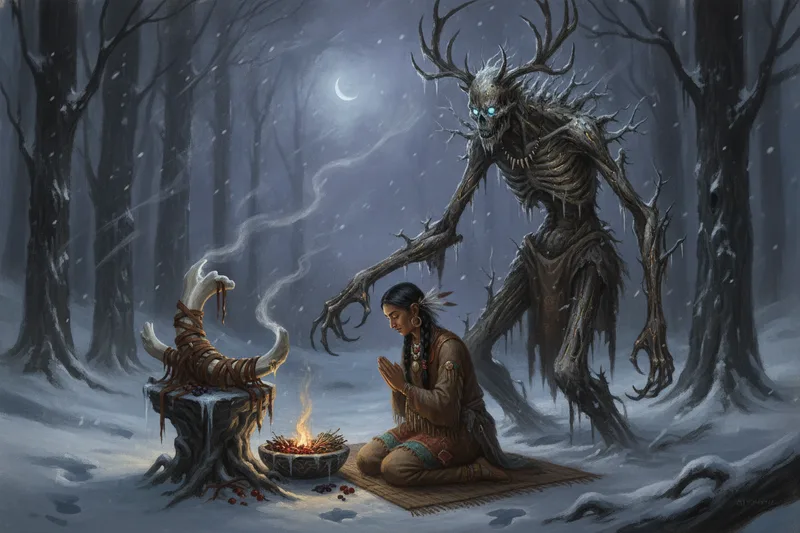
The Rules — Recognizing and Responding to Windigo Transformation
⚠ A NOTE BEFORE THESE ⚠
These reflect documented historical belief and real legal history, not a how-to guide
- Treat serious, sustained talk of cannibalism during famine as an emergency, not a passing remark. — In the tradition, the thought itself — dwelt on seriously enough — was understood as the first stage of transformation, which is why communities took early warning signs seriously rather than waiting for an irreversible act.
- Watch for a growing, unnatural hunger that food does not satisfy, paired with emotional coldness toward others. — The 'ice heart' and insatiable appetite are the tradition's two central diagnostic signs of a person beginning to transform.
- Act decisively once transformation is confirmed by community consensus, not unilaterally or on suspicion alone. — Historical windigo-killing cases, including the 1907 case of Jack Fiddler — a recognized 'windigo fighter' within his community — involved communal recognition and consensus before action, not a single person's private judgment.
- Understand that outside legal systems historically did not recognize this framework. — In R v. Machekequonabe (1897), an Ojibwa man who killed a person he and his community believed was transforming into a Wendigo was convicted of manslaughter under Canadian colonial law, despite acting in accordance with his community's own legal and spiritual understanding — a case still studied in Canadian legal history as an example of colonial law overriding Indigenous legal systems.
- Do not conflate the modern 'windigo psychosis' psychiatric label with the traditional belief itself. — Scholarship (notably Lou Marano's 1982 critique) argues the clinical diagnosis was a colonial-era overstatement with no substantiated cases — treating the two as interchangeable misrepresents both the science and the tradition.
What They Don't Tell You
The scariest accurate fact about the Wendigo has nothing to do with claws or snow or howling in the dark. It's that the tradition was built to answer a real, specific, survivable-seeming temptation — and that it worked by making the consequence of giving in total and permanent rather than merely social. There was no partial transformation, no redemption arc, no path back. That totality is the actual design of the belief: in a crisis severe enough to make the unthinkable thinkable, the only thing powerful enough to hold the line was a consequence worse than starvation itself.
What Does a Wendigo Want?
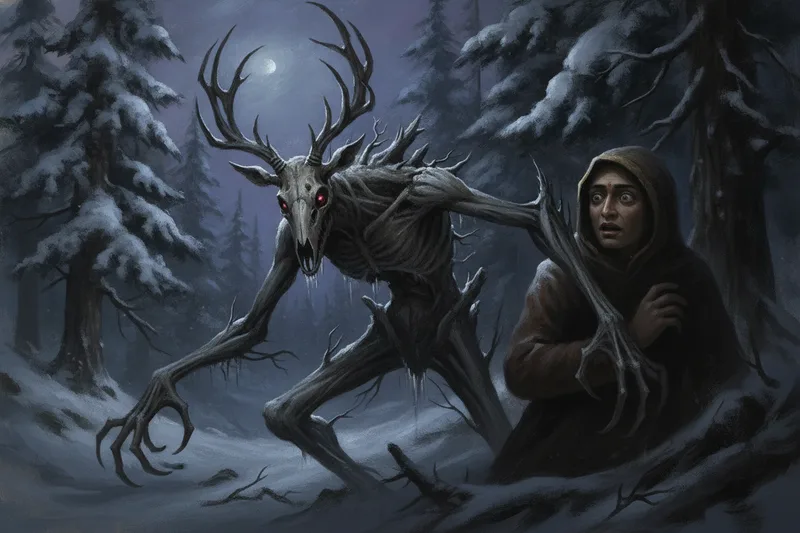
A Wendigo wants to eat, without limit and without end. Unlike entities elsewhere on this site that act from grievance, revenge, or a specific unresolved injustice, the Wendigo's want is purely appetitive — and the tradition is explicit that the appetite scales with consumption rather than being reduced by it. Every victim makes the Wendigo bigger, and a bigger Wendigo is hungrier, not satisfied.
This design has a clear didactic purpose: it models addiction and unchecked greed as a structural trap rather than a simple appetite that can eventually be filled. There is no amount of feeding that resolves a Wendigo's hunger, which is exactly the point Basil Johnston identified when he described the figure as the embodiment of dangerous excess.
Who Traditional Accounts Say Is Most at Risk
- Anyone in a genuine, prolonged famine or survival crisis, historically the specific condition the tradition addresses
- A person showing early signs of obsessive thought about cannibalism, even without acting on it
- Someone becoming emotionally cold, withdrawn, or acquisitive toward companions' food or wellbeing during a crisis
- Communities without an elder or recognized authority willing to name and act on early warning signs
How Communities Historically Responded
| Offering | Purpose |
|---|---|
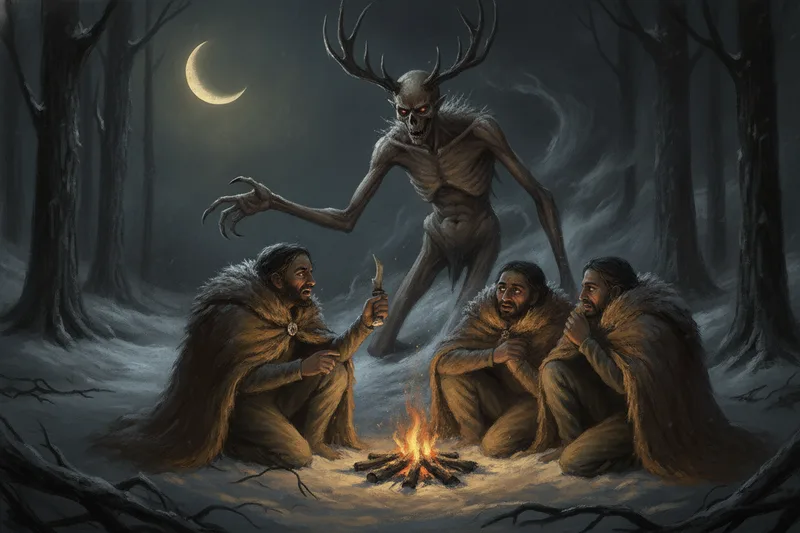
| Early Recognition by Elders | Community elders and recognized spiritual authorities were understood as the appropriate judges of whether someone was beginning to transform — not an individual's private suspicion acting alone. |
| Windigo Fighters | Some individuals, like Jack Fiddler in early 20th-century Ontario, were recognized within their communities specifically for their role in confronting and stopping windigo transformations — a serious, high-stakes responsibility, not a folkloric title. |
| Consensus Before Action | Historical and legal records of windigo-related killings consistently show community-level recognition and agreement preceding action, reflecting the gravity with which this was treated. |
| Living With the Aftermath Under Colonial Law | Individuals who acted according to their community's own legal and spiritual framework were, in cases like Machekequonabe's, nonetheless prosecuted under colonial Canadian law — a tension between Indigenous legal systems and imposed colonial law that is itself part of this entity's real documented history. |
Who Historically Responded
Community Elders — The recognized authority for identifying genuine warning signs and determining an appropriate response, grounded in deep familiarity with the people involved.
Windigo Fighters — Individuals specifically recognized within their communities for experience confronting windigo transformation — Jack Fiddler is the best-documented historical example, credited within his community with having stopped numerous transformations over his lifetime.
The Key Difference From Other Entities Here — There is no ritual exorcism or reversal described in the tradition — once transformation was confirmed, the belief held that it could not be undone, which is precisely what made community recognition and early action so consequential.
What If You Dream of a Wendigo?
| Symbol | Meaning | |
|---|---|---|
| 🍽 | Insatiable Hunger in a Dream | Often interpreted outside the strict tradition as a reflection of a want or ambition that keeps growing the more it's fed — a warning about chasing something with no natural stopping point. |
| 🥶 | A Heart Turning to Ice | Commonly read as anxiety about losing empathy or warmth toward people close to you, especially under sustained stress or scarcity. |
| 🌲 | Being Pursued Through Snow | Frequently interpreted as a sense of being chased by a consequence you can't outrun — often tied to a decision or temptation you know you shouldn't act on. |
| 🗣 | Hearing Your Name Called From the Trees | A dream motif tied to the danger of a tempting shortcut that looks, from a distance, like it's calling specifically to you. |
The Wendigo in Culture — Honestly Assessed
Algernon Blackwood, The Wendigo (1910): The novella most responsible for popularizing the term in English. Academic analysis treats it as a clear case of cultural appropriation — Blackwood strips the cannibalism taboo that gave the figure its real weight and repurposes it as generic wilderness horror for a white protagonist's psychological unraveling.
Basil Johnston, The Manitous: The Spiritual World of the Ojibway: An Ojibwe scholar's own documentation of the Wendigo within the broader Anishinaabe spiritual framework — the most directly community-grounded source used on this page.
Modern horror films, TV, and games (Antlers, Supernatural, Marvel, Until Dawn, Fallout, and others): Near-universally depict an antlered, deer-skull creature — a design with no basis in the traditional description, and the single most common distortion of this entity in mainstream media.
Lou Marano's 1982 critique in Current Anthropology: A serious academic challenge to the 'windigo psychosis' psychiatric framing that much of the 20th century took at face value — essential context that most popular treatments of this topic omit entirely.
Cross-Cultural Patterns
Skinwalker · Chupacabra · Mothman · Jersey Devil · Flatwoods Monster
| Transformation is a curse chosen by the victim | No — a consequence of crossing a taboo |
| Hunger diminishes with feeding | No — it grows with every victim |
| Traditional description includes antlers | No — a modern invention |
| Dawn as a hard limit | No |
| Reversible once transformed | No, per tradition |
Global Equivalent: The closest structural parallel on this site is the Navajo Skinwalker — both are North American Indigenous traditions carrying serious real-world weight, both have been significantly flattened by non-Native commercial media, and both encode a specific cultural warning (chosen evil for Skinwalker, taboo-breaking desperation for Wendigo) rather than functioning as a generic monster. The European werewolf is a useful contrast rather than a true parallel: a werewolf's curse is usually involuntary and externally inflicted, while Wendigo transformation in the tradition follows from the person's own act or sustained intent.
In Culture — Books, Film, Academic Debate
| Type | Title | Description |
|---|---|---|
| Literature | Algernon Blackwood, The Wendigo (1910) | Introduced the figure to English-language readers; academically recognized as an appropriative, significantly altered version of the tradition. |
| Academic | Basil Johnston, The Manitous: The Spiritual World of the Ojibway | An Ojibwe scholar's framing of the Wendigo as the embodiment of dangerous excess, within Anishinaabe cosmology. |
| Academic Controversy | Lou Marano, "Windigo Psychosis: The Anatomy of an Emic-Etic Confusion" (Current Anthropology, 1982) | A major critique arguing the psychiatric 'windigo psychosis' diagnosis was a colonial-era construct without substantiated clinical cases. |
| Legal History | R v. Machekequonabe (1897) and the Jack Fiddler case (1907) | Real, documented Canadian legal cases arising from windigo-related killings, now studied as examples of colonial law overriding Indigenous legal and spiritual frameworks. |
ACCURACY RATING: HIGH IN ETHNOGRAPHIC AND LEGAL SOURCES · HEAVILY DISTORTED IN MAINSTREAM MEDIA
Is the Wendigo Still Believed In?
- Yes, as a serious moral and spiritual concept — the Wendigo remains a meaningful part of Algonquian cultural and spiritual life, distinct from its horror-media depiction.
- The 'windigo psychosis' clinical diagnosis, once treated as established fact by outside researchers, has been substantially discredited by later scholarship (notably Marano, 1982) as a colonial-era overstatement with no substantiated clinical cases.
- Real historical legal cases — R v. Machekequonabe (1897), the Jack Fiddler case (1907) — document the genuine, serious weight this belief carried, including tragic conflicts between Indigenous legal frameworks and imposed colonial law.
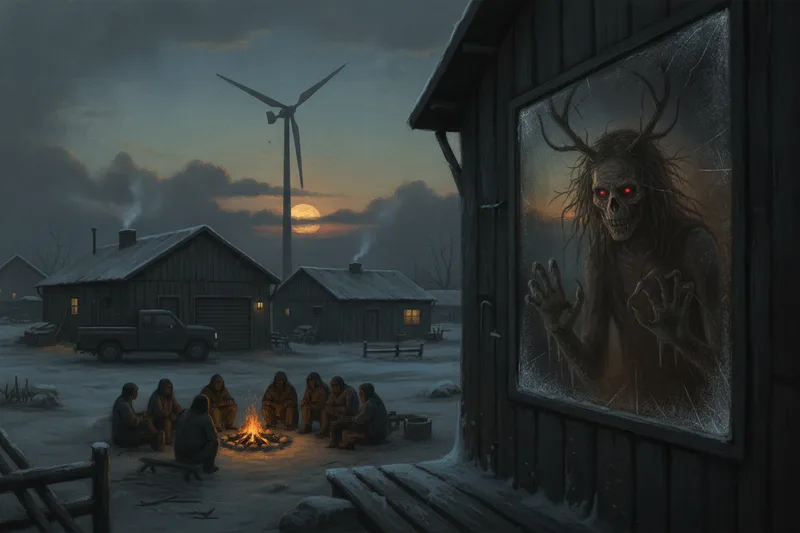
- Modern mainstream depictions (the antlered monster of recent film, TV, and games) have little to no connection to the traditional description or meaning, which is a documented source of frustration among Algonquian commentators and scholars who see a serious cultural and legal history reduced to a generic horror design.
Expert & Academic Context
- Basil Johnston — The Manitous: The Spiritual World of the Ojibway — An Ojibwe scholar's own account of the Wendigo within the broader Anishinaabe spiritual framework, describing it as an embodiment of dangerous excess.
- Lou Marano — "Windigo Psychosis: The Anatomy of an Emic-Etic Confusion," Current Anthropology (1982) — Based on five years of fieldwork among the Northern Ojibwa and Cree plus archival research; argues the psychiatric 'windigo psychosis' label was a colonial-era construct without substantiated cases.
- R v. Machekequonabe (1897) and related Canadian legal records (including the 1907 Jack Fiddler case) — Real, documented legal cases studied in Canadian legal history as examples of colonial law overriding Indigenous legal and spiritual authority in windigo-related killings.
The Wendigo's documented history makes a case most horror-blog treatments never attempt: that this tradition had real, serious legal and social consequences, not just narrative ones. A person could be, and was, prosecuted under a legal system that did not recognize the framework their own community operated under — and the psychiatric establishment spent decades treating a colonial misreading of the belief as established medical fact, a position serious scholarship has since dismantled. Stripped of the antlers and the jump scares that mainstream media has grafted onto it, the real Wendigo is a story about the exact line a society draws around its worst possible crime, what happens to a person who crosses it, and who gets to decide when that line has been crossed — questions with far more weight than any monster design.
Frequently Asked Questions
▶What is a Wendigo?
A Wendigo is a possessing spirit from Algonquian tradition — the consequence of committing (or in some accounts, seriously intending) cannibalism, especially during winter famine. A person who crosses this line is believed to transform into a gaunt, perpetually hungry being whose appetite only grows the more it consumes.
▶Is the Wendigo real?
The belief is real, serious, and historically consequential — it produced documented legal cases (including R v. Machekequonabe, 1897) where people were prosecuted for killing someone they and their community believed was transforming. Whether a literal supernatural transformation occurs is a matter of belief, not something independently verifiable. What is well-documented is that the 'windigo psychosis' psychiatric diagnosis once treated as medical fact has since been seriously challenged by scholars as a colonial-era overstatement.
▶What does a Wendigo look like?
In the traditional description: an emaciated, unnaturally tall humanoid with skin stretched over bone and a heart of ice. The antlers and deer-skull face common in modern horror films, TV shows, and video games have no basis in the original tradition — they're a 21st-century pop-culture invention.
▶Where did the Wendigo originate?
In the oral traditions of Algonquian-speaking peoples (Ojibwe, Cree, Innu, and related nations) across the Great Lakes region and boreal Canada, as a mechanism for enforcing an absolute taboo against cannibalism during survival crises like winter famine.
▶Is windigo psychosis a real medical condition?
This is genuinely contested. Early-to-mid 20th-century anthropologists treated it as an established psychiatric illness, but anthropologist Lou Marano's detailed 1982 critique in Current Anthropology argued no actual clinical case was ever substantiated, and that the diagnosis largely reflects outside researchers misreading a spiritual and legal concept through a Western psychiatric lens.
▶Is the Wendigo the same as a werewolf?
No. A werewolf's curse is typically involuntary — inflicted by a bite, bloodline, or external curse. A Wendigo's transformation, in the traditional belief, follows from the person's own act or sustained intent to commit cannibalism, making it closer in structure to a severe moral consequence than an affliction.
Explore More
Related Spirits
Skinwalker · Chupacabra · Mothman · Jersey Devil · Flatwoods Monster
Comparisons
Stories Are Being Summoned
One ghost story per week. Every Tuesday at midnight.
Comments
Loading comments…