Skinwalker
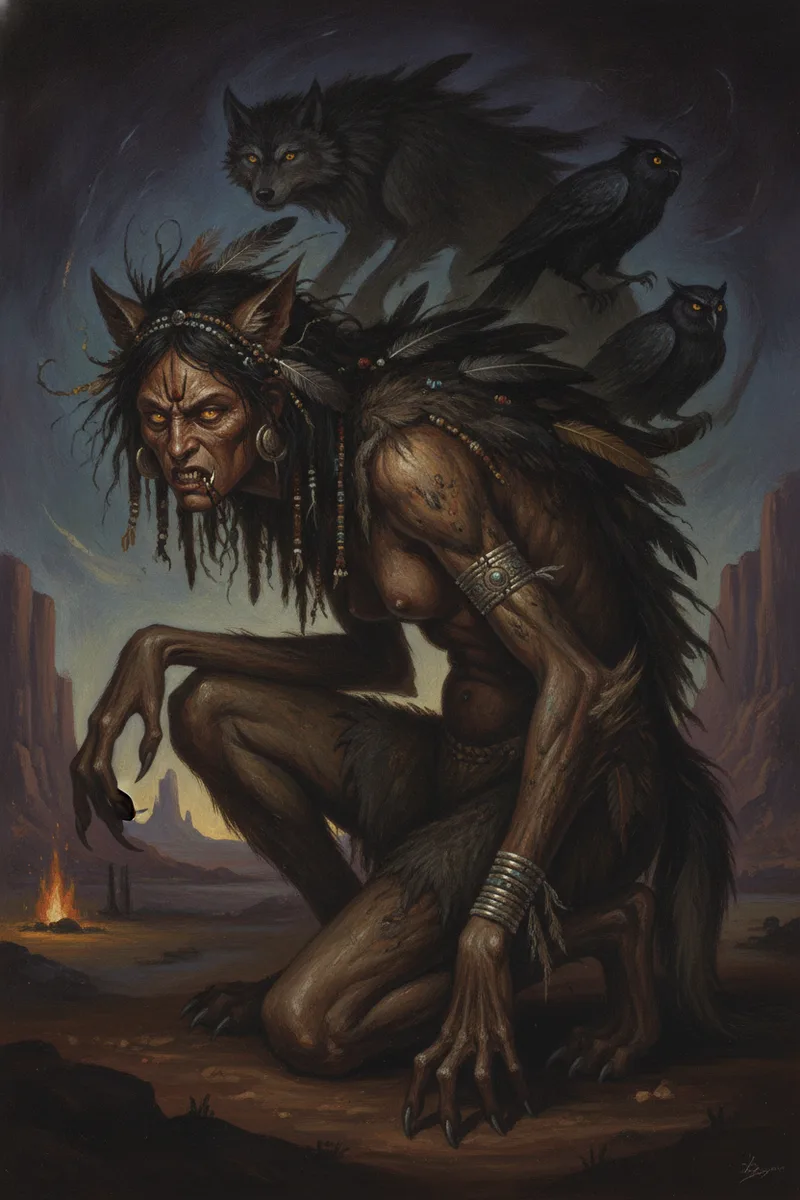
It doesn't have to look like a wolf, or a coyote, or anything with a name. It only has to be wrong. And once you've seen the eyes, you will never mistake a real animal for one again.
- What Is a Skinwalker?
- Why the Skinwalker Is Terrifying
- Origin — The Witchery Way
- Appearance & Manifestation
- The Long Road Home
- The Rules — How Traditional Protection Works
- What They Don't Tell You
- What Does a Skinwalker Want?
- Who Traditional Accounts Say Is Most at Risk
- Protective & Ceremonial Practice
- The Healer
- What If You Dream of a Skinwalker?
- The Skinwalker in Culture — Honestly Assessed
- Cross-Cultural Patterns
- In Culture — Books, Film, Television
- Is the Skinwalker Still Believed In?
- Expert & Academic Context
- Frequently Asked Questions
- Explore More
| Skinwalker | |
|---|---|
| Also Known As | Yee Naaldlooshii, Yenaldlooshi, Naagloshii (colloquial) |
| Script | yee naaldlooshii (Diné bizaad / Navajo language) |
| Pronunciation | yay NAHL-dloh-shee |
| Region | Navajo Nation — the Four Corners region of Arizona, New Mexico, Utah, and Colorado, USA |
| Category | Human Witch / Shapeshifting Sorcerer (Diné "Witchery Way") |
| Danger Level | Severe |
| Fear Method | Pursuit in animal form, cursing through corpse powder, possession, and the terror of not knowing which neighbor it might be |
| Warning Sign | An animal that will not behave like an animal — a coyote running upright, a wolf pacing a truck at highway speed, eyes that burn with a light no real animal's eyes produce, tapping at a window or roof late at night with no one outside |
| First Documented | Oral tradition predating sustained European contact; first substantial outside academic documentation in Clyde Kluckhohn's Navaho Witchcraft (Papers of the Peabody Museum, Harvard University, 1944), based on 1930s fieldwork with 93 Navajo informants |
| Still Believed? | Yes — actively believed and treated with real caution across the Navajo Nation today. Discussing it openly, especially with outsiders, is itself considered taboo; the Navajo Nation has discouraged the public spread of skinwalker stories for commercial or entertainment purposes |
| Deep Dives | Folk StoriesOrigin & HistoryIs It Real?In Pop CultureHow to SurviveDream Meaning |
| Related | Wendigo · Chupacabra · Mothman · Jersey Devil · Flatwoods Monster |
What Is a Skinwalker?
A skinwalker — yee naaldlooshii, "he/she who goes on all fours by means of it" — is a human being in Navajo (Diné) tradition who has acquired the power of a witch and uses it to take on the form, movement, or characteristics of an animal, most often a coyote, wolf, fox, or owl. It is not a monster born evil. It is not cursed against its will. In Diné belief, a skinwalker was once an ordinary person — sometimes a relative, sometimes a respected member of the community — who chose a specific, transgressive path to gain supernatural power, a path traditionally called the Witchery Way (ánt'įįhnii).
This is the detail that almost every non-Navajo retelling gets wrong, and it is the detail that actually makes the belief frightening within its own culture: a skinwalker is not an inherited curse, like a European werewolf, and not a wandering spirit, like a ghost. It is a choice made by someone who already has a name, a family, and a place at the table. The horror is not the coyote on the road. The horror is the possibility that the coyote used to be someone you trusted.
Why the Skinwalker Is Terrifying
INSTINCT EXPLOITED: THE UNCANNY ANIMAL AND THE UNKNOWABLE NEIGHBOR
You are driving a reservation road after dark — one of those long, straight stretches where the headlights are the only light for twenty miles in either direction. A shape breaks from the brush at the edge of the beam. A coyote, you think. Ordinary. You've seen a hundred of them.
Except this one does not run away from the light. It runs alongside it.
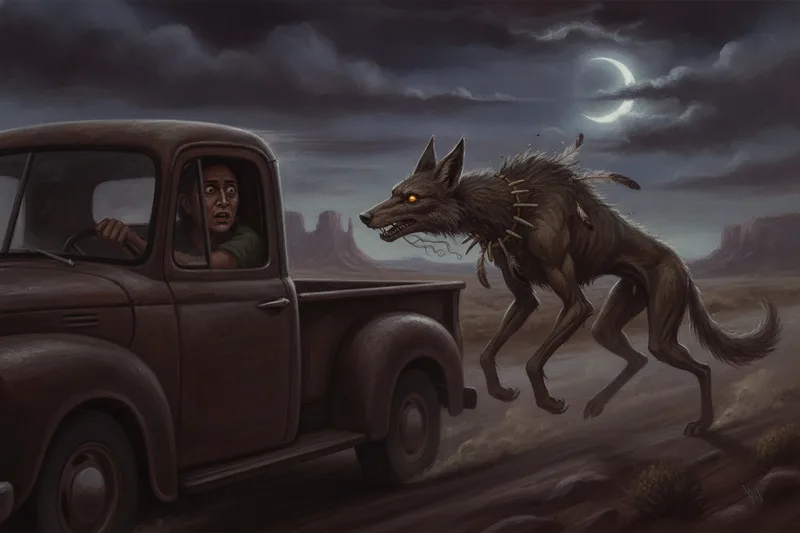
You are doing sixty. It keeps pace without visibly straining, loping at a speed no coyote should sustain, its head turned toward your window instead of toward the road ahead of it — the way a predator watches prey, not the way an animal watches a car. You glance over for half a second and its eyes catch the dashboard glow and hold it, burning back at you with a light that doesn't fade the way eyeshine should. It isn't reflecting your headlights. It's producing its own.
You speed up. It matches you.
You don't look again. You keep your eyes on the road, because somewhere in the back of every Navajo childhood is the same instruction, repeated by a grandmother, an uncle, a medicine man: don't look it in the eyes. Something can pass between you if you do. You don't know exactly what. You've never wanted to find out.
By the time you reach the turnoff for home, the thing beside the road is gone — not fallen behind, not left in the dust. Simply gone, the way it was never bound by the same rules of running that a real coyote is bound by. You pull into your driveway with your hands still shaking on the wheel. You do not get out right away. And later, lying awake, you will think about the neighbor two houses down who has done unusually well for himself the last few years, with no clear explanation for where the money came from — and you will hate yourself a little for thinking it, and you will think it anyway.
Origin — The Witchery Way
A Category, Not a Creature
Clyde Kluckhohn's 1944 ethnography divided Navajo witchcraft into four broad practices: witchery (ánt'įįhnii), sorcery, wizardry, and frenzy witchcraft. Kluckhohn himself noted this four-part split was likely his own analytical framework rather than a native Navajo category — the real tradition is more fluid. The skinwalker, as the term is used today, sits within "witchery" — the darkest of these practices, associated with necrophilia, grave robbery, incest, and murder as the price of admission. A skinwalker is not a separate species. It is what a person becomes after choosing this specific path.
The Price of Power
According to the accounts Kluckhohn's informants gave him, initiation into the Witchery Way traditionally required an act so transgressive it severed the initiate from ordinary human relationship — in the accounts recorded, killing a close family member, often a sibling. This is reported belief, not a claim about actual historical killings, but the function of the story is precise: it tells the listener that this power cannot be stumbled into by accident. You have to want it badly enough to destroy the thing most people would never destroy. That is why a skinwalker is always, in the tradition, someone who made a decision — not someone who was bitten, or born under a curse, or caught in the wrong forest at the wrong time.
Corpse Powder and the Curse
The weapon most associated with Navajo witches in ethnographic accounts is antł'įįh — "corpse powder," reportedly made from the ground bones of the dead, particularly infants or twins. Blown into a victim's face, placed in their hogan, or scattered in their footprints, it was believed to cause a specific wasting illness recognized within Navajo medicine as "Witchery Way sickness" — distinct from illness caused by other spiritual imbalances, and treated with its own specific ceremonies.
Why the Coyote
The animal forms most associated with skinwalkers — coyote, wolf, fox, owl, crow — are not random. In Navajo cosmology, the coyote (ma'ii) is already an ambivalent figure: a trickster present at the time of creation, neither fully good nor fully evil, associated with chaos that is sometimes necessary and sometimes catastrophic. The owl carries a strong association with death and ill omen across Diné tradition — hearing an owl call near a home is itself considered a warning. A witch choosing to travel as a coyote or an owl is, in effect, choosing the form already closest to the boundary between order and danger.
A Social Leveling Mechanism
Anthropologists who have studied Navajo witchcraft accusations, building on Kluckhohn's fieldwork, note a recurring pattern: accusations of witchery disproportionately target people who have acquired unusual wealth, status, or livestock without an explanation the community finds sufficient. In a historically clan-based, resource-sharing society, the skinwalker accusation functions, in part, as a social check — a story that makes unexplained accumulation suspicious rather than simply impressive. The fear of being seen as a witch, and the fear of being preyed upon by one, point in the same direction: do not get rich in ways your neighbors cannot account for.
Appearance & Manifestation
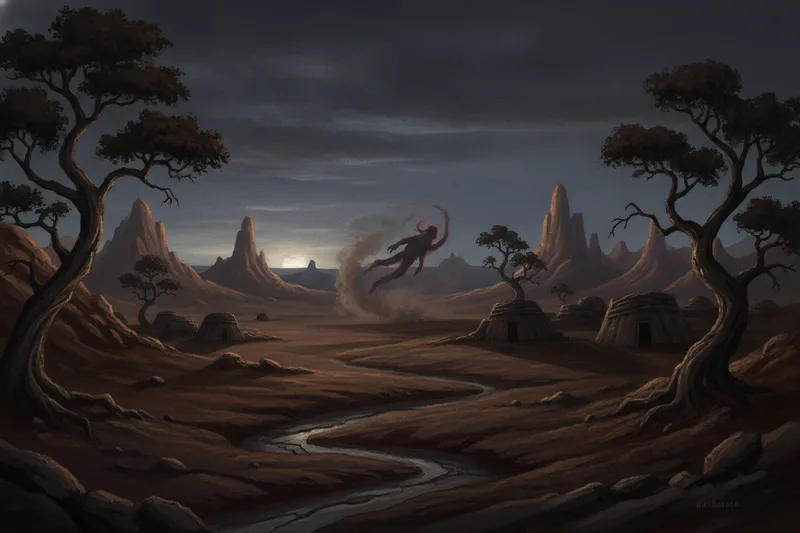
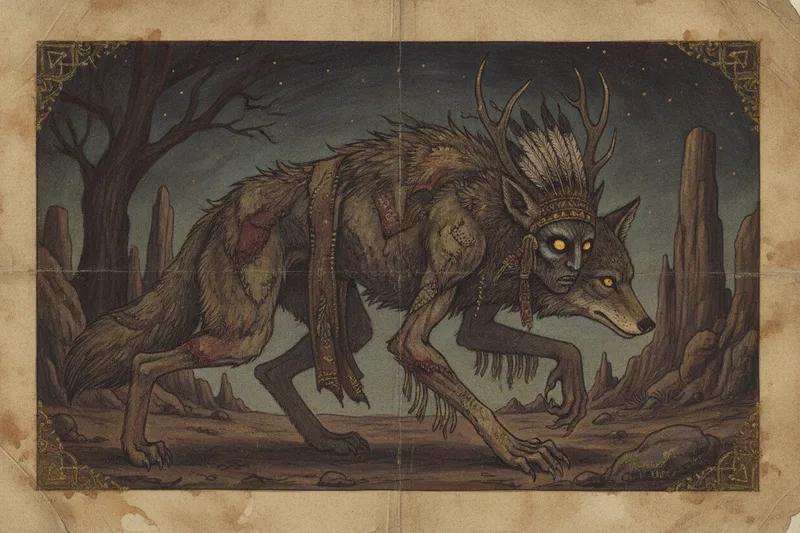
| 👁 Sight | Most often reported as a coyote, wolf, fox, dog, or owl that moves wrong — running upright on two legs, keeping pace with a vehicle at sustained highway speed, or possessing limbs that read as slightly too long for the body. In partially-transformed accounts: a humanoid figure, grey-skinned, with an animal's head or an animal's gait, moving in jerking, unnatural motions. |
| 🔆 The Eyes | The single most consistent detail across reported encounters: eyes that glow with their own light rather than reflecting a headlight or flashlight the way a real animal's eyeshine does. Often described as red, yellow, or an unnaturally sustained white. Diné tradition holds that direct eye contact with a skinwalker is dangerous — something can be taken from you, or passed into you, through the gaze. |
| 🔊 Sound | Knocking or tapping on windows, walls, or rooftops late at night, with nothing visible causing it. Some accounts describe a skinwalker calling a person's name in a voice that mimics someone familiar — a direct parallel to warning traditions in many other cultures about never answering your name the first time you hear it called at night. |
| 🐾 Movement | The defining tell distinguishing a skinwalker from a real animal is locomotion that violates the animal's own biology — sustained speeds no coyote or wolf can hold, upright bipedal running, or a disappearance that isn't flight so much as simply ceasing to be there. |
| 🌑 Time | Overwhelmingly a night phenomenon. Encounters are almost always reported after dark, on isolated roads, or near a home at a late hour — consistent with witchcraft practices across many traditions being associated with the hours when ordinary social accountability is weakest. |
| 🛣️ Habitat | Long, isolated stretches of reservation highway are the most commonly cited setting in modern accounts, alongside the area around a specific ranch property in Utah's Uintah Basin that has become its own, separate branded phenomenon (see In Culture, below). Traditionally, witchery was associated with the boundaries of settlement — the edge of a hogan's light, the point where a path leaves sight of other homes. |
The Long Road Home
This is a composite account, representative of the kind of story told and retold along the reservation highways of the Four Corners — not a report naming any real person. The details below reflect the recurring structure of these accounts rather than a specific documented case.
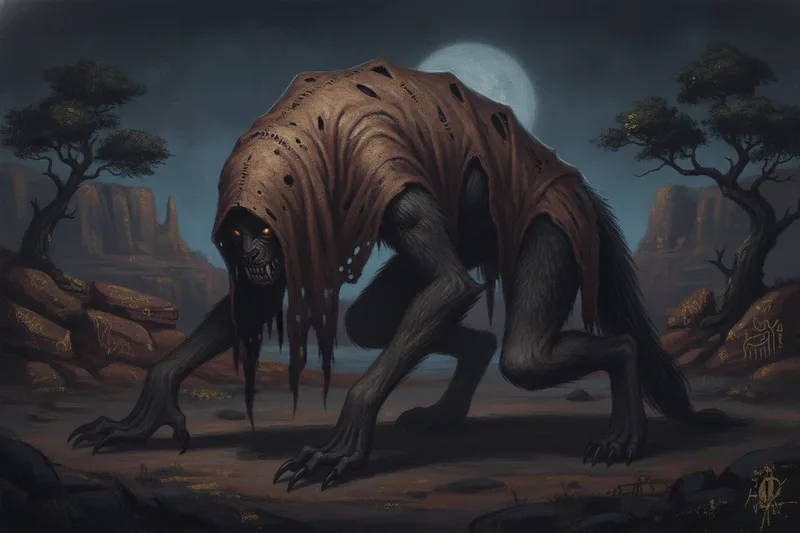
Ray was driving back from Shiprock a little after eleven, the kind of flat, dark stretch where the only variation in the landscape is the occasional mesa cutting a black shape out of a sky that's otherwise nothing but stars. He'd made the drive a hundred times. He wasn't worried about anything except staying awake.
The coyote came out of the brush on the passenger side, level with his back tire, and for the first quarter mile he thought nothing of it — coyotes ran roads all the time, spooked by the engine, cutting across to the other side. Except this one didn't cut across. It held its line, exactly level with his window, exactly as fast as his truck, for longer than any coyote should have been able to run without falling behind.
He eased off the gas to let it pass him and get ahead, out of some instinct to end the moment. It eased its pace to match. He sped back up. It matched that too.
He did what every aunt, every grandmother, every reservation kid grows up being told to do: he did not look directly at it. He kept his eyes forward, his hands tight on the wheel, and he drove — not faster, because panic invites attention, but steady, the way you're taught to walk past a dog that hasn't decided yet whether you're a threat.
At the turnoff for his mother's place, the thing was simply gone. Not left behind. Not peeled off toward the brush. Gone, in the space between one glance and the next.
He didn't tell his mother that night. He told her the next morning, over coffee, and she didn't ask him to describe it twice. She asked him one question: did you look it in the eyes? He said no. She nodded like that was the correct answer to a test he hadn't known he was taking, and she said she'd call someone — a hataalii, a singer, someone who knew the right ceremony — just to be safe. Not because something had definitely happened to him. Because you don't wait to find out.
The Rules — How Traditional Protection Works
⚠ A NOTE BEFORE THESE ⚠
These are documented traditional beliefs, not instructions — presented for understanding, not as a how-to guide
- Never look a skinwalker directly in the eyes. — Diné tradition holds that eye contact creates a channel — something can pass from the witch into you, or from you into it. Avoiding the gaze is the single most consistently repeated piece of protective advice across accounts.
- Never say its human name aloud, even if you believe you recognize who it is. — In some accounts, correctly identifying and naming a skinwalker aloud is believed to curse the person back — they will reportedly fall ill or die within days. This is treated as a dangerous and serious act, not a casual accusation.
- Do not run from it; do not stop for it. — Running signals prey and panic. Stopping invites direct confrontation. The consistent advice across accounts is to continue at a steady pace toward a populated or well-lit place without escalating.
- Use juniper or cedar smoke and corn pollen for protection and cleansing. — Both are central to Diné ceremonial life generally, not specific to witchcraft alone — corn pollen in particular is used for blessing across nearly every Navajo ritual context, representing order, beauty, and the restoration of hózhǫ́ (harmony/balance).
- Avoid wearing the pelt of a predatory animal or owl feathers. — This is specifically taboo in Navajo tradition because of its direct association with the Witchery Way — wearing such items is believed to invite the same supernatural danger the witch itself represents.
- If you suspect you've been cursed or targeted, call a hataalii, not a priest of another tradition. — Witchery Way sickness is treated within its own specific framework of Navajo ceremony, most notably the Evilway (Ánti'į́) ceremonial complex, which is understood to counteract witchcraft specifically rather than general misfortune.
- Do not discuss skinwalkers casually, especially not for entertainment, with outsiders. — This is the rule most often broken by non-Navajo retellings, including this page. Traditional belief holds that discussing it carelessly draws attention and invites danger — which is also the documented basis of the Navajo Nation's discouragement of commercialized skinwalker content.
What They Don't Tell You
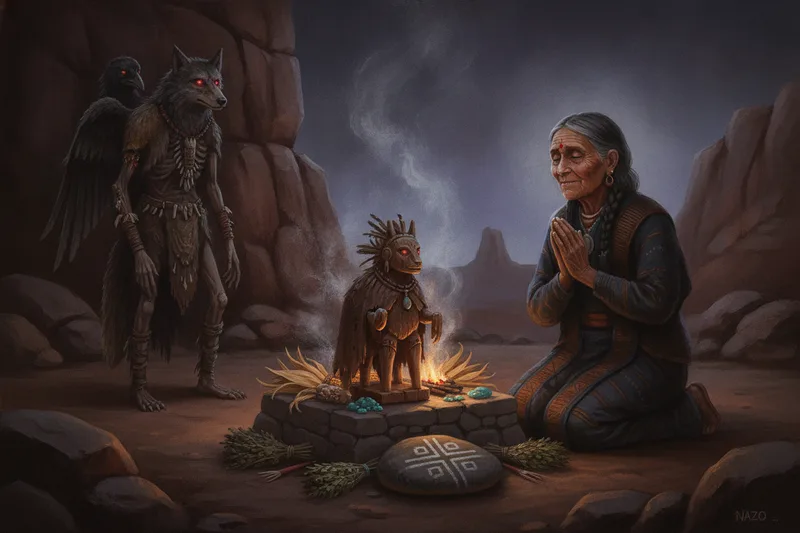
The scariest detail in the entire tradition is almost never the part that makes it into pop culture. It isn't the coyote on the road or the glowing eyes at the window. It's that a skinwalker is understood to still be a person — still has a family, a house, a seat at ceremonies, a name everyone in town knows. The tradition does not describe an outside monster invading a safe community. It describes the possibility that evil already has a place at your table, wearing a familiar face, and that the price it paid to get its power was something unthinkable done to someone it should have protected. That is a far colder kind of fear than a wolf in the woods — because a wolf doesn't know your name.
What Does a Skinwalker Want?
Within the tradition, the motives attributed to someone who chooses the Witchery Way are explicitly human ones, scaled up by supernatural power: envy, revenge, personal wealth, and dominance over people the witch resents or fears. This separates the skinwalker sharply from entities whose hunger or malice is simply their nature — the skinwalker wants exactly what an ordinary bitter, greedy, or vengeful person wants. It has just found a terrible way to get it.
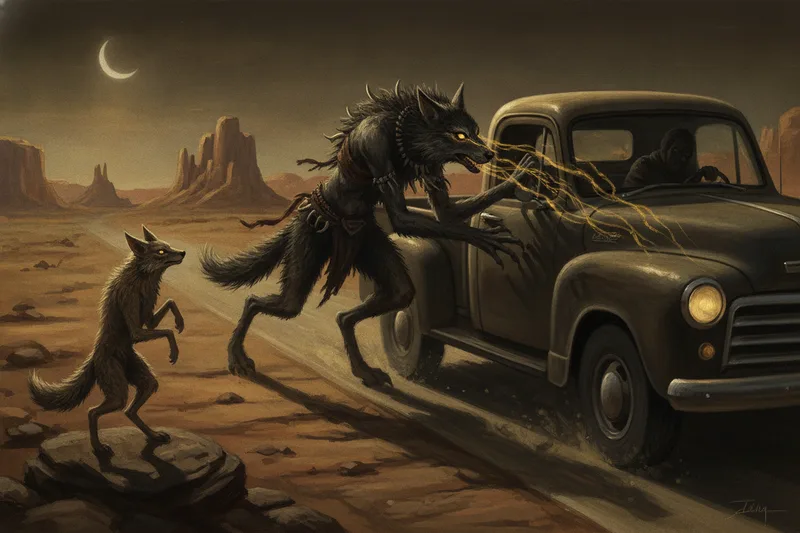
Accounts of skinwalker activity are frequently tied to specific interpersonal grievances — a land dispute, a feud between families, resentment over a relative's success. The curse is rarely random. It targets someone the witch has a reason to resent, which is part of why witchcraft accusations in Navajo communities have historically clustered around real social tensions rather than appearing evenly across the population.
There is no recorded tradition of a skinwalker wanting to be stopped, redeemed, or released — unlike entities elsewhere in this project whose hunger comes from unfinished business or trapped circumstance. The skinwalker chose this. The want is the point.
Who Traditional Accounts Say Is Most at Risk
- Anyone traveling alone on an isolated reservation road late at night
- Someone currently in an active dispute — over land, inheritance, a relationship, or a grievance — with another individual or family
- A person who has recently acquired sudden, unexplained wealth or success, making them a target of suspicion as much as a potential victim
- Households near open desert or brush where animal activity at the property line goes unexplained
- Anyone who has broken a specific taboo — wearing a predator's pelt, disturbing a grave, handling owl feathers carelessly
- People already weakened by grief, illness, or a recent death in the family, which in Navajo belief can create spiritual vulnerability
Protective & Ceremonial Practice
| Offering | Purpose |
|---|---|
| Corn Pollen Blessing | Corn pollen (tádídíín) is used across nearly all Navajo ceremonial contexts, not witchcraft alone, to invoke hózhǫ́ — beauty, order, and harmony. Carrying and ceremonially using corn pollen is one of the most common everyday protective practices. |
| Juniper and Cedar Smoke | Burning juniper or cedar is used for spiritual cleansing of a person, object, or space believed to have been exposed to witchcraft or negative influence. |
| The Evilway Ceremonial Complex | Evilway (Ánti'į́) ceremonies, performed by a trained hataalii, are specifically understood to counteract witchcraft and the effects of contact with the dead or with malevolent influence — distinct from the Blessingway ceremonies used for general protection and life events. |
| Community Vigilance Rather Than Individual Ritual | Because skinwalker belief is tied to specific social suspicion, part of "protection" in practice is social: knowing your community, being cautious about unexplained behavior or wealth, and maintaining the relationships and reputation that make an accusation against you implausible. |
The Healer
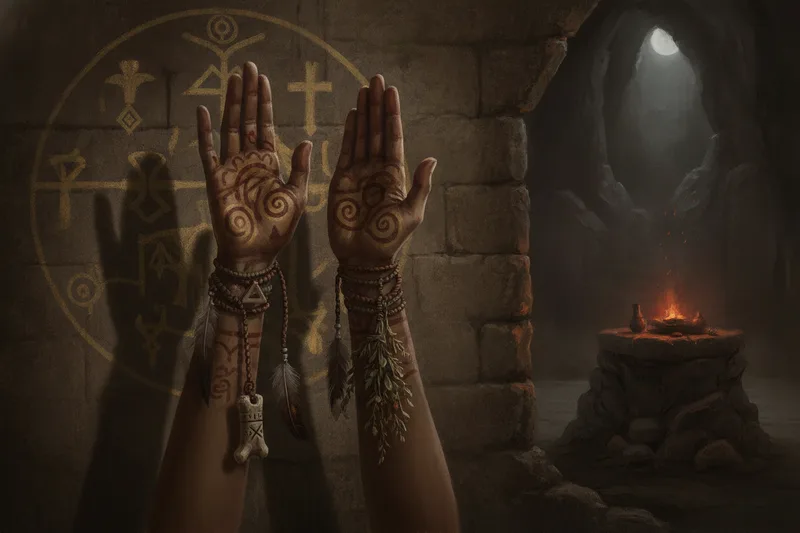
Hataalii (Medicine Person / Singer) — The primary authority for diagnosing and treating witchcraft-related illness in Navajo tradition. A hataalii has trained for years, sometimes decades, to correctly perform specific, lengthy ceremonial chants and is the equivalent of both a diagnostician and a ritual specialist.
A Specific Evilway Ceremony — Rather than a generic exorcism, the hataalii selects from a structured body of specific ceremonies suited to the particular form of witchcraft-related illness being treated — these can run for several days.
Family and Clan Elders — Before a hataalii is called, family elders are typically the first consulted — both for guidance and because witchcraft suspicion often implicates specific interpersonal relationships that elders are best positioned to help navigate carefully.
The Key Difference From Western Exorcism — There is no single universal ritual "against" a skinwalker the way pop culture suggests. Treatment is specific to the diagnosis, performed by a trained specialist within a structured ceremonial tradition — not a improvised ritual performed by a frightened individual.
What If You Dream of a Skinwalker?
| Symbol | Meaning | |
|---|---|---|
| 🐺 | Being Chased by an Animal That Won't Fall Behind | A common interpretation outside the strict traditional framework: a feeling of being pursued by a threat you cannot outrun through ordinary effort — often tied to a conflict, debt, or confrontation you have been avoiding rather than resolving. |
| 👀 | Locking Eyes With Something That Shouldn't Have Human Eyes | Dream-interpretation readings outside the strict tradition often connect this to the fear of being truly seen — exposed, recognized, or known in a way you did not consent to. |
| 🏠 | Something Tapping at Your Window at Night | Frequently interpreted as anxiety about the safety or stability of home itself — a sense that the boundary you rely on for safety is not as solid as you need it to be. |
| 🤝 | Recognizing a Familiar Face in Animal Form | The most psychologically loaded version of this dream — tied to betrayal anxiety, suspicion of someone close to you, or guilt about a relationship you no longer fully trust. |
The Skinwalker in Culture — Honestly Assessed
Tony Hillerman's "Skinwalkers" (1986) and the Navajo Tribal Police novels: A bestselling mystery novel using the skinwalker legend as a plot device within a procedural centered on Navajo Tribal Police officers. Hillerman, who was not Navajo, consulted extensively with Navajo advisors and is generally credited with more care than most outside treatments, though the question of a non-Native author profiting from this material remains a legitimate point of criticism from within the community.
The Secret of Skinwalker Ranch (History Channel, 2020–present): A long-running documentary-style series (seven seasons as of its most recent renewal) centered on a specific Utah ranch property associated with UFO and paranormal claims, loosely borrowing the "skinwalker" name for branding. It is a separate, largely unrelated phenomenon from the Navajo witchcraft tradition and is the single biggest driver of search interest in the bare term today.
Horror films using the "skinwalker" name: Several English-language horror films have used "skinwalker" as a label for what is functionally a werewolf story — cursed transformation, lunar triggers, bite-based contagion — none of which reflects the actual Navajo tradition. This is the most consistent and most criticized distortion: flattening a human witch's chosen power into an inherited monster-curse borrowed wholesale from European folklore.
Navajo community response: Navajo cultural commentators and, per reporting on the subject, the Navajo Nation itself have pushed back on the volume of non-Native commercial content built on this specific tradition, given its status as a genuinely taboo subject within Diné culture rather than open-source horror material.
Cross-Cultural Patterns
Wendigo · Chupacabra · Mothman · Jersey Devil · Flatwoods Monster
| Transformation is an inherited curse | No — a chosen power |
| Requires a transgressive initiation | Yes, per tradition |
| Dawn as a hard limit | No |
| Detectable by unnaturally glowing eyes | Yes |
| Remains fundamentally human | Yes — a witch, not a separate species |
Global Equivalent: The closest global parallel is the Nagual of Mesoamerican tradition — a human sorcerer who transforms into an animal through learned power and will, not through affliction. Both stand in sharp contrast to the European werewolf, who is almost always a victim of a curse, a bite, or a bloodline rather than an architect of their own power. The Wendigo of Algonquian tradition is a closer geographic neighbor but a very different category: a spirit of hunger and taboo-breaking (cannibalism) that consumes a person from within, rather than a human witch who retains full agency and intent throughout.
In Culture — Books, Film, Television
| Type | Title | Description |
|---|---|---|
| Literature | Tony Hillerman, Skinwalkers (1986) | Part of the long-running Leaphorn & Chee mystery series following Navajo Tribal Police detectives; widely read, Native-advised, but authored by a non-Navajo writer. |
| Television | The Secret of Skinwalker Ranch (History Channel) | A separate branded phenomenon centered on a specific Utah property; the dominant driver of modern search interest in the bare term "skinwalker." |
| Film | Various horror features titled "Skinwalkers" | Generally depict a European-style werewolf curse rather than the actual Navajo witchcraft tradition — the most common and most criticized misrepresentation of this entity. |
| Academic | Clyde Kluckhohn, Navaho Witchcraft (1944) | The foundational outside ethnographic study, based on fieldwork with 93 Navajo informants in the 1930s, and still the most-cited academic source on the subject. |
ACCURACY RATING: HIGH IN ETHNOGRAPHIC SOURCES (KLUCKHOHN, 1944) · FREQUENTLY MISREPRESENTED IN MAINSTREAM MEDIA
Is the Skinwalker Still Believed In?
- Yes, actively. This is not a historical curiosity — skinwalker belief remains a living, operative part of Navajo cultural life, and witchcraft accusations and protective ceremonies continue in practice today.
- Discussing skinwalkers casually, especially with outsiders, is itself considered taboo within traditional Diné belief — the concern is that careless discussion draws unwanted attention and can invite genuine danger, not simply that it's disrespectful.
- The Navajo Nation has, according to reporting on the subject, discouraged the public spread of skinwalker stories for commercial or entertainment purposes — a direct, documented objection to the exact pattern this page is a part of. That tension is worth stating plainly rather than ignoring: this is sacred, taboo material to the community it comes from, being written about by outsiders for a general audience.
- The widening gap between the Navajo tradition (a human witch, chosen power, specific social function) and the pop-culture version (a generic cursed werewolf, driven largely by a Utah ranch TV show) is itself a documented source of frustration among Navajo commentators, who see their specific, serious cultural and spiritual framework flattened into interchangeable horror content.
Expert & Academic Context
- Clyde Kluckhohn — Navaho Witchcraft (Papers of the Peabody Museum of American Archaeology and Ethnology, Harvard University, 1944) — The foundational academic study of Navajo witchcraft, based on fieldwork conducted in the 1930s with 93 Navajo informants. Kluckhohn himself cautioned that his categorization scheme was an outside analytical tool rather than a native Navajo framework — a caveat worth preserving rather than smoothing over.
- EBSCO Research Starters — "Skinwalker (mythology)" — A research-encyclopedia overview summarizing the core tradition, terminology, and its relationship to broader Navajo witchcraft belief for a general academic audience.
- Contemporary reporting on Navajo community and Navajo Nation statements regarding the commercialization of skinwalker folklore — Multiple outlets and cultural commentators have documented objections from within the Navajo community to non-Native commercial and entertainment use of this specific, taboo tradition.
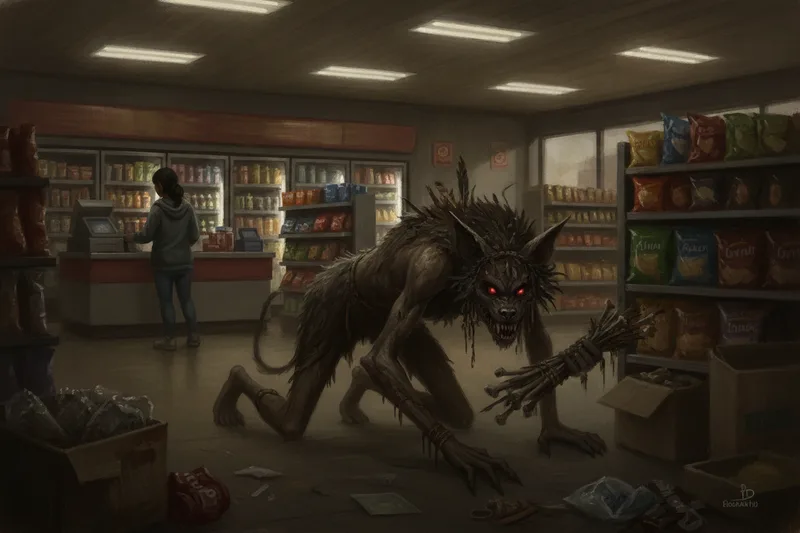
The skinwalker occupies an unusual position among the entities documented on this site: it is one of the only traditions where the source community has actively and specifically objected to outside retelling, including the kind of content this very page represents. That tension doesn't disappear by writing carefully — but it is worth naming directly rather than hiding behind a generic respect disclaimer. What makes the skinwalker distinctive, even within that discomfort, is its core insight: it is one of the few widely known supernatural traditions where the monster is explicitly, unambiguously a person who made a choice. Not cursed. Not born wrong. Not possessed. A person who decided that someone else's life was worth less than the power they wanted, and who now wears an ordinary face at ceremonies, at the grocery store, at your table. Pop culture consistently erases this in favor of a generic werewolf, trading the tradition's real and specific horror — the human cost of power, and the impossibility of ever being fully sure who paid it — for something far more comfortable and far less true.
Frequently Asked Questions
▶What is a skinwalker?
In Navajo (Diné) tradition, a skinwalker — yee naaldlooshii — is a human being who has gained witchcraft power through the Witchery Way and uses it to take on the form or characteristics of an animal, most often a coyote, wolf, fox, or owl, typically to spy, curse, or harm. It is a person who chose this power, not a creature born or cursed into it.
▶Are skinwalkers real?
Skinwalker belief is real and actively held within Navajo communities today — it is a genuine, living part of Diné spiritual and social life, including real witchcraft accusations and real protective ceremonies. Whether a supernatural shapeshifting being literally exists is a matter of belief rather than something that can be independently verified, the same as with any other tradition's supernatural claims. What is verifiably real is the depth and seriousness with which the tradition is held.
▶What does a skinwalker look like?
Most reported encounters describe an otherwise-recognizable animal — a coyote, wolf, fox, or owl — that moves or behaves wrong: running upright, keeping pace with a vehicle at unsustainable speed, or possessing eyes that glow with their own light rather than reflecting a light source. Partially transformed accounts describe a humanoid figure with an animal's head or gait.
▶What happens if you meet a skinwalker?
Traditional guidance is consistent across accounts: do not make direct eye contact, do not run, do not stop to confront it, and continue calmly toward a lit or populated area. If contact is suspected to have caused illness or misfortune afterward, the recommended response is to consult family elders and a hataalii (medicine person) rather than attempt any improvised countermeasure.
▶What is a Navajo skinwalker, specifically, versus the pop-culture version?
The Navajo tradition describes a human witch who chose a transgressive path to power and retains full human agency and intent while shapeshifting. The pop-culture version — seen in horror films and casual retellings — almost always borrows the European werewolf template instead: an involuntary curse triggered by a bite or the moon. These are different traditions with different rules, and conflating them is the single most common inaccuracy in non-Navajo treatments of this subject.
▶Is a skinwalker the same thing as a werewolf?
No. A werewolf, in European tradition, is typically an unwilling victim of a curse or affliction. A skinwalker, in Navajo tradition, is a witch who deliberately sought out the power to shapeshift, usually for a specific motive like revenge, wealth, or dominance over someone they resent. The transformation mechanism, the moral framing, and the cultural function of the two traditions are fundamentally different despite surface similarity.
▶Can a skinwalker look like a dog?
Yes — accounts describe skinwalkers taking the form of canid animals broadly, which includes dog-like appearances alongside coyote and wolf forms, usually distinguished from an ordinary dog by unnatural movement, sustained speed, or glowing eyes.
▶What is Skinwalker Ranch, and is it related to the Navajo tradition?
Skinwalker Ranch is a specific property in Utah's Uintah Basin associated with a long-running History Channel series investigating UFO and paranormal claims. It borrows the "skinwalker" name from local legend about the area but is a largely separate modern phenomenon from the core Navajo witchcraft tradition described on this page, and is not the same thing as a skinwalker itself.
Explore More
Related Spirits
Wendigo · Chupacabra · Mothman · Jersey Devil · Flatwoods Monster
Comparisons
Stories Are Being Summoned
One ghost story per week. Every Tuesday at midnight.
Comments
Loading comments…