Chupacabra
Most legends on this site are centuries old, with origins lost to oral tradition. This one was born in a single town, in a single year, and we can point to the exact sighting that started it. That doesn't make the dead goats any less real.
- What Is a Chupacabra?
- Why the Chupacabra Is Unsettling
- Origin — A Legend We Can Actually Trace
- Appearance & Manifestation
- Three Goats in Canóvanas
- Practical Protection for Livestock
- What Makes This Entity Different
- What Does a Chupacabra Want?
- Who Is Most at Risk
- Preventive Measures
- Who Actually Investigates
- What If You Dream of a Chupacabra?
- The Chupacabra in Culture
- Cross-Cultural Patterns
- In Culture — Books, Investigation, Media
- Is the Chupacabra Still Believed In?
- Investigation & Documentation
- Frequently Asked Questions
- Explore More
| Chupacabra | |
|---|---|
| Also Known As | El Chupacabras, The Goat-Sucker |
| Script | Chupacabra (Spanish: chupar "to suck" + cabra "goat") |
| Pronunciation | choo-pah-KAH-brah |
| Region | Puerto Rico & Texas — originated in Canóvanas, Puerto Rico (1995); spread rapidly to Mexico, the southwestern United States (especially Texas), and across Latin America |
| Category | Cryptid / Livestock-Predator Legend |
| Danger Level | Moderate |
| Fear Method | Nocturnal predation on livestock, reportedly draining animals of blood; an unsettling, wrong-looking appearance in both of its two competing descriptions |
| Warning Sign | Dead livestock — overwhelmingly goats, chickens, and rabbits — found with puncture wounds and reportedly little visible blood loss at the scene; strange tracks; a foul, sulfuric smell in some accounts |
| First Documented | March 1995, Canóvanas, Puerto Rico; the creature itself was first publicly described by eyewitness Madelyne Tolentino that August, following a wave of roughly 150 livestock deaths |
| Still Believed? | Yes, and the belief is genuinely contested rather than uniformly accepted — livestock deaths attributed to chupacabra continue to be reported, but every DNA-tested carcass on record from the Texas cases (Elmendorf, Cuero, Rockdale) has come back as coyote, dog, or a coyote-dog hybrid, almost always suffering from severe mange |
| Deep Dives | Folk StoriesOrigin & HistoryIs It Real?In Pop CultureHow to SurviveDream Meaning |
| Related | Skinwalker · Wendigo · Mothman · Jersey Devil · Flatwoods Monster |
What Is a Chupacabra?
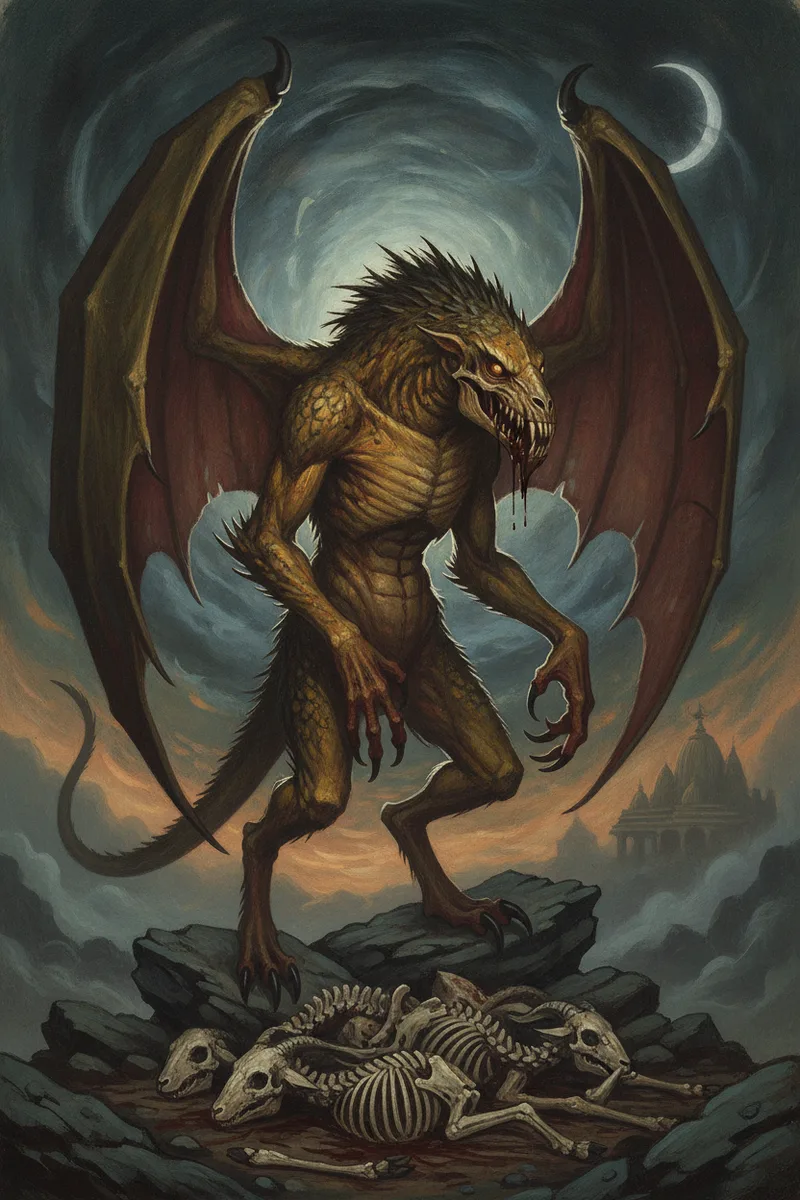
The chupacabra — literally "goat-sucker" in Spanish — is a cryptid blamed for killing livestock, especially goats, and draining them of blood. What makes it unusual among the entities on this site is that it isn't ancient. It has a documented birthdate: March 1995, in Puerto Rico, following a sudden wave of unexplained animal deaths. Within months it had a name, a description, and a continent-spanning following.
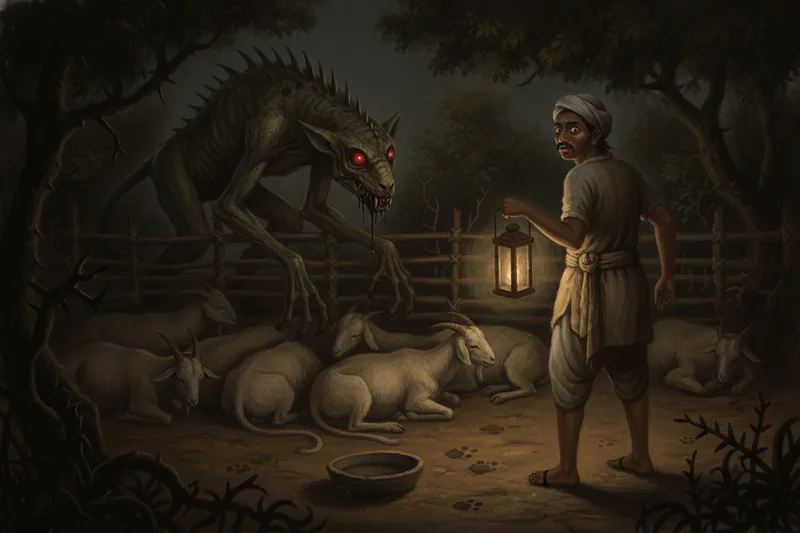
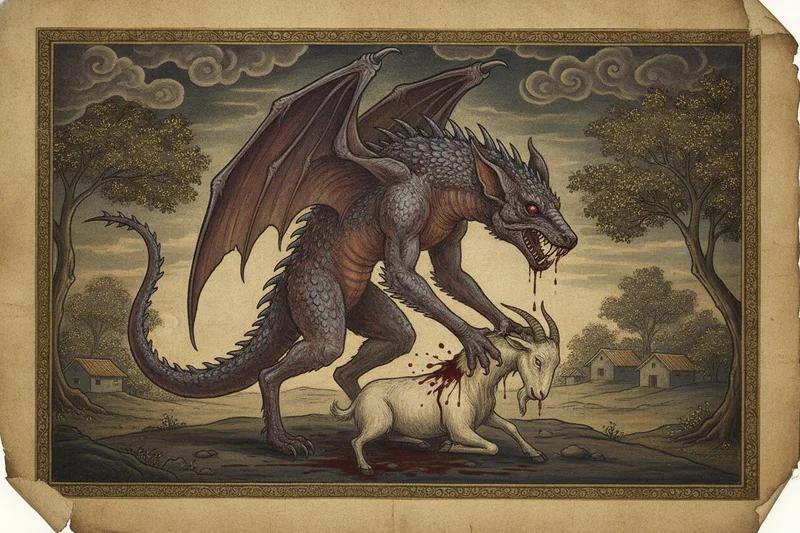
There are, confusingly, two chupacabras. The original Puerto Rican version, described by eyewitness Madelyne Tolentino in August 1995, was reptilian: roughly four feet tall, standing upright, with grey-green skin, large red or black oval eyes, a row of spikes or quills running down its spine, and a habit of hopping like a kangaroo. A second, completely different description emerged later, mostly from Texas and Mexico: a hairless, dog-like or coyote-like quadruped with a pronounced ridge along its back. These are, by most physical descriptions, two different creatures sharing one name — which is itself one of the more interesting facts about this legend.
Why the Chupacabra Is Unsettling
INSTINCT EXPLOITED: THE SAFETY OF YOUR OWN LAND
You keep goats. You've kept goats for years — it's unremarkable work, the kind that doesn't make for stories. You know the sound of your own property at night: the specific creak of the shed door, the particular rustle of wind through the mesquite, the pattern of your dogs' barking when it's nothing and when it's something.
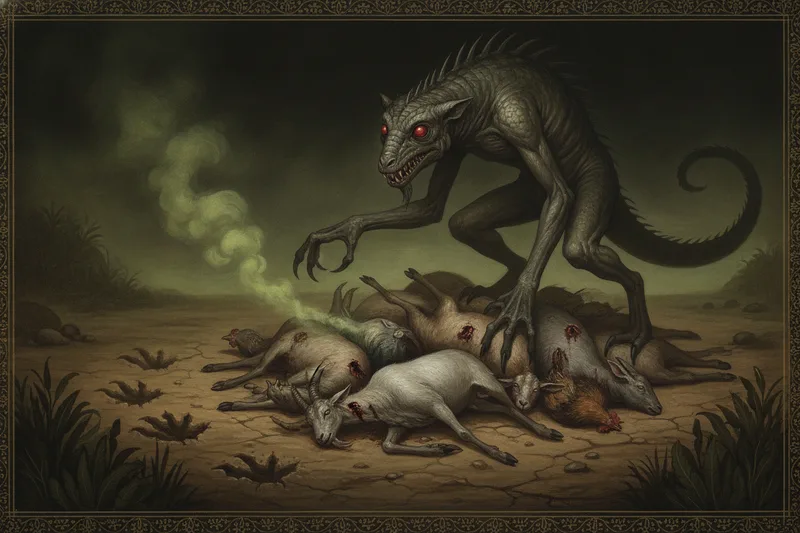
This morning, three goats are dead in the pen. Not mauled — that's the detail that gets you. No torn-open carcasses, no scattered viscera the way a mountain lion or a pack of dogs would leave. Two small puncture wounds on each neck, and almost no blood anywhere. Not in the pen, not on the ground, not on the goats themselves. Whatever did this took the blood with it.
Your dogs didn't bark all night.
You walk the fence line and find a gap low enough for something small to squeeze under — too small, you'd have said, for anything that could kill three full-grown goats in a single night without leaving a mess. There's a smell near the gap, something sour and sulfuric that doesn't match anything you associate with the land you've worked your whole life.
You call your neighbor. He had two chickens taken the same way last month, out past the county line. He doesn't say the word first. You say it first. And once it's said — chupacabra — you both feel a strange kind of relief, because a name, even an absurd one, is better than three dead goats and no explanation at all.
Origin — A Legend We Can Actually Trace
March to August, 1995
The first livestock deaths were reported in Canóvanas, Puerto Rico, in March 1995, eventually totaling roughly 150 animals. The creature itself wasn't publicly described until August, when local eyewitness Madelyne Tolentino came forward with a detailed account: a reptilian, upright, spine-ridged creature with enormous eyes. Her description became the template every subsequent Puerto Rican sighting measured itself against.
The Species Connection
Investigative journalist Benjamin Radford spent five years researching the chupacabra's origin, publishing his findings in Tracking the Chupacabra (University of New Mexico Press, 2011). Radford traced Tolentino's description directly to the 1995 science-fiction horror film Species — partly filmed in Puerto Rico that same year — which featured an alien-human hybrid, Sil, with a strikingly similar build: upright, grey-skinned, large dark eyes, spinal ridges. Tolentino had seen the film before her sighting. Radford's conclusion was not that Tolentino lied, but that she had, in his assessment, genuinely come to believe the creature from the film was real and present in Canóvanas.
Two Creatures, One Name
The chupacabra that spread through Mexico and the southwestern United States from the late 1990s onward looks almost nothing like Tolentino's original description. This version is a hairless, canine or coyote-like quadruped — a completely different body plan from an upright, reptilian biped. Folklorists studying the legend's spread generally treat these as two separate cultural phenomena that happened to converge on the same name, rather than one creature with inconsistent witnesses.
Older Blood-Drinking Traditions Underneath It
Puerto Rico and the wider Caribbean already had blood-draining and vampiric folk figures before 1995 — a detail that likely made the chupacabra concept land quickly and travel fast, since it slotted into fears that already had cultural scaffolding, rather than requiring an entirely new belief structure to take hold.
Rapid Continental Spread
Within a few years of the original Puerto Rico reports, chupacabra sightings and livestock-death attributions had spread through Mexico, much of Central and South America, and the southern United States — an unusually fast diffusion for a cryptid, likely accelerated by 1990s tabloid television and, later, early internet forums.
Appearance & Manifestation
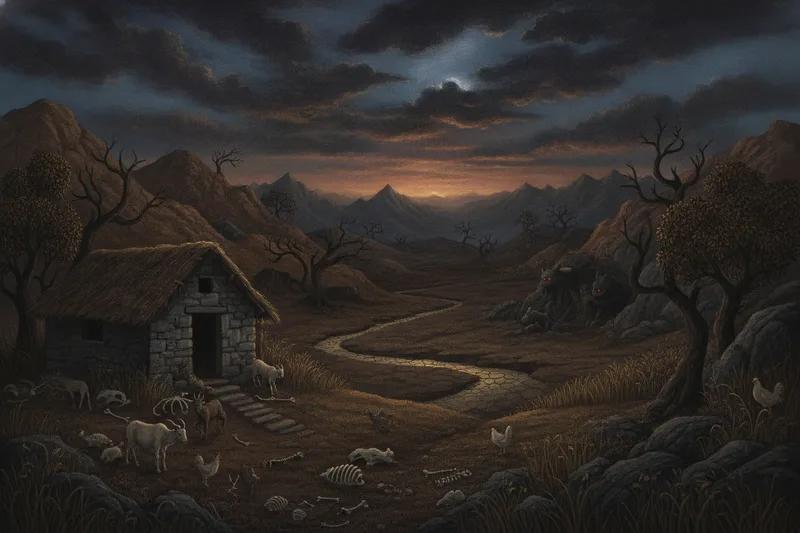
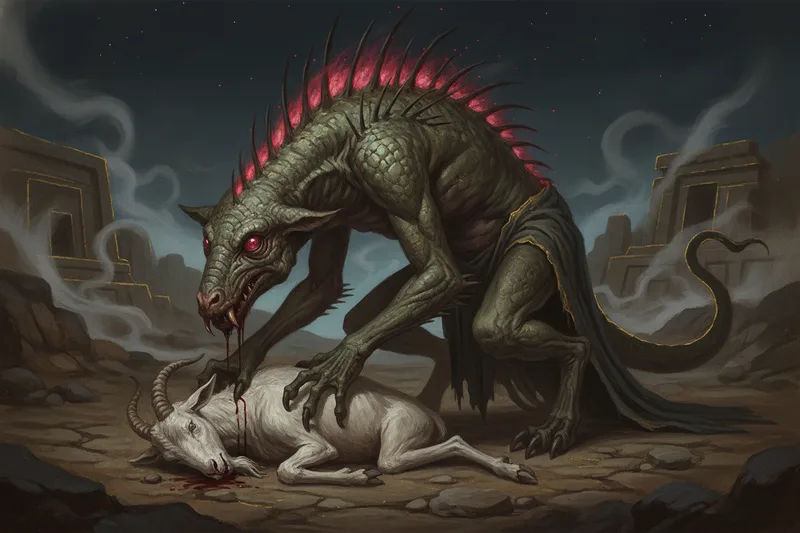
| 👁 Sight (Original, Puerto Rico) | Roughly four feet tall, standing and moving upright, grey-green or grey skin, large red or black oval eyes with no visible pupils, a row of spikes or quills running down the spine, and a hopping, kangaroo-like gait — per Madelyne Tolentino's 1995 account. |
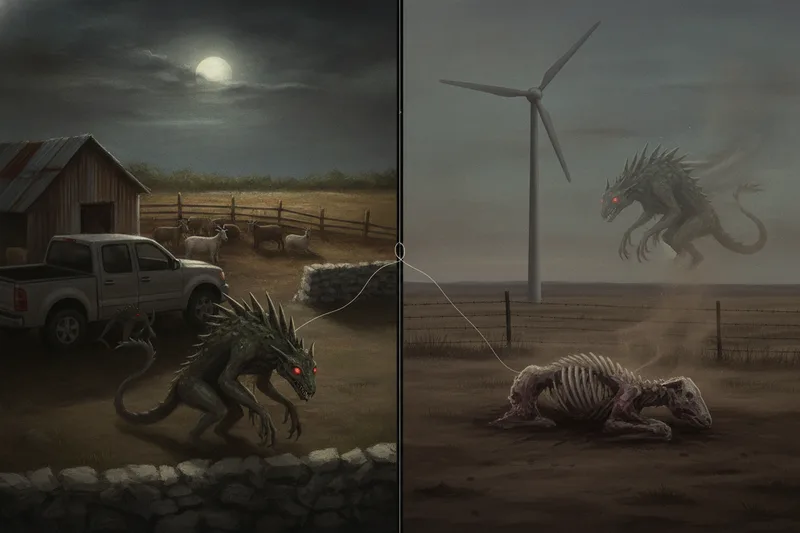
| 🐺 Sight (Later, Texas/Mexico) | A hairless, dog- or coyote-like quadruped with a ridged spine, often described as grey or bluish-grey skin and oversized fangs — the version behind nearly every carcass that has later been DNA-tested as a mangy coyote or dog. |
| 🔊 Sound | Most accounts describe silence as the defining sound — dogs that don't bark, no commotion overnight despite dead livestock discovered in the morning. |
| 🍃 Smell | A foul, sulfuric or rotten-egg smell reported at some attack sites, sometimes described as lingering near fence lines or entry points. |
| 🌑 Time | Overwhelmingly nocturnal, with attacks discovered only the following morning — consistent with real nocturnal predator behavior generally, not a detail unique to the chupacabra. |
| 🏚 Habitat | Rural ranches and farmland, particularly areas with goat, chicken, or rabbit livestock — South Texas brush country has produced the single largest concentration of modern reports and investigated carcasses. |
Three Goats in Canóvanas
This is a composite account representative of the original 1995 Puerto Rico reports, not a report about a specific named individual.
In the months after the first livestock deaths began, a farmer outside Canóvanas started sleeping in a chair by the window instead of her bed. She had lost two goats already — found in the morning with small wounds at the throat and almost no blood on the ground beneath them, which struck her as wrong in a way she couldn't fully articulate. A predator leaves a mess. This left almost nothing.
On the third night, she heard it before she saw anything: a thin, high sound from the pen, not quite an animal distress call and not quite anything else she could name. By the time she reached the window with her flashlight, the pen was already still. In the beam, for less than two seconds, she believed she saw something crouched near the fence — grey, upright, too tall to be a dog, gone the instant the light found it.
She did not go outside. She called her brother, who arrived within the hour with two other men from the next farm over. They found the third goat exactly like the first two. They also found, for the first time, a strange smell near the gap in the fence — sharp, sulfurous, nothing like the usual smell of the pen.
Within a week, farms across the area were reporting the same pattern: goats, chickens, rabbits, found the same way, almost nowhere near each other, all with the same wrongness to the wounds. By the time Madelyne Tolentino's account reached the newspapers that August, this farmer already knew, without needing the name yet, that whatever this was, it was not confined to her own fence line.

Practical Protection for Livestock
⚠ A NOTE BEFORE THESE ⚠
Unlike most entities on this site, chupacabra protection is overwhelmingly practical rather than ritual — because the leading scientific explanation is a real, physical predator
- Use fully enclosed, predator-proof livestock housing at night. — Standard protection against any nocturnal predator — coyotes, foxes, or feral dogs — which is exactly what the leading scientific explanation for most reported chupacabra attacks turns out to be.
- Install motion-activated lighting around pens and coops. — Mangy, disoriented coyotes and dogs — the animals most often misidentified as chupacabras — are typically more cautious around sudden light than a healthy, confident predator would be.
- Check fence lines regularly for gaps large enough for a coyote or dog to pass through. — The entry points found at real investigated attack sites are consistently sized for a canid, not for anything exotic.
- If livestock is killed, have the carcass examined by a vet or wildlife biologist rather than assuming the worst. — Every DNA-tested chupacabra carcass on record has identified as a known canid species — a straightforward diagnostic step that has resolved the mystery in every confirmed case so far.
- Treat any unusually bald, emaciated wild canid near your property as a mange case, not a cryptid, and contact local animal control. — Sarcoptic mange causes severe hair loss, skin crusting, and emaciation in coyotes and dogs — producing exactly the 'hairless monster' silhouette behind the modern Texas/Mexico chupacabra description, and it's a treatable, documented condition, not a supernatural one.
What Makes This Entity Different
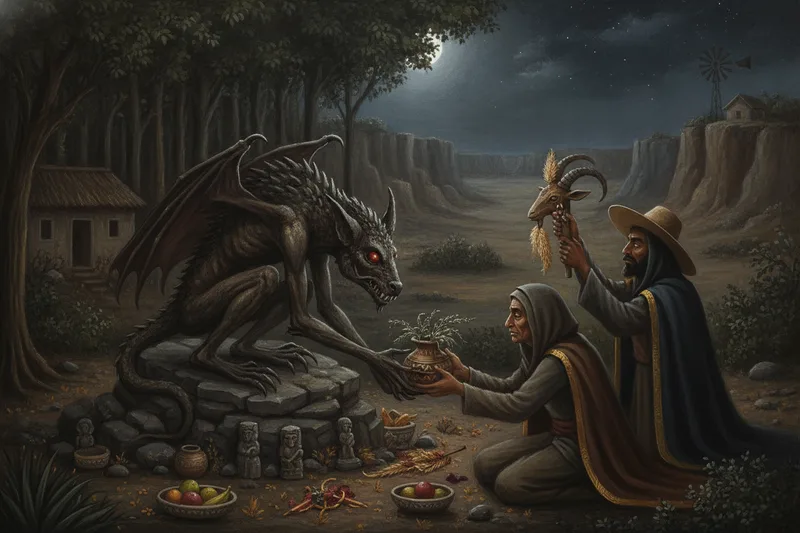
Almost every entity on this site survives because its origin is unrecoverable — centuries of oral retelling with no single starting point to point to. The chupacabra is the opposite: we can name the month, the eyewitness, and even the movie that likely shaped the original description. And yet the belief didn't collapse once the origin became known. Livestock really do keep dying under strange circumstances. Ranchers really do find animals drained and unmarked by any obvious predator. The name survived the debunking because it was never really about the creature — it was always a fast, satisfying label for a real, recurring, unsettling problem: something is killing my animals, and I don't know what.
What Does a Chupacabra Want?
Within the folklore, the chupacabra's motive is simple and animal: hunger, specifically for blood rather than flesh, which is why carcasses are typically found with the body otherwise intact. This is a meaningfully different motive structure from almost every other entity on this site, most of which want power, revenge, or release from an unfinished death. The chupacabra wants exactly what a predator wants — nothing more complicated than survival.
The scientific explanation, where confirmed, points to a far more mundane and arguably sadder motive: a mangy, weakened coyote or dog, no longer fast or strong enough to catch wild prey, turning to the easiest available food source — penned livestock close to human homes.
Who Is Most at Risk
- Rural livestock owners, especially those keeping goats, chickens, or rabbits in outdoor or minimally secured enclosures
- Properties near brush country or undeveloped land, where coyote populations (healthy or mange-afflicted) are already present
- Areas with an active, recent mange outbreak in the local coyote or wild dog population
- Communities already primed by local news coverage or social media to attribute any unusual livestock death to the chupacabra specifically, rather than investigating the ordinary explanation first
Preventive Measures
| Offering | Purpose |
|---|---|
| Secure Enclosures | Fully enclosed pens and coops, checked regularly for gaps, remain the single most effective protection against the real predators behind the legend. |
| Lighting and Deterrents | Motion-activated lights and noise deterrents are standard, practical measures against nocturnal predators generally. |
| Veterinary and Wildlife Authority Involvement | Contacting a vet or wildlife biologist after any unexplained livestock death provides a real diagnosis rather than an open-ended mystery — and has, in every confirmed Texas case, identified a known animal rather than anything unexplainable. |
| Community Reporting | Comparing notes with neighboring properties, as happened in the original 1995 Puerto Rico outbreak, remains useful for spotting real patterns — such as a mange outbreak moving through a local coyote population — rather than independently reinventing the same folklore explanation farm by farm. |

Who Actually Investigates
Wildlife Biologist — The relevant expert for identifying the actual animal involved — able to recognize mange, injury patterns, and species-specific tracks or bite marks that distinguish a known predator from an unexplained one.
Veterinary Pathologist — Can examine a carcass for cause of death and species identification, as was done in the DNA-tested Texas cases that consistently returned coyote, dog, or coyote-dog hybrid results.
Local Animal Control / Extension Service — The practical first call for an ongoing livestock-predation problem — agencies like Texas A&M AgriLife Extension have directly investigated and published findings on specific chupacabra cases.
The Key Difference From Every Other Entity Here — There is no ritual specialist for a chupacabra, because the leading explanation isn't spiritual. The 'healer' for this entity is closer to a diagnostician than a shaman — which is itself the most distinctive thing about this legend compared to everything else on this site.
What If You Dream of a Chupacabra?
| Symbol | Meaning | |
|---|---|---|
| 🐐 | Finding Dead Livestock | Commonly interpreted outside the strict folklore as anxiety about an unseen drain on your resources or energy — something depleting you steadily without an obvious, visible cause. |
| 🚧 | A Gap in a Fence | Often read as a feeling that your usual boundaries or defenses have a specific, identifiable weak point you haven't yet addressed. |
| 👂 | Silence Where There Should Be Noise | A dream motif frequently tied to a sense that a warning system you rely on — a person, a habit, an instinct — has failed to alert you to something before it was too late. |
| 🔦 | Catching a Glimpse That Vanishes in Light | Often interpreted as the frustration of almost understanding a problem, only for the answer to disappear the moment you try to examine it directly. |
The Chupacabra in Culture
Benjamin Radford, Tracking the Chupacabra (2011): A five-year investigative book tracing the legend's origin to Madelyne Tolentino's 1995 account and its likely source in the film Species — the most thorough real investigation of this specific cryptid's origin.
1990s–2000s Tabloid and Talk-Show Coverage: Spanish and English-language tabloid television significantly accelerated the chupacabra's spread across Latin America and the southern United States in the years immediately following 1995.
Texas A&M AgriLife Extension coverage: University extension researchers have directly examined and published on specific Texas 'chupacabra' carcasses, consistently identifying known canid species affected by mange.
Modern pop culture appearances: The chupacabra has appeared across American television, animation, and horror media since the late 1990s, almost always drawing on the hairless-canine Texas/Mexico description rather than Tolentino's original reptilian account.
Cross-Cultural Patterns
Skinwalker · Wendigo · Mothman · Jersey Devil · Flatwoods Monster
| Origin point is specifically datable | Yes — March/August 1995 |
| Consistent single physical description | No — two unrelated descriptions share one name |
| Leading explanation is supernatural | No — documented mange/canid identification in confirmed cases |
| Primarily targets humans | No — livestock-focused |
| Requires ritual countermeasure | No — practical/veterinary response |
Global Equivalent: The closest parallel isn't another cryptid so much as the broader category of livestock-predation folklore found worldwide — any tradition where unexplained animal deaths get attributed to a named supernatural predator before a mundane explanation (disease, a known predator species) is identified. What makes the chupacabra distinctive is how recent and well-documented its own debunking is, compared to older traditions where the original triggering event is long lost to history.
In Culture — Books, Investigation, Media
| Type | Title | Description |
|---|---|---|
| Investigative Nonfiction | Benjamin Radford, Tracking the Chupacabra (University of New Mexico Press, 2011) | The definitive investigative account, tracing the original description to the 1995 film Species and Madelyne Tolentino's eyewitness account. |
| Academic/Extension | Texas A&M AgriLife Extension coverage of DNA-tested specimens | Direct scientific examination of specific Texas 'chupacabra' cases, consistently resolving to coyote, dog, or coyote-dog hybrid with mange. |
| Television | 1990s–2000s tabloid and cable coverage | A major driver of the legend's rapid spread across Latin America and the southern United States. |
ACCURACY RATING: HIGH — ORIGIN AND MOST CONFIRMED CASES ARE DOCUMENTED AND TRACEABLE, UNUSUALLY SO FOR A CRYPTID
Is the Chupacabra Still Believed In?
- Yes, and the belief persists even though its 1995 origin and the film-inspired original description are well documented — a reminder that knowing where a legend came from doesn't automatically stop it being used to explain new events.
- Every DNA-tested 'chupacabra' carcass from the well-known Texas cases (Elmendorf, Cuero, Rockdale) has identified as a coyote, dog, or coyote-dog hybrid, almost always affected by severe sarcoptic mange — a documented, physical, treatable condition rather than anything supernatural.
- Despite this, new livestock-death reports continue to be labeled chupacabra rather than investigated as mange or ordinary predation first, partly because the name is faster and more satisfying than waiting for a diagnosis.
- The legend's two incompatible physical descriptions (Puerto Rico's reptilian biped vs. the Texas/Mexico hairless canine) have never been reconciled by believers, which folklorists generally take as evidence that these are two separate cultural phenomena that happened to converge on one name rather than consistent sightings of one creature.
Investigation & Documentation
- Benjamin Radford — Tracking the Chupacabra (University of New Mexico Press, 2011) — A five-year investigation tracing the chupacabra's origin to Madelyne Tolentino's 1995 Puerto Rico sighting and the film Species, which she had seen shortly before her account.
- Skeptical Inquirer coverage of the chupacabra's origin and spread — Ongoing documentation and analysis of the legend's development, including the split between the original reptilian description and the later canine version.
- Texas A&M AgriLife Extension reporting on DNA-tested Texas specimens — Direct scientific identification of specific named 'chupacabra' cases (including the Elmendorf, Cuero, and Rockdale carcasses) as mange-afflicted coyotes, dogs, or hybrids.
The chupacabra occupies a genuinely unusual place in this site's catalogue: almost every detail of its creation is known, dated, and traceable to a specific person and a specific movie — and yet the belief didn't evaporate once that became public knowledge. That persistence is the actual subject worth studying here, more than the creature itself. Rural communities facing real, recurring, unexplained livestock losses reached for the fastest available explanatory framework, and once the name existed, it proved more durable than the mystery that birthed it. The chupacabra isn't really a story about a monster. It's a case study in how quickly a culture can manufacture, adopt, and keep a legend running long after the specific triggering event has been fully explained.
Frequently Asked Questions
▶What is a chupacabra?
The chupacabra ("goat-sucker") is a cryptid blamed for killing livestock, especially goats, and draining them of blood. It originated in Puerto Rico in 1995, where it was first described as an upright, reptilian creature; a separate, later description from Texas and Mexico depicts a hairless, dog-like animal instead.
▶Is a chupacabra real?
A supernatural blood-draining creature has never been confirmed. What is real is that livestock keep dying under unsettling circumstances, and that every DNA-tested carcass from the well-documented Texas cases has identified as a coyote, dog, or coyote-dog hybrid, almost always suffering from severe sarcoptic mange, which causes the hairless, 'wrong-looking' appearance behind most modern sightings.
▶What does a chupacabra look like?
There are two different, largely incompatible descriptions. The original 1995 Puerto Rico version is reptilian and upright: roughly four feet tall, grey-green skin, large red or black eyes, spinal spikes, and a kangaroo-like hop. The later Texas/Mexico version is a hairless, coyote- or dog-like quadruped — the version behind nearly every investigated carcass.
▶Where did the chupacabra originate?
In Canóvanas, Puerto Rico, in 1995, following a wave of roughly 150 unexplained livestock deaths. The creature's first detailed public description came from eyewitness Madelyne Tolentino that August — a description investigator Benjamin Radford later traced to the 1995 film Species, which Tolentino had seen shortly before her sighting.
▶Is a chupacabra a dog?
In the overwhelming majority of physically examined and DNA-tested cases from Texas, yes — specifically a coyote, dog, or coyote-dog hybrid suffering from sarcoptic mange, a skin condition that causes severe hair loss and emaciation, producing an appearance unsettling enough to be mistaken for an unknown creature.
▶What does the chupacabra symbolize?
Beyond the literal legend, the chupacabra has become a broader cultural shorthand for an unseen, draining threat — something quietly taking a toll on a community or a resource before anyone can identify the real cause.
Explore More
Related Spirits
Skinwalker · Wendigo · Mothman · Jersey Devil · Flatwoods Monster
Explore Further
Stories Are Being Summoned
One ghost story per week. Every Tuesday at midnight.
Comments
Loading comments…