Boba Jinn
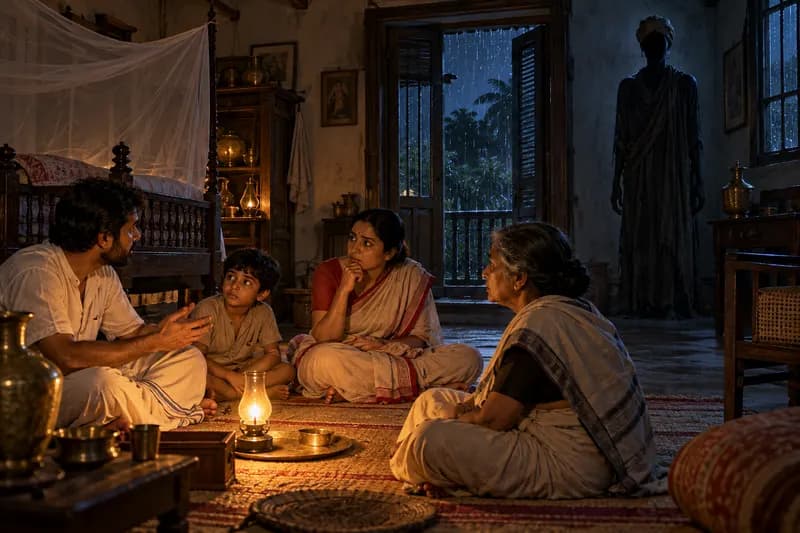
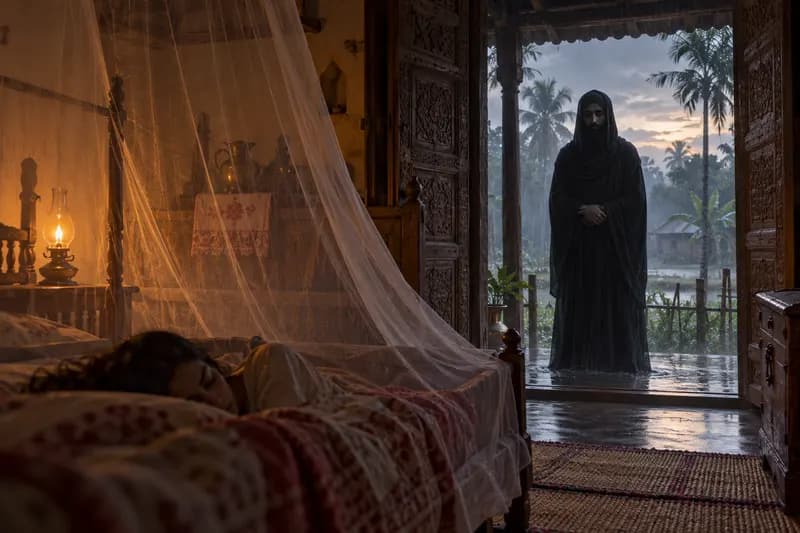
You wake up. Something is sitting on your chest. You cannot move. You cannot scream. You cannot breathe. It has no face — and it says nothing at all.

- What Is a Boba Jinn?
- Why the Boba Jinn Is Terrifying
- Origin — How It Came to Exist
- Appearance & Manifestation
- The Schoolteacher of Murshidabad
- The Rules — How to Survive
- What They Don't Tell You
- What Does the Boba Jinn Want?
- You're Most at Risk If...
- Offerings & Appeasement
- The Healer
- What If You Dream of a Boba Jinn?
- The Boba Jinn in Art History
- Cross-Regional Patterns
- In Culture — Movies, Books, Games
- Is the Boba Jinn Still Real?
- Expert & Academic Context
- If You Encounter a Boba Jinn
- Frequently Asked Questions
- Explore More
| Boba Jinn | |
|---|---|
| Also Known As | Boba Jinni, Boba Djinn, the Mute Jinn, the Silent Jinn |
| Script | বোবা জিন (Bengali script) |
| Pronunciation | BOH-ba JINN (বো-বা জিন) |
| Region | Bengal (West Bengal, Bangladesh); Muslim-majority villages across the Bengal delta |
| Category | Sleep Paralysis Entity / Islamic Jinn |
| Danger Level | Dangerous |
| Fear Method | Nocturnal chest compression, paralysis induction, suffocation |
| Warning Sign | Waking unable to move or speak; a pressing weight on the chest; a dark shape at the edge of vision |
| First Documented | Oral tradition — pre-colonial Bengali Islamic folklore; no single canonical text, transmitted through village accounts across generations |
| Still Believed? | Yes — extremely common in rural Bengal; almost every household has a Boba Jinn story; active belief in both West Bengal and Bangladesh |
| Related | Jinn · Ifrit · Churail (Islamic) · Shaitaan · Hamzad · Khabees |
What Is a Boba Jinn?
The Boba Jinn (বোবা জিন) is a supernatural entity from Bengali Islamic folklore believed to be responsible for sleep paralysis — the terrifying experience of waking up unable to move, speak, or breathe while sensing a malevolent presence in the room. "Boba" means "mute" or "dumb" in Bengali, and "Jinn" comes from the Islamic tradition of invisible beings created from smokeless fire. The name is precise: this is the silent jinn, the one that does not speak, does not announce itself, does not negotiate. It simply arrives, sits on your chest, and presses down.
What makes the Boba Jinn extraordinary is that it sits at the exact intersection of two vast belief systems — the Islamic cosmology of Jinn (beings of free will made from fire, capable of good and evil) and the universal human experience of sleep paralysis, which occurs across every culture on Earth. Bengali Muslims did not invent sleep paralysis. They gave it a name, a shape, and a set of rules. And in doing so, they created one of the most widely experienced supernatural encounters in South Asian folklore — because unlike most entities in this database, almost everyone has met the Boba Jinn.
Why the Boba Jinn Is Terrifying
INSTINCT EXPLOITED: THE BODY'S BETRAYAL
You are asleep. You are in your own bed, in your own room, in your own house. This is the safest place you know.
Then you wake up. Except you don't — not fully. Your eyes open. You can see the ceiling. You can see the familiar darkness of your room. You can hear your own breathing, shallow and fast. But your body is gone. Your arms will not lift. Your legs will not move. Your mouth will not open. You are locked inside yourself.
And then you feel it. Weight. Not on the blanket — on you. Something heavy, formless, pressing down on your sternum. The pressure builds. Your lungs shrink. Each breath is shallower than the last. You try to scream and nothing comes out. You try to thrash and nothing moves. You are fully conscious and completely trapped.
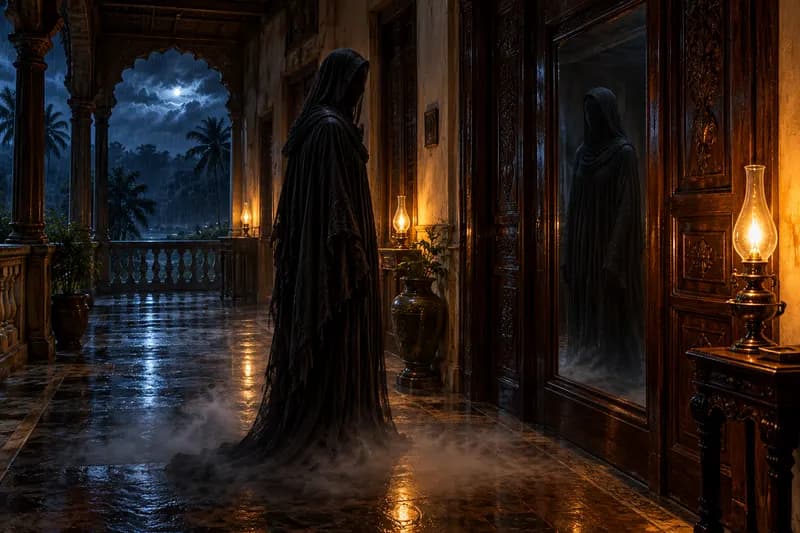
At the edge of your vision — because you cannot turn your head — there is something. A shape. Dark, dense, without features. It doesn't move. It doesn't need to. It is already exactly where it needs to be: on top of you.
This is what makes the Boba Jinn different from every other entity. The Churel lures. The Vetala argues. The Pishacha hunts. The Boba Jinn takes away your ability to respond. It removes your voice, your movement, your agency. You are reduced to a pair of open eyes and a shrinking pair of lungs. That's all you are.
And it says nothing. That is the worst part. It says absolutely nothing. A monster that screams can be screamed back at. A monster that speaks can be reasoned with. A monster that is silent — that simply sits and presses and waits — leaves you alone with your own terror, which is always worse than anything it could say.
Origin — How It Came to Exist
The Islamic Root
In Islamic theology, Jinn are beings created by Allah from smokeless fire — a parallel creation to humans (made from clay) and angels (made from light). Jinn have free will, can be Muslim or non-Muslim, good or evil, and exist in a world that overlaps with ours but remains largely invisible. The Quran devotes an entire surah (Surah Al-Jinn, 72) to them. Bengali Islam inherited this cosmology and adapted it to local experience — producing region-specific Jinn types that reflect Bengali fears, landscapes, and nightly terrors.
The Bengali Adaptation
"Boba" (বোবা) means mute, silent, unable to speak. Bengali Muslims named this particular Jinn after its defining characteristic: it does not communicate. Unlike other Jinn in Islamic tradition — which can speak, possess, bargain, or even convert — the Boba Jinn is defined by absence. No voice, no demands, no negotiation. It arrives in silence, attacks in silence, and leaves in silence. The naming is a work of folk genius — it captures both the entity's nature and the victim's experience, because the person being attacked also cannot speak.
The Sleep Paralysis Connection
Sleep paralysis is a medically documented phenomenon that occurs when the brain wakes before the body's REM-atonia (muscle paralysis during dreaming) has fully lifted. The person is conscious but cannot move, often experiences chest pressure, difficulty breathing, and vivid hallucinations of a presence in the room. It affects roughly 8% of the global population at least once. Every culture has an explanation: the "Old Hag" in Newfoundland, the "Kanashibari" in Japan, the "Mare" in Scandinavia (from which "nightmare" derives). The Boba Jinn is Bengal's answer.
Why It Became So Widespread
The Boba Jinn belief is almost universal in rural Bengal because sleep paralysis itself is almost universal. Unlike entities that require specific locations (cremation grounds, crossroads, rivers) or specific victims (pregnant women, travelers), the Boba Jinn can visit anyone, anywhere, any night. It needs no special conditions. You just need to fall asleep. This makes it the most democratic of all supernatural experiences — it crosses class, gender, age, and education. The rickshaw-wallah and the schoolteacher have the same Boba Jinn story.
The Theological Tension
The Boba Jinn sits at an interesting theological boundary. Orthodox Islamic scholars might classify all Jinn encounters under general Jinn theology — beings of free will who may occasionally trouble humans. But the folk tradition is more specific and more visceral. Village beliefs about the Boba Jinn include details that don't appear in any Islamic text: that it targets people who sleep on their backs, that it is repelled by reciting Ayatul Kursi, that it feeds on fear itself. This is where scripture meets experience, where theology meets the 3 a.m. terror of a body that won't obey.
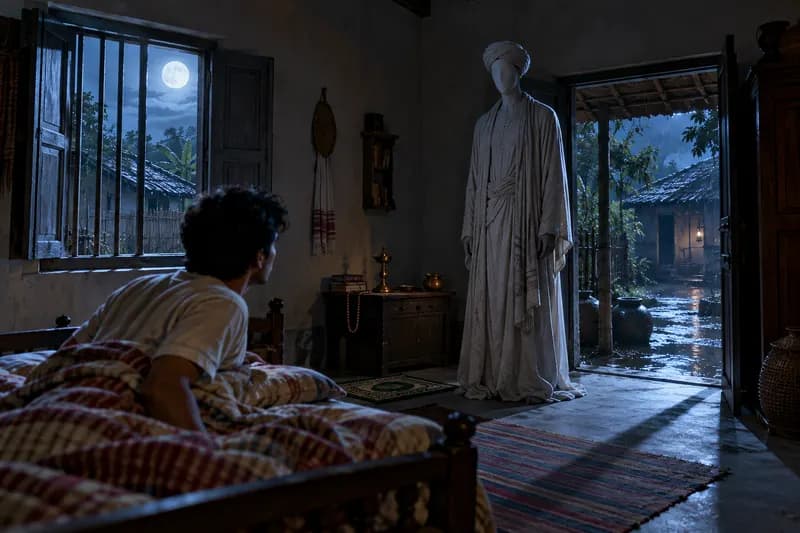
Appearance & Manifestation
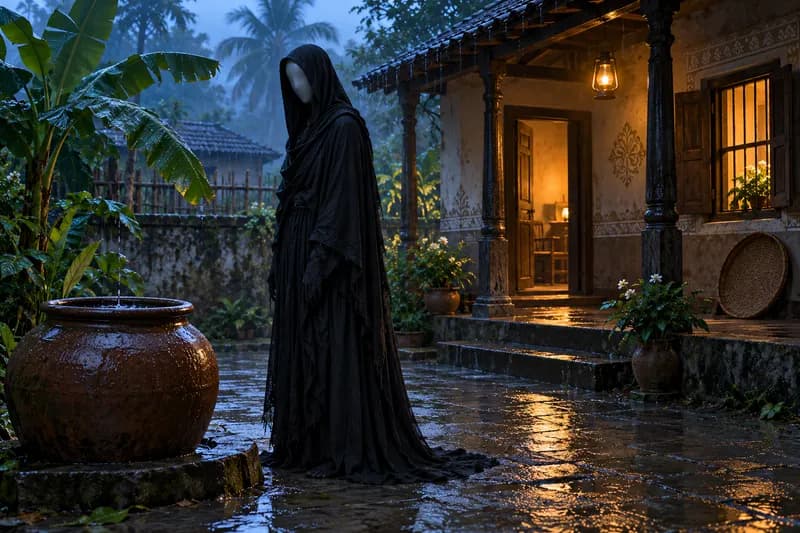
| 👁 Sight | Rarely seen clearly — perceived as a dark, dense shadow at the periphery of vision. Some accounts describe a formless mass, others a humanoid silhouette without features. The face, if it has one, is never visible. Many victims report seeing nothing at all — only feeling the weight. Those who do see something describe it as darker than the darkness around it. |
| 🔊 Sound | Silent. Completely, absolutely silent. This is the defining characteristic. No breathing, no footsteps, no voice. The only sounds during an encounter are the victim's own panicked heartbeat and the increasingly desperate attempts to breathe. Some report a faint buzzing or ringing, but this may be the auditory hallucination that accompanies sleep paralysis itself. |
| 🍃 Smell | No consistent scent reported. Some accounts mention a vague staleness — the smell of a room that has been closed too long, air that has been breathed too many times. But most victims report no smell at all. The Boba Jinn is sensory deprivation made manifest. |
| ❄ Temperature | Heavy, oppressive warmth — not cold. Unlike many entities in this database, the Boba Jinn brings heat, not chill. The sensation is of being smothered under a weight that generates its own suffocating warmth. The room feels close, airless, thick. |
| 🌑 Time | Between 2 a.m. and 4 a.m. — the deepest part of the night, when REM sleep is most intense and the body's paralysis mechanisms are most active. Never at dusk or dawn. The Boba Jinn is a creature of absolute night. |
| 🏚 Habitat | Your bedroom. That is the horror. The Boba Jinn does not inhabit cremation grounds, rivers, crossroads, or forests. It inhabits the space where you sleep. It requires no special geography — only a sleeping human body. The safest place becomes the most dangerous. |
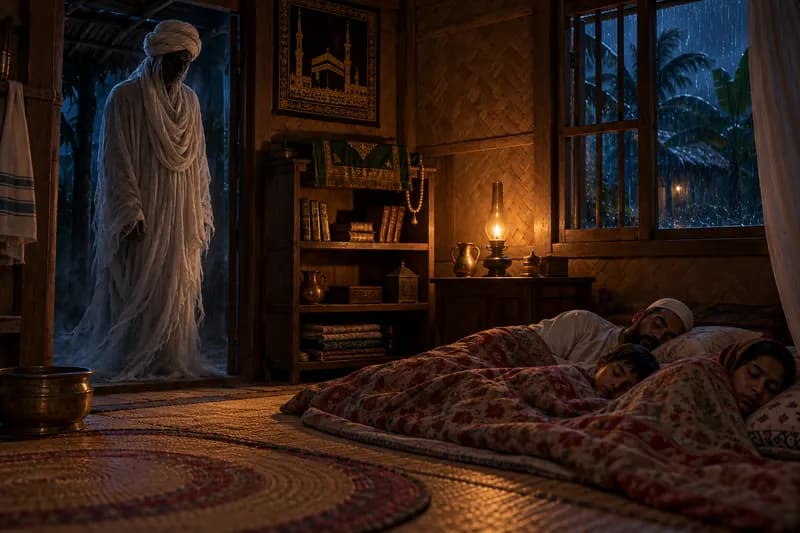
The Schoolteacher of Murshidabad
Rafiq Molla was a schoolteacher in a village outside Berhampore, in the Murshidabad district of West Bengal. He was thirty-four years old, educated, rational, and mildly embarrassed by the beliefs of his neighbors. When his mother told him to recite Ayatul Kursi before sleeping, he did it to keep her quiet, not because he believed a verse from the Quran could stop a shadow from sitting on his chest.
The first time it happened, he was twenty-six. He woke up — or thought he woke up — at some hour he could not identify. The room was exactly as it always was. The tin roof. The slow fan. The rectangle of moonlight on the floor from the window that never closed properly. Everything normal. Except he could not move.
He tried his right hand first. Nothing. Then his left. Nothing. His legs were stone. His jaw was locked. He could breathe, but barely — shallow pulls of air that seemed to stop halfway down his throat. And there was weight. On his chest. Not sharp, not painful — just heavy. Like someone had placed a sack of rice on his sternum and walked away.
He could see the ceiling. He could see the fan. He could see, at the very edge of where his eyes could reach without turning his head, a dark patch near the door that he did not remember being there when he fell asleep. It was not moving. It was not shaped like anything specific. But it was there, and it was wrong.
The whole thing lasted perhaps ninety seconds. Then his body released — all at once, like a cramp breaking — and he sat up gasping, soaked in sweat. The dark patch was gone. The room was normal. His heart was hammering so hard he could feel it in his teeth.
He told no one. A schoolteacher does not tell people he was visited by a Boba Jinn.
It happened again three weeks later. And again a month after that. Always the same: the paralysis, the weight, the dark shape, the silence. Always between 2 and 4 a.m. Always when he was sleeping on his back.
By the fourth time, Rafiq stopped being embarrassed about his mother's advice. He began reciting Ayatul Kursi before sleeping — not loudly, not performatively, but quietly, under his breath, the way his mother had always done it. He turned onto his side before closing his eyes.
The visits became less frequent. They did not stop entirely — once or twice a year, he would wake up frozen, the weight pressing — but they became rarer. When his students asked him, years later, whether he believed in Jinn, he gave a careful answer: "I believe in what I have experienced. And I have experienced something I cannot explain."
His mother, when told this story, was not surprised. "The Boba Jinn does not care if you believe in it," she said. "It comes anyway. The Ayatul Kursi is not for the Jinn. It is for you — so you remember you are not alone in the dark."
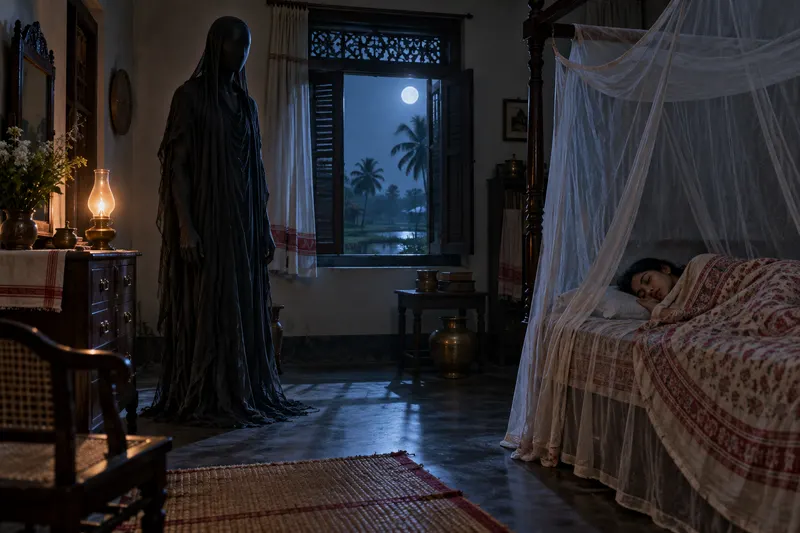
The Rules — How to Survive
☠ WARNING ☠
Seven rules for surviving a Boba Jinn encounter
- Do not sleep on your back. — The Boba Jinn attacks sleepers in the supine position. Sleep on your side. This is the single most consistent piece of folk advice across all of Bengal — and it aligns with medical evidence that sleep paralysis is more common when sleeping face-up.
- Recite Ayatul Kursi (Verse 2:255 of the Quran) before sleeping. — The most powerful protective verse in Islamic tradition against Jinn. Spoken before sleep, it creates a barrier. This is not optional advice in Bengali Muslim households — it is as routine as locking the door.
- If paralyzed, move your smallest extremity first — a toe, a finger. — Bengali folk wisdom says the Boba Jinn's grip is total but fragile. If you can break it at any point — even a single finger — the whole hold shatters. Focus every ounce of will on moving one toe. Medical advice for sleep paralysis says the same thing.
- Do not attempt to look at it directly. — The dark shape at the edge of your vision is the Boba Jinn. If you strain to see it — if you focus your attention on it — the paralysis deepens and the pressure intensifies. Close your eyes. The Jinn feeds on your attention, not your body.
- Keep the room ventilated. Do not sleep in a sealed room. — Stale, airless rooms are believed to attract the Boba Jinn. An open window, a working fan, moving air — these are practical protections. The connection between stuffy rooms and sleep disturbance is, again, both folk wisdom and medical fact.
- Do not eat heavily before sleeping. — A full stomach pressing on the diaphragm makes breathing harder in sleep and is associated with more intense sleep paralysis episodes. Bengali grandmothers have been saying this for centuries.
- If someone near you is frozen — shake them awake. Do not hesitate. — The Boba Jinn flees when the victim is roused by an external force. If you see someone rigid in bed, eyes open but unresponsive, grab their shoulder and shake hard. You are not interrupting sleep. You are breaking a siege.
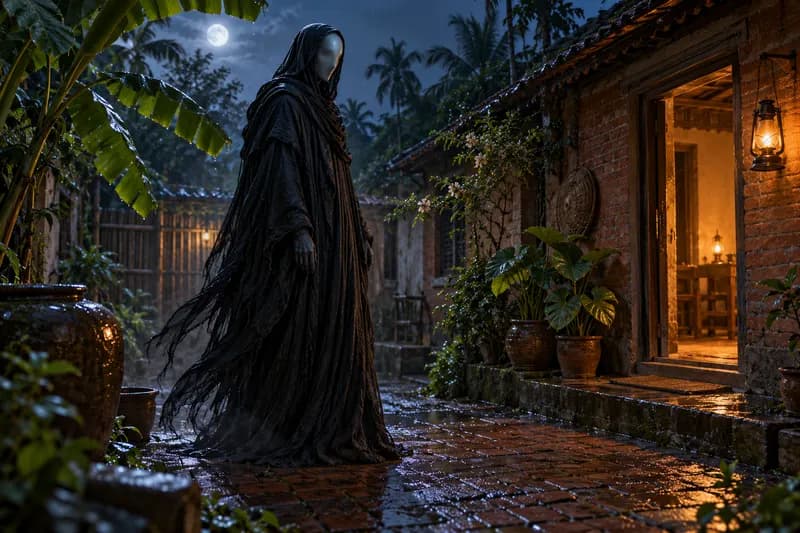
What They Don't Tell You
The Boba Jinn is not random. Ask anyone in rural Bengal who has experienced it repeatedly, and a pattern emerges: it comes during periods of stress, exhaustion, grief, and anxiety. It comes when you are sleeping badly, eating poorly, living under pressure. The folk tradition and the medical literature converge perfectly here — sleep paralysis is triggered by sleep deprivation, stress, irregular schedules, and sleeping supine. The Boba Jinn is, in a very real sense, your body's warning system wrapped in the language of the supernatural. It is telling you something is wrong. The terror is real. The message underneath it is: *you are not taking care of yourself, and the night knows it.*
What Does the Boba Jinn Want?
The Boba Jinn doesn't want anything. That is why it is terrifying.
Most entities in folklore have motivation — revenge, hunger, justice, territory. The Churel wants to punish the men who wronged her. The Vetala wants intellectual engagement. The Pishacha wants flesh. You can understand them. You can negotiate. You can give them what they want.
The Boba Jinn has no agenda. It does not speak, does not demand, does not bargain. It arrives, presses, and leaves. There is no transaction. No communication. No reason you can identify and address. This is what makes it so deeply unsettling — it violates the human need for why.
In Islamic theology, some Jinn are simply chaotic — entities that trouble humans not out of malice but out of indifference, the way a person might step on an anthill without noticing. The Boba Jinn may be this: a being passing through your space, briefly pressing against the boundary between its world and yours, unaware or uncaring that it is crushing the breath out of you.
Or — and this is the interpretation that keeps people awake — it does know. It knows exactly what it is doing. It just has nothing to say about it.
You're Most at Risk If...
- You sleep on your back — the single strongest predictor in both folk tradition and medical literature
- You are sleep-deprived, stressed, or grieving
- You sleep in a hot, airless, enclosed room
- You eat heavily before bed
- You have an irregular sleep schedule — shift workers, students during exams, new parents
- You have experienced sleep paralysis before — recurrence rates are high
Offerings & Appeasement
| Offering | Purpose |
|---|---|
| Quranic Recitation | Ayatul Kursi (2:255) before sleep is the primary protection. Some families also recite the last two surahs of the Quran (Al-Falaq and An-Nas) — the "Mu'awwidhatain" or protective surahs — and blow gently over the sleeping person. This is not ritual magic. It is standard Islamic practice for protection against unseen harm. |
| Taweez (Amulet) | A small written charm, usually a Quranic verse inscribed on paper and sealed in a metal or leather case, worn around the neck or placed under the pillow. Common across Bengali Muslim households. The taweez for Boba Jinn specifically often contains Ayatul Kursi or verses from Surah Al-Jinn. |
| Salt and Iron | Folk (non-Islamic) protections that persist in syncretic Bengali practice: a pinch of salt under the pillow, an iron object (a knife, a key, a nail) placed near the bed. These are pre-Islamic Bengali beliefs that survived conversion and merged with Jinn lore. |
| Communal Du'a | In severe cases — when the Boba Jinn visits the same person repeatedly — a family gathering for collective prayer (du'a) is organized. The community prays together for the affected person's protection. This is as much social support as spiritual protection — it tells the victim they are not alone. |

The Healer
Huzur / Maulvi — The local Islamic cleric is the first line of defense. He will prescribe specific Quranic recitations, prepare a taweez, and may perform a ruqyah (spiritual healing through Quranic recitation over the affected person). This is considered legitimate Islamic practice, not folk superstition.
Ojha (Folk Healer) — In syncretic Bengali practice, the ojha combines Islamic prayer with older folk methods — herbal preparations, specific sleeping positions, dietary advice, and rituals that predate Islam in Bengal. The ojha is practical where the maulvi is theological.
Fakir — Wandering Sufi mystics who are believed to have power over Jinn through their spiritual attainment. A fakir's blessing is considered especially potent against the Boba Jinn. In some villages, a fakir passing through will be specifically asked to pray over someone who has been experiencing repeated attacks.
The Family Itself — In most cases, the first and most effective response is the family. A mother reciting over her child. A wife shaking her husband awake. A grandmother teaching the grandchild to sleep on their side. The Boba Jinn is fought at the household level, with the tools the household already has: prayer, vigilance, and the refusal to let someone suffer alone in the dark.
What If You Dream of a Boba Jinn?
| Symbol | Meaning | |
|---|---|---|
| 🫁 | Pressure on Your Chest | You are carrying a burden you have not named. Something is pressing on you — a secret, a debt, a responsibility you cannot escape — and you have been absorbing the weight without speaking about it. The Boba Jinn in your dream is the weight you refuse to acknowledge. |
| 🤐 | Unable to Scream | You have something to say and no way to say it. A truth you cannot speak, a warning you cannot give, a feeling you cannot express. The muteness is the message — you are being silenced, either by others or by yourself. |
| 👤 | A Dark Shape Without Features | An unknown threat. Something in your life that you sense is wrong but cannot identify — a relationship, a situation, a creeping problem that has no face yet. The shapelessness is the danger: you cannot fight what you cannot name. |
| 🔓 | Breaking Free from Paralysis | You are about to overcome something that has held you in place. The moment of release — when the body finally unlocks — represents a breakthrough. The dream is not the Boba Jinn's power. It is yours. |
The Boba Jinn in Art History
Pre-Modern — Bengali Islamic Manuscript Tradition: Unlike Hindu entities with rich temple-sculpture traditions, the Boba Jinn exists almost entirely in oral culture. Islamic restrictions on depicting supernatural beings mean there are no canonical visual representations. The Boba Jinn lives in words, not images — which makes it, paradoxically, more frightening. Everyone who has experienced it describes it differently, because there is no agreed-upon image to anchor to.
19th Century — Colonial Ethnographies: British colonial administrators and ethnographers documented Bengali Muslim beliefs about Jinn, including sleep-related entities. These accounts appear in district gazetteers and folklore collections — clinical, detached descriptions of an experience the writers clearly did not take seriously, which makes them useful as evidence precisely because they were not trying to be persuasive.
20th Century — Bengali Folk Art (Patachitra): The scroll-painting tradition of Bengal occasionally depicts Jinn encounters, though the Boba Jinn specifically is rare in visual form. When it appears, it is rendered as a dark, amorphous cloud pressing down on a sleeping figure — the visual language borrowing from both Islamic geometric abstraction and Hindu figurative tradition.
Contemporary — Sleep Paralysis Art Globally: The most famous visual representation of the Boba Jinn experience was painted in 1781 by Henry Fuseli — "The Nightmare" — depicting a demon squatting on a sleeping woman's chest. Fuseli was painting the European version. The image is universal. Every culture that has the experience has produced the same image: something dark, something heavy, something sitting on you while you cannot move.
Cross-Regional Patterns
Jinn · Ifrit · Churail (Islamic) · Shaitaan · Hamzad · Khabees · Qareen · Pari
| Dawn as hard limit | Unclear — attacks end when sleep paralysis breaks, not necessarily at dawn |
| Iron weakness | Folk tradition says yes; not part of Islamic Jinn theology |
| Tree-dwelling | No |
| Counting compulsion | No |
| Backward feet | No |
Global Equivalent: The Boba Jinn is Bengal's name for a universal phenomenon. Every culture has one: the "Old Hag" who sits on your chest in Newfoundland, the "Kanashibari" (金縛り, "bound in metal") in Japan, the "Mare" in Scandinavia (which gave us the word "nightmare"), the "Phi Am" in Thailand, the "Pisadeira" in Brazil. The experience is identical — paralysis, chest pressure, a dark presence — only the name changes. The Boba Jinn is unique in its Islamic framing: it is not a ghost, not a demon, but a Jinn — a being with its own existence, its own world, its own will. It does not haunt. It *trespasses.*
In Culture — Movies, Books, Games
| Type | Title | Description |
|---|---|---|
| Film | The Nightmare (2015, dir. Rodney Ascher) | A documentary about sleep paralysis featuring global accounts of the chest-sitting entity. The Bengali Boba Jinn is not named, but the experience described by every subject is identical — paralysis, weight, shadow, silence. The film is, inadvertently, the best visual document of what the Boba Jinn does. |
| Painting | The Nightmare — Henry Fuseli (1781) | The canonical image of sleep paralysis in Western art: an incubus squatting on a sleeping woman's chest. This is the Boba Jinn painted by a Swiss artist who had never heard of Bengali folklore but knew exactly what the experience felt like. The universality is the point. |
| Literature | Bengali Gothic Fiction (Satyajit Ray, Rajshekhar Bose) | Bengali literary tradition includes numerous ghost stories featuring Jinn encounters. While the Boba Jinn is rarely the central figure (it is too common to be exotic), sleep paralysis episodes appear in Bengali fiction as markers of the supernatural threshold — the moment when the rational protagonist first admits that something is wrong. |
| Television | Aahat / Fear Files (Indian horror anthology) | Indian television horror anthologies have dramatized Jinn encounters including sleep paralysis episodes. The depictions vary in quality but consistently reproduce the core elements: the frozen body, the dark shape, the crushing weight, the total silence. |
| Global Media | Sleep Paralysis in Horror Cinema | Films like Dead Awake (2016), Mara (2018), and Slumber (2017) are all dramatizations of the Boba Jinn experience under Western names. The sleep paralysis entity has become a recognized sub-genre of horror — and every version is telling the same story Bengali villages have told for centuries. |
ACCURACY RATING: EXPERIENCE UNIVERSALLY CONSISTENT · CULTURAL FRAMING VARIES
Is the Boba Jinn Still Real?
- Belief in the Boba Jinn is not declining — it is one of the most actively held supernatural beliefs in Bengal, because the experience it describes keeps happening. You cannot disbelieve something that happens to you at 3 a.m.
- In rural Bangladesh and West Bengal, Boba Jinn encounters are discussed as matter-of-factly as weather. It is not considered remarkable or rare. "The Boba Jinn came last night" is a sentence spoken at breakfast tables across the delta without drama.
- Medical knowledge has not replaced the belief — it has been absorbed alongside it. Many educated Bengalis know the term "sleep paralysis" and still call it the Boba Jinn. The scientific explanation and the folk explanation coexist, because the scientific explanation describes the mechanism but not the feeling.
- Islamic scholars generally do not discourage Boba Jinn belief, because Jinn are canonical in Islam. The Quran explicitly confirms their existence. The question is not whether Jinn exist — it is whether this specific nocturnal experience is caused by one.
- Sleep paralysis support communities online include a significant number of South Asian members who describe their experiences using Jinn terminology. The folk framework travels with diaspora communities — Bengali families in London, New York, and Dubai report Boba Jinn encounters in the same language their grandparents used in Murshidabad.
Expert & Academic Context
- Sleep Paralysis: Historical, Psychological, and Medical Perspectives — Brian Sharpless & Karl Doghramji — Comprehensive academic overview of sleep paralysis across cultures, including South Asian Jinn-related interpretations. Establishes the medical framework (REM-atonia, hypnagogic hallucinations) while respecting the cultural frameworks that give the experience meaning.
- Jinn, Psychiatry and Contested Diagnoses — Simon Dein & Abdool Samad Illias — Academic analysis of how Jinn beliefs interact with psychiatric practice in Muslim communities. Directly relevant to the Boba Jinn — explores how folk explanations and clinical explanations can coexist without one invalidating the other.
- Bengali Folk Beliefs — Ashutosh Bhattacharya — Foundational ethnographic documentation of Bengali supernatural beliefs, including pre-Islamic and Islamic-syncretic entities. Contains some of the earliest systematic documentation of Boba Jinn accounts from village fieldwork.
- The Jinn in Islamic Theology — Amira El-Zein — Scholarly treatment of Jinn in Islamic tradition, tracing the concept from pre-Islamic Arabia through Quranic revelation to regional folk adaptations. Provides the theological framework within which the Boba Jinn belief operates.
- District Gazetteers of Bengal (Colonial era) — British colonial records documenting folk beliefs district by district. The Murshidabad, Nadia, and Jessore gazetteers contain references to sleep-related Jinn beliefs that match contemporary Boba Jinn accounts almost exactly — suggesting the belief has been stable for at least 150 years.
The Boba Jinn represents one of folklore's most elegant solutions to an inexplicable experience. Sleep paralysis is terrifying precisely because it defies the body's most basic promise — that you control your own limbs. Every culture that encounters it creates an entity to explain it, because "your brain chemistry briefly malfunctioned" is not a satisfying answer at 3 a.m. when something is sitting on your chest. The Bengali Islamic framework is particularly sophisticated: it places the experience within a legitimate theological category (Jinn), provides specific protective actions (Quranic recitation), and normalizes the experience within community life (everyone has a story, no one is stigmatized for it). The Boba Jinn belief system is, functionally, a mental health support structure — it names the terror, provides coping tools, and removes the isolation of the experience. The fact that it does all this while being "superstition" is worth sitting with.
If You Encounter a Boba Jinn
Frequently Asked Questions
▶What is a Boba Jinn?
A Boba Jinn is a supernatural entity from Bengali Islamic folklore believed to cause sleep paralysis. "Boba" means "mute" in Bengali — this is the silent Jinn that sits on your chest while you sleep, preventing you from moving, speaking, or breathing properly. It is one of the most commonly reported supernatural experiences in Bengal.
▶Is the Boba Jinn real?
The experience it describes — waking up paralyzed, feeling a weight on your chest, sensing a dark presence — is medically documented as sleep paralysis, affecting roughly 8% of people globally. Whether the cause is a Jinn or a neurological event depends on your framework. The experience itself is undeniably real.
▶How do you protect yourself from the Boba Jinn?
Bengali Muslim tradition prescribes: sleep on your side (never on your back), recite Ayatul Kursi before sleeping, keep the room ventilated, do not eat heavily before bed, and if paralyzed, focus all effort on moving a single finger or toe to break the hold. These align closely with medical advice for preventing sleep paralysis.
▶Is a Boba Jinn the same as a ghost?
No. In Islamic theology, Jinn are a separate category of being — created from smokeless fire, possessing free will, existing in their own world that occasionally overlaps with ours. A ghost is a dead human. A Jinn was never human. The Boba Jinn is not haunting you — it is trespassing.
▶Why does the Boba Jinn only come at night?
Sleep paralysis occurs during transitions into or out of REM sleep, which is most intense between 2 and 4 a.m. The folk explanation is that the Boba Jinn is a creature of darkness. The medical explanation is that your brain's sleep-wake transition is most vulnerable during deep-night REM cycles. Both explanations point to the same hours.
▶Can the Boba Jinn kill you?
Folk tradition says prolonged Boba Jinn encounters can cause death, though this is rare and usually attributed to other factors (heart conditions, extreme fear). Medically, sleep paralysis itself is not dangerous — the perceived breathing difficulty is caused by chest muscle paralysis, not actual suffocation. But the terror is genuine and can have lasting psychological impact.
Explore More
Explore Further
Stories Are Being Summoned
One ghost story per week. Every Tuesday at midnight.