Jinn
They were here before you. Made from fire without smoke — older than Adam, older than clay. And they never left.

- What Is a Jinn?
- Why the Jinn Is Terrifying
- Origin — How They Came to Exist
- Appearance & Manifestation
- The Bride of the Old Haveli
- The Rules — How to Stay Safe
- What They Don't Tell You
- What Does a Jinn Want?
- You're Most at Risk If...
- Offerings & Accommodation
- The Healer
- What If You Dream of a Jinn?
- The Jinn in Art & Architecture
- Cross-Regional Patterns
- In Culture — Movies, Books, Games
- Are Jinn Still Real?
- Expert & Academic Context
- If You Encounter a Jinn
- Frequently Asked Questions
- Explore More
| Jinn | |
|---|---|
| Also Known As | Djinn, Jinnaat, Genie, Hamzad, Qareen |
| Script | جن (Arabic/Urdu) · ജിന്ന് (Malayalam) |
| Pronunciation | JINN (جِنّ) — rhymes with 'pin' |
| Region | Pan-India (Islamic communities); strongest traditions in Lucknow (Uttar Pradesh), Hyderabad (Telangana), Kerala Mappila coast, Bhopal (Madhya Pradesh), Kashmir |
| Category | Islamic Spirit / Parallel-dimension being |
| Danger Level | High |
| Fear Method | Possession, shapeshifting, obsessive attachment, madness, physical illness |
| Warning Sign | Sudden personality change; speaking in unknown languages; aversion to Quranic recitation; unexplained illness that no doctor can diagnose |
| First Documented | Quran (7th century CE) — Surah Al-Jinn (72), Surah Ar-Rahman (55:15); Indian Islamic folk traditions from 12th century CE onward |
| Still Believed? | Yes — actively and widely. Ruqyah (Quranic healing) centers operate across India; belief in Jinn possession remains a living part of Indian Muslim communities from Kerala to Kashmir |
| Related | Ifrit · Qareen · Bhut (Gond) · Churel · Yakshini |
What Is a Jinn?
The Jinn (جن) are supernatural beings created from smokeless fire — 'maarij min naar,' as the Quran describes — who exist in a dimension parallel to our own. They are not ghosts. They are not demons. They are a separate creation entirely: sentient, willful, capable of good and evil, bound by their own societies, religions, and laws. In Islamic theology, they were created before humans — from fire, as humans were created from clay — and they share the earth with us, unseen.
In India, Jinn belief arrived with Islam in the 12th century and merged with pre-existing ghost traditions in ways that are unique to the subcontinent. The Jinn of Lucknow's old quarters are not the same as the Jinn of Arabian folklore — they have absorbed the landscape, the languages, the local fears. In Kerala's Mappila Muslim communities, Jinn coexist with Yakshi and Theyyam traditions. In Hyderabad's Deccan culture, they haunt specific ruins, tombs, and wells with a specificity that no Middle Eastern Jinn tradition matches. Indian Jinn are Islamic in origin but subcontinental in character — shaped by the same soil, water, and darkness that shaped every other entity in Indian folklore.
Why the Jinn Is Terrifying
INSTINCT EXPLOITED: THE INVISIBLE NEIGHBOR
You are alone in the house. It is late — past Isha prayer. The lights are off in every room except the one you sit in. You hear nothing unusual. You see nothing unusual. Everything is exactly as it should be.
But something is watching you. Not from outside the window. Not from behind the door. From inside the room. Standing in the corner you are not looking at. Breathing air you cannot feel. It has been there for hours. It has been there for days. It lives in your house the way you live in your house — except you cannot see it, and it can see everything you do.
This is what makes Jinn different from every other entity in Indian folklore. A Churel hunts you. A Vetala traps you. A Bhoot haunts you. But a Jinn lives next to you. It occupies the same physical space — the same room, the same corridor, the same bathroom — in a dimension layered over yours like a transparency over a photograph. It eats. It sleeps. It has children. It has a life. And occasionally, through accident or intention, the membrane between its world and yours tears open.
The possession is not dramatic at first. Your sister starts sleeping later than usual. She stops eating certain foods. She flinches at the sound of the Quran being recited. Her eyes, when she looks at you, seem to be looking through you — as if she is seeing someone standing behind you that you cannot see. The doctors find nothing. The tests come back normal. Everything is fine, except your sister is slowly becoming someone else.
In Lucknow, they say the old havelis in Chowk have Jinn families living in the upper floors — the ones nobody uses anymore. In Hyderabad, the Golconda Fort ruins are avoided after Maghrib prayer. In Kerala, the Mappila fishermen know which stretches of coast belong to them and which stretches belong to the others. The geography of Jinn in India is precise, local, and mapped by centuries of coexistence.
You cannot banish what was here before you. You can only learn to share the space — and pray the membrane holds.
Origin — How They Came to Exist
The Quranic Creation
In Islamic theology, Jinn were created from 'maarij min naar' — smokeless, scorching fire — before the creation of humankind from clay. The Quran (Surah Ar-Rahman, 55:15) states this directly. They are not fallen angels, not human spirits — they are a third category of sentient creation, with free will, the ability to choose belief or disbelief, and their own Day of Judgment. Iblis (Shaytan), who refused to bow to Adam, was himself a Jinn — not an angel — making the very origin of evil in Islamic cosmology a Jinn story.
The Indian Arrival
Jinn belief entered the Indian subcontinent with the spread of Islam from the 12th century onward — through Sufi saints, traders, and the Delhi Sultanate. But it did not arrive into empty ground. India already had a dense ecosystem of spirits: Bhoot, Pret, Churel, Vetala, Yakshi. What happened was not replacement but merger. The Jinn absorbed local characteristics. In Bengal, Jinn began to resemble Bhoot. In Kerala, they shared territory with Yakshi. In the Deccan, they haunted the same ruins and wells that Hindu traditions attributed to Pishacha.
The Parallel World (Aalam al-Jinn)
Jinn do not come from 'somewhere else' — they are here, occupying the same physical space as humans but in a parallel dimension. They live in communities with kings, marriages, marketplaces, and mosques. Some are Muslim, some are not. They eat — preferring bones, dung, and food over which the name of Allah has not been spoken. They can see humans, but humans cannot ordinarily see them. In Indian folk practice, certain places are understood as 'thin' points where the two worlds overlap: old wells, abandoned ruins, specific trees, crossroads at dusk.
Types of Jinn in Indian Tradition
Indian Islamic folklore recognizes several categories: the Ifrit (powerful, dangerous, associated with fire and smoke), the Marid (the most powerful, often associated with water and the sea — significant in Kerala's coastal Mappila tradition), the Qareen (a personal Jinn assigned to every human at birth — your shadow-self, your unseen companion), and the Si'lat (shapeshifters who take human form, often appearing as beautiful women or old men). Each type has merged with Indian folk categories in specific ways — the Marid with the Jalpari, the Si'lat with the Mohini.
Why India's Jinn Are Different
In Middle Eastern tradition, Jinn are abstract, theological, somewhat distant. In India, they are local. They live in specific buildings, specific trees, specific rooms. They have names. Families know which Jinn cohabits their house. The Lucknow tradition of acknowledging the Jinn of a haveli before moving in — pouring milk at the threshold, reciting specific surahs — has no equivalent in Arab Jinn lore. Indian Islam made the Jinn domestic, neighborhood-level, almost intimate. This is both what makes Indian Jinn belief so resilient and what makes it so deeply unsettling.

Appearance & Manifestation
| 👁 Sight | Jinn are ordinarily invisible. When they manifest, they most often appear as animals — black dogs, black cats, snakes (especially cobras), or large insects. In human form, they may appear as extraordinarily beautiful strangers, very old men, or figures with some wrongness — feet that don't touch the ground, eyes without pupils, a face that seems familiar but belongs to no one you know. In some Indian traditions, seeing a tall shadow with no source at Maghrib (dusk) is a Jinn sighting. |
| 🔊 Sound | Whispering — the waswasa. A voice inside your head that sounds like your own thoughts but isn't. In Indian folk tradition, hearing your name called when no one is there (especially at dusk or in the bathroom) is the most common auditory sign. Some accounts describe music — a harmonium or singing — coming from empty rooms in old havelis. |
| 🍃 Smell | Strong, sudden fragrance — attar of roses, sandalwood, or jasmine — in places where no source exists. Alternatively, the sudden overwhelming smell of burning or sulfur. In Hyderabadi tradition, the smell of itr (perfume) in an abandoned room means a Jinn is present and possibly welcoming. |
| ❄ Temperature | Sudden, localized cold in warm rooms — or the opposite: a blast of inexplicable heat, as though a furnace opened nearby. Consistent with their origin in fire. In Kerala's tropical climate, a sudden chill in a warm room is immediately associated with Jinn presence. |
| 🌑 Time | Most active at Maghrib (dusk), the transitional period between day and night. Also dangerous at the time of Fajr (pre-dawn). The hours between Isha (night prayer) and Fajr are considered the period when the membrane between worlds is thinnest. Thursdays and Fridays hold special significance in Indian Jinn tradition. |
| 🏚 Habitat | Abandoned buildings, old havelis, ruins (especially Mughal-era), bathrooms, wells, crossroads, specific trees (peepal, neem), cemeteries (qabristan), and any place that is dirty, damp, or neglected. In Indian cities: old quarters of Lucknow, Hyderabad's Golconda and Charminar area, the backwaters and isolated mosques of Kerala's Malabar coast. |
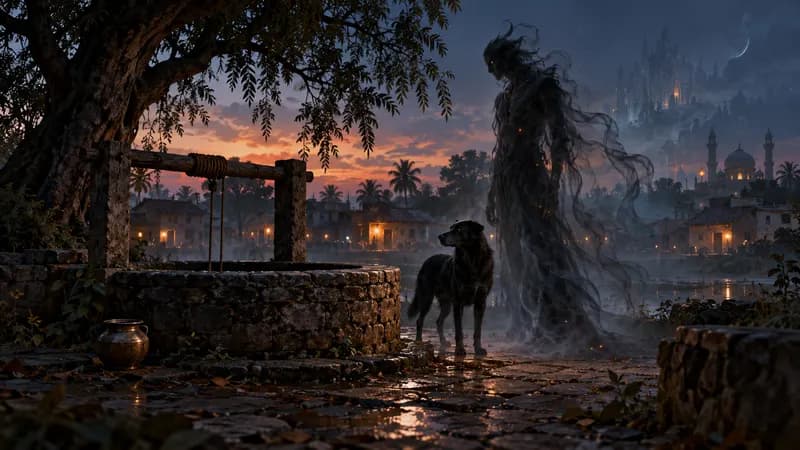
The Bride of the Old Haveli
In the narrow lanes behind Lucknow's Chowk, there is a haveli that has been in the Rizvi family for seven generations. The upper two floors have not been used in living memory. The staircase past the second landing is bricked up — not sealed with a lock, but bricked, with mortar and plaster, as though the family wanted to make sure nobody went up by accident. The ground floor and first floor are well-maintained, lived-in, normal. But the family never speaks about the upper floors, and guests are never told why.
In 1987, a young bride came to live in the haveli after her marriage to the youngest Rizvi son. Her name was Shaheen. She was from Barabanki, a small-town girl, and the size of the Lucknow haveli overwhelmed her. During her first week, she noticed the bricked-up staircase and asked her mother-in-law about it. The older woman's face changed — not fear exactly, but a careful blankness, the expression of someone choosing their words very precisely. 'Those floors are not ours,' she said. 'We live here. They live there. We don't go up. They don't come down.'
Shaheen did not understand. She asked her husband that night. He was less careful. 'There's a family of Jinn upstairs,' he said, as matter-of-factly as if he were describing tenants. 'They've been there since my great-grandfather's time. Probably longer. We made an arrangement. Milk at the base of the staircase on Thursdays. No construction on the upper floors. No loud music after Isha. In return, nothing happens.'
For three years, nothing happened. Shaheen placed the milk every Thursday. She never heard anything from above — no footsteps, no sounds, nothing. She began to think it was an old family superstition, harmless, maybe even charming in its way. The haveli was beautiful. Life was good. She had a son.
The trouble began when Shaheen's brother-in-law, recently returned from Dubai, decided the upper floors were wasted space. He was modern, dismissive, educated abroad. He hired a mason to break the brick wall on a Wednesday — not even a Thursday, but close enough. The mason came at noon. By 2 PM, he had opened a hole large enough to step through.
The mason came down the stairs thirty minutes later. His face was gray. He would not say what he had seen. He packed his tools and left. He did not return for his payment. He did not return at all.
That night, Shaheen's infant son developed a fever that no medicine could touch. Not high — just persistent, exactly 100.1 degrees, unwavering, for eleven days. The doctors in Lucknow found nothing wrong. The child did not cry. He simply lay still, eyes open, watching the ceiling as though tracking something moving across it that no one else could see.
Shaheen's mother-in-law called a maulvi from the old mosque near Akbari Gate — a man who was known for this kind of work. He came after Isha prayer. He did not go upstairs. He sat in the courtyard, recited Surah Al-Baqarah for two hours straight, and burned loban (frankincense) until the smoke filled every room on the lower floors. Then he told the family to re-brick the wall. Immediately. Before Fajr.
The wall was rebuilt by 4 AM. The mason — a different one — worked by lamplight. Shaheen placed milk at the base of the staircase. Three glasses instead of one.
By morning, her son's fever broke. It did not reduce gradually. It stopped — as though someone had turned off a switch. The child slept normally for the first time in eleven days.
Shaheen lived in that haveli for twenty-seven more years. She placed the milk every Thursday without exception. She never spoke about the upper floors to anyone outside the family. When asked about the bricked staircase by visitors, she used her mother-in-law's exact words: 'Those floors are not ours. We live here. They live there.'
She said it with the same careful blankness. The same precision. Because by then, she understood that the words were not superstition. They were a lease agreement.
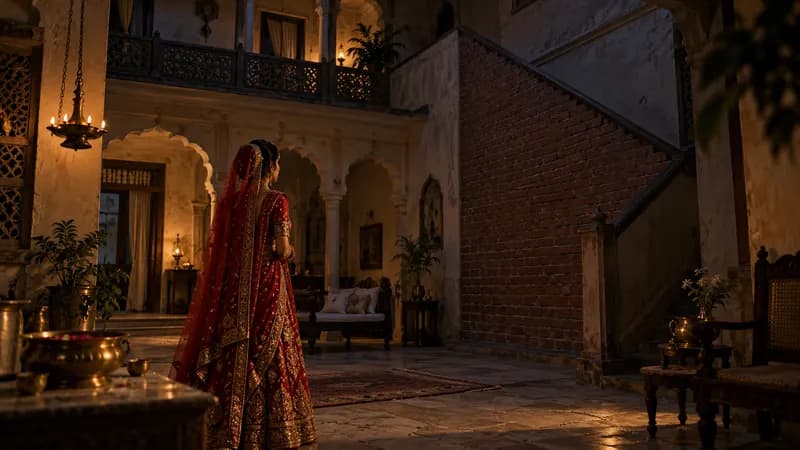
The Rules — How to Stay Safe
☠ WARNING ☠
Seven rules for coexisting with Jinn
- Recite Ayatul Kursi (Surah Al-Baqarah 2:255) before sleeping. — The single most cited protection in Indian Islamic tradition. The 'Throne Verse' is believed to place a barrier between you and any Jinn in your vicinity until dawn.
- Do not pour hot water on the ground without saying 'Bismillah.' — Jinn live in the ground, in drains, in low places. Pouring boiling water without warning — especially in bathrooms — can harm a Jinn and provoke retaliation. This rule is universally observed across Indian Muslim households.
- Do not stay in the bathroom longer than necessary. Do not sing or talk in the bathroom. — Bathrooms are considered Jinn habitations. The Islamic practice of reciting a specific dua before entering the bathroom (seeking refuge from male and female Jinn) is directly tied to this belief.
- Do not whistle or clap after Maghrib (sunset). — Sound attracts Jinn attention during their active hours. Whistling after dark is one of the most consistent prohibitions across Indian Muslim communities from Kashmir to Kerala.
- Never disturb an abandoned or sealed space without proper recitation. — Jinn settle in unused spaces. Opening a sealed room, demolishing an old wall, or clearing a ruin without reciting Quranic verses first can displace a Jinn — and a displaced Jinn is a dangerous Jinn.
- If you suspect Jinn presence, burn loban (frankincense) and recite Surah Al-Jinn. — The combination of frankincense smoke and Surah Al-Jinn (Chapter 72) is the standard Indian Muslim practice for acknowledging Jinn presence without confrontation. It is a signal — 'I know you are here, and I mean no harm.'
- Do not harm snakes found inside the house without warning them first. — In Indian Islamic tradition, a snake inside the house may be a Jinn in animal form. The practice is to tell the snake three times to leave. If it does not leave after three warnings, it is an ordinary snake. If it disappears, it was a Jinn — and you must recite Ayatul Kursi immediately.

What They Don't Tell You
The deepest layer of Indian Jinn belief is not about fear — it is about coexistence. In the old Muslim neighborhoods of Lucknow, Hyderabad, and Bhopal, families do not try to remove Jinn from their homes. They accommodate them. The Thursday milk offering, the sealed upper floor, the room that nobody enters — these are not acts of terror. They are the terms of a shared tenancy, negotiated over generations. The Jinn were here first. The family acknowledges this. And in return, the Jinn — most of the time — respect the boundary. The real secret of Indian Jinn tradition is that it is, at its core, a theology of neighborliness applied to the invisible. You cannot see them, you cannot understand them, but you can learn to live alongside them — as long as you never, ever forget they are there.
What Does a Jinn Want?
A Jinn does not want to haunt you. It wants to be left alone.
The vast majority of Jinn encounters in Indian tradition are not attacks — they are boundary violations. A family renovates a room a Jinn has claimed. A child throws stones at a tree where a Jinn rests. Someone pours boiling water down a drain without warning. The Jinn retaliates not out of malice but out of the same instinct that makes you angry when someone enters your house without knocking.
Possession — the dramatic, frightening kind — usually occurs when a Jinn becomes attached to a specific human. This can be desire (a Jinn falling in love with a human, a recurring motif in Indian Muslim folklore), anger (a human has harmed the Jinn or its family), or simple proximity (living too close for too long, the boundaries eroding). The Jinn enters because the distance collapsed.
What the Jinn wants, fundamentally, is what you want: space, respect, and to be acknowledged as real. The entire Indian Islamic tradition of Jinn management — the offerings, the sealed rooms, the recitations — is built on this understanding. You are not dealing with a monster. You are dealing with a neighbor you cannot see.

You're Most at Risk If...
- You are in a state of emotional vulnerability — grief, anger, deep fear, or spiritual emptiness
- You are alone in an abandoned building, ruin, or old haveli after Maghrib
- You have recently disturbed a sealed or unused space — demolished a wall, cleared a ruin, cut down an old tree
- You are in the bathroom for extended periods, especially after dark
- You are a young woman living alone — a disproportionate number of Indian Jinn possession accounts involve young women, reflecting both genuine folk belief and patriarchal anxiety
- You have stopped regular prayer or spiritual practice — the 'shield' of consistent practice is believed to thin when practice lapses
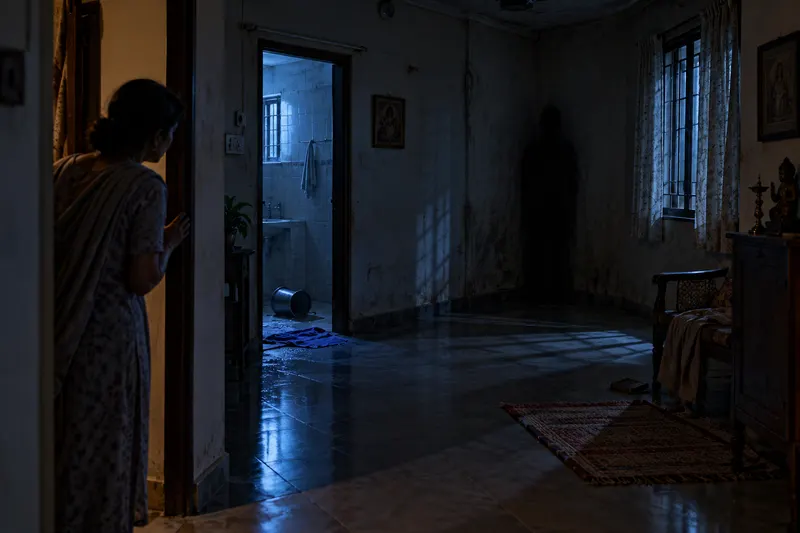
Offerings & Accommodation
| Offering | Purpose |
|---|---|
| Thursday Milk | The most widespread Indian Jinn offering: a glass or bowl of milk placed at the threshold of a known Jinn habitation every Thursday evening. Not worship — acknowledgment. The milk is not drunk by the Jinn literally but serves as a symbol of the ongoing agreement between human and Jinn households. |
| Loban (Frankincense) | Burning loban — frankincense resin on hot coals — is the universal Indian Muslim method for cleansing a space. The smoke is believed to be pleasant to benevolent Jinn and repellent to malevolent ones. Used after moving into a new house, after a death, or after any disturbance. |
| Surah Recitation | Reciting specific Quranic chapters — Al-Baqarah, Al-Jinn, Al-Falaq, An-Nas — is not an offering but a boundary-setting act. It tells the Jinn: this space is protected, these people are under divine covenant. In Indian practice, playing a recording of Surah Al-Baqarah in an empty house serves the same function. |
| The Sealed Room | In many old Indian Muslim families, one room — or one floor, or one corner — is simply ceded to the Jinn. It is never opened, never cleaned, never used. This is the most profound form of accommodation: giving up physical space in your own home to an entity you cannot see, because you believe — with generational certainty — that it was there first. |
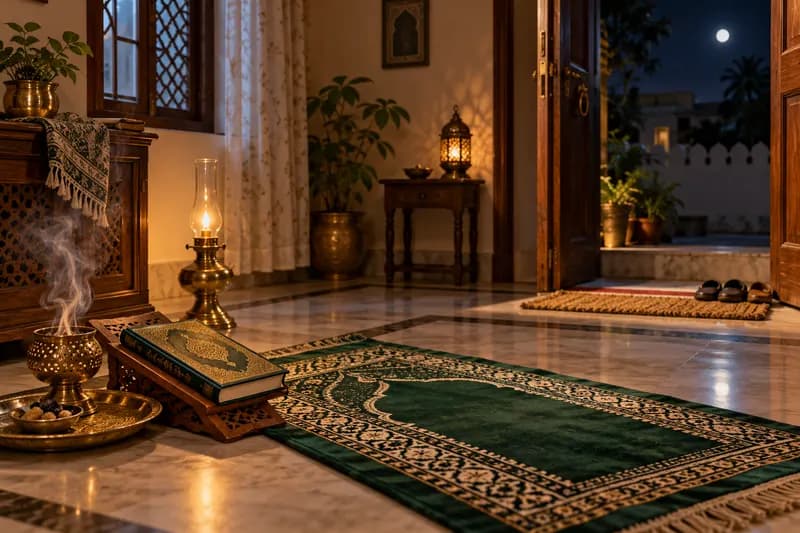
The Healer
Maulvi / Maulana (Ruqyah Specialist) — A trained Islamic scholar who performs Ruqyah — Quranic recitation over the afflicted person. This is the orthodox, mainstream Islamic method. The healer recites specific verses, blows on the person or on water that the person drinks, and commands the Jinn to leave in the name of Allah. Major Ruqyah centers operate in Lucknow, Hyderabad, Delhi, and Mumbai.
Sufi Peer / Baba — In Indian Sufi tradition, certain saints (living and dead) are believed to have authority over Jinn. Dargahs (Sufi shrines) across India — Ajmer, Nizamuddin, Haji Ali — are sites where people bring Jinn-afflicted family members. The Sufi approach is less confrontational than orthodox Ruqyah: it negotiates, cajoles, sometimes even befriends the Jinn.
Amil (Folk Practitioner) — The amil operates in the space between Islamic orthodoxy and Indian folk practice. They use taweez (written amulets), specific numerological formulas, and sometimes non-Quranic invocations to communicate with or bind Jinn. Controversial within orthodox Islam but extremely common across Indian Muslim communities, especially in rural areas.
The Key Difference from Hindu Healing — Hindu exorcism (of Bhoot, Pret, Churel) often involves physical rituals — neem leaves, iron, turmeric, fire. Islamic Jinn healing is almost entirely verbal — words, recitation, breath. The weapon is scripture, not substance. This reflects the theological difference: Jinn are not ghosts. They are rational beings who understand language, who can be reasoned with, who respond to divine authority.
What If You Dream of a Jinn?
| Symbol | Meaning | |
|---|---|---|
| 🐍 | A Snake Inside Your House | In Indian Islamic dream interpretation, a snake inside your home — especially a black one — may represent a Jinn presence. If the snake speaks or behaves unnaturally, it is almost certainly a Jinn encounter. The dream is telling you to check your home protections: are you reciting Ayatul Kursi? Is there a neglected space? |
| 👤 | A Beautiful Stranger | Dreaming of an extraordinarily beautiful person you have never met — one who feels intensely familiar — is interpreted as a Jinn showing its true form to you. If these dreams recur, Indian tradition considers it a sign that a Jinn has become attached to you. A maulvi should be consulted. |
| 🔥 | Fire Without Heat | Seeing fire that does not burn — smokeless, clean, almost liquid — is a direct vision of the Jinn's native element. This dream is not necessarily threatening. It may be a neutral encounter, an accidental glimpse across the membrane. |
| 🏚 | An Empty Room with Presence | You are in a room. It is empty. But you know — with absolute certainty — that someone is there. You can feel their attention. You cannot see them. This is the most common Jinn dream in Indian Muslim tradition: the experience of the invisible neighbor, rendered in sleep. |
The Jinn in Art & Architecture
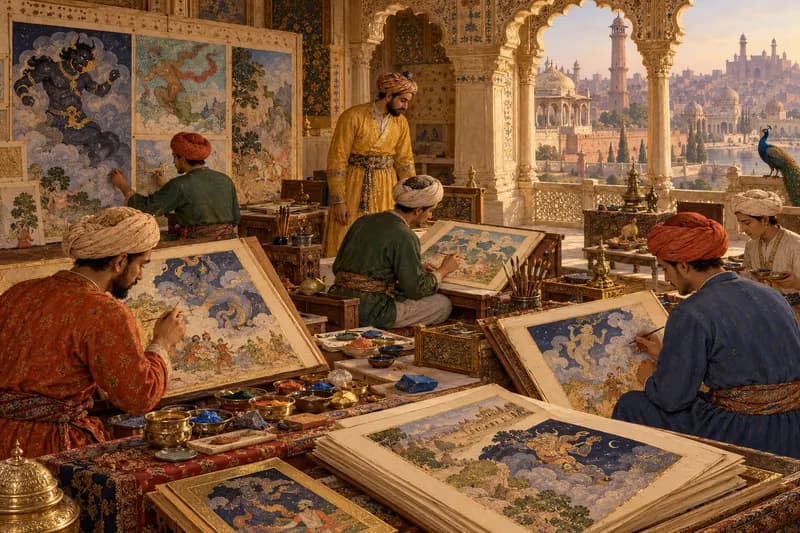
Mughal-Era Miniature Paintings (16th–18th Century): Mughal ateliers produced illustrations for texts like the Hamzanama (Adventures of Hamza), which feature vivid depictions of Jinn — beings of fire, shapeshifters, Jinn courts and kingdoms. These paintings show Jinn as powerful, regal entities with crowns and courts, not monsters. The Hamzanama alone contains over 1,400 painted scenes, many featuring Jinn encounters.
Dargah Architecture Across India: Sufi shrines (dargahs) across India incorporate spaces specifically designed for Jinn-related healing. The architecture itself accommodates belief: enclosed chambers for ruqyah sessions, specific trees within the compound where Jinn are believed to reside, chains and iron fixtures at entrances (iron repels Jinn in folk belief). Nizamuddin Dargah in Delhi, Ajmer Sharif in Rajasthan, and Nagore Dargah in Tamil Nadu all feature these elements.
Taweez and Calligraphic Art: The taweez (protective amulet) tradition produced an entire visual art form: geometric patterns, Quranic calligraphy, and numerological grids inscribed on metal, paper, or cloth. These are not merely text — they are visual compositions designed to create barriers against Jinn. The aesthetic is mathematical, precise, and beautiful in a way that is entirely distinct from other Indian art traditions.
Physical Evidence: The evidence of Jinn belief is built into Indian Muslim architecture itself — the sealed rooms, the threshold designs, the specific placement of Quranic calligraphy over doorways, the iron nails hammered into lintels. These are not decorative choices. They are architectural protection systems, embedded in the physical fabric of Indian Muslim homes for centuries.
Cross-Regional Patterns
Ifrit · Qareen · Bhut (Gond) · Churel · Yakshini
| Dawn as hard limit | No — active at any time, strongest at dusk |
| Iron weakness | Yes — strong in folk tradition |
| Tree-dwelling | Yes — specific trees (peepal, neem, babool) |
| Counting compulsion | No |
| Backward feet | No (but shapeshifting can produce physical anomalies) |
Global Equivalent: The Jinn is often equated with the Western 'Genie' — a catastrophic mistranslation. The Disney Genie is a Jinn the way a house cat is a tiger. The actual closest equivalent in world folklore is the Fae of Celtic tradition: a parallel race sharing human territory, capable of benevolence and malice, governed by their own laws, and requiring specific protocols for safe interaction. Both the Jinn and the Fae are not ghosts — they are neighbors.
In Culture — Movies, Books, Games
| Type | Title | Description |
|---|---|---|
| Television | Ssshhhh...Koi Hai (Star Plus, 2001–2010) | Long-running Indian horror anthology that featured multiple Jinn-themed episodes. Brought Jinn possession narratives to mainstream Hindi television. The depiction leaned toward horror rather than theological accuracy, but it cemented Jinn in Indian pop-culture consciousness. |
| Film | Bulbbul (Netflix, 2020) | While primarily a Churel narrative, Bulbbul features elements of Jinn-adjacent possession in its Bengali Muslim household setting — the invisible forces, the unexplained illness, the recitation as protection. It captures the syncretic nature of Indian supernatural belief where Islamic and Hindu traditions blur. |
| Literature | The Djinn Falls in Love (anthology, 2017) | An anthology of Jinn fiction from Muslim writers worldwide, including Indian contributors. Contains stories that capture the Indian Jinn experience: domestic, intimate, neighborhood-level encounters rather than grand supernatural battles. |
| Film | Pari (2018, Bollywood) | Stars Anushka Sharma in a story involving Jinn/Ifrit mythology set in Bangladesh-India border communities. One of the few Hindi films to engage directly with Islamic supernatural lore rather than defaulting to Hindu ghost traditions. |
| Video Game | Prince of Persia: The Sands of Time (2003) | While set in Persia, the Jinn-inspired sand creatures introduced an entire generation of Indian gamers to Jinn mythology. The game's visual language — smokeless fire, shapeshifting, parallel dimensions — drew directly from Jinn lore. |
ACCURACY RATING: THEOLOGICALLY GROUNDED IN ISLAM · HEAVILY FICTIONALIZED IN MEDIA

Are Jinn Still Real?
- Jinn belief is not declining in India — if anything, it is growing. Ruqyah (Quranic healing) centers have multiplied across Indian cities over the past two decades, driven by YouTube, WhatsApp, and social media amplification of possession accounts.
- In Lucknow, Hyderabad, and Bhopal — cities with deep Mughal-era Muslim heritage — Jinn are discussed with the same matter-of-factness as weather. Specific buildings, ruins, and trees are known to be Jinn habitations. This knowledge is transmitted through families, neighborhoods, and mosque communities.
- Kerala's Mappila Muslim communities maintain one of the most syncretic Jinn traditions in India — Jinn beliefs coexist with Theyyam rituals, Yakshi stories, and Ayurvedic healing. A Mappila family may consult both a maulvi for ruqyah and a local Theyyam practitioner for the same illness.
- The sealed-room tradition is still practiced in old Muslim households across North India. During real estate transactions in old Lucknow and Hyderabad, it is not uncommon for the selling family to inform the buyers about the Jinn arrangement — which rooms to avoid, which offerings to maintain.
- WhatsApp and YouTube have created a new wave of Jinn documentation — videos claiming to show Jinn possession, audio recordings of ruqyah sessions, and viral stories of encounters. The medium is modern; the belief is ancient.
Expert & Academic Context
- Quran — Surah Al-Jinn (72), Surah Ar-Rahman (55:15), Surah Al-Baqarah (2:255) — The foundational theological source for Jinn in Islamic tradition. Surah Al-Jinn describes a group of Jinn who heard the Quran and believed. Surah Ar-Rahman describes their creation from smokeless fire. Ayatul Kursi (2:255) is the primary protective verse used against Jinn across the Muslim world.
- Ibn Kathir — Tafsir (14th century CE) — The most widely referenced Quranic commentary in South Asian Islamic scholarship. Contains detailed discussions of Jinn nature, types, and interaction protocols that shaped Indian Muslim understanding for centuries.
- Imam al-Suyuti — 'Laqt al-Marjaan fi Ahkam al-Jaan' — A comprehensive medieval treatise on Jinn jurisprudence — their rights, obligations, and the Islamic legal framework for human-Jinn interaction. Widely studied in Indian madrasas.
- Sufi Literature — Malfuzat tradition — The recorded conversations of Indian Sufi saints (Nizamuddin Auliya, Moinuddin Chishti, and others) contain numerous references to Jinn encounters, negotiations, and the Sufi method of Jinn management — which emphasizes compassion over confrontation.
- Zubaan Books — Indian folklore collections — Contemporary Indian publishers documenting syncretic supernatural traditions across Muslim communities, including the merger of Jinn belief with pre-Islamic Indian ghost traditions.
- Anand Vivek Taneja — 'Jinnealogy: Time, Islam and Ecological Thought in the Medieval Ruins of Delhi' (2017) — Academic study of how Jinn belief functions in contemporary Delhi — centering on the Firoz Shah Kotla ruins, where thousands of people leave letters for Jinn every Thursday, requesting help with jobs, marriages, court cases, and illness. A landmark work on living Jinn belief in modern India.
- Projit Mukharji — 'Doctoring Traditions' (2009) — Academic analysis of how Islamic healing (including Jinn-related ruqyah) intersects with biomedical practice in South Asian Muslim communities. Documents the parallel health system that Jinn belief sustains.
The Jinn in Indian Islam occupies a unique theological and cultural position: it is simultaneously canonical (Quranically attested, theologically non-negotiable) and syncretic (deeply merged with pre-Islamic Indian spirit traditions). This dual nature makes Indian Jinn belief more resilient than perhaps any other supernatural tradition in the subcontinent. You cannot dismiss it as superstition without dismissing the Quran itself. And you cannot reduce it to pure theology because the local practices — the milk offerings, the sealed rooms, the Thursday letters at Firoz Shah Kotla — are profoundly Indian innovations with no Middle Eastern equivalent. The Jinn reveals something essential about Indian Islam itself: it is not imported religion overlaid on Indian soil. It is Indian religion — grown in Indian soil, shaped by Indian anxieties, speaking Indian languages, haunting Indian houses.
If You Encounter a Jinn
Frequently Asked Questions
▶What is a Jinn?
A Jinn is a supernatural being created from smokeless fire, as described in the Quran. Jinn are not ghosts or demons — they are a separate category of sentient creation with free will, capable of good and evil. They live in a dimension parallel to ours, sharing the same physical space but ordinarily invisible to humans.
▶Are Jinn real in Islam?
Belief in Jinn is a required part of Islamic faith. The Quran mentions Jinn in multiple chapters (an entire surah — Al-Jinn — is named after them). Denying the existence of Jinn is theologically equivalent to denying angels. This is why Jinn belief in Indian Muslim communities is not fading — it is doctrinally anchored.
▶How are Indian Jinn different from Arabian Jinn?
Indian Jinn have absorbed local characteristics over centuries. They haunt specific buildings, trees, and ruins. Families maintain ongoing relationships with household Jinn through offerings and sealed rooms. The Lucknow Thursday-milk tradition, the Hyderabad ruin-avoidance customs, and the Kerala Mappila coastal Jinn practices have no equivalent in Middle Eastern Jinn lore. Indian Islam made the Jinn local, domestic, and intimate.
▶Can Jinn possess humans?
Yes, according to both Islamic theology and Indian folk tradition. Possession typically occurs when a human accidentally harms a Jinn (pouring hot water, disturbing their space) or when a Jinn becomes attached to a human. Symptoms include personality changes, aversion to Quranic recitation, speaking in unknown languages, and unexplained illness. Treatment is Ruqyah — Quranic recitation by a trained maulvi.
▶What is Firoz Shah Kotla and why do people write letters to Jinn there?
Firoz Shah Kotla is a 14th-century ruin in Delhi where thousands of people — mostly Muslim but also Hindu and Sikh — visit every Thursday to leave handwritten letters for Jinn, requesting help with personal problems. Candles are lit, incense burned, and letters placed in the crevices of the ruins. Academic Anand Vivek Taneja documented this practice extensively in his 2017 book 'Jinnealogy.'
▶How do you protect yourself from Jinn?
The primary protection in Indian Islamic tradition is consistent Quranic recitation — especially Ayatul Kursi before sleep and the 'three Quls' (Surah Al-Ikhlas, Al-Falaq, An-Nas). Practical precautions include: saying Bismillah before pouring hot water, not lingering in bathrooms, not whistling after dark, and maintaining offerings if you live in a known Jinn-habitation property.
Explore More
Related Spirits
Ifrit · Qareen · Bhut (Gond) · Churel · Yakshini
Explore Further
Comparisons
Stories Are Being Summoned
One ghost story per week. Every Tuesday at midnight.