Bhut (Gond)
The dead do not leave. They hover at the edges of the village, waiting to be fed, waiting to be acknowledged. Forget them, and they remind you.
- What Is a Bhut (Gond)?
- Why the Gond Bhut Is Terrifying
- Origin — How It Came to Exist
- Appearance & Manifestation
- The Well at Dindori
- The Rules — How to Survive
- What They Don't Tell You
- What Does the Gond Bhut Want?
- You're Most at Risk If...
- Offerings & Appeasement
- The Healer
- What If You Dream of a Gond Bhut?
- The Bhut in Gond Art
- Cross-Regional Patterns
- In Culture — Movies, Books, Games
- Is the Gond Bhut Still Real?
- Expert & Academic Context
- If You Encounter a Gond Bhut
- Frequently Asked Questions
- Explore More
| Bhut (Gond) | |
|---|---|
| Also Known As | Bhoot, Bhuta, Gond Spirit, Village Ghost |
| Script | भूत (Devanagari) / ভূত (Bengali) |
| Pronunciation | BHOOT (भूत) |
| Region | Gond tribal areas of Central India — Madhya Pradesh, Chhattisgarh, Maharashtra (Vidarbha), Telangana, Odisha |
| Category | Tribal Ghost / Ancestral Spirit |
| Danger Level | Moderate |
| Fear Method | Illness, crop failure, livestock death, household disturbance — indirect punishment rather than direct attack |
| Warning Sign | Unexplained illness in the family; livestock dying without cause; repeated bad luck; a cold spot in the house that will not warm |
| First Documented | Oral tradition of the Gond people — one of India's largest tribal communities; documented in colonial-era ethnographies by British administrators (19th century) |
| Still Believed? | Yes — the Gunia (village priest/healer) system remains active across Gond communities; bhut appeasement rituals are performed regularly |
| Related | Pret · Vetala · Masaan · Raktabija Spirit · Chenga · Dakini |
What Is a Bhut (Gond)?
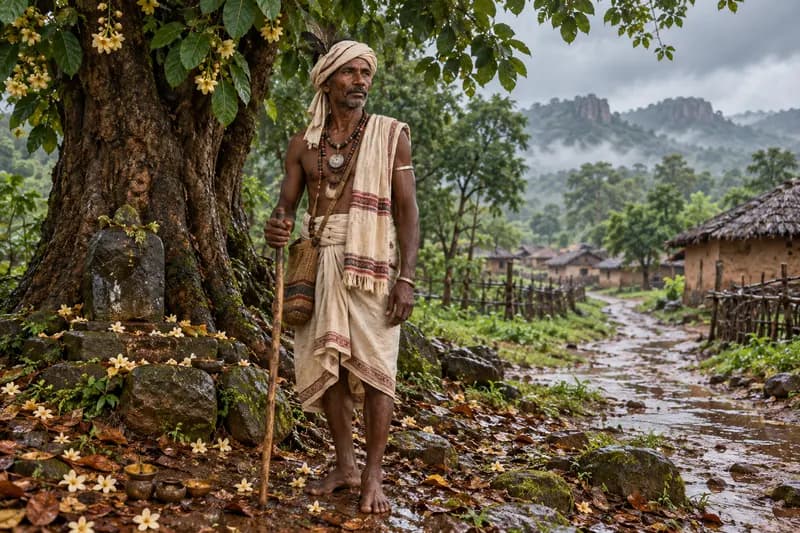
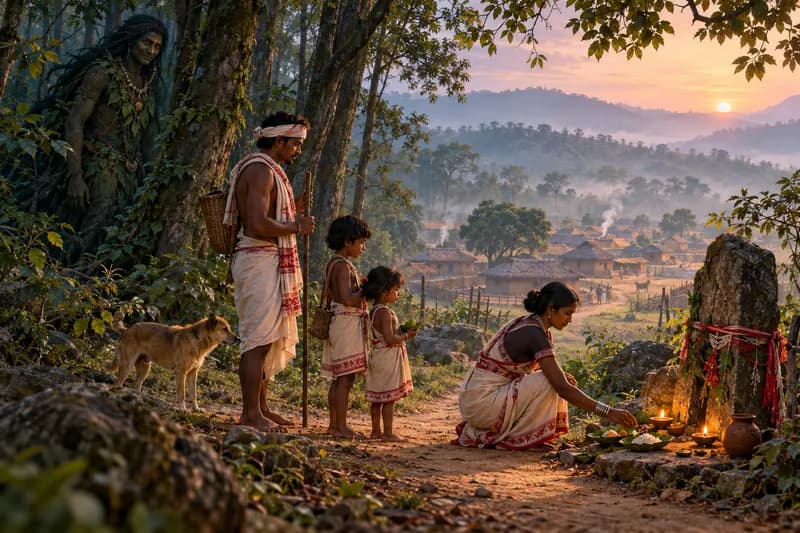
The Bhut (भूत) in Gond tribal tradition is the ghost of a person who has died and remains attached to the living world — usually because their death was untimely, their funeral rites were incomplete, or they have unfinished emotional business with the living. Unlike the literary ghosts of Hindu mythology (the Vetala, the Pishacha), the Gond Bhut is a village-level entity, rooted in the specific social dynamics of a particular community. It is not a cosmic force. It is a dead neighbor.
What distinguishes the Gond Bhut from the broader Hindu concept of 'bhoot' is its fundamentally social nature. The Bhut does not haunt random people — it haunts its own family, its own village, the people it knew in life. Its grievances are personal: a son who did not perform the proper rites, a wife who remarried too quickly, a land dispute left unresolved. The Bhut is managed not through Sanskrit mantras or Brahminical ritual but through the Gunia — the village priest-healer who mediates between the living and the dead using tribal methods passed down through generations.
Why the Gond Bhut Is Terrifying
INSTINCT EXPLOITED: GUILT TOWARD THE DEAD
Your father died in March. The fever took him in three days — too fast for the family to gather, too fast for everything to be done correctly. You performed the rites as best you could. The Gunia came. The body was taken to the cremation site. The offerings were made. But something was rushed. Something was missed. You are not sure what.
In April, your cow stops giving milk. In May, your youngest daughter develops a cough that will not clear. In June, the rice you planted — the same rice, in the same field, with the same water — does not sprout. Your wife says it is a bad season. Your mother says it is your father.
You lie awake at night and feel a presence in the room that is not hostile but is waiting. It feels like your father felt when he was disappointed in you — not angry, just present, just watching, just letting you know that you have failed to do something you should have done. The room is cold in a way that has nothing to do with the weather.
This is the terror of the Gond Bhut. It is not the terror of the monster. It is the terror of the family member you have let down — magnified by death, extended beyond the grave, made inescapable because you cannot apologize to someone who is no longer alive to hear you.
The Bhut does not scream. It does not appear with terrible eyes and dripping claws. It just makes things go wrong. And the wrongness has a texture — it feels personal, targeted, deserved. Because on some level, you know: you did not do enough. And the dead know it too.
Origin — How It Came to Exist
The Gond Worldview
The Gond people — one of India's largest tribal communities, numbering over 13 million — maintain a cosmology that is distinct from mainstream Hinduism. In the Gond worldview, death is not an ending but a transition. The dead remain connected to the living through bonds of kinship, obligation, and land. A properly honored dead person becomes a benevolent ancestor — a protective presence. An improperly honored dead person becomes a Bhut — a disruptive, dissatisfied ghost.
What Creates a Bhut
A Bhut is created by failure — failure of the living toward the dead. Incomplete funeral rites, neglected offerings, unresolved disputes, broken promises to the dying. The Bhut is not evil by nature. It is a person who died with needs that were not met and who cannot move on until those needs are addressed. The responsibility lies with the living, not the dead.
The Village Ecosystem
In Gond communities, the dead are part of the village ecosystem. They have rights — the right to be remembered, the right to receive offerings at specific times, the right to have their wishes honored. When these rights are violated, the Bhut enforces them through the only means available to the dead: disruption. Illness, crop failure, and bad luck are not random — they are complaints from the other side.
The Gunia System
The Gunia is the Gond village priest-healer — the person who can communicate with the dead and diagnose the cause of a Bhut disturbance. The Gunia does not use Sanskrit mantras or Brahminical ritual. Instead, they use tribal methods: trance, divination with rice grains or arrows, communication through dreams, and negotiation with the spirit. The Gunia identifies what the Bhut wants and advises the family on how to provide it.
Distinction from Hindu Bhoot
The mainstream Hindu 'bhoot' is a broader category — any restless spirit. The Gond Bhut is more specific: it is always a known person, always connected to a specific family or village, and always amenable to appeasement through proper ritual. It is not a cosmic evil but a social problem — a relationship that needs repair, even across the boundary of death.
Appearance & Manifestation
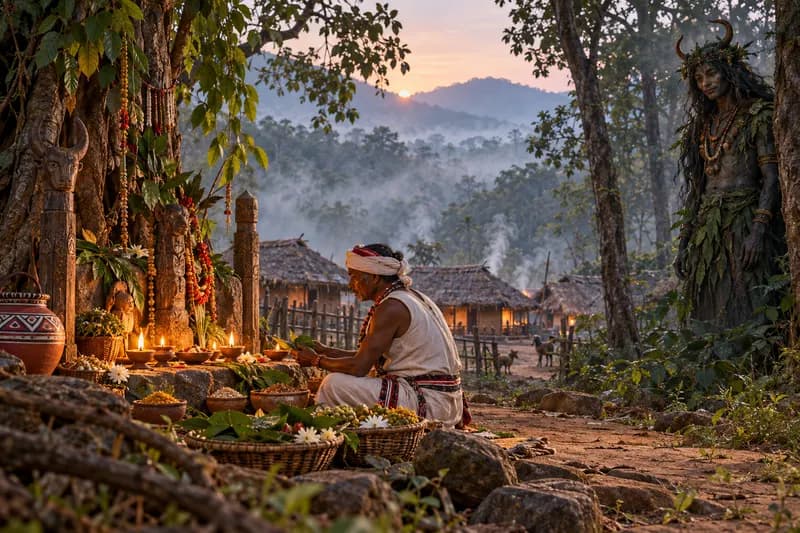
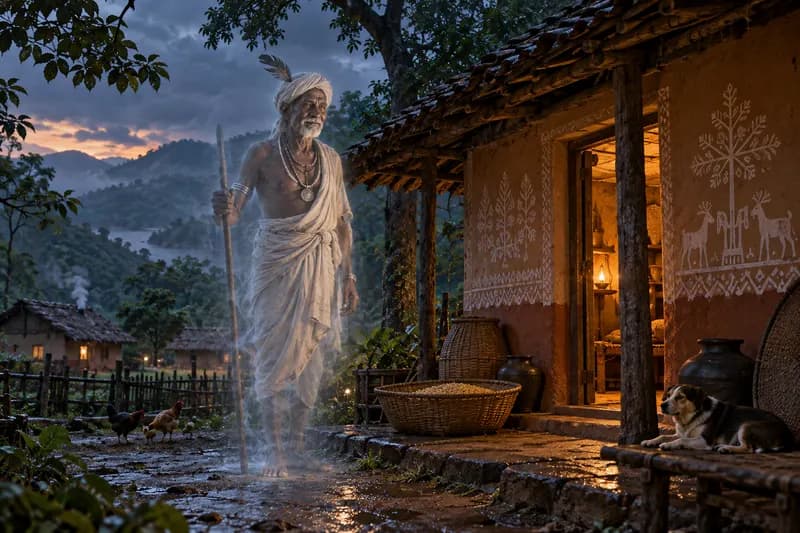
| 👁 Sight | Rarely seen directly. The Gond Bhut manifests through effects, not appearances. When glimpsed, it appears as a shadowy human form — recognizable as the person it was in life but indistinct, like a figure seen through smoke. Some accounts describe it at the edges of the village at dusk, near the cremation ground, or standing in the family's field. |
| 🔊 Sound | Footsteps in an empty house. A sigh from a room with no one in it. The creak of a cot that belonged to the dead person. Sometimes the Bhut is heard calling a family member's name — once, softly, at a time when the person is alone. The voice is recognizable. |
| 🍃 Smell | The smell of the person in life — their specific body smell, their clothing, the mustard oil they used. This is the most emotionally devastating manifestation: you smell your dead father's hair oil in a room where no one has used it in months. |
| ❄ Temperature | A persistent cold spot in the house — typically in the corner or bed where the person slept, or in the room where they died. This cold does not respond to fire, blankets, or sunshine. It is present during all seasons and is the Bhut's most common signature. |
| 🌑 Time | Most active at dusk and during the night, but the effects — illness, crop failure, livestock problems — manifest continuously. The Bhut is always present; it simply becomes more perceptible when the busy noise of daytime life quiets down. |
| 🏚 Habitat | The family home. The family's fields. The village cremation ground. The Bhut does not wander — it stays where its connections are. It is a ghost of place as much as of person, bound to the land and the house and the people it knew. |
The Well at Dindori
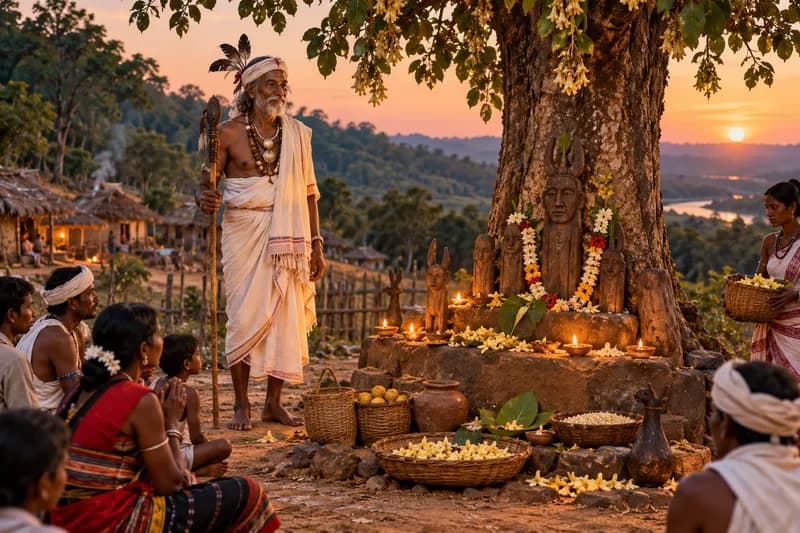
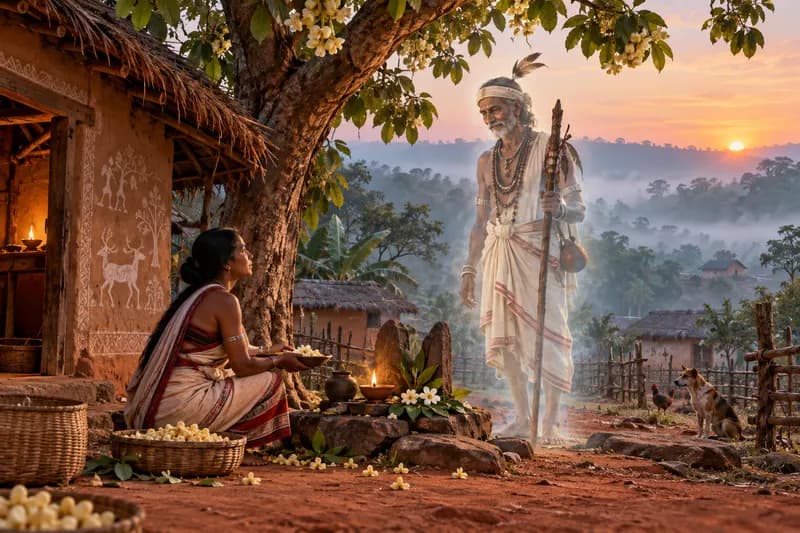
In a Gond village outside Dindori, in eastern Madhya Pradesh, there was a man named Mangal who died of snakebite during the monsoon. He was fifty-three years old and had two sons — the elder, Raju, who lived in the village, and the younger, Suresh, who had gone to Nagpur for work. Mangal died on a Tuesday evening. Suresh could not come home for the funeral. He sent money. He did not come.
The rites were performed by Raju. The Gunia was called. The body was cremated. The offerings were made at the prescribed intervals. Everything was done correctly — or so Raju believed. But the Gunia, a woman named Kamla Bai who had served the village for thirty years, said quietly after the thirteenth-day ceremony: 'The father wanted both sons present. One son was not enough.'
Within a month, the family's well — which had given clean water for as long as anyone could remember — began tasting bitter. Not contaminated in a way that modern testing would flag, but bitter, the way water tastes when something is wrong with the earth beneath it. The neighbors' wells were fine. Only Mangal's family well turned bad.
Then the goats began dying. Not all at once — one every few weeks, without visible illness. The goat would simply lie down and not get up. The veterinarian from the block office found nothing. Raju spent money on medicines. The goats kept dying.
Raju went to Kamla Bai. She entered her trance — sitting on the floor of her house, rocking, humming, her eyes half-closed. When she spoke, it was not her voice. It was Mangal's. The words were simple: 'My son did not come. My son did not say goodbye. I am waiting.'
Raju called Suresh. Suresh came home. He did not believe in bhuts. He had been in Nagpur for three years and had begun to think of these things as village superstitions. But the well was bitter and the goats were dead and his brother's face was gray with exhaustion.
Kamla Bai performed the rite. Suresh sat before the cremation ground and spoke to his father — not in ritual language, not in Sanskrit, but in Gondi, in the words he would have used if his father were sitting across from him on the porch. He said he was sorry. He said he should have come. He said the money he sent was not the same as being there and he knew it. He cried.
The well cleared within a week. The goats stopped dying. Kamla Bai said, simply: 'He heard. He is satisfied.'
Suresh went back to Nagpur. He came home for every festival after that. Every single one.
The Rules — How to Survive
☠ WARNING ☠
Six rules for living with a Gond Bhut
- Perform funeral rites completely and correctly. — The most common cause of a Bhut is incomplete rites. Every step matters — the cremation, the offerings on the third, seventh, and thirteenth days, and the annual remembrance. Cutting corners creates ghosts.
- Consult the Gunia at the first sign of disturbance. — The Gunia can identify which Bhut is active and what it wants. Delaying consultation allows the disturbance to escalate. Early intervention is simpler and less costly.
- Do not ignore patterns of bad luck. — In Gond tradition, sustained bad luck is not random — it is communication. Illness, crop failure, and livestock death occurring together are the Bhut's way of getting your attention. Listen before the message gets louder.
- Honor the dead person's known wishes. — If the dead person expressed specific wishes — about land, about family, about their funeral — those wishes must be honored. A Bhut created by a broken promise can only be settled by keeping the promise.
- Maintain annual offerings. — Even after the initial rites are completed, annual offerings keep the relationship with the dead healthy. Neglecting these offerings is like neglecting a living relative — the consequences accumulate.
- Resolve family disputes, especially about land. — Land disputes are the single most common trigger for Gond Bhut activity. The dead person's attachment to their land is powerful. Disputes over inheritance, boundaries, or usage create lasting disturbance.
What They Don't Tell You
The Gond Bhut system is, at its core, a community mental health framework disguised as ghost stories. The Gunia — sitting in trance, speaking in the dead person's voice — is performing a function that Western psychology would recognize as grief counseling, family therapy, and conflict mediation. The 'ghost' forces the family to confront what they have been avoiding: the unfinished conversation, the broken promise, the guilt. The ritual of appeasement is the ritual of closure. The dead person's 'satisfaction' is the family's own emotional resolution, projected outward and made manageable through the structure of belief. This does not make it less real. It makes it more sophisticated than it appears.
What Does the Gond Bhut Want?
The Gond Bhut wants what the person wanted in life: to be remembered, to be honored, and to have their wishes respected.
It is not a cosmic entity with mysterious purposes. It is your dead uncle who is angry that you sold the field he asked you to keep. It is your dead mother who wanted all her children at her funeral and one of them did not come. It is your dead father who told you to take care of the family shrine and you let it fall into disrepair.
The demands are specific, personal, and usually reasonable. The Bhut does not ask for impossible things — it asks for the things the living should have done anyway. This is what makes it so effective as a social mechanism: the ghost's demands align with the community's values. Honor your parents. Keep your promises. Take care of the land. Remember the dead.
When the demands are met, the Bhut is satisfied. It becomes an ancestor — a benevolent presence rather than a disruptive one. The transformation is not dramatic. The cold spot warms. The well clears. The crops grow. The dead, having been heard, rest.
You're Most at Risk If...
- You have recently lost a family member and the funeral rites were rushed or incomplete
- You did not attend the funeral of a close relative
- You are involved in a dispute over the dead person's land or property
- You broke a promise made to someone who has since died
- You have neglected annual offerings to deceased family members
- You are experiencing a sustained pattern of bad luck — illness, crop failure, livestock death — that defies practical explanation
Offerings & Appeasement
| Offering | Purpose |
|---|---|
| Funeral Rite Completion | If the original rites were incomplete, the Gunia will prescribe a completion ceremony. This may involve re-performing specific steps, making additional offerings at the cremation ground, or conducting a full thirteenth-day ceremony that was skipped. |
| Food Offerings | Cooked food — typically the dishes the dead person preferred in life — placed at the cremation ground or at a designated spot near the family home. This is a personal offering, not a generic one. The dead person is given what they liked to eat. |
| Animal Sacrifice | In some Gond communities, a chicken or goat is sacrificed as part of the appeasement ritual. This is the most significant offering and is reserved for serious disturbances. The animal is consumed by the community after the ritual — nothing is wasted. |
| Verbal Acknowledgment | The simplest and often most important offering: speaking to the dead person directly, acknowledging what went wrong, and promising to correct it. The Gunia facilitates this communication, but the words must come from the family member who is responsible. |
The Healer
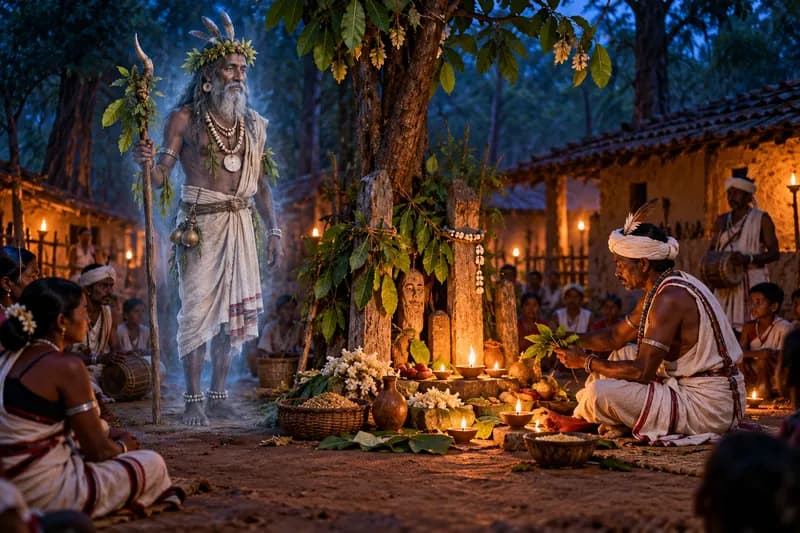
Gunia (Village Priest-Healer) — The Gunia is the central figure in Gond supernatural practice — a healer, diviner, and spirit-medium who communicates with the dead through trance, rice-grain divination, and dream interpretation. The Gunia diagnoses the cause of the Bhut disturbance and prescribes the remedy. This is not a Brahminical priest — it is a tribal specialist with authority rooted in community trust.
Patel (Village Headman) — In cases where the Bhut's demands involve community matters — land disputes, family feuds, shared resources — the Patel works alongside the Gunia to implement the necessary resolutions. The spiritual and social dimensions of the problem are addressed simultaneously.
Family Elders — Older family members who knew the dead person and understand the specific grievances can provide crucial context. The Gunia diagnoses; the elders explain; the family acts.
The Key Difference — The Gond Bhut is not exorcised. It is *appeased.* The distinction is fundamental. Exorcism implies an enemy to be expelled. Appeasement implies a relationship to be repaired. The dead person is not a demon — they are a family member who needs something. Give it to them, and they rest.
What If You Dream of a Gond Bhut?
| Symbol | Meaning | |
|---|---|---|
| 👤 | A Dead Relative Looking at You | Unfinished business. Something between you and this person was not resolved before they died. The dream is not a threat — it is a reminder. What did you leave unsaid? What did you promise and not deliver? |
| 🏡 | A Cold Room in Your Family Home | Emotional distance within the family. A relationship that has gone cold — not necessarily with a dead person but with the living. The Bhut in the Gond system represents social obligations. The cold room is the obligation you are ignoring. |
| 🌾 | Crops Dying in a Familiar Field | Something you have been cultivating — a relationship, a project, a responsibility — is failing because of neglect. Not active destruction but passive abandonment. The dream asks: what have you stopped tending? |
| 🕯 | Lighting a Lamp for Someone | You are ready to honor someone you have been neglecting. The dream is not about the dead — it is about your own willingness to remember, to acknowledge, to close the loop. Lighting the lamp is the first step. |
The Bhut in Gond Art
Gond Painting Tradition: Gond art — one of India's most celebrated tribal art forms — depicts the natural and supernatural worlds with equal vividness. Spirits, ancestors, and forest entities appear in the distinctive Gond style: bold lines, intricate dot-and-dash patterns, and a visual language that treats the visible and invisible worlds as continuous. These paintings are not illustrations of folklore — they are maps of a cosmology.
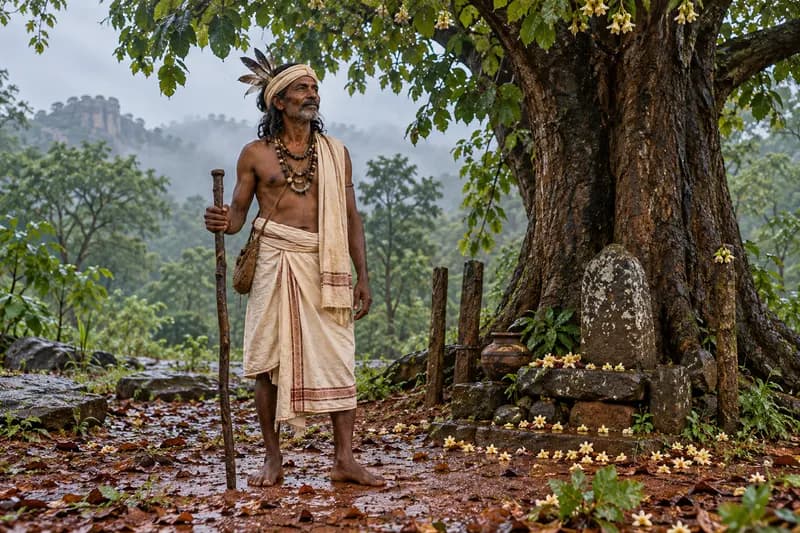
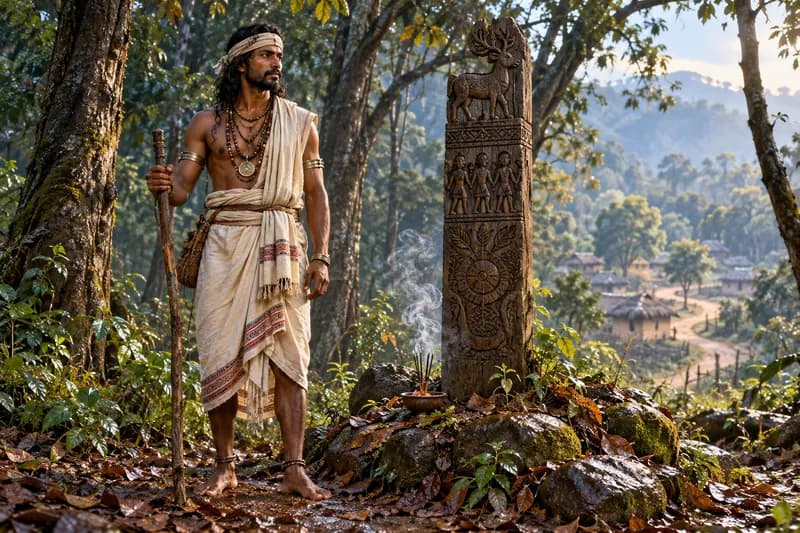
Memorial Stones and Posts: Gond communities erect memorial stones and wooden posts for significant dead — markers that serve as both grave-markers and shrines. These physical objects are the anchor points for ancestor-spirit relationships, the place where offerings are left and communication happens.
Ritual Objects — Gunia Practice: The Gunia's ritual objects — specific types of arrows, rice grains used for divination, brass vessels, and trance-inducing instruments — constitute a material culture that documents the Bhut tradition in physical form. These objects are not decorative. They are tools.
Living Practice: The most important 'art' of the Gond Bhut tradition is the Gunia's trance performance — the act of entering trance, speaking in the dead person's voice, and mediating between the living and the dead. This is a performative tradition that combines theater, therapy, and theology in a form that has been practiced for centuries.
Cross-Regional Patterns
Pret · Vetala · Masaan · Raktabija Spirit · Chenga · Dakini · Rakshasi · Yogini
| Dawn as hard limit | No — effects are continuous |
| Iron weakness | Some traditions — not primary |
| Tree-dwelling | No — home/village bound |
| Counting compulsion | No |
| Backward feet | No |
Global Equivalent: The closest global parallel is the Ancestor Spirit traditions of sub-Saharan Africa — particularly the Yoruba 'Egungun' and the Zulu 'Amadlozi,' where dead relatives remain actively involved in family affairs and must be regularly honored through offerings and rituals. The Roman 'Lemures' (restless dead who haunt families) and the Chinese 'Hungry Ghost' tradition also parallel. All share the core mechanic: the dead have rights, and the living have obligations.
In Culture — Movies, Books, Games
| Type | Title | Description |
|---|---|---|
| Literature | Verrier Elwin — Folk Tales and Tribal Art | British anthropologist Verrier Elwin, who lived among the Gond for decades, documented their folk tales and spiritual practices extensively. His work remains the most comprehensive published source on Gond supernatural beliefs. |
| Art | Jangarh Singh Shyam — Gond Painting | The late Jangarh Singh Shyam brought Gond art to international attention. His paintings — and those of his successors — depict the Gond spirit world with a sophistication and beauty that has made Gond art one of India's most recognized tribal art forms. |
| Academic | Christoph von Furer-Haimendorf — Tribal Studies | Haimendorf's ethnographic studies of Indian tribal communities include documentation of Gond spiritual practices, the Gunia system, and the role of ancestor spirits in community governance. |
| Documentary | Gond Tribal Life — Various Filmmakers | Several documentaries on Gond communities include footage of Gunia rituals, offering ceremonies, and community discussions about spirit activity. These provide visual documentation of practices that are primarily preserved through oral tradition. |
| Reference | Ghosts, Monsters and Demons of India — Rakesh Khanna | Includes documentation of tribal ghost traditions alongside the better-known Hindu and literary entities, providing comparative context for the Gond Bhut within the broader Indian supernatural landscape. |
ACCURACY RATING: HIGH IN ETHNOGRAPHIC SOURCES · LARGELY ABSENT FROM POPULAR MEDIA
Is the Gond Bhut Still Real?
- The Gunia system remains active across Gond communities in Madhya Pradesh, Chhattisgarh, and Maharashtra. Gunia healers are consulted for illness, bad luck, and family disputes as a first resort, not a last one.
- Bhut appeasement rituals are performed regularly — not as historical reenactments but as practical responses to perceived disturbances. Families invest real resources (food, animals, time) in these rituals because they believe they work.
- The belief coexists with modern healthcare. Many Gond families will consult both a doctor and a Gunia when illness strikes — addressing both the physical and the spiritual dimensions of the problem. This is not contradiction. It is comprehensiveness.
- Urbanization and migration are the primary threats to the tradition. Gond people who move to cities often lose connection with the Gunia system. But return visits to the village frequently involve consulting the Gunia about problems that developed during the absence.
- The Indian government's scheduled tribe framework provides some institutional support for tribal practices, though the Gunia system is not formally recognized. It persists because the communities that use it find it effective — not because of external preservation efforts.
Expert & Academic Context
- Verrier Elwin — The Tribal Art of Middle India / Folk Tales of Mahakoshal — Elwin lived among the Gond for over two decades. His documentation of their spiritual practices, including the Bhut tradition and Gunia system, remains the most detailed and sympathetic published account.
- Christoph von Furer-Haimendorf — The Gonds of Andhra Pradesh — Ethnographic study including documentation of ancestor spirit beliefs, funeral rites, and the social function of ghost traditions in Gond communities.
- W.V. Grigson — The Maria Gonds of Bastar — Colonial-era ethnography of a specific Gond sub-group, including detailed descriptions of spiritual practices, the Gunia's role, and the community's relationship with the dead.
- Contemporary ethnographic studies — Ongoing academic research by Indian anthropologists continues to document the Gunia system and Bhut traditions in Gond communities, providing evidence that the tradition remains active and functional.
The Gond Bhut tradition reveals a sophisticated social technology operating beneath the surface of 'ghost stories.' The system enforces community values — honor your dead, keep your promises, resolve your disputes, tend your land — through the mechanism of supernatural consequence. The Gunia serves as therapist, mediator, and priest simultaneously. The 'ghost' is the externalized voice of collective conscience, speaking demands that the community would make anyway but that carry more weight when attributed to the dead. This does not diminish the tradition's reality for its practitioners. If anything, it reveals its intelligence: a system that maintains social cohesion, processes grief, resolves conflict, and honors the dead — all through the elegant fiction that the dead are still watching.
If You Encounter a Gond Bhut
Frequently Asked Questions
▶What is a Gond Bhut?
A Gond Bhut is the ghost of a deceased person in Gond tribal tradition — specifically, a ghost created by incomplete funeral rites, broken promises, or unresolved family business. It is always a known person, always connected to a specific family, and always amenable to appeasement.
▶How is a Gond Bhut different from a regular bhoot?
The Gond Bhut is more specific and more social. It is always a known dead person with identifiable grievances. It is managed through the Gunia (tribal priest-healer), not through Brahminical ritual. It can be appeased and transformed into a benevolent ancestor — it is not permanently malevolent.
▶What does a Gond Bhut do?
It causes indirect disturbances: unexplained illness, crop failure, livestock death, household problems, sustained bad luck. It does not typically appear as a terrifying apparition — it communicates through consequences.
▶Who is the Gunia?
The Gunia is the Gond village priest-healer — a person who can communicate with the dead through trance, divination, and dream interpretation. The Gunia diagnoses which Bhut is causing problems and prescribes the ritual remedy. The role is passed down through families and carries significant community authority.
▶Can a Gond Bhut be dangerous?
Moderately. It will not attack you physically, but sustained disturbance — illness, financial ruin, family breakdown — can be seriously damaging. The danger escalates the longer the Bhut is ignored. Early consultation with the Gunia prevents escalation.
▶Do Gond people still believe in Bhuts?
Yes. The Gunia system is active across Gond communities. Appeasement rituals are performed regularly. The belief coexists with modern healthcare and is maintained because practitioners find it effective for addressing the social and emotional dimensions of illness and misfortune.
Explore More
Stories Are Being Summoned
One ghost story per week. Every Tuesday at midnight.