Bhomiya
It does not wander. It does not seek you out. It stands at the boundary of the village — and decides who deserves to enter.
- What Is a Bhomiya?
- Why the Bhomiya Is Terrifying
- Origin — How It Came to Exist
- Appearance & Manifestation
- The Road Through Barmer
- The Rules — How to Coexist
- What They Don't Tell You
- What Does the Bhomiya Want?
- You're Most at Risk If...
- Offerings & Appeasement
- The Healer
- What If You Dream of a Bhomiya?
- The Bhomiya in Art History
- Cross-Regional Patterns
- In Culture — Movies, Books, Games
- Is the Bhomiya Still Real?
- Expert & Academic Context
- If You Encounter a Bhomiya Shrine
- Frequently Asked Questions
- Explore More
| Bhomiya | |
|---|---|
| Also Known As | Bhomiyaji, Bhomia, Bhomiyo, Bhumiya |
| Script | भोमिया (Devanagari) |
| Pronunciation | BHO-mee-yaa (भो-मी-या) |
| Region | Rajasthan; also found in parts of Gujarat, Madhya Pradesh, and Uttar Pradesh |
| Category | Ancestor Spirit / Village Guardian Deity |
| Danger Level | Low |
| Fear Method | Crop failure, livestock disease, communal misfortune as punishment for disrespect |
| Warning Sign | Unexplained illness in livestock; sudden crop blight near the village boundary; stones falling from the shrine without wind |
| First Documented | Oral traditions of Rajasthani pastoral communities (pre-medieval); referenced in regional folk ballads and Rajput genealogical chronicles |
| Still Believed? | Yes — actively worshipped across rural Rajasthan; stone shrines maintained at village gates with daily offerings of incense and vermilion |
| Related | Bhairava Spirit · Airi · Sati Ghost · Sagasji · Putana · Chudail |
What Is a Bhomiya?
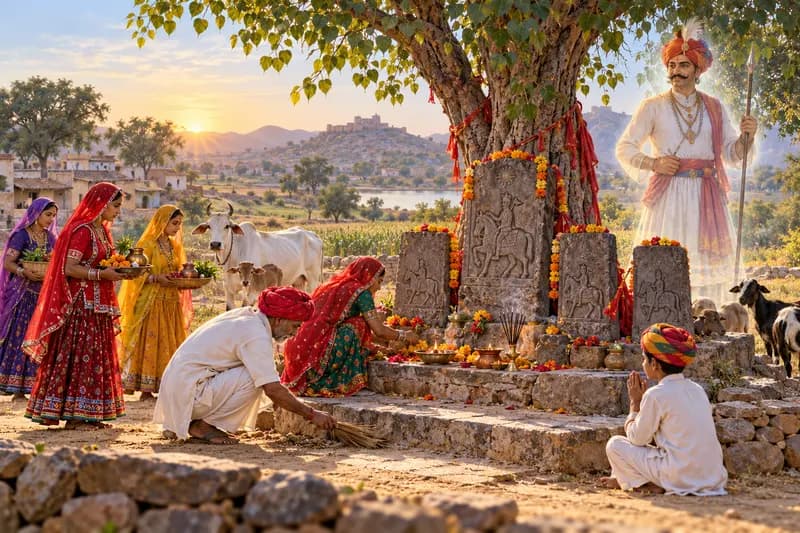
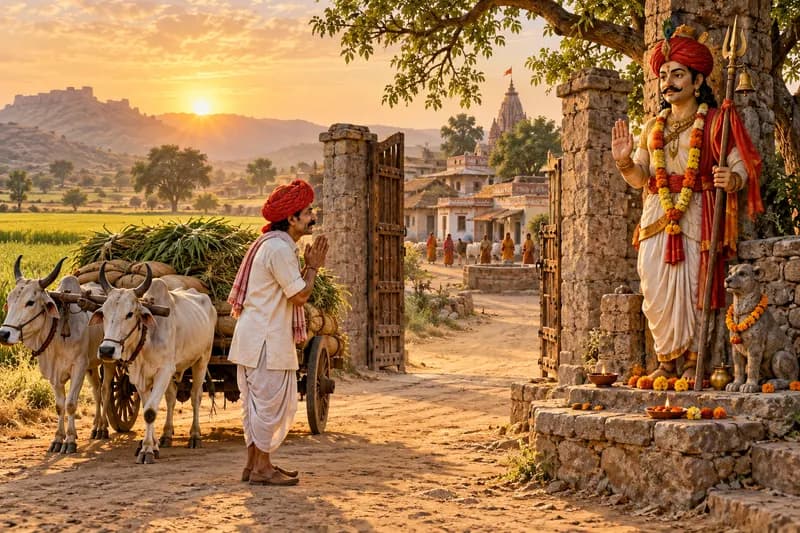
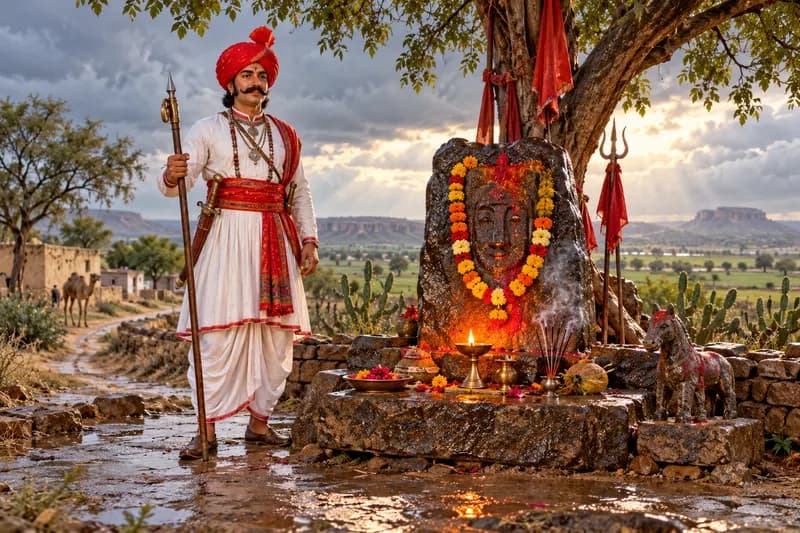
The Bhomiya (भोमिया) is an ancestor spirit venerated across Rajasthan and parts of western India as the guardian deity of a village's boundary. The word derives from 'bhumi' — earth, land — and a Bhomiya is, in the most literal sense, a spirit of the land itself. It is not a ghost that haunts. It is a departed ancestor — often a warrior, a village founder, or a person who died protecting the community — who has been elevated to the status of a territorial protector. The Bhomiya resides in a stone shrine, typically placed at the entrance gate or boundary wall of a village, and from that fixed position watches over everyone who enters, exits, and lives within.
What makes the Bhomiya distinct from other Indian spirit entities is its fundamentally civic nature. It is not wild. It is not vengeful by default. It operates on a contract: the village maintains the shrine, offers vermilion and incense, and remembers the ancestor's name. In return, the Bhomiya guards the boundary — protecting crops from blight, livestock from disease, and the community from hostile outsiders and malevolent spirits. Break the contract, neglect the shrine, or disrespect the land, and the Bhomiya's protection turns to punishment. But the punishment is never random. It is always proportional, always communal, and always a warning before it becomes a curse.
Why the Bhomiya Is Terrifying
INSTINCT EXPLOITED: THE COST OF FORGETTING
You inherit a plot of land at the edge of a Rajasthani village. The old stone shrine near the gate looks like rubble — cracked, weather-beaten, the vermilion faded to a pale rust. Nobody told you what it was. You clear it to widen the path for your tractor.
The first week, three goats fall sick. Bloating, refusal to eat, a glassy look in the eyes that the veterinarian cannot explain. The second week, the wheat near the boundary starts yellowing from the roots — not drought, not fungus, nothing the agricultural officer has seen before. The third week, your youngest child develops a fever that comes every evening at exactly the same hour and breaks at dawn.
Your neighbor, an old woman who has lived here sixty years, walks to your gate. She does not look at the cleared ground where the shrine was. She looks at you. "You moved Bhomiyaji," she says. Not a question.
The fear of the Bhomiya is not the fear of a monster in the dark. It is the fear of consequences. The fear that the land you stand on has a memory, and that memory has opinions. That every village sits on a contract signed in blood generations ago — a warrior who died defending this ground, a founder who gave his life so the settlement could survive — and that contract does not expire because you forgot to read it.
The Bhomiya does not chase you. It does not need to. You are already standing on its territory.
Origin — How It Came to Exist
The Founding Death
A Bhomiya is created when a person of exceptional local importance — a village founder, a warrior who died defending the community, a leader who sacrificed himself during famine or invasion — is elevated after death to the status of a territorial guardian. This is not automatic. The community must collectively recognize the death as significant, build a shrine at the boundary, and begin the cycle of offerings. The act of enshrinement transforms the dead person from a human ancestor into a Bhomiya — a spirit of the land itself.
The Rajput Connection
Many Bhomiyas in Rajasthan trace their origins to Rajput warriors who fell defending their villages against Mughal invasions, Maratha raids, or inter-clan warfare. The genealogical chronicles (khyats) of Rajput clans often record the names and deeds of specific Bhomiyas. These are not anonymous spirits. They are named ancestors with documented histories. The shrine preserves not just their spiritual presence but their story — who they were, how they died, and why their death mattered.
The Pastoral Tradition
Among Rajasthan's pastoral communities — the Rabari, the Bishnoi, the Meghwal — the Bhomiya tradition is even older than the Rajput warrior cult. Here, the Bhomiya is often a herder or a community elder who understood the land intimately — its water sources, its grazing patterns, its dangers. After death, this knowledge becomes spiritual guardianship. The Bhomiya knows the land because the Bhomiya once walked it.
Land as Sacred Contract
The philosophical core of the Bhomiya belief is that land is not property — it is a relationship. The ancestor died on this ground, for this ground, and now exists within it. The shrine at the gate is a visible reminder: someone paid the price for this village to exist. Every harvest, every safe birth, every season without invasion is payment on that original debt. The Bhomiya ensures the debt is remembered.
Spread Beyond Rajasthan
While most concentrated in Rajasthan, the Bhomiya tradition extends into Gujarat's Saurashtra region, parts of western Madhya Pradesh, and the Bundelkhand region of Uttar Pradesh. In each area, the core concept remains identical — a dead protector bound to the land — but the specifics of worship, the design of shrines, and the associated festivals vary with local custom.
Appearance & Manifestation
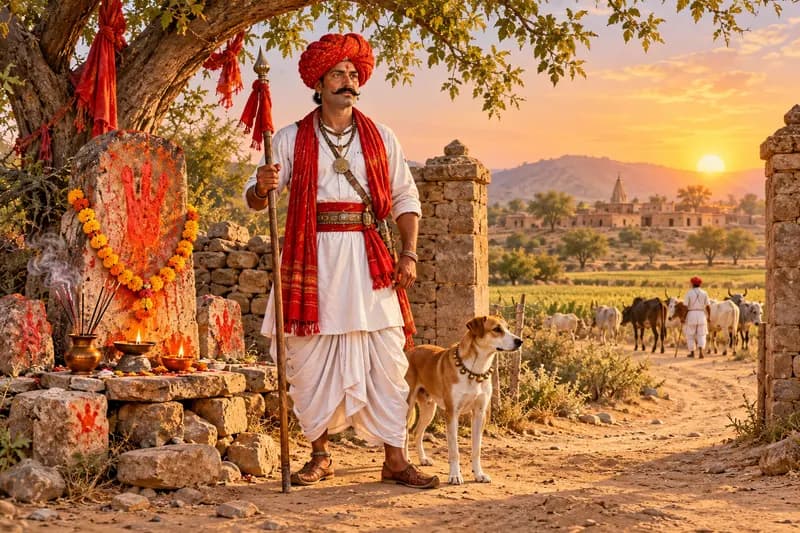
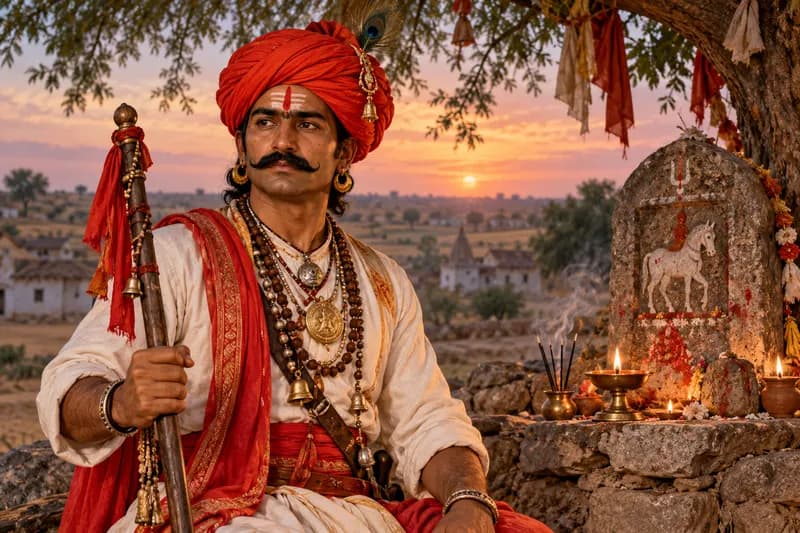
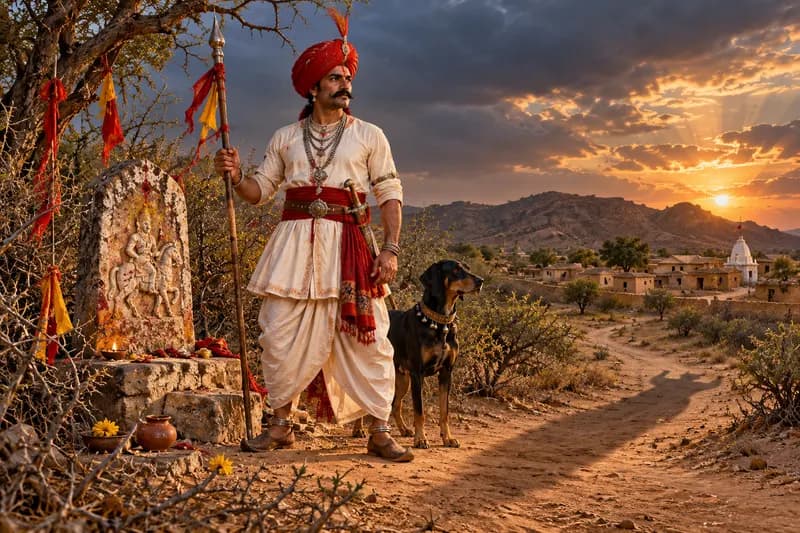
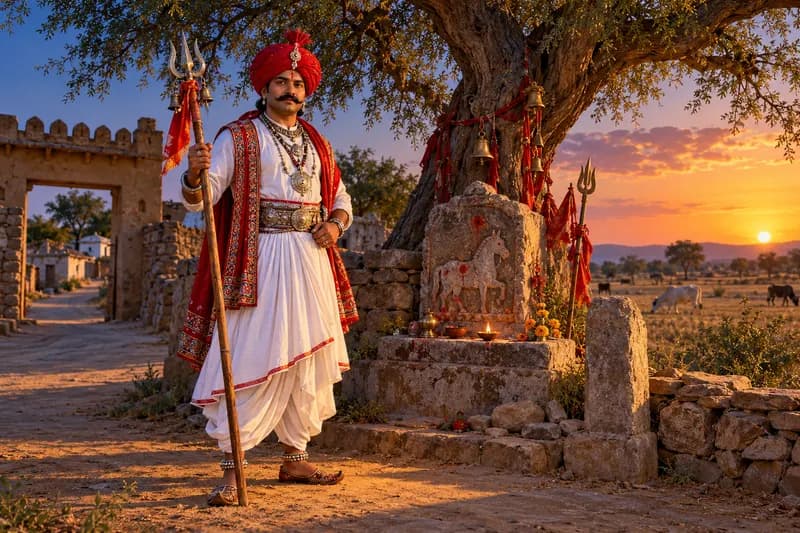
| 👁 Sight | The Bhomiya is rarely seen as an apparition. Its presence is the shrine itself — a rough stone or cluster of stones, painted with vermilion, sometimes carved with a rudimentary face or a horse-mounted warrior figure. In rare sighting accounts, it appears as a mounted horseman in white, patrolling the village boundary at dusk — there one moment, gone the next. |
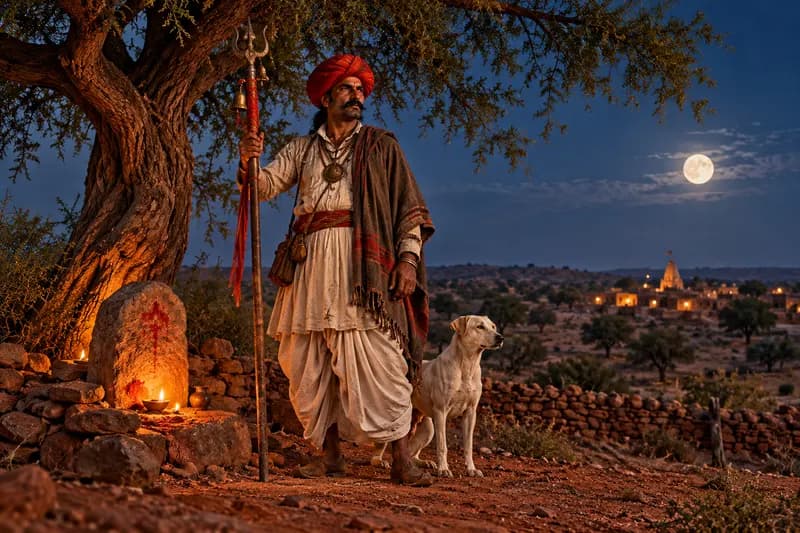
| 🔊 Sound | No voice. The Bhomiya does not speak. Its communication is entirely through consequence — crop health, livestock condition, the general fortune of the village. Some accounts mention the faint sound of hoofbeats near the boundary at night, especially on Amavasya, as the Bhomiya makes its rounds. |
| 🍃 Smell | The smell of the shrine — sandalwood incense, vermilion paste, marigold garlands aging in the desert heat. When offerings have lapsed, a dry, dusty smell — like sun-baked clay and forgotten stone — is said to settle near the boundary even when the wind is still. |
| ❄ Temperature | No dramatic temperature changes. The Bhomiya is not a cold-spot spirit. If anything, the shrine area feels warmer — the residual heat of desert stone, the small oil lamp that burns there. Discomfort near the shrine, when it occurs, is not cold but a heaviness — a weight in the chest, a reluctance to move. |
| 🌑 Time | Active at all hours but most potent at dusk and dawn — the boundary times, the transition hours. The Bhomiya is a boundary spirit in every sense. Its influence peaks when the village itself transitions between day and night, between safety and exposure. |
| 🏚 Habitat | Always at the village gate or boundary wall. Never inside the village, never in the fields beyond. The Bhomiya occupies the threshold — the exact line between inside and outside, between community and wilderness. The shrine is placed where this line is sharpest. |
The Road Through Barmer
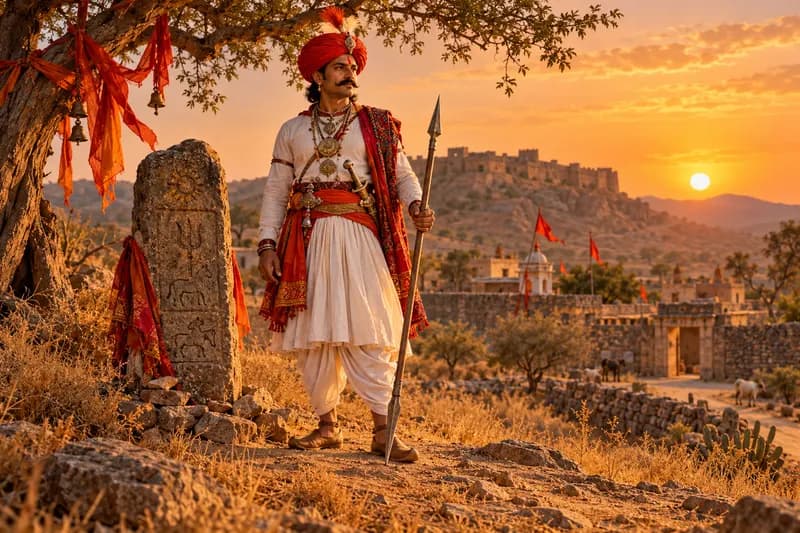
In a village south of Barmer, where the Thar Desert presses close and the boundary between settlement and sand is a single stone wall, there stood a Bhomiya shrine that was older than anyone living could remember. The stone was dark with decades of vermilion, worn smooth by generations of hands. A carved horseman, barely visible under the layers of paint, rode eternally across the front face. The villagers called him Bhomiyaji and spoke his name the way you speak the name of a grandfather — with respect, but without fear.
The shrine sat at the only road into the village. Every cart, every tractor, every person on foot passed it. Every morning, the headman's wife placed a stick of incense and a smear of fresh vermilion on the stone. On festival days, they slaughtered a goat and let the blood touch the base of the shrine. This had been done for as long as the village had existed.
In 2003, the state government widened the road. The contractor was from Jodhpur — a city man who had no patience for village superstitions. The shrine was directly in the path of the new road. He told the villagers it would be moved. They said it could not be moved. He said it was a pile of rocks. They said it was Bhomiyaji.
The contractor moved the stones with a JCB on a Tuesday morning. The villagers watched in silence. The headman's wife did not place incense that day. The stones were dumped in a pile behind the new boundary wall, next to a drainage ditch.
Within a week, the contractor's JCB broke down — a hydraulic failure that the mechanic said looked like the lines had been cut, though nobody had been near the machine. The replacement part, ordered from Jodhpur, was delivered to the wrong address. Twice. The road crew developed a stomach illness — not food poisoning, something else, a cramping that came and went with no pattern. Work stopped for ten days.
The villagers said nothing. They did not gloat. They did not threaten. They simply waited.
On the eleventh day, the contractor came to the headman's house. He did not apologize — he was not that kind of man — but he asked, carefully, where the stones should go. The headman took him to the new boundary wall and showed him a spot at the new gate. The stones were placed there. The headman's wife brought vermilion and incense. The carved horseman faced the road again.
The JCB started on the first try. The stomach illness stopped. The road was completed on schedule.
The contractor never spoke about it afterward. But three months later, a relative of his in Jodhpur asked if he had any work in that village. He said no. He said he would not go back. He did not explain why.
The Rules — How to Coexist
⚠ CAUTION ⚠
Five rules for living in Bhomiya territory
- Never move, damage, or disrespect a Bhomiya shrine. — The shrine is the Bhomiya's anchor — its body, its seat, its contract made visible. Moving the stones breaks the territorial agreement. Consequences fall on whoever broke it and, often, on the entire village.
- Maintain daily offerings — incense, vermilion, and acknowledgment. — The Bhomiya does not require elaborate worship. It requires consistency. A daily act of recognition — 'I know you are here, I remember who you were' — keeps the contract alive. Lapsed offerings are the most common cause of Bhomiya displeasure.
- When entering a village for the first time, pause at the Bhomiya shrine. — The Bhomiya watches the gate. Every stranger who enters is observed. A moment of pause — not prayer, just acknowledgment — signals that you recognize the authority of the boundary. Rushing past is read as disrespect.
- If livestock fall sick or crops fail near the boundary, consult the shrine first. — These are the Bhomiya's primary warning signs. Before calling the veterinarian or the agricultural officer, check whether the shrine has been neglected, the stones disturbed, or the offerings lapsed. Restoring the shrine often resolves the issue faster than any modern intervention.
- Never build on or over the shrine site, even if the shrine appears abandoned. — A Bhomiya shrine is never truly abandoned. The spirit remains bound to the land beneath it. Construction over the site traps the Bhomiya and converts its protection into hostility. The land remembers even when the people forget.
What They Don't Tell You
The Bhomiya is not a punishment system. It is the oldest form of community insurance in Indian folk religion. The ancestor who died for the village becomes the village's permanent security — not because of magic, but because of memory. The shrine at the gate is a mnemonic device: it forces every generation to remember that this place exists because someone died for it. The 'supernatural' consequences of neglect — sick livestock, failed crops, mysterious illness — are the community's way of encoding a truth that modernity wants to forget: *land has a history, and that history has a claim on you.* The Bhomiya is not guarding the village from outside threats. It is guarding the village from its own amnesia.
What Does the Bhomiya Want?
The Bhomiya wants one thing: to be remembered.
Not worshipped — that implies hierarchy. Not feared — that implies hostility. Remembered. The Bhomiya was a person. It had a name, a life, a death that meant something. The shrine, the vermilion, the incense — these are not rituals of appeasement. They are rituals of memory. Each offering says: 'You existed. You mattered. Your death gave us this ground.'
When the Bhomiya punishes — and it does punish — the punishment is always a form of the same message: you forgot. The crops fail near the boundary because you stopped tending the boundary's guardian. The livestock sicken because you stopped honoring the one who watched over the grazing lands. The child develops a fever because the contract that protects children was allowed to lapse.
Restore the memory and the punishment stops. It is that simple. The Bhomiya is perhaps the most forgiving entity in the entire Indian supernatural tradition — because all it asks is that you do not erase the person who died so you could live here.
You're Most at Risk If...
- You are a new owner of land in rural Rajasthan and do not know the local shrines
- You are a contractor or developer working near village boundaries
- You have moved or damaged a stone structure at a village gate without asking its significance
- You have inherited property and allowed the shrine on it to fall into disrepair
- You pass through villages frequently without pausing at boundary markers
- You are from the city and dismiss rural shrine traditions as superstition
Offerings & Appeasement
| Offering | Purpose |
|---|---|
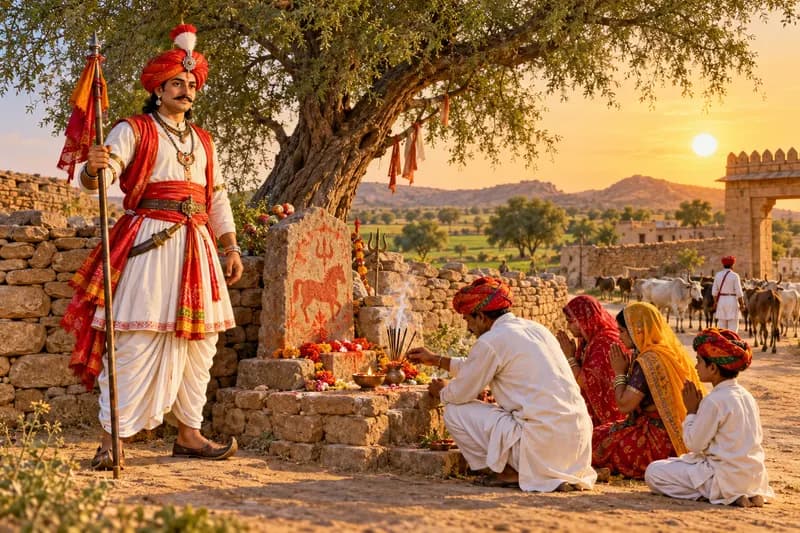
| Daily Maintenance | A stick of incense, a fresh smear of vermilion (sindoor) on the shrine stone, and a moment of verbal or silent acknowledgment. This is the minimum — the daily premium on the community's insurance policy. Typically performed by the headman's family or a designated shrine-keeper. |
| Festival Offerings | On Navratri, Dussehra, and the local village festival (mela), the Bhomiya receives a full offering: coconut, jaggery, marigolds, and in many communities, the blood of a sacrificed goat touched to the base of the shrine. These are the annual renewals of the contract. |
| Crisis Appeasement | When the Bhomiya is believed to be angry — evidenced by livestock disease, crop failure, or unexplained communal illness — a special ceremony is performed. A Bhopa (folk priest) is called. The shrine is washed, repainted with fresh vermilion, and offerings of liquor, meat, and sweets are placed at its base. A recitation of the ancestor's story — who they were, how they died — is performed aloud. |
| The Reinstallation Rite | If a shrine has been moved or destroyed, it must be formally reinstalled. This involves a Bhopa identifying the correct location (often through trance or divination), placing the stones with specific mantras, and performing a full night vigil with offerings. The community must be present. The Bhomiya must see that the village remembers. |
The Healer
Bhopa (Folk Priest) — The Bhopa is the traditional intermediary between the village and its Bhomiya. Bhopa families often serve the same shrine for generations. They perform the reinstallation rites, interpret signs of the Bhomiya's displeasure, and maintain the oral history of the ancestor — who they were, how they died, and what the original contract requires.
Village Headman (Sarpanch) — In many communities, the headman's family holds hereditary responsibility for the Bhomiya shrine. The headman's wife often performs the daily offerings. When a Bhomiya issue arises, the headman convenes the village elders to determine the cause and the remedy — this is a civic matter, not just a spiritual one.
Tantrik (for Severe Cases) — In rare cases where the Bhomiya's anger has escalated beyond normal appeasement — prolonged illness, repeated crop failures, a death near the boundary — a tantrik may be called to negotiate directly with the spirit. This is unusual and indicates the contract has been severely broken.
The Key Principle — You do not exorcise a Bhomiya. You do not banish it. You restore the relationship. The Bhomiya is not an intruder — it is the oldest resident of the village. The solution is always the same: remember the ancestor, restore the shrine, resume the offerings. The Bhomiya was never the problem. The forgetting was.
What If You Dream of a Bhomiya?
| Symbol | Meaning | |
|---|---|---|
| 🏇 | A Horseman at a Gate | You are being warned about a boundary you are crossing — not a physical one, but a moral or social one. Someone set a limit for a reason, and you are about to violate it. The horseman is not threatening you. He is showing you where the line is. |
| 🪨 | A Stone Shrine Crumbling | You are neglecting a foundational relationship — a parent, a mentor, someone whose sacrifice made your current life possible. The crumbling shrine is the deteriorating connection to your own history. The dream is saying: tend it before it collapses. |
| 🌾 | Withering Crops Near a Boundary | Something in your life that was once productive is dying because you stopped maintaining the conditions that made it grow. Not talent, not luck — maintenance. The daily discipline you abandoned. The small consistent effort you replaced with nothing. |
| 🔴 | Vermilion on Your Hands | You have inherited a responsibility you did not ask for. The vermilion is the mark of duty — it does not wash off, it does not fade on its own. Someone before you started something, and it is now yours to continue. The dream is not a curse. It is an assignment. |
The Bhomiya in Art History
Medieval Period — Hero Stones (Devali/Paliya): The oldest physical representations of Bhomiyas are hero stones — carved memorial slabs depicting mounted warriors, sometimes with a sun and moon above (signifying eternal witness). Found across Rajasthan, these stones date from the 8th to 15th centuries and often mark the site where the ancestor fell in battle.
Rajput Miniature Paintings — 16th–18th Century: Rajasthani miniature paintings occasionally depict boundary shrines with small vermilion-stained stones at village gates. These appear as background details in scenes of village life — evidence that the Bhomiya tradition was so embedded in daily existence that artists included it as naturally as they included trees or wells.
Folk Art — Phad Paintings: The Phad scroll paintings of Rajasthan — massive narrative textiles depicting the stories of folk heroes like Pabuji and Devnarayan — frequently include Bhomiya shrines in their landscape panels. The Bhopas who perform with these scrolls sing the stories of the depicted ancestors, making the Phad itself a form of Bhomiya worship.
Contemporary — Living Shrines: The most powerful 'art' of the Bhomiya tradition is not in museums. It is the thousands of active shrines across rural Rajasthan — rough stones painted bright vermilion, placed at village gates, tended daily. These are folk installations that have been continuously maintained for centuries. They are not preserved artifacts. They are living practice.
Cross-Regional Patterns
Bhairava Spirit · Airi · Sati Ghost · Sagasji · Putana · Chudail · Daayan · Dain / Dayan
| Dawn as hard limit | No — active at all hours |
| Iron weakness | No |
| Tree-dwelling | No — stone shrine |
| Counting compulsion | No |
| Backward feet | No |
Global Equivalent: The closest parallel in world folklore is the Roman Lares — ancestral spirits who guarded the household and its boundaries, venerated at small household shrines (lararia) with daily offerings of incense and food. Like the Bhomiya, the Lares were not feared but maintained — protectors whose benevolence depended on continued respect. The Japanese Dosojin (road boundary spirits) and the West African ancestor shrines share similar logic: the dead who protect the living, anchored to a specific place, sustained by memory.
In Culture — Movies, Books, Games
| Type | Title | Description |
|---|---|---|
| Literature | Vijaydan Detha — Rajasthani Folk Collections | The great Rajasthani folklorist Vijaydan Detha documented numerous Bhomiya traditions in his massive collection of Rajasthani folk tales. His work preserves oral accounts of specific Bhomiyas — their names, their deeds, and the consequences of shrine neglect — that would otherwise have been lost. |
| Film | Paheli (2005) | While not directly about a Bhomiya, this Rajasthani ghost story directed by Amol Palekar draws from the same folk ecosystem. The desert landscape, the boundary spirits, the idea that the land itself has memory — all are part of the Bhomiya tradition's cultural soil. |
| Documentary | Rajasthan's Folk Deities — Various ethnographic works | Multiple ethnographic documentaries and academic films have covered the Bhomiya tradition as part of Rajasthan's living folk religion. These are not entertainment — they are field recordings of active belief, capturing the daily rituals, the shrine maintenance, and the community relationships that keep the tradition alive. |
| Music | Bhopa Performances — Phad Scroll Narration | The Bhopa caste of Rajasthan performs all-night narrations of folk epics using painted Phad scrolls, often incorporating Bhomiya praise songs. These performances — part music, part theater, part worship — are the primary vehicle through which Bhomiya stories are transmitted across generations. |
| Reference Book | Ghosts, Monsters and Demons of India — Rakesh Khanna | Comprehensive documentation of the Bhomiya within the broader taxonomy of Indian folk spirits, including regional variants and the relationship between Bhomiya worship and other ancestor-cult traditions of western India. |
ACCURACY RATING: HIGH — BASED ON ACTIVE FOLK TRADITION · LIMITED FICTIONAL REPRESENTATION
Is the Bhomiya Still Real?
- Actively maintained across rural Rajasthan — thousands of Bhomiya shrines are tended daily with vermilion, incense, and offerings. This is not declining tradition. In many villages, it is the most consistently observed religious practice.
- Development conflicts involving Bhomiya shrines are documented regularly. Road-widening projects, new construction, and land redistribution schemes have all encountered Bhomiya shrine disputes — government records confirm that projects have been rerouted to accommodate shrines that communities refused to move.
- The Bhopa community continues to serve as hereditary priests of Bhomiya shrines. Their role is not ceremonial — they are called upon to diagnose Bhomiya displeasure, perform reinstallation rites, and maintain the oral histories that give each shrine its identity.
- Among Rajasthani diaspora communities in cities like Jodhpur, Jaipur, and even Mumbai, Bhomiya worship persists in adapted forms — small shrine corners in homes, vermilion-marked stones in apartment compounds, annual visits to the ancestral village shrine.
- No mass hysteria, no panic, no sensational media coverage. The Bhomiya is not a crisis spirit. It is infrastructure — as fundamental to village life as the well or the granary. It is believed in the way you believe in the foundation of your house: not with excitement, but with the quiet certainty that removing it would bring everything down.
Expert & Academic Context
- Komal Kothari — Rajasthani Folk Traditions — The pioneering folklorist of Rajasthan, Kothari documented Bhomiya traditions extensively through decades of fieldwork. His recordings and writings form the most comprehensive academic archive of western Indian folk deity worship.
- Vijaydan Detha — Batan ri Phulwari — Detha's monumental collection of Rajasthani folk tales includes numerous accounts involving Bhomiya spirits, preserving oral narratives that connect specific shrines to specific ancestors and specific historical events.
- Ghosts, Monsters and Demons of India — Rakesh Khanna — Modern comprehensive documentation placing the Bhomiya within the broader taxonomy of Indian folk spirits, with analysis of regional variants and the relationship between ancestor worship and territorial guardianship.
- Ethnographic studies on Rajasthani folk religion — Multiple academic studies — particularly from the University of Rajasthan and the Rupayan Sansthan in Jodhpur — have documented the Bhomiya tradition through fieldwork, recording shrine locations, origin stories, and active worship practices across districts.
- Hero stone inscriptions and archaeological surveys — Archaeological Survey of India records of hero stones (devali/paliya) across Rajasthan provide physical evidence of the Bhomiya tradition dating back to the medieval period. These carved memorial slabs are the earliest tangible records of specific ancestor spirits being venerated at village boundaries.
The Bhomiya represents a fundamentally different relationship between the living and the dead than what most ghost traditions assume. There is no horror here — only obligation. The Bhomiya is the folk-religious expression of a social contract theory: someone died so this community could exist, and the community's continued existence depends on honoring that sacrifice. In a region where water is scarce, land is contested, and survival has always required collective effort, the Bhomiya functions as a binding agent — the one thing every family in the village agrees to maintain, regardless of caste, wealth, or personal belief. The gendered dimension is notable: while many Indian folk spirits arise from women's suffering, the Bhomiya is overwhelmingly male — a warrior, a founder, a protector. It reflects the martial and pastoral cultures of Rajasthan, where the boundary between settled life and the desert was always the most dangerous line in the landscape.
If You Encounter a Bhomiya Shrine
Frequently Asked Questions
▶What is a Bhomiya?
A Bhomiya is an ancestor spirit venerated as the guardian deity of a village boundary in Rajasthan and parts of western India. It is typically the spirit of a warrior, founder, or elder who died protecting the community, enshrined at the village gate in a vermilion-painted stone structure.
▶Is the Bhomiya dangerous?
The Bhomiya's danger level is low (2 out of 5) compared to other Indian folk entities. It does not attack, possess, or kill. Its 'punishments' — livestock illness, crop failure, communal misfortune — are warnings, not death sentences. Restoring the shrine and resuming offerings resolves nearly all Bhomiya-related issues.
▶How is a Bhomiya different from a ghost?
A ghost is typically understood as a trapped or resentful spirit. The Bhomiya is neither trapped nor resentful — it is a voluntarily venerated ancestor who has been elevated to the status of a territorial protector. It does not haunt. It guards. Its presence is desired, maintained, and honored by the community it protects.
▶What happens if you destroy a Bhomiya shrine?
According to folk belief, destroying or moving a Bhomiya shrine without proper ritual causes communal misfortune — livestock disease, crop failure, unexplained illness, mechanical breakdowns. These consequences are believed to continue until the shrine is restored and proper appeasement is performed by a Bhopa (folk priest).
▶Are Bhomiya shrines still active?
Yes. Thousands of Bhomiya shrines remain active across rural Rajasthan with daily offerings. Government development projects have been documented rerouting roads and construction to avoid disturbing Bhomiya shrines. The tradition is not declining — it is one of the most consistently maintained folk-religious practices in western India.
▶Can a Bhomiya be removed or exorcised?
No, and the concept is considered inappropriate. A Bhomiya is not an unwanted spirit — it is the village's chosen guardian. The correct response to any Bhomiya-related issue is restoration, not removal. You fix the relationship; you do not end it.
Explore More
Related Spirits
Bhairava Spirit · Airi · Sati Ghost · Sagasji · Putana · Chudail · Daayan · Dain / Dayan
Stories Are Being Summoned
One ghost story per week. Every Tuesday at midnight.