Airi
He died protecting strangers. Now he protects the road itself — and God help the person who disrespects his shrine.
- What Is an Airi?
- Why the Airi Is Terrifying
- Origin — How It Came to Exist
- Appearance & Manifestation
- The Shepherd of Barmer
- The Rules — How to Survive
- What They Don't Tell You
- What Does the Airi Want?
- You're Most at Risk If...
- Offerings & Appeasement
- The Healer
- What If You Dream of an Airi?
- The Airi in Art History
- Cross-Regional Patterns
- In Culture — Movies, Books, Games
- Is the Airi Still Real?
- Expert & Academic Context
- If You Encounter an Airi
- Frequently Asked Questions
- Explore More
| Airi | |
|---|---|
| Also Known As | Airi Devta, Veer Airi, Airi Baba |
| Script | ऐरी (Devanagari) |
| Pronunciation | AY-ree (ऐ-री) |
| Region | Rajasthan, particularly Marwar (Jodhpur division) and the Thar Desert belt |
| Category | Hero Ghost / Deified warrior spirit |
| Danger Level | Moderate |
| Fear Method | Protective violence against disrespecters; road accidents near ignored shrines |
| Warning Sign | A sudden feeling of being watched on a desert road; unexplained vehicle trouble near roadside shrines |
| First Documented | Oral traditions of Rajput and Rajasthani folk culture; documented in colonial-era gazetteers of Marwar |
| Still Believed? | Yes — roadside Airi shrines are actively maintained across Rajasthan; truck drivers and travelers make offerings daily |
| Related | Jhunjhar · Sagasji · Bheru · Devchar · Putana · Chudail |
What Is an Airi?
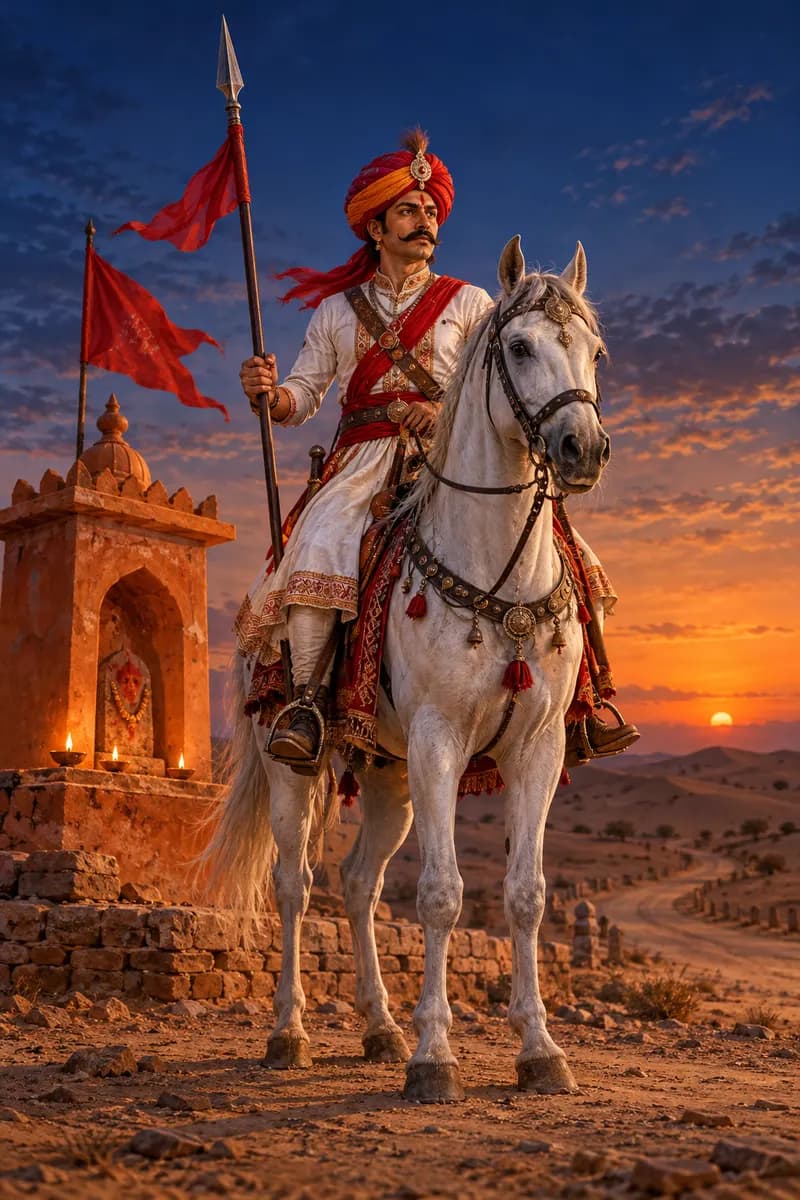
An Airi (ऐरी) is a hero ghost from Rajasthani folklore — the spirit of a person who died protecting others, typically in battle, during a bandit attack, or while defending a village. Unlike malevolent ghosts that arise from trauma or injustice, the Airi is created by sacrifice. The person's death was voluntary, noble, and violent — and the intensity of that final act is what binds the spirit to the place where it fell. The Airi does not haunt. It guards.
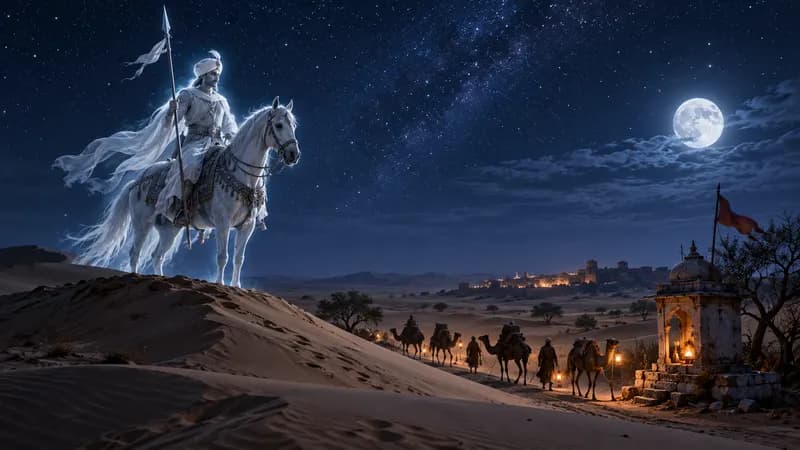
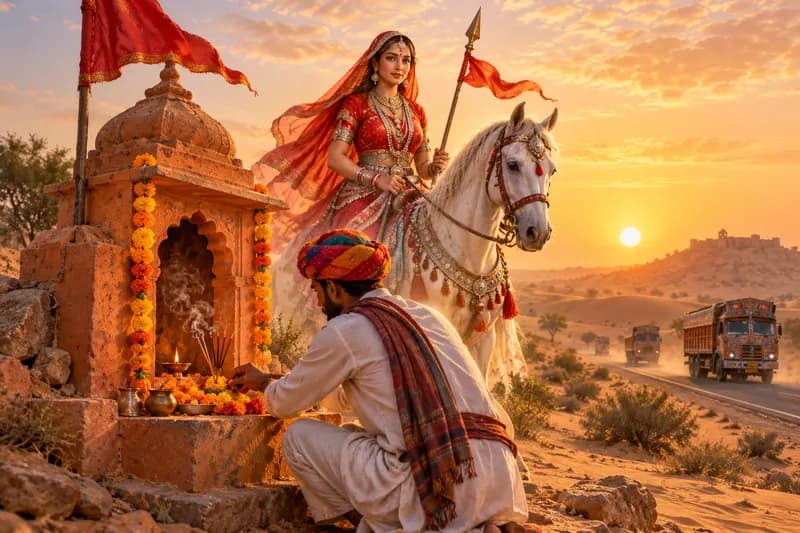
Across the desert highways and village roads of Rajasthan, small shrines mark the spots where Airis are believed to stand watch. These are not ancient temples — many are simple stone platforms with a red flag, a trident, or a painted image. Truck drivers stop to offer incense and marigolds before long journeys. Villagers bring offerings after safe returns. The Airi is not feared in the way a Churel or Bhoot is feared. It is respected the way a soldier's memorial is respected — with the understanding that disrespect has consequences.
Why the Airi Is Terrifying
INSTINCT EXPLOITED: THE DEBT OF THE PROTECTED
The Airi is not a monster. It does not hunt you. It does not invade your home or whisper in your ear. It stands where it died — on a road, at a crossroads, at the edge of a village — and it watches. If you are in danger, it may save you. If you are respectful, it will let you pass. If you ignore it, if you mock it, if you damage its shrine — then you learn what a hero ghost can do.
The stories are consistent. A truck driver who urinated near an Airi shrine lost control of his vehicle within the hour. A contractor who bulldozed a roadside platform to widen a highway found his equipment breaking down, his workers falling sick, his project plagued by accidents until he rebuilt the shrine twice as large.
What makes this terrifying is not the violence. It is the morality. The Airi operates on a code: protect those who acknowledge the sacrifice, punish those who don't. You are not dealing with a mindless spirit. You are dealing with the ghost of someone who was brave enough to die for strangers — and who has very strong opinions about gratitude.
The scariest thing about the Airi is the question it forces you to ask: Do I deserve protection? Because the Airi can tell. And if the answer is no, the desert road suddenly feels very long.
Origin — How It Came to Exist
The Heroic Death
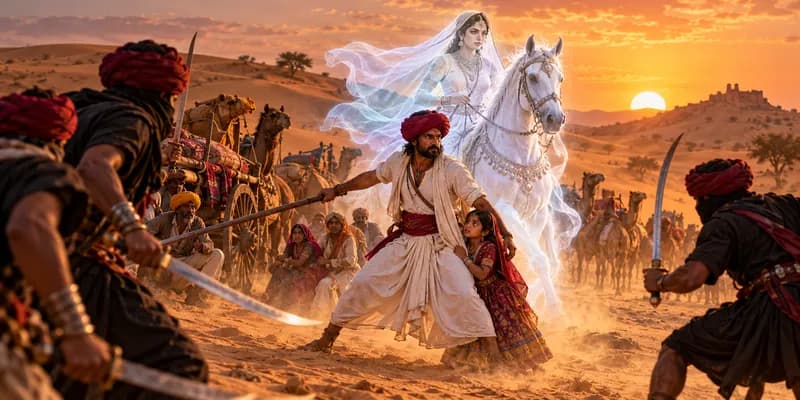
An Airi is created when a person dies in the act of protecting others. The death must be violent, voluntary, and selfless — a warrior falling in battle, a shepherd fighting off bandits to save his flock, a traveler who died defending a caravan. The critical element is not the status of the person but the nature of the death. A king who dies protecting his subjects becomes an Airi. A nameless goatherd who dies fighting a leopard to save a child also becomes an Airi. The desert does not care about your caste.
The Rajput Connection
The Airi tradition is deeply intertwined with Rajput martial culture — a society that valorized death in battle above all other endings. In Rajput folklore, the spirit of a warrior who fell bravely could not simply pass on. The intensity of the final act — the rage, the love, the refusal to retreat — was too strong. It anchored the spirit to the earth. The Airi is, in this sense, a Rajput afterlife for heroes: not heaven, not hell, but eternal guard duty.
The Shrine Tradition
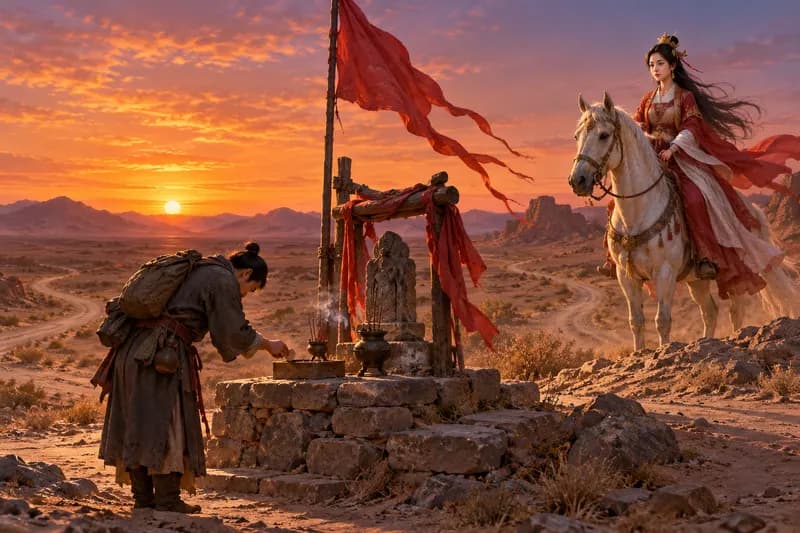
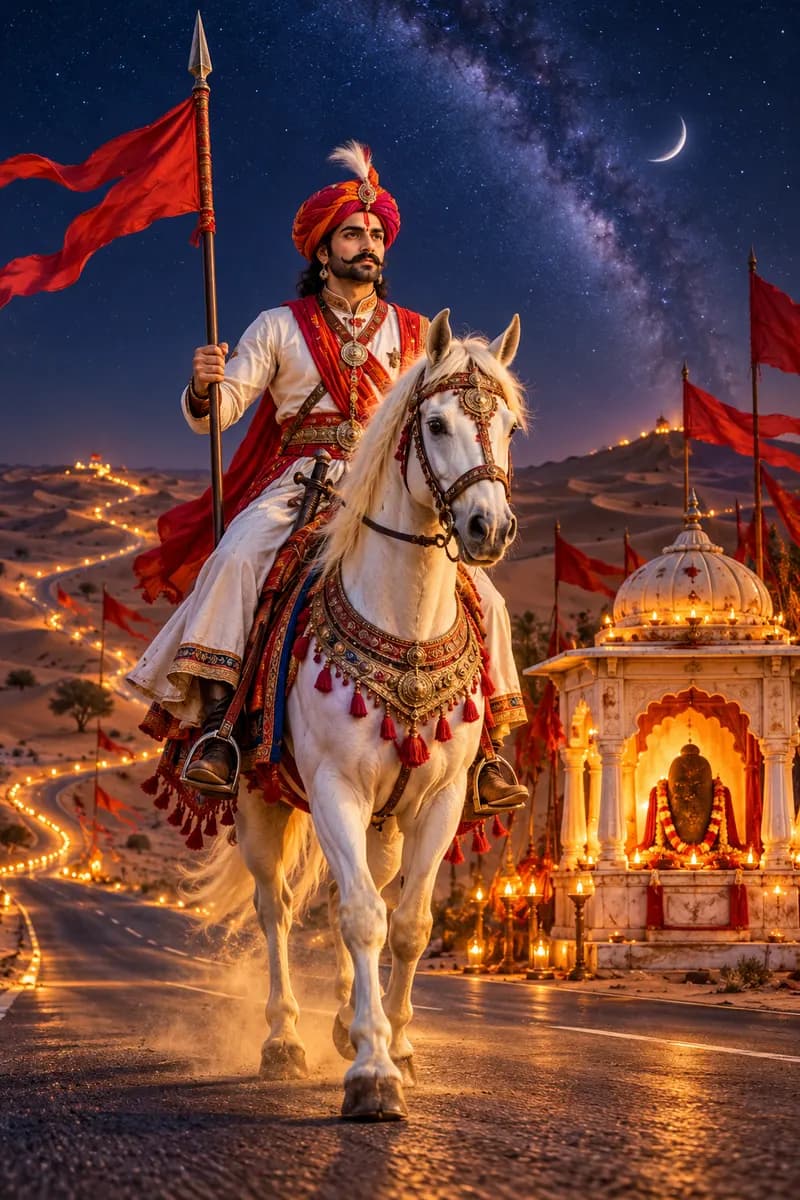
When a person dies heroically, the community builds a shrine at the spot — a simple stone platform, often painted orange or red, with a trident (trishul) or a carved image of a horseman. This shrine becomes the Airi's anchor. It is where offerings are made, where travelers pause, where the boundary between the living and the dead is thinnest. Some Airi shrines are centuries old. Others were built within living memory, marking deaths from the colonial period or even the 20th century.
The Desert Logic
Rajasthan is harsh terrain — extreme heat, scarce water, vast distances between settlements. In this landscape, protection is not abstract. It is survival. The Airi tradition makes spiritual sense in this context: the desert produces dangers (bandits, animals, thirst, sandstorms), and the Airi produces guardians. The dead protect the living because the living cannot always protect themselves.
From Ghost to God
Over time, some Airis evolve from local hero ghosts to regional deities. An Airi that is worshipped for generations, that accumulates stories of miraculous interventions, that becomes associated with a specific power (safe travel, protection of livestock, victory in disputes) gradually crosses the line from ghost to god. This is one of the most fascinating aspects of Indian folk religion: divinity is not fixed. It is earned, over centuries, through sustained belief and demonstrated results.
Appearance & Manifestation
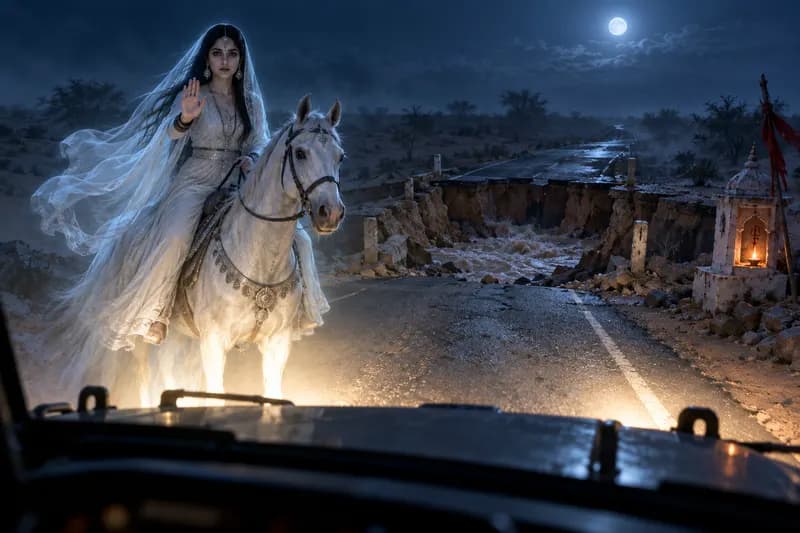
| 👁 Sight | Rarely seen directly. When witnessed, the Airi appears as a mounted warrior — a figure on horseback, often carrying a lance or sword, dressed in the style of the era in which he died. Accounts describe a translucent figure that appears most often at twilight, visible for only seconds before vanishing. The horse is always part of the apparition. |
| 🔊 Sound | The sound of hoofbeats on a road where no horse is present. A metallic ringing, like a sword being drawn. Some travelers report hearing a shout — a battle cry — seconds before narrowly avoiding an accident. The Airi's warning is auditory, sharp, and brief. |
| 🍃 Smell | The scent of dhoop (incense) or burning camphor near the shrine, even when no one has made a recent offering. In the open desert, a sudden smell of marigolds where no flowers grow. The Airi's presence announces itself through the offerings it has received. |
| ❄ Temperature | A sudden coolness in the desert heat — a pocket of cold air around the shrine area, even in summer. Not threatening cold, but noticeable. Travelers describe it as 'shade where there is no shade.' |
| 🌑 Time | Most active at twilight and during the pre-dawn hours. The Airi is not strictly nocturnal — it guards at all hours — but sightings cluster at the boundary between day and night, the transitional moments when the desert shifts. |
| 🏚 Habitat | Roadside shrines, crossroads, battlefield sites, and the specific location where the heroic death occurred. The Airi does not wander. It is anchored to its spot. Its territory is the stretch of road around its shrine — usually a few hundred meters in either direction. |
The Shepherd of Barmer
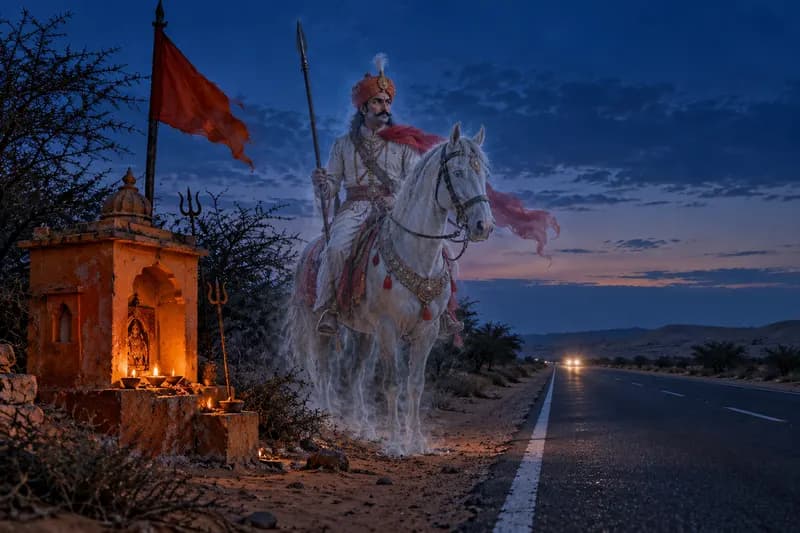
In the district of Barmer, in the western reaches of the Thar Desert, there is a shrine on the road between Barmer town and Dhorimanna. It is a modest thing — a stone platform barely a meter high, painted orange, with a faded image of a man holding a staff. A red flag hangs from a wooden pole beside it, bleached almost white by the sun. Every truck that passes slows down. Most drivers touch their foreheads in acknowledgment. Some stop and leave a coin, a marigold, a lit incense stick.
The shrine is for a shepherd whose name has been remembered differently by different families — some say Bhura, some say Kana, some say it does not matter because what he did is what counts. What he did was this: sometime in the early 1900s, a group of bandits — dacoits — descended on a caravan of traders crossing the desert near this spot. The traders were from Jodhpur, carrying cloth and spices to the border markets.
The shepherd was grazing his goats nearby. He was not a warrior. He was not armed beyond his staff and a knife used for cutting rope. He was nobody — a man with thirty goats and a turban and no stake in the traders' business. But when the dacoits attacked, the shepherd ran toward the fight, not away from it.
What happened next varies by telling. In some versions, he killed two dacoits before being cut down. In others, he simply placed himself between the bandits and a trader's young son, absorbing the blows meant for the child. In all versions, he died. In all versions, the traders survived because of the time his intervention bought them — time to scatter, to hide, to escape into the dunes.
The traders built the first shrine. A stone, a marking, a whispered acknowledgment. Within a generation, travelers on that road began reporting things. A feeling of safety in a stretch of desert known for banditry. A sudden alertness — a sharpening of attention — just before a dangerous curve. One truck driver, in a story told and retold in the dhabas of Barmer, swore that he saw a figure step into his headlights on a foggy winter night, causing him to brake hard — only to discover, when the fog cleared, that the road ahead had washed away in a flash flood he would have driven straight into.
The shrine has been rebuilt three times. Each time larger. Each time with more flags, more tridents, more painted images. The shepherd who was nobody in life has become, in death, the most important person on that road. Truck drivers who have never met a ghost and never will still slow down when they pass. They leave a rupee. They touch their foreheads. They say, without irony or embarrassment: 'Airi Baba, keep the road safe.'
And the road, by all accounts, is safe. Safer than it should be, for a desert highway with poor visibility and no guardrails. Whether this is the shepherd's doing or simply the result of a thousand drivers slowing down at the same spot is a question that the people of Barmer do not find interesting. The shrine is there. The road is safe. That is enough.
The Rules — How to Survive
☠ WARNING ☠
Seven rules for coexisting with an Airi
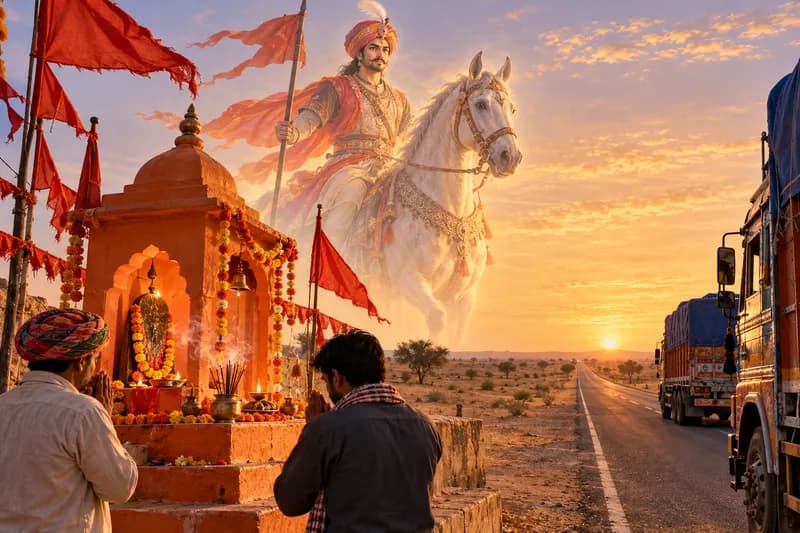
- Always acknowledge the shrine. A nod, a pause, a coin. — The Airi operates on a reciprocity code. Acknowledgment costs you nothing and earns you protection. Ignoring the shrine is not neutral — it is disrespect.
- Never damage or move an Airi shrine. — The shrine is the Airi's anchor point. Destroying or relocating it unleashes the spirit's protective aggression — directed at whoever caused the damage. Construction projects that remove Airi shrines are plagued with accidents until the shrine is restored.
- Do not mock the offering or the belief. — The Airi is a spirit of sacrifice and honor. Mocking its tradition — laughing at the shrine, dismissing the belief — is taken as a personal insult by an entity that died for strangers.
- If you make a promise at the shrine, keep it. — Some travelers promise a return offering — 'If I arrive safely, I will bring sweets and incense.' Breaking this promise is treated by the Airi as betrayal, and the protection is withdrawn.
- Do not urinate, defecate, or dump waste near the shrine. — This is the most commonly reported trigger for Airi aggression. The shrine is sacred ground — the place where a person gave their life. Physical pollution of the site is the deepest disrespect.
- Travel respectfully through the Airi's territory. — Reckless driving, excessive speed, or aggressive behavior on the road near an Airi shrine invites consequences. The Airi protects — but it protects those who deserve protection.
- If you feel suddenly alert or uneasy near a shrine, pay attention. — This may be the Airi warning you. Sudden alertness, a feeling of being watched, an urge to slow down — these are the Airi's communication methods. Ignore them at your own risk.
What They Don't Tell You
The Airi is proof that Indian folklore does not divide the dead into good and evil. The same culture that produced the Churel, the Bhoot, and the Pishacha also produced this — a ghost that is worshipped, loved, and trusted. The Airi tradition reveals something profound about the Indian relationship with death: that how you die matters more than who you were in life. A thief who dies protecting a child becomes an Airi. A king who dies running from battle does not. The desert strips everything down to essentials — and in the desert's folklore, the only essential is whether you stood your ground.
What Does the Airi Want?
The Airi wants what it wanted in its final living moment: to protect. The impulse that drove a person to step between danger and an innocent stranger does not die with the body. It intensifies. It becomes the entire identity of the spirit.
But the Airi also wants recognition. Not worship in the grand temple sense — not elaborate rituals or priestly intervention. Just acknowledgment. A pause at the shrine. A coin. A marigold. A whispered 'I know you are here.' The Airi died for people who were, in most cases, strangers. The least those strangers' descendants can do is remember.
This combination — protection and recognition — is what makes the Airi unique in Indian ghost lore. It is not a transaction in the way that temple worship is a transaction. It is more like the relationship between a community and its war memorial. You do not pray to a war memorial. You honor it. And if you forget to honor it, something essential about the community's moral fabric begins to fray.
The Airi, in this sense, is not just a ghost. It is the desert's conscience — a reminder that sacrifice happened here, that someone died so that others could live, and that this debt is never fully repaid.
You're Most at Risk If...
- You damage or disrespect a roadside shrine in Rajasthan
- You are involved in construction that threatens an Airi site
- You mock or dismiss local beliefs about hero ghosts
- You break a promise made at an Airi shrine
- You behave recklessly on a road under an Airi's protection
- You pollute or desecrate the area around a shrine
Offerings & Appeasement
| Offering | Purpose |
|---|---|
| Daily Traveler's Offering | A coin, a marigold, or a lit incense stick at the roadside shrine. This is the minimum — the equivalent of a tip of the hat. Most truck drivers carry marigolds specifically for this purpose. |
| Return Offering | After a safe journey, travelers return to the shrine with sweets (laddoo or peda), coconut, and red cloth for the flag. This closes the loop — protection given, gratitude returned. |
| Annual Offering | Communities near Airi shrines hold annual gatherings — not elaborate festivals, but communal meals at the shrine site. Food is shared, stories of the Airi's origin are retold, the shrine is repainted and repaired. This maintains the relationship across generations. |
| Restoration | If an Airi shrine has been damaged, rebuilding it — larger and better than before — is the most powerful offering. It communicates not just respect but commitment. Several highway Airi shrines in Rajasthan have grown from simple stones to elaborate structures through successive restorations. |
The Healer
Bhopa (Rajasthani Folk Priest) — The Bhopa is the traditional intermediary between the living and hero ghosts in Rajasthan. He knows the songs, the stories, and the specific rituals for each local Airi. If an Airi is disturbed, the Bhopa is the first call — he will identify the offense and prescribe the restoration.
Village Elder / Shrine Keeper — Many Airi shrines have informal keepers — typically the oldest member of the family or community that first built the shrine. They know the Airi's story, its temperament, and what it requires.
Community Resolution — When an Airi is offended by a collective act (road construction, land development), the resolution is typically collective — the community gathers, the shrine is rebuilt, and a communal meal is held at the site. No individual exorcist is needed because the Airi is not a problem to be solved. It is a relationship to be repaired.
The Key Difference — You do not exorcise an Airi. You do not banish it. You apologize to it, restore its shrine, and resume the relationship. The Airi is not an enemy — it is a guardian you have offended.
What If You Dream of an Airi?
| Symbol | Meaning | |
|---|---|---|
| 🐴 | A Warrior on Horseback | Protection is being offered to you. Something in your life requires courage, and the dream is telling you that the strength is available — you need only acknowledge it. |
| 🛤 | A Roadside Shrine | You are passing through a transitional period and need to pause. The shrine in the dream represents a point of gratitude you have skipped — something or someone who protected you that you have not acknowledged. |
| 🛡 | Being Shielded from Danger | Someone in your life is protecting you in ways you have not recognized. The dream is pushing you to see the sacrifice others make on your behalf — and to honor it. |
| ⚔ | A Battle You Cannot Join | You are witnessing someone else's sacrifice and feeling helpless. The dream may reflect guilt about receiving protection you feel you do not deserve — or a call to become the protector yourself. |
The Airi in Art History
Hero Stones (Devli/Paliya) — 7th Century Onward: Rajasthan has thousands of hero stones — carved stone slabs depicting warriors in their moment of sacrifice, often on horseback with weapons raised. These are the oldest visual representations of the Airi tradition, predating the shrines by centuries.
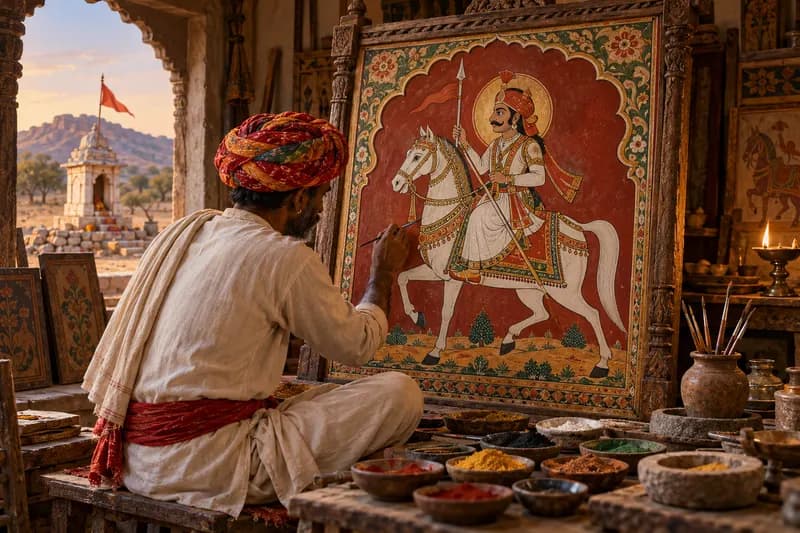
Phad Scroll Paintings — 14th Century Onward: Rajasthani phad paintings narrate the stories of folk heroes, including many who became Airis. These scrolls, painted on cloth and unrolled during performances by Bhopa priests, are both art and ritual — the painted image is believed to contain the hero's spirit.
Roadside Shrine Art — Contemporary: Modern Airi shrines feature painted tiles, printed images, and sometimes hand-painted murals depicting the hero in battle or on horseback. These are folk art in its most functional form — images that serve as both identification and invocation.
Truck Art: The most unexpected canvas for Airi imagery is the Indian truck itself. Trucks in Rajasthan sometimes carry painted images of local Airi figures on their tailgates — mobile shrines that carry the hero's protection along the highway.
Cross-Regional Patterns
Jhunjhar · Sagasji · Bheru · Devchar · Putana · Chudail · Daayan · Dain / Dayan
| Dawn as hard limit | No — active 24/7 |
| Iron weakness | No |
| Tree-dwelling | No — shrine-bound |
| Counting compulsion | No |
| Backward feet | No |
Global Equivalent: The closest global parallel is the Roman concept of the Lar — a household guardian spirit of a deified ancestor. The Greek hero cult, where warriors who died gloriously were worshipped at their tombs, is another strong parallel. In Japanese tradition, the goryō — spirits of the wronged dead who are appeased through worship — share the Airi's transition from feared ghost to protective deity. But the Airi's roadside location and its specific connection to travelers make it uniquely Rajasthani.
In Culture — Movies, Books, Games
| Type | Title | Description |
|---|---|---|
| Film | Rajasthani Folk Cinema | Several Rajasthani-language films depict the origin stories of famous Airis — warriors who died in battle and were subsequently worshipped. These films blend action, devotion, and supernatural elements in a style unique to regional cinema. |
| Music | Bhopa Performances | The Bhopa tradition of Rajasthan preserves Airi stories through musical performance — the priest-singer unrolls a phad scroll and sings the hero's story through the night, accompanied by the ravanhatta (a bowed instrument). These performances are both entertainment and ritual. |
| Literature | Rajasthani Folk Tale Collections | Multiple collections of Rajasthani folklore include Airi narratives — stories of heroic sacrifice and subsequent supernatural guardianship. Vijaydan Detha's collections are among the most comprehensive. |
| Documentary | Shrine Documentaries | Several ethnographic documentaries have explored roadside shrine culture in Rajasthan, including the Airi tradition. These provide visual documentation of living folk belief in the 21st century. |
| Reference Book | Ghosts, Monsters and Demons of India — Rakesh Khanna | Documents the Airi tradition alongside other Rajasthani hero-ghost traditions, providing comparative analysis across regions. |
ACCURACY RATING: DEEPLY ROOTED IN LIVING TRADITION · UNDERREPRESENTED IN MAINSTREAM MEDIA
Is the Airi Still Real?
- Airi shrines are actively maintained across Rajasthan — not as heritage sites but as living places of worship. New offerings appear daily at shrines on major highways.
- Truck drivers remain the most consistent practitioners of Airi worship. Long-haul drivers on Rajasthani routes carry marigolds and incense specifically for roadside shrine stops. This is practical, not sentimental — they believe it keeps them safe.
- New Airi shrines are still being created. When a person dies heroically — in a road accident while saving others, in a confrontation with criminals — communities sometimes establish shrines at the site. The tradition is not frozen in the past.
- Highway construction projects in Rajasthan routinely accommodate Airi shrines — widening roads around them rather than through them. Engineers and contractors have learned that removing a shrine causes more delays (from worker unease and community protest) than preserving it.
- The belief cuts across class and education. Educated, urban Rajasthanis who do not believe in ghosts will still slow down at an Airi shrine. The respect, if not the supernatural belief, is universal.
Expert & Academic Context
- Hero Stones of Rajasthan — Archaeological Studies — Academic documentation of devli/paliya (hero stones) across Rajasthan, tracing the visual and ritual tradition of hero veneration from medieval to modern periods.
- Vijaydan Detha — Rajasthani Folk Collections — Comprehensive collections of Rajasthani folklore including multiple Airi narratives, preserving oral traditions in literary form.
- Colonial-Era Gazetteers of Marwar — British administrative records documenting 'hero worship' at roadside shrines, providing historical evidence of the Airi tradition's existence in the 19th century.
- Ghosts, Monsters and Demons of India — Rakesh Khanna — Modern documentation of the Airi tradition within the broader context of Indian supernatural beliefs.
- Ethnographic Studies of Roadside Shrines — Contemporary academic studies of roadside shrine culture in Rajasthan, examining the intersection of folk belief, road safety, and community identity.
The Airi tradition reveals a fundamental feature of Indian folk religion that is often missed by outside observers: the boundary between ghost and god is not fixed. It is a spectrum, determined by community belief, demonstrated efficacy, and the moral quality of the spirit's origin. The Airi begins as a ghost — a spirit of the violently dead — and evolves, through worship and accumulated narrative, toward divinity. This process, playing out at roadside shrines across Rajasthan, is folk religion in its most dynamic and democratic form. Anyone can become an Airi. The only qualification is the willingness to die for someone else.
If You Encounter an Airi
Frequently Asked Questions
▶What is an Airi?
An Airi is a hero ghost from Rajasthani folklore — the spirit of a person who died protecting others. The spirit remains at the place of death, guarding travelers and the surrounding area. Airis are worshipped at roadside shrines across Rajasthan.
▶Are Airis dangerous?
To respectful travelers, no — Airis are protective. They become dangerous only when their shrines are damaged, disrespected, or ignored. The danger level is moderate because the Airi operates on a clear code of reciprocity: respect earns protection, disrespect earns consequences.
▶Why do truck drivers worship Airis?
Truck drivers spend long hours on dangerous desert highways. Airi shrines dot these routes, and drivers believe that stopping to make offerings earns protection for the journey ahead. This belief is widespread, practical, and taken seriously regardless of education or urbanization.
▶How is an Airi different from a regular ghost?
Most Indian ghosts arise from traumatic, unjust, or incomplete deaths and are driven by negative emotions — revenge, grief, hunger. An Airi arises from a heroic, sacrificial death and is driven by the same protective impulse that defined its final living moment. It is a ghost made of courage rather than suffering.
▶Can an Airi become a god?
Yes — over generations of worship, some Airis accumulate enough devotional energy and narrative power to transition from hero ghost to folk deity. This process is gradual, community-driven, and one of the most fascinating aspects of Indian folk religion.
▶What should I do if I see an Airi shrine?
Slow down. If you can safely stop, leave a small offering — a coin, a flower, or simply a moment of silent acknowledgment. Do not damage, mock, or pollute the shrine area. This is both respectful and, according to tradition, practically wise.
Explore More
Stories Are Being Summoned
One ghost story per week. Every Tuesday at midnight.