Bheru
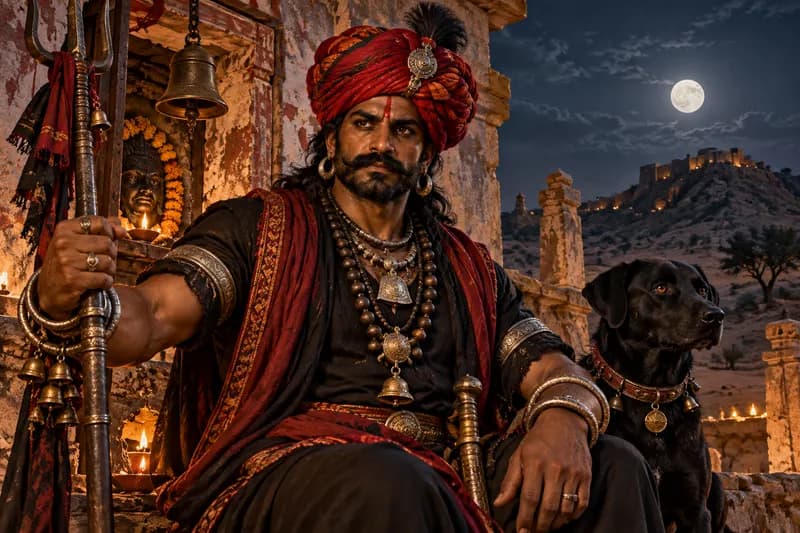
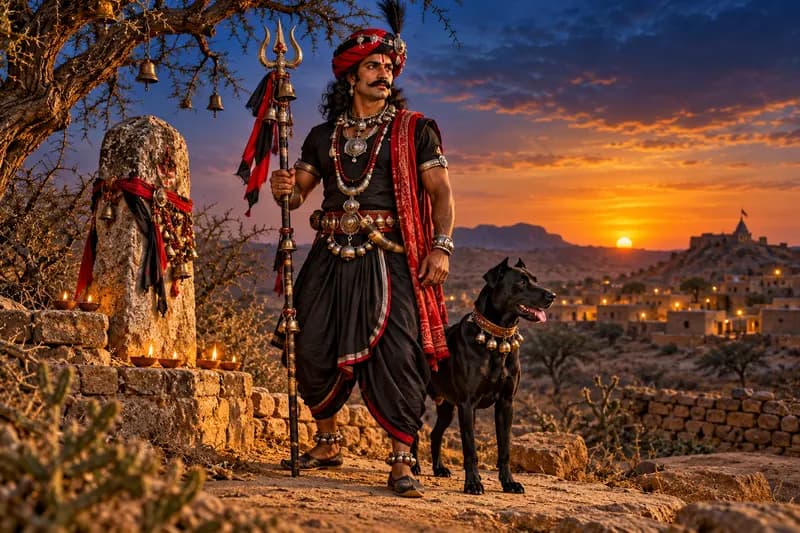
He is Shiva's guard dog in divine form. He protects the village — and he bites harder than anything in the dark.
- What Is Bheru?
- Why Bheru Is Terrifying
- Origin — How It Came to Exist
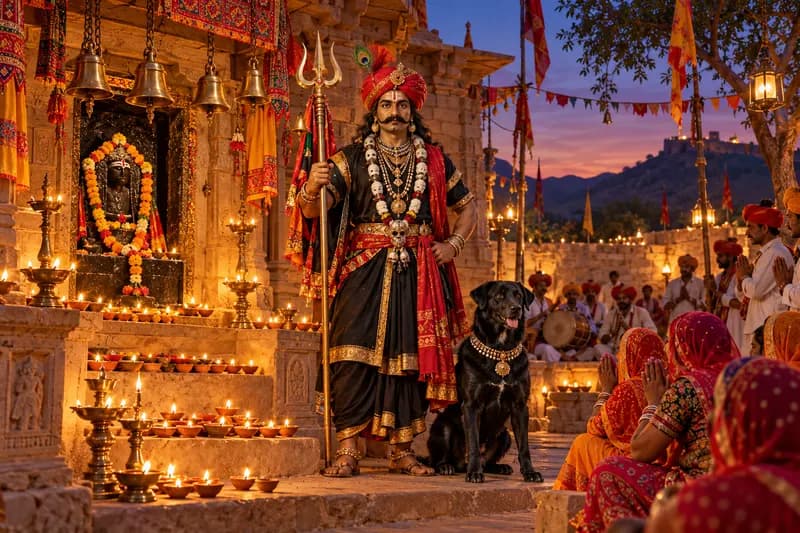
- Appearance & Manifestation
- The Oath at the Crossroads
- The Rules — How to Live with Bheru
- What They Don't Tell You
- What Does Bheru Want?
- You're Most at Risk If...
- Offerings & Appeasement
- The Healer
- What If You Dream of Bheru?
- Bheru in Art History
- Cross-Regional Patterns
- In Culture — Movies, Books, Games
- Is Bheru Still Real?
- Expert & Academic Context
- If You Encounter Bheru
- Frequently Asked Questions
- Explore More
| Bheru | |
|---|---|
| Also Known As | Bhairuji, Bheruji, Bhairav Devta, Kala Bhairav (folk form) |
| Script | भैरूजी (Devanagari) |
| Pronunciation | BHAY-roo-jee (भै-रू-जी) |
| Region | Rajasthan; also found across Gujarat, Madhya Pradesh, and Maharashtra in variant forms |
| Category | Guardian Spirit / Folk Bhairava manifestation |
| Danger Level | Dangerous |
| Fear Method | Fierce retribution against oath-breakers, thieves, and village transgressors; sudden illness or madness |
| Warning Sign | A black dog appearing repeatedly; the sound of anklets or bells near the shrine at night; sudden unexplained rage |
| First Documented | Shaiva tantric traditions (Bhairava worship); folk adaptations documented in Rajasthani oral traditions from at least the 12th century |
| Still Believed? | Yes — Bheruji shrines are found in virtually every village in Rajasthan; considered the village's primary supernatural guardian |
| Related | Bhairava Spirit · Airi · Jhunjhar · Sagasji · Putana · Chudail |
What Is Bheru?
Bheru (भैरूजी) is the folk Rajasthani manifestation of Bhairava — Shiva in his most fierce, terrifying, and protective form. In the classical Sanskrit tradition, Bhairava is a cosmic deity: the destroyer of fear, the guardian of the cosmos, the enforcer of divine law. In Rajasthani villages, this cosmic terror has been domesticated — not tamed, but localized. Bheru is the village Bhairava. He guards the boundary, punishes thieves, enforces oaths, and protects the community from supernatural threats that other entities cannot handle.
What makes Bheru uniquely important in Rajasthani folk religion is his dual nature. He is simultaneously a deity (worshipped with mantras, invoked in temples) and a spirit (feared in the dark, associated with possession, linked to dogs and cremation grounds). This is not a contradiction — it is the essence of Bhairava theology compressed into village practice. Bheru is the divine made local, the cosmic made personal. He is Shiva's guard dog, stationed at the village gate, and he does not distinguish between supernatural and human threats. Both receive the same treatment: swift, fierce, and absolute.
Why Bheru Is Terrifying
INSTINCT EXPLOITED: THE ENFORCER YOU CANNOT DECEIVE
The Churel hunts specific victims. The Vetala asks riddles. The Pishacha feeds in the dark. But Bheru does not hunt, does not ask, does not feed. Bheru judges. And his judgment is immediate, physical, and total.
You stole from the village well fund. You broke an oath sworn at his shrine. You lied in a dispute and called on Bheru as your witness. Now Bheru knows. And Bheru does not forgive.
The punishment varies. Sometimes it is sudden, violent illness — a fever that comes from nowhere and breaks only when you confess. Sometimes it is madness — a disorientation, a rage that is not yours, a compulsion to run to the shrine and throw yourself at the feet of the stone figure. Sometimes it is the dogs. Black dogs appear at your doorstep, one after another, staring with an intensity that is not canine. They do not bite. They do not need to. You understand what they represent.
Bheru is terrifying because he is justice without appeal. There is no argument, no defense, no mitigating circumstance. You broke the rule. You offended the guardian. And the guardian, who is a folk version of the most terrifying form of the most powerful god in the Hindu pantheon, has decided to make you an example.
The scariest thing about Bheru is that everyone in the village knows it is happening — and nobody intervenes. Because Bheru only punishes the guilty. And if Bheru is after you, you are guilty. End of discussion.
Origin — How It Came to Exist
From Bhairava to Bheru
Bhairava is one of the oldest and most complex forms of Shiva — attested in Shaiva tantric texts from at least the 6th century CE. He is the guardian of the directions, the protector of sacred sites, the enforcer of cosmic order. In Rajasthan, this cosmic deity underwent a transformation that is common in Indian religion: he was localized. The village took the concept of Bhairava — fierce, protective, judicial — and compressed it into a village guardian. Bheru is Bhairava with a postal address.
The Dog Connection
Bhairava is always depicted with a dog — his vahana (vehicle) and companion. In Rajasthani folk practice, this connection is literal. Stray dogs near Bheruji shrines are considered sacred — manifestations or agents of the deity. Feeding dogs is an offering to Bheru. Hurting a dog near a Bheru shrine is an offense against the deity himself. The black dog, in particular, is Bheru's eyes in the village — it watches, reports, and occasionally acts.
The Oath-Keeper
One of Bheru's most important village functions is as witness and enforcer of oaths. When disputes arise — property boundaries, business agreements, marital conflicts — parties may be asked to swear their truthfulness at the Bheruji shrine. The oath is not symbolic. The community believes that a false oath at Bheru's shrine will be punished within days or weeks — through illness, accident, or public humiliation. This function makes Bheru the village's supernatural judiciary.
Boundary Guardian
Bheruji shrines are typically placed at the village boundary — at the entrance, at the crossroads, at the edge where the settlement meets the wild. This placement is deliberate. Bheru guards the liminal space between civilization and chaos, between the known and the unknown. He is the first line of defense against whatever comes from outside — bandits, spirits, disease, misfortune.
The Tantric Substrate
Beneath the folk practice lies a tantric tradition of considerable sophistication. Bhairava worship involves specific mantras, yantras, and rituals that are preserved by village priests and tantric practitioners. The folk Bheru may seem simple — a stone figure, some vermillion, a brass bell — but the theological infrastructure behind it connects to one of the deepest streams of Indian religious thought.
Appearance & Manifestation
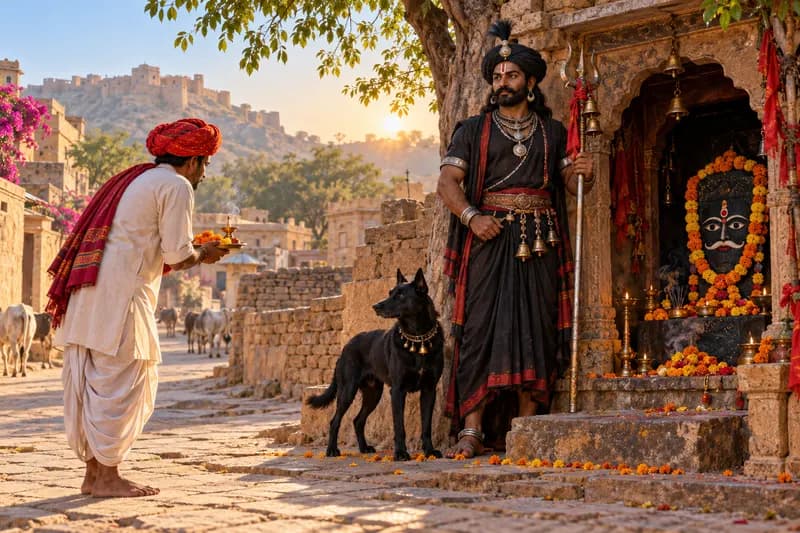
| 👁 Sight | At the shrine: a stone or metal figure with fierce eyes, often with a trident, a drum, and a dog companion. In manifestation: a tall, dark figure with wild hair and burning eyes, sometimes seen at the village boundary at night. Black dogs that stare with unusual intensity are considered visual signs of Bheru's attention. |
| 🔊 Sound | The sound of bells or anklets near the shrine when no one is there — Bhairava is traditionally depicted wearing anklets. Dog howling at night, particularly if multiple dogs howl simultaneously, is interpreted as Bheru patrolling. During possession episodes, the affected person speaks in a voice that the community recognizes as Bheru's — deep, commanding, furious. |
| 🍃 Smell | The strong smell of liquor and marigolds near the shrine, even when no recent offerings have been made. During festivals, the shrine area is saturated with dhoop, camphor, and the metallic tang of animal sacrifice (in traditions where this is still practiced). |
| ❄ Temperature | Not cold — electric. People near active Bheruji shrines report a buzzing energy, a vibration in the air that feels charged. During possession episodes, the affected person's body temperature rises significantly — they become hot to the touch, as if burning from within. |
| 🌑 Time | Bheru patrols at night — the village boundary is his jurisdiction after dark. He is most active during Amavasya (new moon) and during the Navratri period. But his judicial function operates at all hours — an oath-breaker can be struck at any time of day. |
| 🏚 Habitat | The village boundary, crossroads, and the Bheruji shrine. Every village in Rajasthan has at least one — many have several, at different boundary points. The shrine is always at the edge, never in the center. Bheru guards from the periphery. |
The Oath at the Crossroads
In a village in the Marwar region — the dry, flat country between Jodhpur and Jaisalmer — there was a dispute between two brothers over a piece of land. Their father had died without a clear will, and each brother claimed the same field. The field was not large, but in Marwar, where every acre of arable land is precious, it was enough to fracture a family.
The village panchayat heard both sides. The evidence was inconclusive — both brothers had witnesses, both had arguments, and neither would yield. The sarpanch, an old man who had seen every kind of village dispute, made the traditional decision: let Bheruji decide.
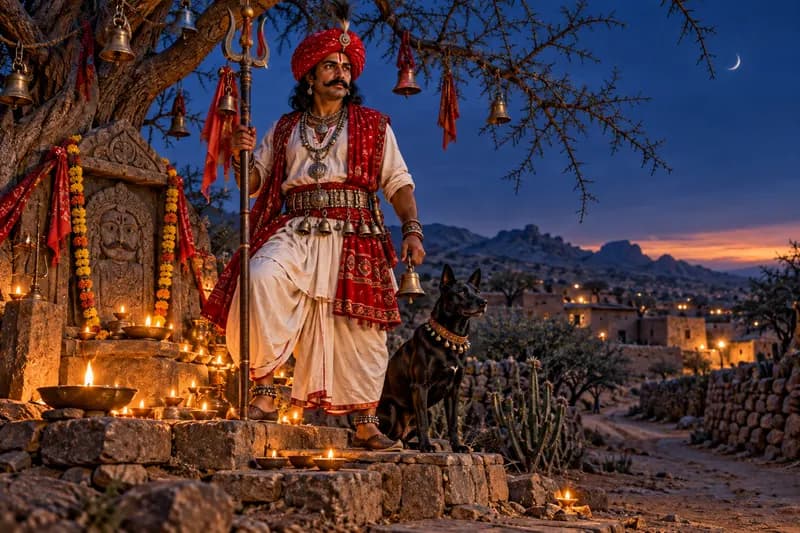
Both brothers were taken to the Bheruji shrine at the village crossroads. It was a simple platform — a stone figure about two feet tall, painted orange, with fierce white eyes and a brass bell hanging from a wooden pole. A black dog was sleeping near the base, as black dogs always seemed to sleep near this particular shrine.
The sarpanch explained the process. Each brother would place his hand on the stone figure and swear that the land was rightfully his. If he was telling the truth, nothing would happen. If he was lying, Bheruji would know — and Bheruji would act.
The elder brother went first. He placed his hand on the stone, looked at the fierce painted eyes, and said: 'This land is mine by right. My father promised it to me. I swear this on Bheruji.' His voice was steady. His hand did not tremble.
The younger brother stepped forward. He placed his hand on the stone. He opened his mouth to speak. And then he stopped. The black dog at the base of the shrine had opened its eyes and was staring directly at him — not with animal curiosity but with something older, harder, and completely aware. The younger brother looked at the dog. The dog looked at the younger brother. Nobody else moved.
The younger brother removed his hand from the stone. He turned to the sarpanch and said: 'The land is his. I withdraw my claim.'
No one asked why. No one pressed him. The sarpanch nodded. The elder brother took the land. The younger brother walked home. The black dog closed its eyes and went back to sleep.
When asked about it later — years later, after the brothers had reconciled, after the younger brother had prospered through other means — the younger brother would say only this: 'I looked at the dog and I knew that Bheruji already knew. There was no point in lying to something that could see inside my chest.'
The shrine is still there. The black dog, or a black dog very much like it, is still sleeping at its base. And disputes in that village are still settled the same way: take it to Bheruji. Let the guardian decide.
The Rules — How to Live with Bheru
☠ WARNING ☠
Seven rules for living under Bheru's watch
- Never swear a false oath at a Bheruji shrine. — This is the single most dangerous thing you can do in a Rajasthani village. A false oath at Bheru's shrine invites immediate and severe retribution — illness, madness, public exposure of your lie.
- Feed the dogs near the shrine. — Dogs are Bheru's agents. Feeding them is an offering to the deity. Harming them is an offense. The black dog at the shrine is not a stray — it is Bheru's eyes.
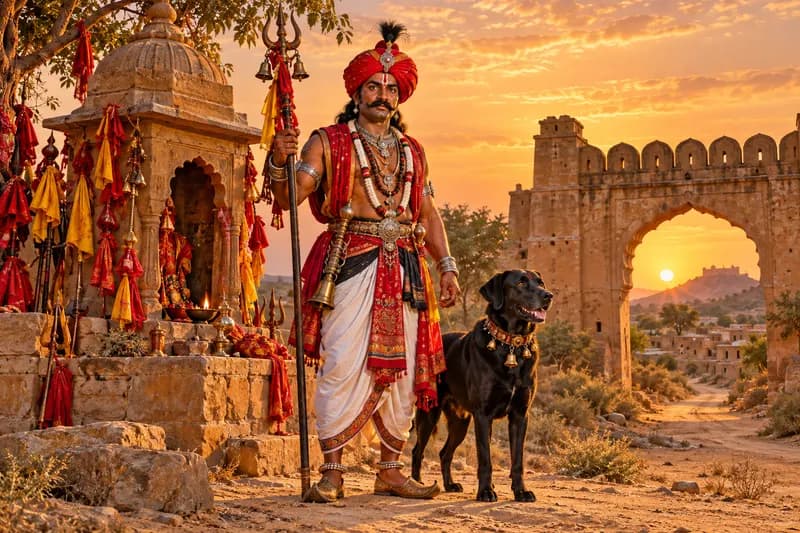
- Make offerings at the village boundary when entering. — When entering a village with a Bheruji shrine at its boundary, acknowledge the guardian. A pause, a respectful gesture, a coin at the shrine. You are entering Bheru's jurisdiction. Register your presence.
- Do not steal within Bheru's territory. — Bheru is the village's supernatural police. Theft within his jurisdiction — particularly from the shrine itself — triggers the harshest response. Objects stolen from Bheruji shrines are said to bring madness to the thief.
- During possession, do not resist. — Bheru sometimes communicates through possession — temporarily inhabiting a village member (often a designated oracle or a random person). When this happens, the possessed person speaks Bheru's judgments. Do not argue with the deity.
- Liquor offerings are required, not optional. — Unlike most Hindu deities, Bheru accepts — and expects — liquor as an offering. Country liquor (daru) poured at the shrine base is the traditional appeasement. This reflects Bhairava's tantric associations with transgressive substances.
- If you hear bells at night near the boundary, stay indoors. — The sound of bells at the village boundary after dark means Bheru is patrolling. This is not a time for humans to be at the boundary. Bheru's patrol is his business. Stay inside and let the guardian work.

What They Don't Tell You
Bheru is proof that the line between god and ghost in Indian religion is not a line at all — it is a gradient. Bheru is worshipped as a deity in temples. He is feared as a spirit at crossroads. He is consulted as a judge in disputes. He is experienced as a possessing force during rituals. He is all of these simultaneously, without contradiction, because Indian folk religion does not require its sacred beings to be only one thing. Bheru is the village's answer to a question that organized religion struggles with: who enforces the rules when no one is watching? The answer, in every village in Rajasthan, is the same: the fierce god at the boundary, the one with the dog and the trident and the absolute, terrifying certainty about who is lying.
What Does Bheru Want?
Bheru wants order. Not cosmic order, not theological order, but village order — the day-to-day functioning of a community where people keep their promises, respect boundaries, don't steal from each other, and acknowledge the forces that protect them.
Bheru is not interested in devotion for its own sake. He is not a deity who craves worship. He is a guardian who demands compliance. Keep the oaths you swear. Feed the dogs. Leave the boundary alone after dark. Make the offering. Follow the rules. If you do, Bheru protects. If you don't, Bheru enforces.
In a deeper theological sense, Bheru — as a folk Bhairava — wants the dissolution of pretense. Bhairava in the tantric tradition is the destroyer of ego, the force that strips away illusion. At the village level, this manifests as Bheru's hatred of lies. He cannot be deceived. He sees through every performance, every false oath, every presented innocence. What he wants, ultimately, is for people to stop lying — to him, to each other, to themselves.
This is what makes Bheru the most feared and the most respected entity in Rajasthani folk religion. He is not capricious. He is not random. He is devastatingly, mercilessly fair. And fairness, when it is absolute and inescapable, is more terrifying than any malice.
You're Most at Risk If...
- You have sworn a false oath at a Bheruji shrine
- You have stolen from a village under Bheru's protection
- You have harmed a dog near a Bheruji shrine
- You have damaged or disrespected a Bheruji shrine
- You are at the village boundary after dark during an active patrol
- You have refused to honor a commitment witnessed at the shrine
Offerings & Appeasement
| Offering | Purpose |
|---|---|
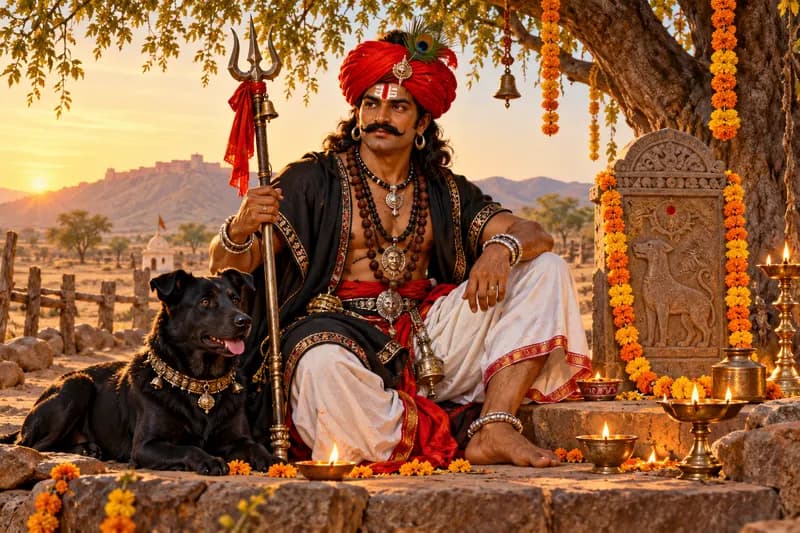
| Standard Offering | Country liquor (daru), marigolds, coconut, and dhoop at the shrine. The liquor is poured at the base of the stone figure. This is the baseline — the regular maintenance of the relationship between village and guardian. |
| Confession Offering | If you have offended Bheru (false oath, theft, disrespect), the remedy begins with public confession at the shrine, followed by a larger offering — a goat in traditions where animal sacrifice is practiced, or a substantial gift of food and cloth where it is not. |
| Dog Feeding | Feeding black dogs — or any dogs near the shrine — is a continuous offering. Some devotees maintain a regular practice of feeding stray dogs in Bheru's name. This is considered one of the most effective ways to maintain Bheru's favor. |
| Festival Offerings | During Navratri and on Bhairav Ashtami (the annual Bhairava festival), major offerings are made — communal feasts at the shrine, night-long vigils, musical performances, and in some traditions, ritual possession where Bheru speaks through a chosen oracle. |
The Healer
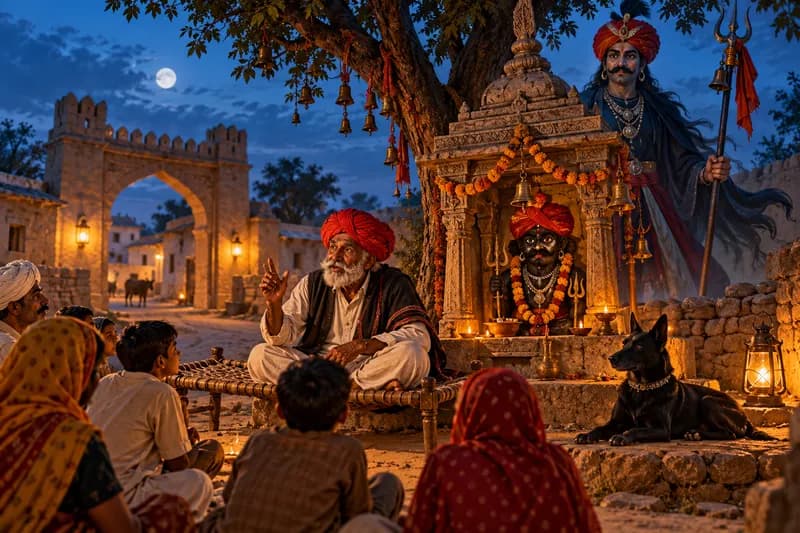
Bheru Oracle (Bhopa/Devli) — Many villages have a designated Bheru oracle — a person through whom Bheru communicates during possession episodes. This person (often called a devli or bhopa) serves as the interface between the community and the guardian. When someone is afflicted by Bheru, the oracle mediates.
Village Priest (Pujari) — The Bheruji shrine priest maintains the daily rituals and knows the specific mantras for appeasement. When someone has offended Bheru, the priest prescribes the offering and oversees the confession.
Tantric Practitioner — In severe cases — prolonged illness, persistent possession, madness attributed to Bheru — a tantrik with specific Bhairava training may be called. This is rare, as most Bheru issues are resolved through the shrine priest. But when the standard approach fails, tantric intervention is the escalation.
The Key Difference — You do not fight Bheru. You do not banish Bheru. You *confess* to Bheru. The solution is always truth — admit what you did, accept the consequence, make the offering, and resume honest living. Bheru only punishes liars. Stop lying and the punishment stops.
What If You Dream of Bheru?
| Symbol | Meaning | |
|---|---|---|
| 🐕 | A Black Dog Staring at You | Bheru is watching. Something in your life requires honesty — a lie you have told, a commitment you have broken, a truth you are avoiding. The dog's stare is Bheru's warning: come clean before the enforcement begins. |
| 🔔 | Hearing Bells at Night | Boundaries are being tested in your life. Someone is crossing a line — yours or someone else's. The bells are Bheru on patrol, reminding you that boundaries exist for a reason and must be defended. |
| 🔱 | A Fierce Figure at a Crossroads | A major decision point. Bheru at the crossroads means you are at a moment where the right path and the easy path diverge. The fierce figure is not blocking you — it is watching which way you choose. |
| 🏘 | A Village Boundary at Dusk | Transition. You are leaving one phase of life and entering another. The boundary in the dream is the threshold — and the guardian at the threshold is asking whether you are entering with clean hands. |
Bheru in Art History
Bhairava Temple Sculptures — 6th Century Onward: Classical Bhairava sculptures in stone and bronze — fierce, multi-armed, with dog companion and trident — form the art-historical foundation for the folk Bheru tradition. Major examples survive at temples across Rajasthan, Madhya Pradesh, and Karnataka.
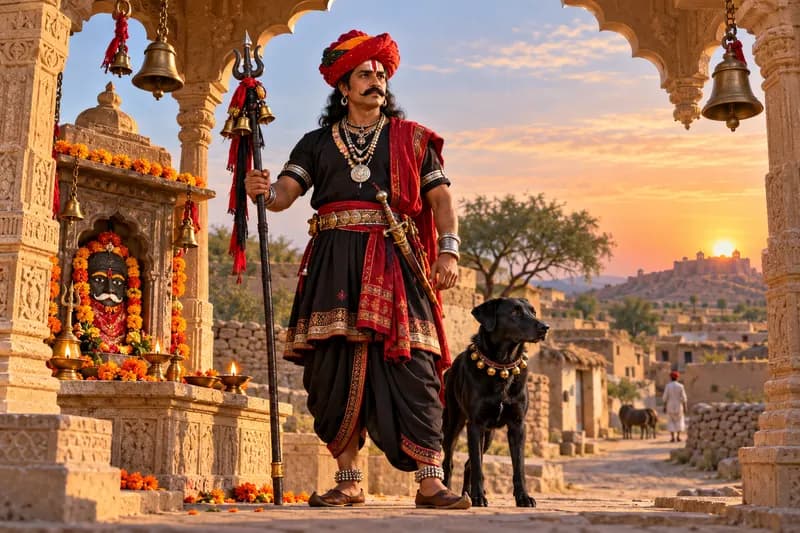
Rajasthani Village Shrines — Medieval to Present: The folk Bheru is most commonly represented as a simple stone figure painted orange with white eyes, placed on a platform at the village boundary. These are crude by art-historical standards but powerful in their directness — the fierce eyes are the essential element.
Phad Paintings — Rajasthani Scroll Art: Bheru/Bhairuji appears in Rajasthani phad scroll paintings, often alongside the folk heroes he protects. In these paintings, he is depicted as a dark-skinned figure with wild hair, riding a dog, with a trident in one hand and a severed head in the other — closer to the classical Bhairava iconography.
Contemporary Shrine Art: Modern Bheruji shrines feature printed tiles, calendart art, and mass-produced metal figures that blend classical Bhairava iconography with folk simplicity. The ubiquity of these images — in every village, at every crossroads — makes Bheru one of the most visually present deities in rural Rajasthan.
Cross-Regional Patterns
Bhairava Spirit · Airi · Jhunjhar · Sagasji · Putana · Chudail · Daayan · Dain / Dayan
| Dawn as hard limit | No — active day and night |
| Iron weakness | No — associated with iron trident |
| Tree-dwelling | No — shrine-bound at boundary |
| Counting compulsion | No |
| Backward feet | No |
Global Equivalent: The closest global parallels are the Greek Hermes as guardian of boundaries and crossroads, and the West African Eshu/Elegua — a trickster-guardian who stands at the crossroads and must be appeased before passage. The Roman Terminus — god of boundaries — shares Bheru's territorial function. But Bheru's combination of judicial, protective, and possessing functions is uniquely Indian — no single Western entity combines the roles of judge, policeman, guardian, and oracle the way Bheru does.
In Culture — Movies, Books, Games
| Type | Title | Description |
|---|---|---|
| Film | Bhairava/Bhairuji in Indian Cinema | Multiple Indian films feature Bhairava figures — both the classical deity and the folk guardian. Rajasthani cinema treats Bheruji as a plot-driving force in village dramas, while Bollywood occasionally uses Bhairava imagery for horror-adjacent supernatural thrillers. |
| Television | Mythological Serials | Indian television mythological serials have featured Bhairava episodes, typically depicting the deity's fierce protective nature. These portrayals blend classical Sanskrit mythology with folk Bheru practices. |
| Music | Bhairav Raga | In Indian classical music, Raga Bhairav — the morning raga associated with Bhairava — is one of the most important melodic structures. The raga's solemn, powerful mood reflects the deity's nature. The musical tradition and the folk Bheru tradition share a common source. |
| Literature | Tantric Literature | Bhairava/Bheru appears extensively in tantric literature — both classical Sanskrit texts and folk Rajasthani manuscripts. These texts provide the theological depth behind the village practice. |
| Reference Book | Ghosts, Monsters and Demons of India — Rakesh Khanna | Documents Bheru alongside other Rajasthani guardian entities, examining the spectrum from deity to ghost that the Bheru tradition occupies. |
ACCURACY RATING: DEEPLY ROOTED IN BOTH CLASSICAL THEOLOGY AND LIVING FOLK PRACTICE
Is Bheru Still Real?
- Bheruji is arguably the most widely worshipped folk deity in Rajasthan. Virtually every village has a Bheruji shrine, and these are not dormant heritage sites — they receive daily offerings, regular festivals, and active consultation for disputes.
- The oath-at-the-shrine practice is still used to resolve disputes in rural Rajasthan. Courts and panchayats may be the formal justice system, but Bheruji remains the informal one — and in many communities, the informal system is more trusted.
- Possession by Bheru is still a regular occurrence at village festivals and shrine gatherings. These episodes are not treated as mental health crises — they are treated as communication. The possessed person speaks Bheru's words, and the community listens.
- Dog-feeding as devotional practice has expanded beyond rural Rajasthan — urban devotees of Bhairava across India feed stray dogs as a form of worship, connecting the folk Bheru tradition with the classical Bhairava tradition.
- New Bheruji shrines are established regularly — at new village boundaries, at new crossroads, at construction sites. The tradition is not static. It grows as the community grows.
Expert & Academic Context
- Bhairava: Image and Ritual in South India — Elizabeth Chalier-Visuvalingam — Academic analysis of Bhairava worship across South India, providing theological context for understanding the folk Bheru as a localized manifestation of a pan-Indian deity.
- Shaiva Tantric Texts — Bhairava Agamas — Classical Sanskrit tantric texts that describe Bhairava's nature, mantras, and ritual worship — the theological foundation beneath the folk Bheru practice.
- Ghosts, Monsters and Demons of India — Rakesh Khanna — Documents Bheru within the broader framework of Indian supernatural beliefs, examining the deity-ghost spectrum that makes Bheru unique.
- Rajasthani Folk Religion — Ethnographic Studies — Contemporary fieldwork documenting Bheruji worship, possession episodes, oath practices, and the social function of the village guardian tradition.
- Tod's Annals and Antiquities of Rajasthan (1829) — Colonial-era documentation of Bhairuji worship in Rajput culture, providing historical baseline data for the tradition's evolution over two centuries.
Bheru represents one of the most important phenomena in Indian religion: the localization of a cosmic deity into a village guardian. This process — sometimes called 'parochializing' — transforms abstract theology into practical community resource. Bhairava the cosmic destroyer becomes Bheru the village policeman. The same mantras that invoke universal Shiva invoke the local guardian of a specific crossroads in Marwar. This is not degradation of the concept — it is its fulfillment. Indian religion has always held that the universal must be accessible locally, and Bheru is the proof. He is simultaneously a philosophical concept about the nature of divine justice and a very practical solution to the problem of who enforces oaths in a village without police.
If You Encounter Bheru
Frequently Asked Questions
▶What is Bheru?
Bheru (Bhairuji) is the folk Rajasthani form of Bhairava — Shiva's fierce, protective manifestation. He serves as the supernatural guardian of villages across Rajasthan, stationed at boundaries and crossroads, protecting the community and enforcing oaths.
▶Is Bheru a god or a ghost?
Both — and this is not a contradiction. Bheru operates on the spectrum between deity and spirit that is characteristic of Indian folk religion. He is worshipped as a god at shrines and temples, feared as a spirit in the dark, and experienced as a possessing force during rituals. He is all of these simultaneously.
▶Why is Bheru associated with dogs?
Bhairava's vahana (vehicle/companion) is the dog. In Rajasthani folk practice, dogs near Bheruji shrines are considered the deity's agents — his eyes and ears in the village. Feeding stray dogs is a form of Bheru worship. Harming dogs near a shrine is an offense against the deity.
▶What happens if you swear a false oath at Bheruji's shrine?
According to widespread belief across Rajasthan, a false oath at Bheruji's shrine triggers swift retribution — fever, illness, madness, or public exposure of the lie. This belief is strong enough that disputes are still resolved through shrine oaths in rural communities.
▶How do you appease Bheru?
Standard offerings include country liquor, marigolds, coconut, and incense at the shrine. If you have offended Bheru, confession at the shrine followed by a larger offering is required. Feeding dogs in Bheru's name is a continuous form of appeasement.
▶Is Bheru dangerous?
To honest people who respect his shrine, Bheru is protective, not dangerous. He becomes dangerous to oath-breakers, thieves, liars, and those who disrespect his shrine or harm dogs near it. The danger level is high because his retribution is swift and severe.
Explore More
Related Spirits
Bhairava Spirit · Airi · Jhunjhar · Sagasji · Putana · Chudail · Daayan · Dain / Dayan
Stories Are Being Summoned
One ghost story per week. Every Tuesday at midnight.