Bhairava Spirit
It doesn't punish the wicked. It punishes everyone who crosses the threshold uninvited — and it decides what 'uninvited' means.
- What Is a Bhairava Spirit?
- Why the Bhairava Spirit Is Terrifying
- Origin — How It Came to Exist
- Appearance & Manifestation
- The Thief of Kashi
- The Rules — How to Survive
- What They Don't Tell You
- What Does the Bhairava Spirit Want?
- You're Most at Risk If...
- Offerings & Appeasement
- The Healer
- What If You Dream of a Bhairava Spirit?
- The Bhairava Spirit in Art History
- Cross-Regional Patterns
- In Culture — Movies, Books, Games
- Is the Bhairava Spirit Still Real?
- Expert & Academic Context
- If You Encounter a Bhairava Spirit
- Frequently Asked Questions
- Explore More
| Bhairava Spirit | |
|---|---|
| Also Known As | Bhairav, Bhairavar, Kala Bhairava, Kshetrapala |
| Script | भैरव (Devanagari) |
| Pronunciation | BHAY-rah-vah (भै-र-व) |
| Region | Pan-India; strongest in Varanasi (Kashi), Nepal, Tamil Nadu, and Tantric centers across the Himalayas |
| Category | Tantric Guardian Spirit / Fierce Manifestation of Shiva |
| Danger Level | Lethal |
| Fear Method | Territorial annihilation, sacred rage, instant retribution for sacrilege |
| Warning Sign | Dogs howling in unison near a temple at night; the smell of blood where no wound exists; a sudden pressure in the chest near sacred boundaries |
| First Documented | Shiva Purana; Tantric texts (Bhairava Agamas, c. 6th–8th century CE); Nepalese Tantric manuscripts |
| Still Believed? | Yes — Kala Bhairava temples active across India and Nepal; the Kotwal (divine policeman) of Varanasi is Bhairava |
| Deep Dives | Folk StoriesOrigin & HistoryIs It Real?In Pop CultureHow to SurviveDream Meaning |
| Related | Vetala · Kapala Spirit · Brahmarakshasa · Pishaach · Shakini |
What Is a Bhairava Spirit?
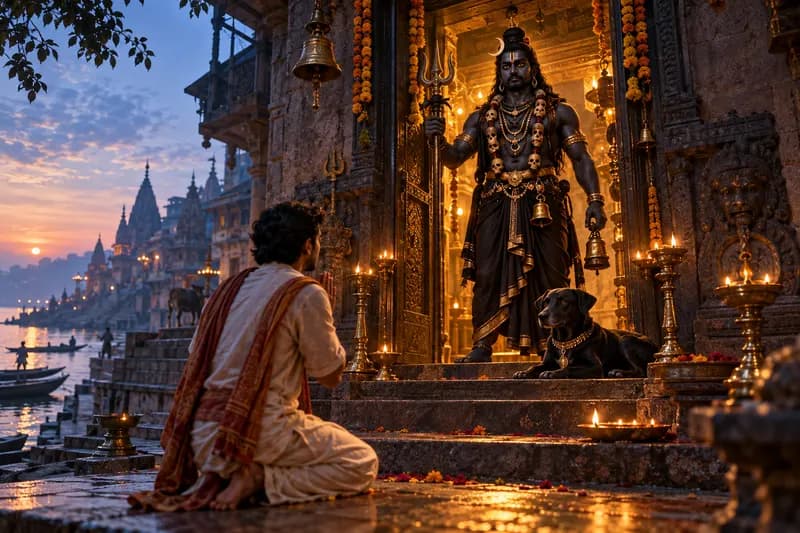
The Bhairava Spirit (भैरव) is the wrathful guardian entity of the Tantric tradition — a fierce, autonomous manifestation of Shiva's destructive aspect that guards sacred sites, cremation grounds, and the boundaries between sanctified and profane space. Unlike ghosts born of human death, the Bhairava Spirit is not a former person. It is a force — summoned, installed, or spontaneously generated at sites of intense spiritual power, tasked with one purpose: preventing the unworthy from entering.
What makes the Bhairava Spirit uniquely terrifying is its absolute authority within its territory. It does not negotiate. It does not warn twice. It does not distinguish between accidental trespass and deliberate sacrilege. Within the boundary it guards, the Bhairava Spirit is judge, jury, and executioner — and its judgment is instantaneous. In Varanasi, Kala Bhairava is called the Kotwal — the divine policeman — and the city itself is considered his jurisdiction. Every other entity in this database can be reasoned with, appeased, or escaped. The Bhairava Spirit can only be respected.
Why the Bhairava Spirit Is Terrifying
INSTINCT EXPLOITED: THE TRESPASS YOU DIDN'T KNOW YOU COMMITTED
You are walking through an old temple complex at night. Perhaps you are a tourist. Perhaps you are curious. Perhaps you took a shortcut through grounds you didn't realize were consecrated. You feel fine. You feel nothing unusual.
Then you feel the pressure.
It starts in your chest — a weight that has no source, a tightness that is not your lungs. The dogs outside the temple begin howling. Not barking — howling, a sound that goes on too long, too uniform, as if they are all responding to the same signal. You smell something metallic. Blood. But there is no blood anywhere you can see.
You have crossed a boundary. Not a physical wall — a spiritual perimeter that was established centuries before you were born, by practitioners who knew exactly what they were inviting to stand guard. The Bhairava Spirit does not appear to you. It does not need to appear. It simply acts.
Within hours, you are sick. Within days, you are delirious. Within a week, if you have not found someone who knows how to apologize on your behalf, you are dead. Not from any disease a doctor can name. From trespass. From the absolute, unforgiving enforcement of a boundary you never saw.
This is what separates the Bhairava Spirit from every other entity: it doesn't hunt. It doesn't roam. It waits — and the waiting is perfect, because it has been waiting for centuries, and it will wait for centuries more. You are not special to it. You are just the next person who walked where you shouldn't have.
Origin — How It Came to Exist
The Cosmic Origin
In Puranic mythology, Bhairava was born when Shiva severed the fifth head of Brahma for the sin of pride. The moment the head fell, Shiva's rage manifested as Bhairava — a being of pure wrath, dripping with the blood of a god. Bhairava was cursed to wander with Brahma's skull stuck to his hand until the sin was absolved. He wandered to Varanasi, where the skull finally fell — and Bhairava became the eternal guardian of that city.
From God to Spirit
The Bhairava Spirit is not Shiva himself but an emanation — a fragment of divine fury given autonomous existence. In Tantric practice, Bhairava Spirits are ritually installed at sacred sites as permanent guardians. The practitioner invokes the wrathful aspect of Shiva, binds it to a location, and sets the terms: protect this place, destroy what threatens it. Once installed, the spirit operates independently — it does not need further instruction.
The Eight Bhairavas
Tantric tradition recognizes eight primary Bhairava forms — Asitanga, Ruru, Chanda, Krodha, Unmatta, Kapala, Bhishana, and Samhara. Each governs a direction, a cremation ground, and a specific type of destruction. The Bhairava Spirit at any given site may be an emanation of one of these eight, or a localized variant shaped by the specific Tantric lineage that installed it.
The Nepalese Tradition
In Nepal's Kathmandu Valley, Bhairava worship reaches its most intense expression. The massive stone mask of Kala Bhairava in Durbar Square has been used for centuries as a truth-detector — oaths sworn before it were considered absolutely binding, and perjurers were believed to die vomiting blood within days. Nepalese Bhairava Spirits guard not just temples but entire valleys.
The Dog Connection
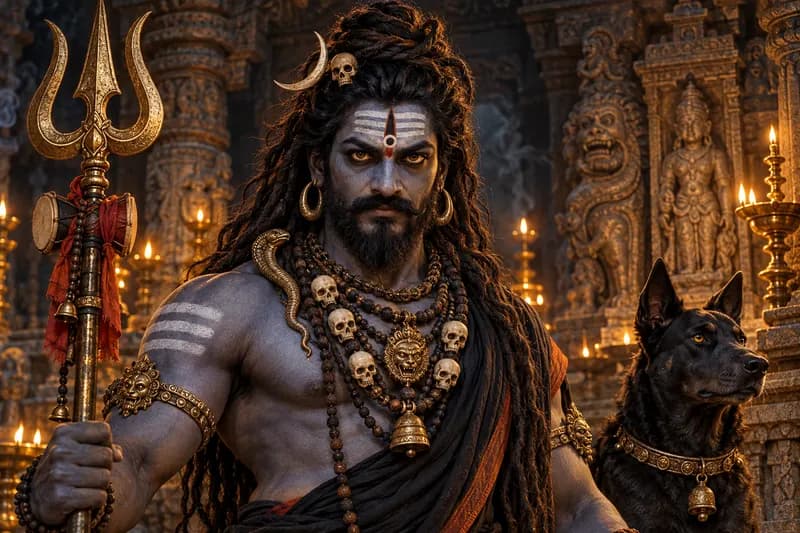
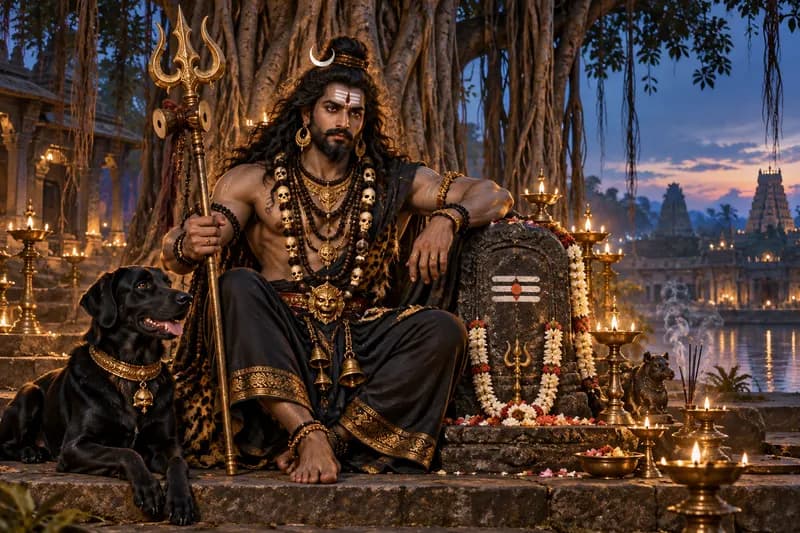
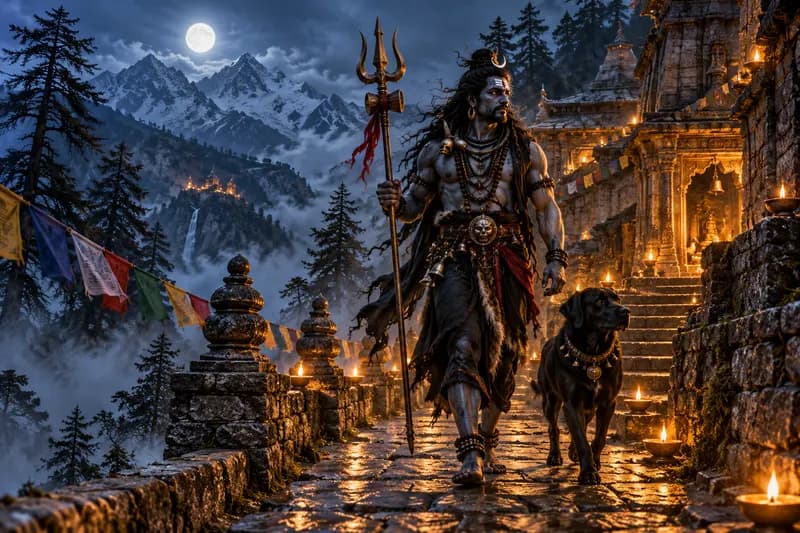
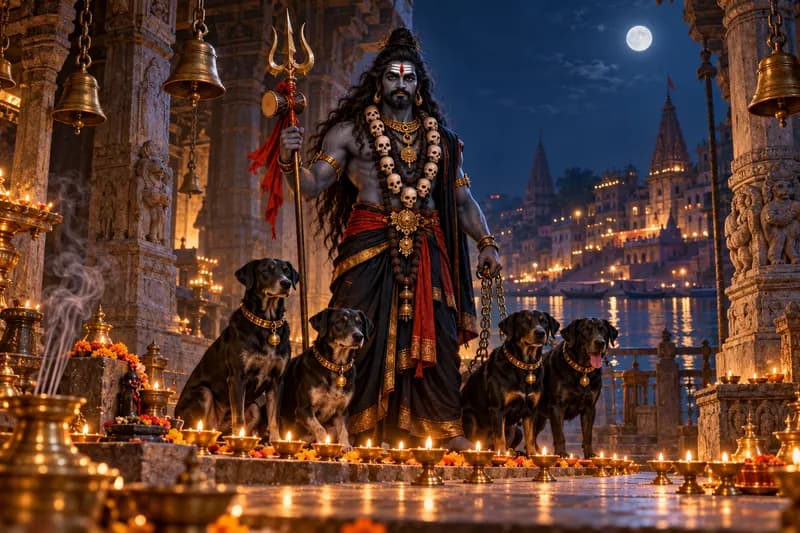
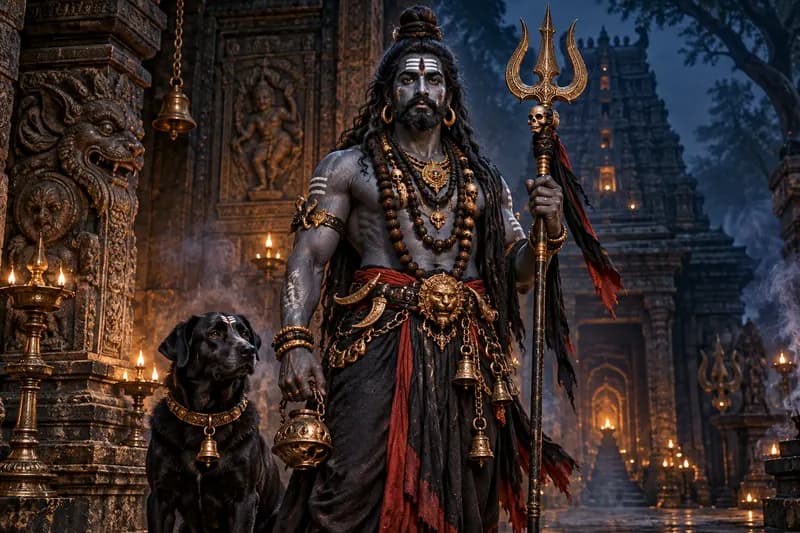
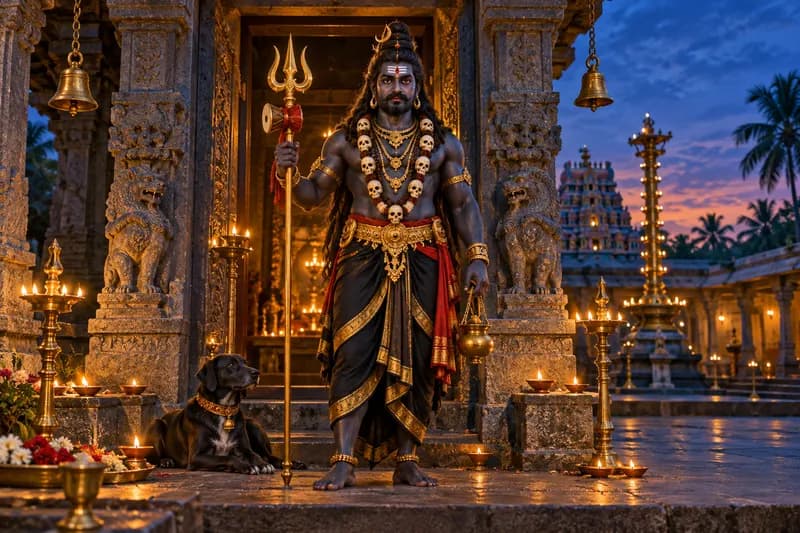
Bhairava's vehicle (vahana) is the dog — specifically, the black dog. In Indian tradition, dogs are liminal creatures: they inhabit the boundary between domestic and wild, between village and cremation ground. Dogs howling near temples at night are considered the voice of Bhairava — a warning that the guardian is alert and watching. Harming a dog near a Bhairava shrine is considered an act of direct provocation.
Appearance & Manifestation
| 👁 Sight | Rarely seen directly. When manifested in temple iconography: black-skinned, wild-eyed, garlands of skulls, four or eight arms holding trident, drum, skull-cup, and sword. Fanged. Tongue extended. Standing on a corpse. In spirit form — a shadow darker than the surrounding darkness, a shape that is felt rather than seen. |
| 🔊 Sound | Dogs howling simultaneously — the unmistakable signature. Also: a deep vibration felt in the bones rather than heard with the ears, like standing inside a drum being struck once. Temple bells ringing with no wind. A growl that seems to come from the ground itself. |
| 🍃 Smell | Blood. Fresh, metallic, unmistakable — the smell of a wound that hasn't been made. In some accounts, the smell of iron heated to glowing. Near Bhairava shrines, the scent of marigolds and blood mingle into something that shouldn't exist but does. |
| ❄ Temperature | Burning heat, not cold. Unlike most spirits in this database, the Bhairava Spirit radiates furnace-warmth — the heat of divine rage. The air near an active Bhairava shrine feels thicker, warmer, pressurized. |
| 🌑 Time | Most active during Bhairava Ashtami (the eighth day of the dark fortnight), and at midnight — the hour called Bhairava Kala. But unlike other entities, the Bhairava Spirit is not bound to darkness. It guards its territory at all hours. It simply becomes more intense at night. |
| 🏚 Habitat | Temple boundaries, cremation grounds, sacred crossroads, and any location where a Tantric practitioner has performed the installation ritual (Bhairava Sthapana). In Varanasi — the entire city. The Bhairava Spirit does not wander. It holds position. |
The Thief of Kashi
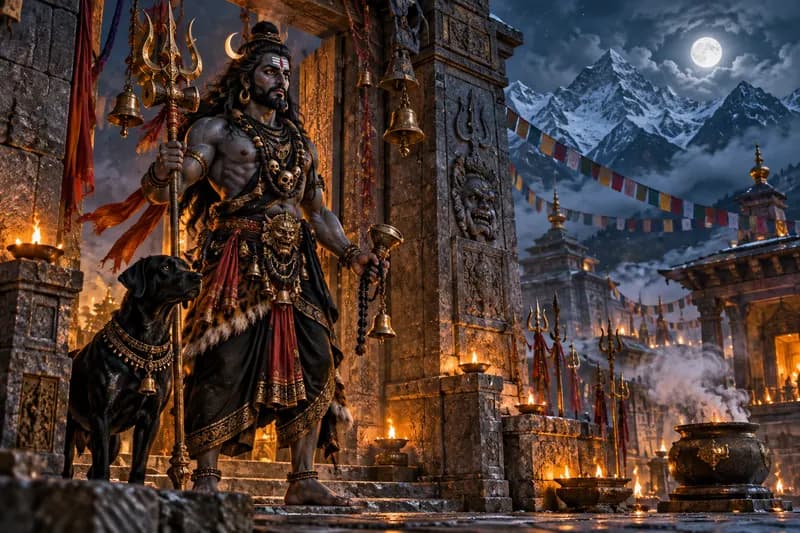
There was a man in Varanasi who decided to rob a temple. Not a major temple — a small shrine near Manikarnika Ghat, half-hidden behind newer construction, attended by an old priest who came once a day to light a lamp and leave. The shrine held a silver trident, old and tarnished, but silver is silver. The man's name does not matter. What matters is what happened.
He went at two in the morning. The ghat was quiet — even the burning ghats have their still hours, between the last cremation of the night and the first of the morning. He brought a cloth bag and a small pry bar. The shrine door was wooden, old, easy to force. He opened it in less than a minute.
The trident was on a stone platform inside, blackened with age and lamp soot. He reached for it.
Every dog within a quarter mile began to howl.
Not one dog, then another. All of them. Simultaneously. As if someone had struck a tuning fork that only dogs could hear. The sound filled the narrow lanes around the ghat — a rising, unified wail that didn't stop.
The man grabbed the trident anyway. It was heavier than he expected. As he lifted it, he felt something warm on his upper lip. He touched it. Blood. His nose was bleeding — freely, heavily, soaking into his shirt. He hadn't hit anything. He hadn't been hit. The blood simply came.
He stumbled out of the shrine with the trident. The dogs were still howling. He made it fifty meters before his legs gave out — not tripping, not stumbling, just failing, as if the muscles had been switched off. He fell face-first onto the stone steps. The trident clattered away from him.
The old priest found him in the morning. The man was alive but could not speak. His nose had stopped bleeding, but his eyes were wrong — unfocused, darting, seeing things that weren't there. The trident was three meters from his hand, lying on the steps as if it had been gently placed there.
The priest picked up the trident, cleaned it, returned it to the shrine. He lit his lamp. He said nothing unusual had happened. When asked about the man, he shrugged. "The Kotwal does his work," he said. "The city is protected."
The man recovered his speech after eleven days. He never recovered his nerve. He left Varanasi and did not return. The shrine is still there. The trident is still there. The dogs still howl when something crosses the line.
The Rules — How to Survive
☠ WARNING ☠
Seven rules for surviving a Bhairava Spirit encounter
- Do not enter sacred sites without permission — spoken or spiritual. — The Bhairava Spirit does not distinguish between accidental and intentional trespass. If you are within the boundary, you are subject to its judgment.
- Never harm, kick, or chase away dogs near temples or cremation grounds. — The dog is Bhairava's vehicle and earthly representative. Harming a dog in Bhairava's territory is a direct provocation — the spirit reads it as an attack on itself.
- If you feel sudden pressure in your chest near a shrine — leave immediately. — The chest pressure is the first warning. It is also the last warning. The Bhairava Spirit gives one signal before it acts. Do not wait for the second.
- Never steal from or desecrate a Bhairava shrine. — This is not a warning about karma or cosmic justice. This is a warning about an entity that was installed specifically to destroy anyone who does exactly this. The response is not proportional. It is total.
- Offer liquor, not milk. The Bhairava Spirit accepts what other gods refuse. — Bhairava is a Tantric entity — it operates outside conventional purity rules. Offerings of liquor (particularly dark liquor), meat, and blood-red flowers are appropriate. Sattvic offerings insult it.
- Only a Tantric practitioner of the same lineage can mediate. — The Bhairava Spirit was installed by a specific Tantric tradition. Only a practitioner of that same tradition has the authority and the mantras to negotiate on your behalf.
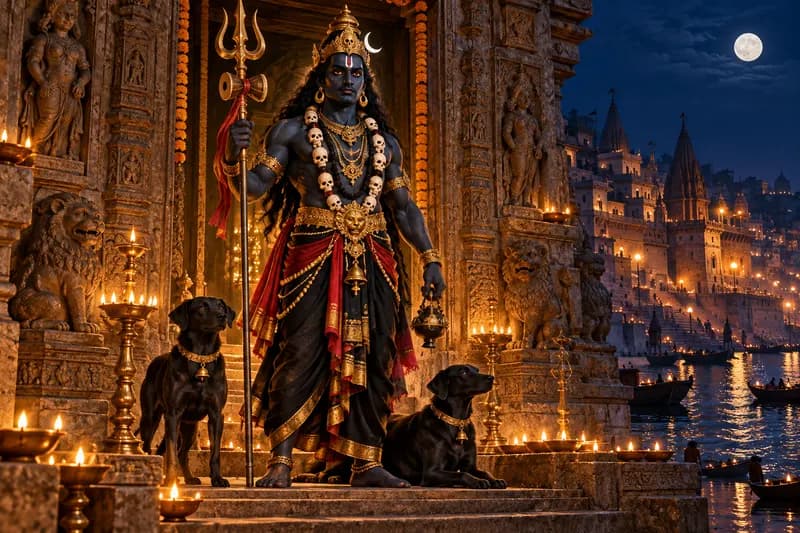
- In Varanasi, the entire city is Bhairava's territory. Act accordingly. — Kala Bhairava is the Kotwal — the divine constable — of Kashi. Every lane, every ghat, every temple is under his jurisdiction. Varanasi is not a city that also has a guardian. It is a guardian that also has a city.
What They Don't Tell You
The Bhairava Spirit is not malevolent. It is not even hostile. It is *territorial* — with a territory that was defined by human practitioners for human purposes. The temples it guards were built to house specific spiritual energies, and the Bhairava was placed there to ensure those energies remain contained and undisturbed. When it destroys a trespasser, it is not acting out of cruelty. It is performing the exact function it was created to perform. The terrifying part is not that it is evil — it is that it is *perfectly obedient* to instructions given centuries ago by people who understood exactly how much violence 'protection' requires.
What Does the Bhairava Spirit Want?
The Bhairava Spirit wants nothing. That is the problem.
It does not desire worship, though it accepts offerings. It does not seek companionship, though it tolerates the priests who tend its shrines. It does not pursue victims, though it annihilates trespassers. The Bhairava Spirit is pure function — a guard dog of the divine that never sleeps, never forgets its orders, and never exercises discretion.
In some Tantric traditions, advanced practitioners seek to become the Bhairava — to merge their consciousness with this wrathful guardian aspect through years of cremation-ground sadhana. These practitioners understand something most people never grasp: the Bhairava Spirit is not a thing to fear. It is a thing to become. The highest Tantric achievement is to guard the sacred with the same absolute, unwavering ferocity.
But for everyone else — for the curious, the careless, the tourist, the thief — the Bhairava Spirit is simply the most dangerous guardian in Indian supernatural tradition. It wants nothing from you except that you stay outside the line.
You're Most at Risk If...
- You enter temples or sacred sites without permission or proper conduct
- You are near cremation grounds at night without spiritual preparation
- You steal from or vandalize shrines, especially in Varanasi or Nepal
- You harm dogs near temples or burning ghats
- You are a practitioner attempting Tantric rituals without proper initiation
- You disrespect the boundary between consecrated and ordinary space
Offerings & Appeasement
| Offering | Purpose |
|---|---|
| Liquor Offering | Dark liquor — traditionally toddy, arrack, or whiskey — poured at the base of the shrine. The Bhairava Spirit accepts what Brahmanical gods refuse. This is not debasement — it is acknowledgment that the guardian operates beyond conventional purity. |
| Blood-Red Flowers | Red hibiscus, red roses, or any flower the color of blood. Placed at the shrine with a lit oil lamp. The color is the message: the offering recognizes the violent nature of the guardian's duty. |
| Meat Offering | In Nepal and certain South Indian traditions, meat is offered directly at Bhairava shrines — typically goat. This is Tantric appeasement at its most direct: feeding the fierce protector the food of fierceness. |
| The Apology Ritual | If you have already trespassed and symptoms have begun (nosebleeds, chest pressure, delirium), a Tantric priest must perform a formal apology at the shrine — acknowledging the violation, offering liquor and red flowers, and requesting the spirit to withdraw its punishment. This works only if performed quickly. |
The Healer
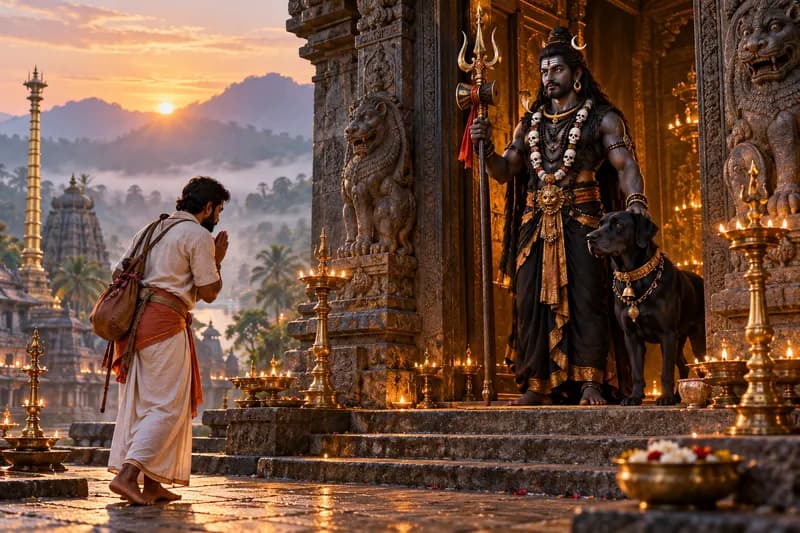
Tantric Priest (Bhairava Lineage) — Only a practitioner initiated into the same Tantric lineage that installed the Bhairava Spirit has authority to negotiate. A priest from a different lineage is a stranger to the guardian — his mantras will not be recognized.
Aghori Sadhu — Aghoris who have completed cremation-ground sadhana have a unique relationship with Bhairava — they are not just protected by the spirit but recognized as kin. An Aghori can mediate because the Bhairava Spirit regards them as part of its own order.
Temple Priest of the Specific Shrine — The hereditary priest who maintains the shrine holds a contractual relationship with the installed spirit. He cannot command it, but he can petition it. His daily offerings are the terms of an ongoing agreement.
The Key Difference — You cannot exorcise a Bhairava Spirit. It is not a haunting — it is a divine installation. The only options are: apologize and leave, or find someone with the authority to request clemency on your behalf.
What If You Dream of a Bhairava Spirit?
| Symbol | Meaning | |
|---|---|---|
| 🐕 | A Black Dog Guarding a Door | A boundary in your life that you are approaching without permission. Something you want to enter — a relationship, a career, a space — that has a guardian you have not acknowledged. The dream is telling you: ask before you enter. |
| 🔥 | A Burning Figure with Multiple Arms | Rage — either yours or someone else's — that is serving a protective function. Anger that is not random but purposeful. The dream suggests that the fury you feel or witness is not destruction — it is defense of something sacred. |
| 💀 | A Skull-Cup Filled with Blood | Sacrifice required. Something must be given up — comfort, innocence, a relationship — in order to pass through a threshold. The skull-cup is the price of entry. The dream is asking: what are you willing to pour out? |
| 🚪 | An Impassable Threshold | You are not ready. Whatever you are trying to access — spiritually, professionally, personally — the way is barred because you have not done the preparatory work. The Bhairava Spirit in your dream is not blocking you out of malice. It is blocking you out of mercy. |
The Bhairava Spirit in Art History
6th–8th Century — Bhairava Agama Sculptures: The earliest sculptural depictions of Bhairava appear in Tantric temple complexes across central and southern India. Stone carvings show the fierce form: skull garlands, trident, fanged mouth open in a perpetual roar. These are not decorative — they are installed guardians, consecrated with the sculpture.
Kathmandu Valley — The Great Masks: The monumental stone mask of Kala Bhairava in Kathmandu's Durbar Square is among the most powerful religious sculptures in Asia. Carved in the 17th century, the massive gilded face has served as a court of truth — oaths sworn before it were considered unbreakable. The mask is not art. It is a functioning spiritual technology.
South Indian Bronze Casting: Chola and post-Chola bronze sculptures of Bhairava — exquisite, detailed, showing every skull in the garland, every weapon in the multiple hands. These bronzes were processional images, carried through streets during festivals, bringing the guardian's presence into every lane of the town.
Living Tradition: Unlike many entities in this database, Bhairava art is not historical — it is ongoing. New Bhairava sculptures are being carved and installed today, in new temples and at new sacred sites. The artistic tradition is unbroken because the belief is unbroken.
Cross-Regional Patterns
Vetala · Kapala Spirit · Brahmarakshasa · Pishaach · Shakini
| Dawn as hard limit | No — active 24/7 |
| Iron weakness | No |
| Tree-dwelling | No — shrine-bound |
| Counting compulsion | No |
| Backward feet | No |
Global Equivalent: The closest global parallel is the Shomer of Jewish mystical tradition — a consecrated guardian entity placed at sacred sites — or the Gargoyle tradition of European cathedrals, which were originally intended as spiritual guardians, not decoration. But neither comes close to the Bhairava Spirit's lethal autonomy. The Egyptian concept of the Ka as a temple guardian shares more DNA — a fragment of divine power given independent function and absolute territorial authority.
In Culture — Movies, Books, Games
| Type | Title | Description |
|---|---|---|
| Film | Kaal Bhairav Rahasya (TV Series, 2017) | Indian television serial exploring mysteries connected to Kala Bhairava worship. Blends supernatural horror with devotional narrative. Popularized the concept of Bhairava as active supernatural force rather than purely devotional figure. |
| Literature | The Tantric texts — Bhairava Agamas | The primary scriptures detailing Bhairava's nature, worship, and the rituals for installing guardian spirits. Not fiction — these are instruction manuals for practitioners. Written in Sanskrit, partially translated, largely restricted. |
| Architecture | Bhairava Temples Across India | Every major Bhairava temple — Kala Bhairava in Varanasi, Bhairavnath in Ujjain, the eight Bhairava shrines of Kathmandu — is itself a cultural artifact. These are living installations where art, architecture, and active spiritual technology are indistinguishable. |
| Video Game | Raji: An Ancient Epic (2020) | Features Bhairava-inspired guardian entities in temple levels. The game's visual design draws from actual temple sculpture, giving Western audiences their first encounter with Bhairava iconography. |
| Music | Bhairava Raga — Indian Classical Music | The Bhairava raga in Indian classical music is considered the most solemn and powerful of the morning ragas. It is not about the spirit directly — but it carries the same energy: fierce, boundary-defining, absolute. |
ACCURACY RATING: MOSTLY FAITHFUL IN TRADITIONAL MEDIA · HEAVILY DILUTED IN MODERN ADAPTATIONS
Is the Bhairava Spirit Still Real?
- Kala Bhairava temples are among the most actively worshipped shrines in India and Nepal. The Kashi Vishwanath complex in Varanasi treats Bhairava as the literal policeman of the city — not metaphorically, not symbolically, literally.
- In Kathmandu, government oaths were historically sworn before the Kala Bhairava mask. The practice was discontinued officially but continues informally. The belief in the mask's truth-detecting power is undiminished.
- Dogs near Bhairava temples are fed and protected by devotees — not out of animal welfare sentiment but because harming them is understood as provoking the guardian spirit directly.
- Tantric practitioners still perform Bhairava installation rituals at new sacred sites. The tradition is not historical — it is current, active, and practiced by living lineages.
- Reports of mysterious illness following temple desecration are still taken seriously in communities across India and Nepal. The connection between sacrilege and Bhairava's retribution is not folklore — it is lived theology.
Expert & Academic Context
- Shiva Purana — Contains the mythological origin of Bhairava — the severing of Brahma's fifth head and the birth of divine wrath incarnate. Primary source for understanding Bhairava's place in the Shaiva cosmology.
- Bhairava Agamas (Tantric texts, c. 6th–8th century CE) — The ritual manuals for Bhairava worship and guardian installation. Partially translated from Sanskrit. These texts detail the eight Bhairava forms and their specific functions.
- David Gordon White — The Alchemical Body — Academic study of Tantric traditions including Bhairava worship, the role of cremation-ground sadhana, and the relationship between practitioner and guardian spirit.
- Alexis Sanderson — Shaivism and the Tantric Traditions — Definitive scholarly work on the Tantric lineages that developed and transmitted Bhairava worship. Maps the historical spread from Kashmir to Nepal to South India.
- Mary Slusser — Nepal Mandala — Comprehensive documentation of Bhairava worship in the Kathmandu Valley, including the Kala Bhairava mask and its judicial function. Essential reference for the Nepalese tradition.
The Bhairava Spirit represents the Indian tradition's most uncompromising answer to the problem of sacred space: how do you protect what is holy from what is profane? The answer is not walls or locks — it is the installation of divine violence itself as a permanent guardian. This reflects a theological position that sanctity requires active defense, that the sacred is not self-sustaining but must be guarded by force. The Bhairava Spirit is the logical conclusion of this belief — a being of pure protective rage, operating without mercy or nuance, because mercy and nuance are liabilities when the thing being protected is irreplaceable.
If You Encounter a Bhairava Spirit
Frequently Asked Questions
▶What is a Bhairava Spirit?
A Bhairava Spirit is a fierce guardian entity from the Tantric tradition — a wrathful manifestation of Shiva that is ritually installed at sacred sites to protect them from desecration. It guards temples, cremation grounds, and consecrated boundaries with lethal authority.
▶Is the Bhairava Spirit evil?
No. The Bhairava Spirit is not malevolent — it is territorial. It was created and installed to perform a protective function, and it performs that function with absolute commitment. It does not seek victims. It responds to trespass.
▶What is Kala Bhairava?
Kala Bhairava is the most prominent form of Bhairava — the 'Black Bhairava' or 'Bhairava of Time.' In Varanasi, Kala Bhairava is considered the Kotwal (divine policeman) of the city. The entire city is under his jurisdiction. In Kathmandu, the great stone mask of Kala Bhairava served as a court of truth.
▶Why do dogs howl near Bhairava temples?
The dog is Bhairava's vehicle (vahana). In tradition, dogs howling near temples at night are considered the voice of Bhairava — a signal that the guardian is alert. This is why dogs near Bhairava shrines are fed and protected, and harming them is considered direct provocation.
▶How do you protect yourself from a Bhairava Spirit?
Respect the boundaries. Do not enter sacred sites without permission. Do not steal from or desecrate shrines. If you feel sudden chest pressure near a temple, leave immediately. If symptoms have begun, find a Tantric priest of the same lineage that installed the guardian — only they have authority to negotiate.
▶Can a Bhairava Spirit be removed?
A Bhairava Spirit is a divine installation, not a haunting. It cannot be exorcised. It can only be ritually decommissioned by a Tantric practitioner of the same lineage that installed it — and this is almost never done, because the site it guards still needs guarding.
Explore More
Related Spirits
Vetala · Kapala Spirit · Brahmarakshasa · Pishaach · Shakini
Explore Further
Stories Are Being Summoned
One ghost story per week. Every Tuesday at midnight.