Betaal (Folk Variant)
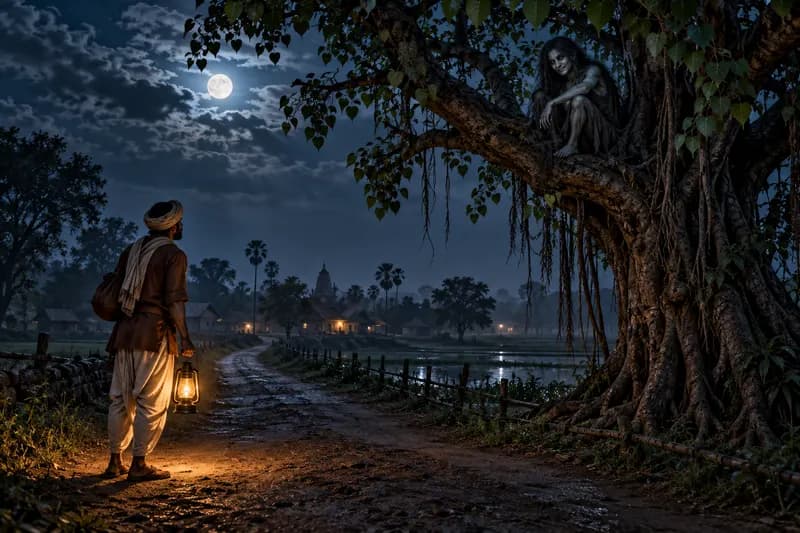
No riddles. No philosophy. No negotiation. This one just hangs in the tree and waits for someone to walk underneath.
- What Is a Betaal (Folk Variant)?
- Why the Folk Betaal Is Terrifying
- Origin — How It Came to Exist
- Appearance & Manifestation
- The Truck Driver of Satara
- The Rules — How to Survive
- What They Don't Tell You
- What Does the Folk Betaal Want?
- You're Most at Risk If...
- Offerings & Appeasement
- The Healer
- What If You Dream of a Betaal?
- The Folk Betaal in Tradition
- Cross-Regional Patterns
- In Culture — Movies, Books, Games
- Is the Folk Betaal Still Real?
- Expert & Academic Context
- If You Encounter a Folk Betaal
- Frequently Asked Questions
- Explore More
| Betaal (Folk Variant) | |
|---|---|
| Also Known As | Betal, Baital, Village Betaal, Tree Betaal |
| Script | बेताल (Devanagari) |
| Pronunciation | bay-TAAL (बे-ताल) |
| Region | Rural India — widespread across Maharashtra, Madhya Pradesh, Rajasthan, Uttar Pradesh, and Karnataka |
| Category | Malevolent Tree Ghost / Folk Spirit |
| Danger Level | Dangerous |
| Fear Method | Ambush from trees, possession, physical assault, nocturnal pursuit |
| Warning Sign | A cold wind from a specific tree at night; a shadow in a tree that moves when the branches do not; the feeling of being watched on a rural road after dark |
| First Documented | Oral folk tradition across rural India; diverged from the literary Vetala tradition at an unknown point — possibly as old as the villages themselves |
| Still Believed? | Yes — rural communities across India maintain active belief in tree-dwelling Betaal; specific trees are avoided, marked, or propitiated |
| Related | Vetala · Bhut (Gond) · Pishaach · Churel · Brahmarakshasa · Daitya |
What Is a Betaal (Folk Variant)?
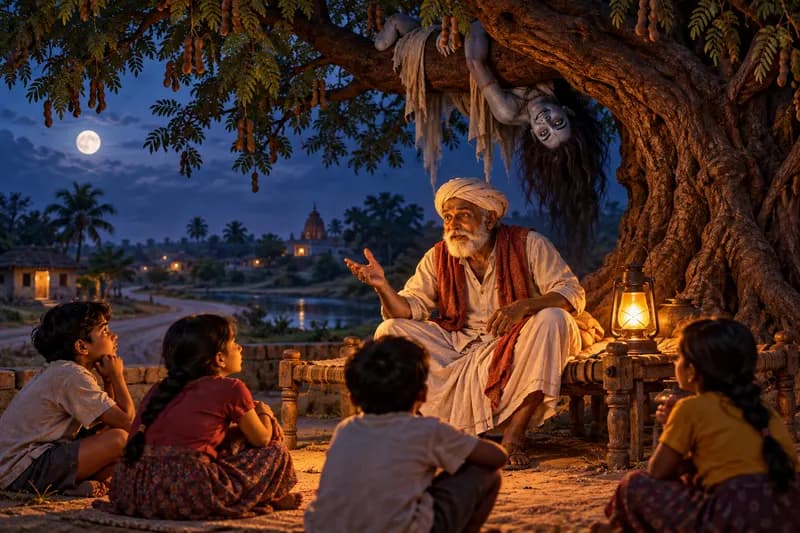
The Betaal of folk tradition is a simplified, more directly dangerous version of the literary Vetala. Where the Vetala of the Kathasaritsagara is a philosophical entity that poses riddles and negotiates with kings, the folk Betaal is a straightforward malevolent tree ghost — a spirit that inhabits specific trees (typically peepal, banyan, or tamarind), waits for travelers passing at night, and attacks through possession, physical violence, or terror. It has no interest in conversation. It does not ask riddles. It drops from its tree and does harm.
This version of the Betaal is the one known to most rural Indians — not through literature but through the warnings of grandmothers, the avoidance of certain trees after dark, and the stories told by people who say they or someone they knew encountered one. The folk Betaal is to the literary Vetala what a street dog is to a wolf: the same family, stripped of grandeur, operating at the village level with blunt and immediate methods. It is less interesting than the Vetala. It is more commonly feared.
Why the Folk Betaal Is Terrifying
INSTINCT EXPLOITED: FEAR OF THE DARK ROAD
You are walking home. The bus dropped you at the highway and the village is three kilometers by the dirt road. You have walked this road a thousand times. You know every bend, every dip, every tree. You know where the peepal tree is — the big one, the old one, the one your grandmother told you to walk past quickly and without looking up.
It is eleven at night. The moon is behind clouds. The road is dark in the way that only a road without streetlights can be dark — absolutely, completely dark, where your feet exist by memory and your eyes are useless.
You reach the peepal tree. You walk faster, the way you always do. You do not look up.
Something drops.
Not on you — beside you. A weight hitting the ground. You hear it land. Heavy, like a body. You stop. Your phone is in your pocket but your hands do not move toward it. Every part of your body has agreed, without consulting your brain, that you do not want to see what just landed next to you in the dark.
Then the cold comes. Not gradually — all at once, as if you stepped through a curtain into a freezer. The air around you drops in temperature so fast your breath is visible. And you feel it: a presence. Not behind you. Not in front of you. Beside you. Walking with you. Matching your pace.
You run. You run the last two kilometers to the village without stopping. You arrive at your house and you do not look back. In the morning, you will tell someone, and they will nod, and they will say: 'Yes. That tree.' And they will not be surprised.
Origin — How It Came to Exist
The Split from Literature
At some unknown point in history, the Vetala of Sanskrit literature and the Betaal of village folklore diverged. The literary Vetala retained its intelligence, its riddles, its philosophical depth. The folk Betaal kept the tree, the night, and the corpse — but shed the sophistication. What remained was a pure predatory ghost, stripped of the qualities that made the Vetala negotiable. The folk Betaal cannot be reasoned with because it has nothing to say.
What Creates a Folk Betaal
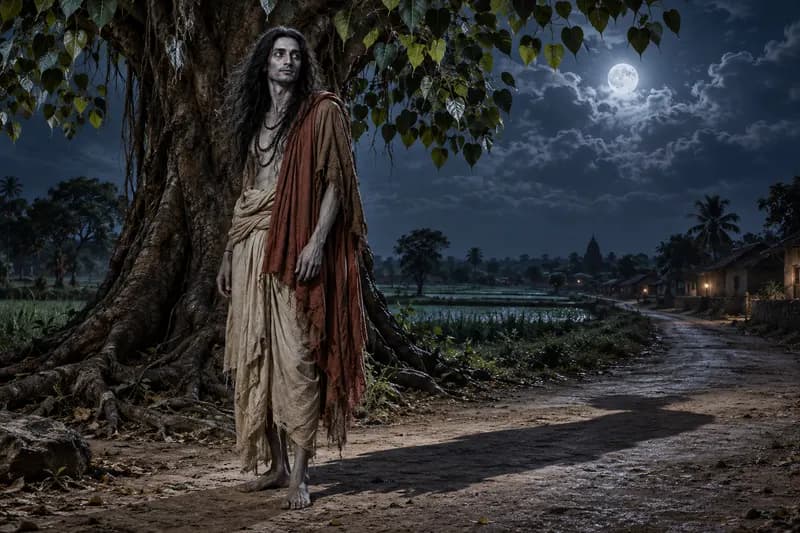
In folk belief, a Betaal is created when a person dies violently or unjustly and their spirit becomes trapped in a tree near the site of death. Unlike the literary Vetala (which is a category of being), the folk Betaal is the ghost of a specific person — usually someone murdered, someone who committed suicide, or someone whose body was not properly cremated. The tree becomes the prison, and the road beneath it becomes the hunting ground.
Why Trees
The peepal (Ficus religiosa), banyan (Ficus benghalensis), and tamarind (Tamarindus indica) are the three trees most commonly associated with the Betaal. All three are large, old, and associated with the supernatural across Indian tradition. The peepal is sacred to Vishnu but also to ghosts — a duality that reflects the Indian understanding that sacred spaces attract both divine and dangerous entities.
The Village Geography
Every Indian village has its known Betaal trees — specific trees that are avoided after dark, that have stories attached to them, that are treated with a mixture of respect and fear. These trees function as supernatural landmarks, organizing the village's mental map of safe and unsafe spaces. The road past the Betaal tree is the road you take during the day. At night, you go the long way around.
Simplification as Survival
The folk Betaal's simplicity is its strength as a survival tool. The literary Vetala requires you to understand riddles, dharmic dilemmas, and the philosophy of death. The folk Betaal requires you to understand one thing: do not walk under that tree at night. This simplicity makes the folk version more effective as a behavioral rule. It survives because it is easy to follow.
Appearance & Manifestation
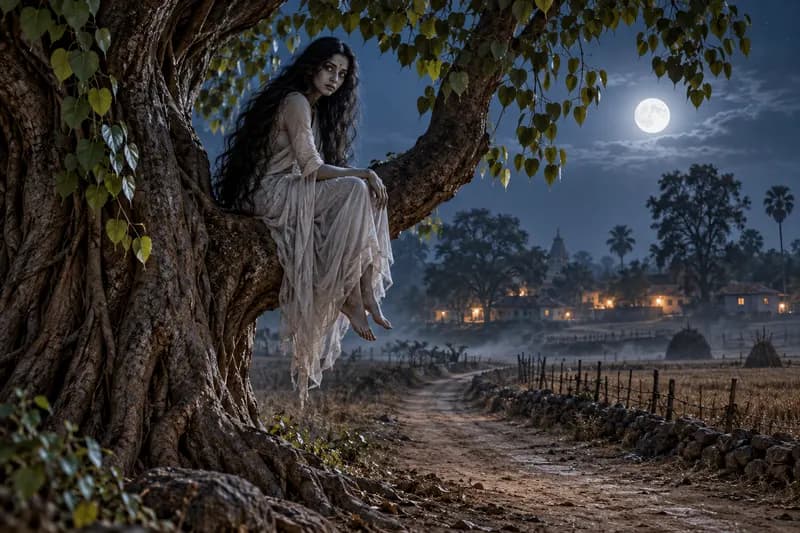
| 👁 Sight | A dark shape in a tree — sometimes human-shaped, sometimes formless, sometimes just a shadow that is denser than the surrounding darkness. When it descends, it appears as a gaunt, dark figure with matted hair and pale or glowing eyes. In some accounts, it is partially transparent. In others, it is solid enough to strike. |
| 🔊 Sound | The creak of a heavy branch when there is no wind. A thud of something landing on the ground. In some accounts, a low growl or hiss. The folk Betaal is not verbal — it does not speak, does not tell stories, does not ask questions. It communicates through the sounds of a body moving in a tree. |
| 🍃 Smell | The smell of the tree — peepal sap, banyan roots, tamarind sourness — combined with something underneath that is wrong. Decay, perhaps, or the cold mineral smell of death. The tree itself smells different after dark, as if the Betaal's presence changes the chemistry of the air around it. |
| ❄ Temperature | A sudden, sharp drop in temperature near the tree — the signature cold that accompanies most Indian supernatural entities. The cold is described as a wall: you walk through warm air, and then you walk into cold, and there is no gradient. The temperature change is immediate. |
| 🌑 Time | Strictly nocturnal. The folk Betaal is active from full dark to first light. The most dangerous hours are between 11 PM and 3 AM — the deep night when the road is emptiest and help is farthest away. It cannot manifest in daylight. |
| 🏚 Habitat | A single tree. The folk Betaal is territorial — it does not roam. It belongs to its tree the way a spider belongs to its web. The tree is always on a road, always in a place where people must pass, always positioned to create maximum vulnerability for nighttime travelers. |
The Truck Driver of Satara
Ramesh drove a truck on the Pune-Kolhapur highway, the stretch that passes through Satara district in western Maharashtra. He had been driving this route for twelve years and knew every pothole, every curve, every dhabha where the tea was drinkable. He drove at night because the highway was emptier and the loads moved faster.
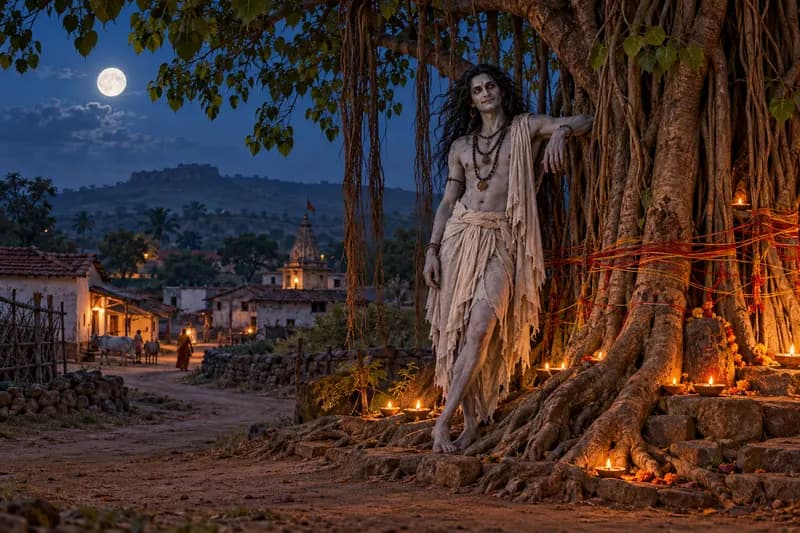
Between Satara and Karad, there was a stretch of road lined with old peepal trees — planted during the British period, massive now, their canopies meeting over the road like a tunnel. Ramesh had driven through this tunnel hundreds of times. Most drivers crossed themselves or muttered a prayer when they entered it. Ramesh did not. He was a practical man.
One November night — Amavasya, new moon, no moonlight — Ramesh was driving through the peepal tunnel at about one in the morning. The road was empty. His headlights cut two white lines through the dark. The truck was loaded with steel rods, heavy enough to keep the cab steady.
He saw the figure standing in the road.
Not on the side of the road — in the center, directly in his lane. A dark shape, human-sized but wrong somehow. Too thin. Too still. No person stands that still in the center of a highway at one in the morning.
Ramesh hit the horn. The figure did not move. He hit the brakes — the truck slowed but steel rods take time to stop. He swerved left, into the opposite lane, passing the figure at perhaps thirty kilometers per hour.
As he passed, two things happened. The temperature inside the cab dropped so sharply that the windshield fogged from the inside. And the figure — which had been on his right — was suddenly on his left. Not running. Not moving. Simply there, as if it had always been on that side.
Ramesh drove. He did not stop. He did not look in the mirror. He drove the remaining forty kilometers to Karad with the heater on full and the radio on loud, and when he stopped at the dhabha near the Karad bypass, his hands were shaking so badly he could not hold the glass of tea.
The dhabha owner — an old man who had been serving truck drivers on that route for thirty years — looked at Ramesh's face and said: 'The peepal stretch?' Ramesh nodded. The old man poured the tea for him. 'Third one this month,' he said.
Ramesh continued to drive the Pune-Kolhapur route. But he rearranged his schedule so that the peepal stretch was always crossed before sunset. Always. He lost money on the schedule change. He did not care.

The Rules — How to Survive
☠ WARNING ☠
Six rules for surviving a folk Betaal
- Do not walk under peepal, banyan, or tamarind trees after dark. — This is the oldest and most universal supernatural rule in rural India. The trees are the Betaal's territory. Avoiding them after dark is the simplest and most effective protection.
- Do not look up into the tree. — Looking up is interpreted as invitation — or at least acknowledgment. The Betaal responds to attention. Walk past quickly, eyes forward, without engaging.
- Iron protects. Carry a nail, a key, or an iron ring. — Iron is the universal repellent for Indian supernatural entities. A piece of iron on your person creates a zone of protection. The folk Betaal is simple enough that simple protections work.
- Recite Hanuman Chalisa. — The Hanuman Chalisa is the most commonly used protective prayer across rural India. Whether it works through divine intervention or psychological steadiness, the effect is the same: people who recite it report feeling less vulnerable.
- Do not stop near the tree. Keep moving. — The folk Betaal is territorial but limited. It can pursue for a short distance from its tree, but it cannot follow you far. Speed and distance are your allies.
- Travel in groups after dark. The Betaal targets individuals. — Solo travelers are vulnerable. Groups are not — whether because the Betaal cannot manage multiple targets or because the collective courage of a group resists the fear that makes individuals vulnerable.
What They Don't Tell You
The folk Betaal may be the most useful ghost in India — not because it is real, but because it is practical. In a country where rural roads have no lighting, where drunk driving kills thousands, where walking alone on empty roads at night is genuinely dangerous (from mundane threats: snakes, wild animals, bandits, open wells, unmarked construction), the Betaal tradition keeps people off dangerous roads after dark. The tree the grandmother warns you about may not contain a ghost. But the road past it at midnight may contain a cobra, an open drainage ditch, or a drunk driver without headlights. The Betaal is a safety system disguised as a ghost story. It works because fear is a more reliable motivator than caution.
What Does the Folk Betaal Want?
The folk Betaal wants what all simple predators want: territory and prey.
Unlike the literary Vetala — which has a philosophy, a code, and a desire for intellectual engagement — the folk Betaal is a basic haunting entity. It inhabits its tree. It attacks what passes beneath it. It does not negotiate, does not bargain, does not tell stories. It is the stripped-down, functional version of one of India's most complex supernatural beings.
In folk belief, the Betaal is driven by the emotions it carried in life: rage at an unjust death, grief at an incomplete cremation, attachment to the place where it died. These emotions have calcified into a simple behavioral loop: wait in the tree, attack what comes close, return to the tree.
The folk Betaal is not intelligent. It is not philosophical. It is not interesting. And that is exactly why it is feared. Because you cannot talk your way out of an encounter with something that has nothing to say.
You're Most at Risk If...
- You are walking alone on a rural road after dark
- You pass under a known Betaal tree — peepal, banyan, or tamarind — at night
- You are traveling during Amavasya (new moon) when the darkness is absolute
- You are between 11 PM and 3 AM on a road without electric lighting
- You are intoxicated, exhausted, or emotionally disturbed — states that lower resistance
- You are not carrying iron or reciting protective prayers
Offerings & Appeasement
| Offering | Purpose |
|---|---|
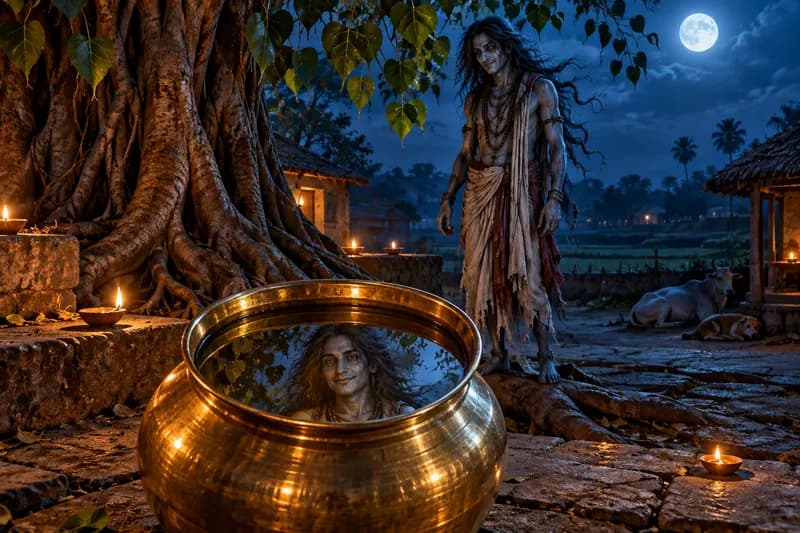
| Saturday Offerings at the Tree | In many villages, offerings are left at the base of known Betaal trees on Saturdays — oil, lemons, black sesame seeds, and sometimes liquor. These offerings maintain a truce: the Betaal stays in its tree, and travelers are left alone. |
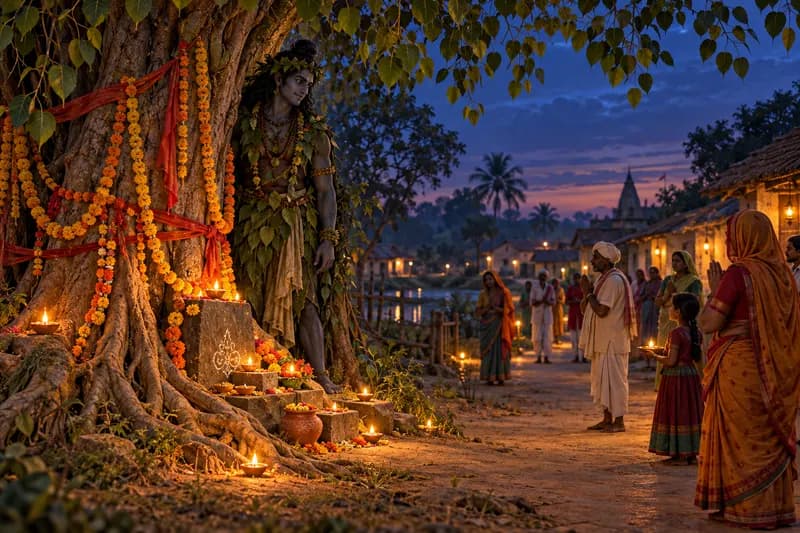
| Vermillion and Thread | Tying red thread around the tree trunk and applying vermillion (sindoor) to the bark marks the tree as acknowledged and respected. This is communication: the village knows the Betaal is there and does not pretend otherwise. |
| Animal Sacrifice (Regional) | In some regions, a chicken is sacrificed at the tree during specific festivals — particularly Navratri. This is the most significant offering and is performed when the Betaal has been particularly active or aggressive. |
| Proper Cremation | The most permanent solution: if the Betaal is the ghost of a specific person, performing the funeral rites that were denied in life can release the spirit from the tree. This requires identifying the Betaal's human identity, which the village ojha or tantrik can sometimes determine. |

The Healer
Village Ojha / Tantrik — The local spiritual practitioner who can diagnose Betaal activity, perform protective rituals, and — in some cases — bind or banish the entity. The ojha uses mantras, iron implements, and specific rituals to address Betaal disturbances.
Hanuman Temple Priest — Hanuman is considered the primary deity of protection against ghosts in folk Hinduism. A Hanuman temple priest can perform abhishek (ritual bathing of the idol) on behalf of someone affected by a Betaal, and blessed offerings from the temple are considered protective.
Family Elder — In many cases, the most effective intervention is a knowledgeable elder who knows the history of the tree and the Betaal — who it was, how it died, what it might want. This knowledge allows for targeted appeasement rather than generic protection.
The Key Difference — The folk Betaal is simple enough that simple solutions work. Iron, prayers, avoidance, offerings — the basic toolkit of Indian supernatural protection is effective here. You do not need a specialist. You need common sense and a piece of iron.
What If You Dream of a Betaal?
| Symbol | Meaning | |
|---|---|---|
| 🌳 | A Dark Tree on a Road | An obstacle on your path that you have been walking past without addressing. Something you avoid — a conversation, a decision, a confrontation — that is growing larger the longer you ignore it. The tree is the thing you walk around. |
| 👤 | Something Dropping from Above | An unexpected disruption. Something is about to fall into your life from a direction you are not watching. The dream advises: look up. Pay attention to what is above you — the things you are not monitoring because you assumed they were stable. |
| 🏃 | Running on a Dark Road | You are fleeing something you cannot see clearly. The fear is real but the threat is vague. The dream may reflect anxiety that is generalized — not about a specific danger but about the dark roads you travel in your life, the risks you take without protection. |
| 🔑 | Holding Iron in Your Hand | You have the protection you need. The dream is reassurance: whatever you are facing, you have the tools to handle it. The iron is your competence, your knowledge, your support system. Hold it and keep walking. |
The Folk Betaal in Tradition
Village Tree Shrines — Pan-India: Across rural India, specific trees are marked with vermillion, thread, and small stone platforms — indicators that the tree is inhabited and must be respected. These are not formal shrines but folk installations, maintained by communities who interact with the tree's presence as part of daily life.
Folk Art and Calendar Prints: The Betaal appears in folk calendar prints and poster art — typically depicted as a dark figure in a tree, often with the Vikramaditya narrative attached even when the folk version being depicted has no connection to the literary tradition. These prints are found in homes, tea stalls, and roadside shops across India.
Bollywood and Regional Cinema: The 'ghost in the tree' is one of the most common visual tropes in Indian horror cinema. While often unnamed, these depictions draw directly from the folk Betaal tradition — the dark road, the old tree, the solitary traveler, the thing that drops from the branches.
Oral Tradition: The folk Betaal's primary medium is the spoken word — stories told at night, warnings given to children, experiences shared between travelers. This oral tradition is the largest and most distributed documentation of the entity, existing in every Indian language and in millions of individual variations.
Cross-Regional Patterns
Vetala · Bhut (Gond) · Pishaach · Churel · Brahmarakshasa · Daitya · Stree · Thayee
| Dawn as hard limit | Yes |
| Iron weakness | Yes |
| Tree-dwelling | Yes — defining trait |
| Counting compulsion | No |
| Backward feet | No — that is the Churel |
Global Equivalent: The closest parallel is the Philippine 'Kapre' — a giant, tree-dwelling spirit that inhabits old mango and balete trees and disturbs travelers. The Scandinavian 'Huldra' (forest spirit that lures travelers) and the West African 'Sasabonsam' (tree-dwelling creature that attacks from above) also share structural elements. But the folk Betaal is more common and more deeply embedded in daily life than any of these — it is not a rare encounter but a nightly reality on millions of rural roads.
In Culture — Movies, Books, Games
| Type | Title | Description |
|---|---|---|
| Television | Vikram aur Betaal (Doordarshan, 1985) | While based on the literary Vetala, this show cemented the Betaal's visual in popular imagination: a dark figure in a tree. The folk Betaal borrows this image even though the folk entity lacks the literary version's intelligence and riddle-telling. |
| Film | Various Indian Horror Films | The 'ghost in the tree' trope appears in hundreds of Indian horror films across languages. The tree, the dark road, the lone traveler — this is the folk Betaal's domain, even when the films do not use the name. |
| Literature | Regional Folk Tale Collections | Every Indian language has folk tale collections that include tree-ghost stories. These are the folk Betaal's primary literary record — not the Sanskrit Kathasaritsagara but the vernacular village story. |
| Reference | Ghosts, Monsters and Demons of India — Rakesh Khanna | Documents the folk Betaal alongside its literary ancestor, noting the divergence between the philosophical Vetala and the predatory village ghost. |
| Digital | Internet Ghost Stories — Reddit, Quora, Social Media | Contemporary accounts of tree-ghost encounters on Indian roads flood social media platforms. These modern testimonials are the folk Betaal tradition continuing in digital form — the same stories, the same warnings, the same trees. |
ACCURACY RATING: UNIVERSAL IN FOLK TRADITION · CONFLATED WITH LITERARY VETALA IN MEDIA

Is the Folk Betaal Still Real?
- Universally believed in rural India. Ask any person from any village if there is a tree in their area that should not be passed at night, and the answer is almost always yes.
- Known Betaal trees are actively maintained — offerings are left, vermillion is applied, and the trees are never cut down. Cutting down a Betaal tree is considered one of the most dangerous acts in folk belief.
- Truck drivers, bus drivers, and regular nighttime travelers on Indian roads consistently report experiences near specific trees. These accounts are detailed, consistent, and told without irony.
- The belief coexists with urbanization. People who live in cities and drive on highways still accelerate past the old trees on the Satara stretch, the Mandla forests, the Bundelkhand backroads. Modernity has not erased the instinct.
- The folk Betaal belief functions as a living safety system: it keeps people off dangerous rural roads at night, away from trees that may harbor snakes or have unstable branches, and traveling in groups rather than alone. Whether supernatural or practical, the system works.
Expert & Academic Context
- Ghosts, Monsters and Demons of India — Rakesh Khanna — Documents the folk Betaal as distinct from the literary Vetala, analyzing the divergence between the philosophical entity of Sanskrit literature and the predatory tree ghost of village tradition.
- Regional Folk Tale Collections (Various) — Collections in Marathi, Hindi, Kannada, Telugu, Tamil, and other languages preserve tree-ghost stories that constitute the folk Betaal's primary literary record.
- William Crooke — The Popular Religion and Folk-Lore of Northern India (1896) — Colonial-era documentation of tree-spirit beliefs across north India, including descriptions of tree avoidance practices, offerings, and encounter accounts.
- Contemporary ethnographic fieldwork — Ongoing anthropological studies in rural India continue to document tree-spirit beliefs as active, maintained traditions — not historical remnants but living practice.
The folk Betaal reveals what happens when a sophisticated literary tradition meets the practical needs of village life. The Vetala of Somadeva — intellectual, philosophical, capable of posing dharmic dilemmas to kings — is beautiful but useless to a farmer walking home at midnight. The folk Betaal strips the entity to its functional core: there is a tree, there is a ghost, stay away after dark. This simplification is not degradation. It is adaptation — the same evolutionary process that turns a complex organism into something perfectly suited to its environment. The folk Betaal is perfectly suited to its environment: the dark road, the old tree, the solitary walker, the fear that keeps them moving toward home.
If You Encounter a Folk Betaal
Frequently Asked Questions
▶What is a folk Betaal?
The folk Betaal is a simplified, village-level version of the literary Vetala. It is a malevolent ghost that inhabits specific trees (peepal, banyan, tamarind) and attacks travelers passing at night. Unlike the literary Vetala, it does not ask riddles or negotiate. It is a straightforward predatory spirit.
▶How is the folk Betaal different from the Vetala?
The literary Vetala (from the Kathasaritsagara) is intelligent, philosophical, and can be negotiated with. The folk Betaal is a simple predatory ghost — it haunts a tree, attacks at night, and has no interest in conversation. Same family, different behavior.
▶Which trees have Betaal?
Peepal (Ficus religiosa), banyan (Ficus benghalensis), and tamarind (Tamarindus indica) are the three trees most commonly associated with the folk Betaal. Old, large specimens on roads between villages are the most frequently identified.
▶How do you protect yourself?
Do not walk under known Betaal trees after dark. Carry iron (a nail, key, or ring). Recite Hanuman Chalisa. Travel in groups. Do not look up into the tree. Keep moving — do not stop near the tree.
▶Can a folk Betaal be removed?
If the Betaal is the ghost of a specific person, performing their unfinished funeral rites can release the spirit. An ojha or tantrik can perform binding rituals. But the most common approach is coexistence: offerings at the tree, avoidance at night, and mutual respect.
▶Do people still believe in the folk Betaal?
Universally in rural India. Known trees are marked, offerings are maintained, and the avoidance rules are observed. Urban Indians who grew up in villages often retain the belief — or at least the instinct — even after decades in cities.
Explore More
Related Spirits
Vetala · Bhut (Gond) · Pishaach · Churel · Brahmarakshasa · Daitya · Stree · Thayee
Stories Are Being Summoned
One ghost story per week. Every Tuesday at midnight.