Bayangi
It gives you everything you ever wanted. Then it takes the one thing you cannot afford to lose.

- What Is a Bayangi?
- Why the Bayangi Is Terrifying
- Origin — How It Came to Exist
- Appearance & Manifestation
- The Mango Trader of Ratnagiri
- The Rules — How to Survive
- What They Don't Tell You
- What Does the Bayangi Want?
- You're Most at Risk If...
- Offerings & Appeasement
- The Healer
- What If You Dream of a Bayangi?
- The Bayangi in Art History
- Cross-Regional Patterns
- In Culture — Movies, Books, Games
- Is the Bayangi Still Real?
- Expert & Academic Context
- If You Encounter a Bayangi Situation
- Frequently Asked Questions
- Explore More
| Bayangi | |
|---|---|
| Also Known As | Bayangi, Bayangu, Bayangya |
| Script | बायंगी (Devanagari) |
| Pronunciation | BAH-yan-gee (बा-यं-गी) |
| Region | Maharashtra — particularly the Konkan coast; traces in Goa and northern Karnataka |
| Category | Wealth Spirit / Faustian Bargain Entity |
| Danger Level | Deadly |
| Fear Method | Seduction through wealth, delayed destruction, life-for-prosperity exchange |
| Warning Sign | Sudden, unexplained financial fortune; a family member falling mysteriously ill shortly after |
| First Documented | Oral traditions of the Konkan coast; referenced in Rakesh Khanna's Ghosts, Monsters and Demons of India; regional tantric grimoires |
| Still Believed? | Yes — coastal Maharashtra and Konkan villages still warn against summoning; practitioners of black magic (karani) reportedly invoke it |
| Related | Vetala · Mohini · Bhut (Gond) · Pishaach · Samandha · Devchar (Goan) |
What Is a Bayangi?
The Bayangi (बायंगी) is a spirit entity from Maharashtra's Konkan coast folklore that offers its summoner extraordinary wealth, success, and material fortune — but demands a human life as payment. It is not a demon in the conventional sense. It does not attack randomly. It does not haunt houses. It is invited. A person desperate for money, drowning in debt, or consumed by greed performs a specific ritual — often guided by a practitioner of karani (Konkan black magic) — and the Bayangi arrives. The deal is made. The wealth follows. And then, inevitably, someone dies.
What makes the Bayangi uniquely terrifying in the Indian supernatural tradition is the precision of the exchange. This is not a curse that might happen. It is a contract that will. The Bayangi is the Konkan coast's answer to the Faustian bargain — except the price is not the summoner's soul. It is the life of someone the summoner loves. A child. A spouse. A parent. The wealth is real. The cost is real. And by the time you understand what you have done, it is too late to undo it.
Why the Bayangi Is Terrifying
INSTINCT EXPLOITED: GREED AND THE DESIRE FOR A SHORTCUT
You are behind on rent. Three months. The landlord has stopped asking politely. Your daughter needs school fees by Friday. Your wife's brother knows a man in the village — an old man, a practitioner, someone who knows the old ways. You go to him because you have run out of other options.
He doesn't ask for much. A few ingredients. A night without sleep. Words you don't understand spoken in a language that isn't quite Marathi. And a promise — a promise you make without fully understanding what it means.
Within a week, things change. A deal closes that should not have closed. Money arrives from a source you cannot explain. A relative you barely knew dies and leaves you property. You pay the rent. You pay the school fees. You buy your wife a sari she has wanted for two years. Life is better. Life is good.
Three months later, your daughter stops eating. The doctors find nothing. She fades. She fades like a candle in a room where someone has opened a window — slowly, steadily, and then all at once.
You go back to the old man. You beg. You offer to return everything — the money, the property, the sari. He looks at you the way a man looks at someone who has signed a contract without reading it. "The Bayangi has already been paid," he says. "You just didn't know the currency."
This is the horror of the Bayangi. It does not chase you through the dark. It does not appear at the foot of your bed. It gives you exactly what you asked for. And the price was always there — you just chose not to see it.
Origin — How It Came to Exist
The Konkan Black Magic Tradition
The Bayangi emerges from the karani tradition of the Konkan coast — a system of folk magic distinct from the Tantric traditions of North India and the mantravadi practices of Kerala. Karani (sometimes spelled karni) is a catch-all term for ritualistic practices that manipulate the supernatural for material gain. The Bayangi is the most extreme expression of this tradition — the spirit you summon when you want wealth badly enough to pay the ultimate price.
The Logic of the Exchange
In Konkan folk belief, nothing comes from nothing. Every gain must be balanced by an equivalent loss. This is not karma in the philosophical sense — it is a transactional worldview embedded in coastal life. Fishermen understand that the sea gives and the sea takes. The Bayangi operates on the same principle: it gives abundantly, but it takes in proportion. The currency is always life — human life. Not the summoner's life (that would be too simple), but the life of someone connected to the summoner by blood or love.
Who Summons It
The Bayangi is not summoned by the wealthy. It is summoned by the desperate — farmers whose crops have failed for the third season, fishermen who have lost their boats, small traders crushed by debt. The karani practitioner who facilitates the summoning is typically a marginal figure — someone who exists at the edge of village society, feared but necessary, the person you go to when you have exhausted every legitimate option.
The Practitioner's Role
The karani practitioner does not summon the Bayangi out of malice. In most accounts, they warn the client. They explain, in terms that are deliberately vague, that the wealth will come with a cost. The client, blinded by desperation, agrees. The practitioner performs the ritual — and then distances themselves. They have fulfilled their function. What follows is between the summoner and the spirit.
What It Represents
The Bayangi is a moral parable made flesh. It is the Konkan coast's way of encoding a truth that every culture knows but few make this visceral: shortcuts to wealth destroy what wealth is supposed to protect. The family. The people you love. The life you were trying to improve. The Bayangi does not punish greed — it fulfills it, completely, and lets the consequences teach the lesson.
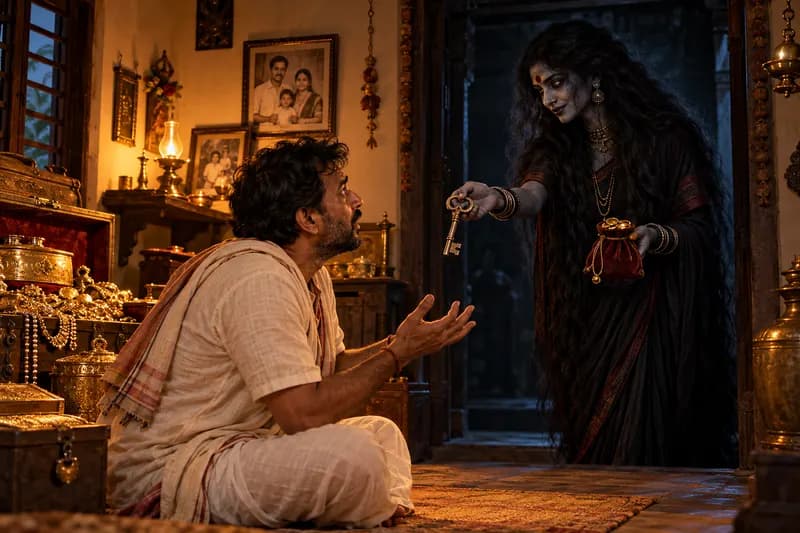
Appearance & Manifestation
| 👁 Sight | The Bayangi is rarely seen. It does not manifest visually the way a Vetala inhabits a corpse or a Churel appears at crossroads. When witnessed — in rare accounts from karani practitioners — it is described as a dark, formless mass, a shadow that moves against the direction of light. Some accounts describe a brief shimmer, like heat haze, at the moment of summoning. |
| 🔊 Sound | Silence. The Bayangi makes no sound. No whispers, no footsteps, no howling. Its presence is marked by an absence of sound — a sudden deadening of ambient noise, as if the air itself has been muted. Dogs stop barking. Crickets go quiet. The silence is the sign. |
| 🍃 Smell | A faint, sweet smell — described variously as overripe fruit, jasmine left too long in water, or the cloying scent of old incense. It arrives without source and lingers after the ritual. Some families report smelling it again when the payment comes due — when the chosen family member begins to sicken. |
| ❄ Temperature | No temperature change is associated with the Bayangi. This is part of what makes it unsettling — unlike most Indian spirits, there is no cold spot, no sudden chill. The Bayangi operates at room temperature. It is comfortable. It is ordinary. That is the point. |
| 🌑 Time | Summoning rituals are performed on Amavasya (new moon) nights, typically between midnight and 3 AM. But the Bayangi's effects — the wealth, the payment — unfold over weeks or months. It is not a creature of a single night. It is a slow-motion transaction. |
| 🏚 Habitat | No fixed habitat. The Bayangi is summoned, not found. Rituals are performed at crossroads, near rivers, or at the edge of cremation grounds. After summoning, it is said to attach itself to the summoner's household — not as a haunting presence but as an invisible ledger, tracking what has been given and what is owed. |
The Mango Trader of Ratnagiri
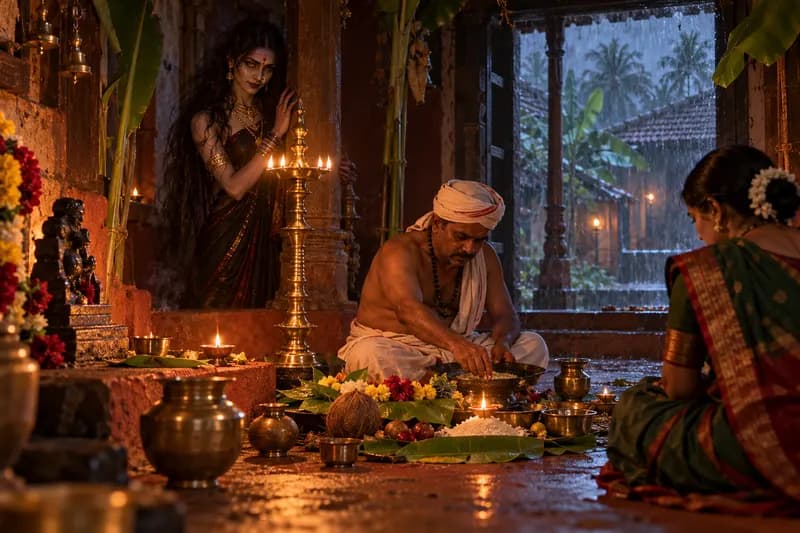
There was a man named Sadashiv who traded Alphonso mangoes out of Ratnagiri. For three seasons, the rain had come wrong — too early, too late, too heavy — and his orchards had produced fruit that was small and sour, unsellable in the Mumbai markets where quality decided everything. His debts had grown like the weeds in his neglected groves. His wife, Suman, had stopped wearing her good bangles — she had sold them quietly, without telling him, to pay the children's school fees.
Sadashiv's cousin knew a man in a village inland from Harnai. An old man who lived alone near a disused well. People went to him for things that could not be solved by prayer or hard work. Sadashiv went because he had tried both and neither had worked.
The old man listened. He did not interrupt. When Sadashiv finished — the debts, the failed harvests, the bangles, the school fees — the old man asked a single question: "How much do you want?" Not "what do you want" but "how much." Sadashiv named a figure. The old man nodded, as if the number was expected.
The ritual was simple. Too simple, Sadashiv thought afterward. A clay lamp. Rice grains arranged in a pattern he did not recognize. Words spoken in a Konkani so old it sounded like a different language. The old man told Sadashiv to go home, sleep, and not speak of this to anyone. Especially not to Suman.
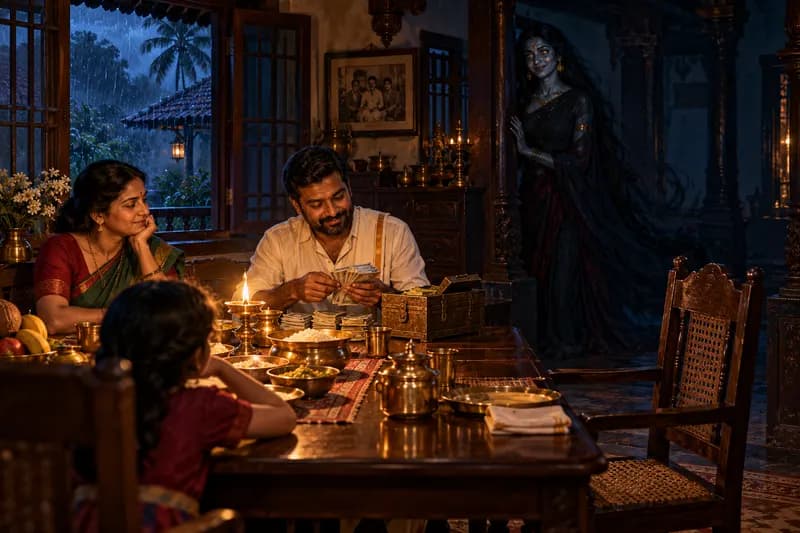
Within a month, the season turned. Late rains came — the exact rains the Alphonso needed. Sadashiv's remaining trees produced fruit so perfect that a Mumbai exporter offered him a contract for the next five years, paid in advance. The money was more than the figure he had named to the old man. He paid his debts. He bought Suman new bangles — gold this time, not glass. He enrolled his son Pramod in a better school in Ratnagiri town.
Pramod was eleven. Bright. Quick with numbers. He had his mother's face and his father's stubbornness. He loved cricket and could name every player in the Indian team going back twenty years. He was the kind of boy who made a room lighter by walking into it.
Six months after the contract, Pramod developed a fever that would not break. The doctors in Ratnagiri found nothing. The doctors in Mumbai found nothing. Suman took him to three temples and two dargahs. The fever stayed. Pramod grew thin. His cricket bat gathered dust in the corner of the room.
Sadashiv went back to the village inland from Harnai. The old man's house was empty. The well was dry. A neighbor said the old man had died two months ago — quietly, in his sleep, as if his work was done.
Pramod died on a Tuesday in April, the month the mangoes ripened. The orchards had never been more productive. The exporter increased the contract. Money continued to arrive, reliably, abundantly, like fruit from a tree that would not stop bearing.
Suman never learned what Sadashiv had done. She buried her son and wore her gold bangles to the funeral because she had nothing else left to hold onto. Sadashiv kept the contract. He kept the money. He could not stop it — the Bayangi does not accept returns.
He lived another thirty years. He became the wealthiest mango trader in the district. He never spent a rupee on himself that he did not have to. He donated to the school Pramod would have attended. He funded a cricket pitch in the village. And every Amavasya night, without fail, he sat alone in the dark and did not sleep, because sleeping meant dreaming, and dreaming meant seeing his son's face asking a question he could not answer.

The Rules — How to Survive
☠ WARNING ☠
Seven rules for surviving a Bayangi encounter
- Never agree to a ritual you do not fully understand. — The Bayangi is summoned through consent. The summoner must participate willingly. If you do not understand what you are agreeing to, you are agreeing blind — and the Bayangi counts silence as acceptance.
- If wealth arrives suddenly and without explanation, investigate its source. — The Bayangi's gifts are never random. If money, property, or opportunity arrives in a way that defies logic, someone may have summoned on your behalf — or at your expense.
- Do not seek out karani practitioners when desperate. — Desperation is the Bayangi's recruiting tool. No one summons it when they are comfortable. The ritual preys on people at their lowest — when judgment is weakest and the cost seems abstract.
- Once the deal is made, it cannot be undone. — There is no counter-ritual for the Bayangi. No mantra, no offering, no pilgrimage reverses it. The transaction is final. This is the most important rule: prevention is the only protection.
- The payment is never the summoner's own life. — The Bayangi takes from those connected to the summoner — a child, a spouse, a sibling, a parent. The summoner is left alive to enjoy the wealth and endure the cost. The cruelty is the point.
- Watch for the sweet smell. — When the Bayangi begins to collect its payment, a faint sweet scent appears in the household — overripe, cloying, wrong. If a family member falls ill and this scent is present, the payment has begun.
- Warn your family. Break the silence. — The karani practitioner always instructs silence — never tell anyone about the ritual. This secrecy protects the Bayangi's mechanism. If the family knows, they can at least choose to refuse the wealth, abandon the household, and break proximity to the summoner.
What They Don't Tell You
The Bayangi is not a punishment for greed. It is a punishment for desperation. The people who summon it are not villains — they are fathers who cannot feed their children, fishermen who have lost everything to the sea, farmers watching their land turn to dust. The karani practitioner is not a predator — they are the last resort, the person who exists because the systems that should have helped have already failed. The real horror of the Bayangi is not that it exists. It is that the conditions that make people seek it out — crushing poverty, impossible debt, the absence of any safety net — are as real today as they were two hundred years ago. The Bayangi is a story about what happens when society offers no exit, and desperation creates its own door.
What Does the Bayangi Want?
The Bayangi does not want anything. That is what makes it terrifying.
Unlike the Vetala, which seeks intellectual engagement, or the Churel, which seeks justice for its suffering, the Bayangi has no personality. No desires. No grudges. It is a mechanism — a supernatural vending machine that dispenses wealth and charges in human life. It does not hate you. It does not enjoy your suffering. It simply fulfills the terms of the contract.
This is worse than malice. Malice can be reasoned with, appeased, redirected. A mechanism cannot. The Bayangi operates like gravity — impersonal, consistent, and utterly indifferent to your feelings about the outcome.
Some karani practitioners believe the Bayangi is not even a spirit in the traditional sense — that it is a principle, a law of supernatural economics that states: extraordinary gain requires extraordinary loss. The spirit form is just the interface. Behind it is something closer to a rule of the universe — one that the Konkan coast learned to name and the rest of the world experiences without knowing what to call it.

You're Most at Risk If...
- You are in severe financial distress with no apparent way out
- Someone in your family has recently consulted a karani practitioner
- Sudden, unexplained wealth has entered your household
- A family member has fallen ill with symptoms no doctor can diagnose
- You live in coastal Maharashtra or the Konkan region and have been offered a ritual solution to money problems
- You have agreed to something — a ritual, a promise, a transaction — that you did not fully understand

Offerings & Appeasement
| Offering | Purpose |
|---|---|
| There Is No Appeasement | This is the defining feature of the Bayangi. Unlike most Indian entities, it cannot be appeased, bribed, or negotiated with after the fact. Once summoned, once the deal is struck, the transaction runs to completion. There is no counter-offering large enough. |
| Preventive Measures | In Konkan tradition, families protect themselves by maintaining strong relationships with their village kuldevta (family deity). Regular worship and offerings to the family god are believed to create a protective boundary that prevents the Bayangi from attaching to the household — but only if the worship predates the summoning. |
| Breaking the Chain | Some accounts suggest that if the summoner publicly confesses — tells the family, the village, anyone who will listen — the Bayangi's payment can be delayed, though never cancelled. Public confession breaks the secrecy that powers the contract. But very few summoners confess, because confession means admitting what they were willing to sacrifice. |
| The Renunciant's Path | In the rarest accounts, a summoner who gives away every rupee of the Bayangi's wealth — returns it all, keeps nothing, reduces themselves to the poverty they started with — can slow the spirit's collection. But the literature is unclear on whether this actually saves the targeted family member or simply delays the inevitable. |

The Healer
Karani Practitioner (If They Will Help) — The same type of practitioner who facilitates the summoning is the only one who understands the mechanism well enough to potentially intervene. But most will not. They warned the client before the ritual. They consider their obligation discharged.
Kuldevta Temple Priest — The family deity's priest may be able to strengthen protective boundaries around the household. This is not an exorcism — it is damage mitigation. The priest cannot undo the Bayangi's contract but may be able to shield specific family members if the intervention comes early enough.
Mantravadi (Konkan Specialist) — A mantravadi versed in Konkan coastal traditions — not a generic tantrik from North India — may have knowledge of rituals that can redirect or delay the Bayangi's collection. These practitioners are rare and do not advertise.
The Hard Truth — There is no reliable healer for a Bayangi situation. Every account in the folklore ends the same way: the wealth stays, and the payment is collected. The only true protection is refusing the deal in the first place.
What If You Dream of a Bayangi?
| Symbol | Meaning | |
|---|---|---|
| 💰 | Finding Unexpected Money | You are being tempted by a shortcut. Something in your waking life is offering you a gain that feels too easy, too convenient. The dream is a warning: examine what it will cost. Nothing comes without a price. |
| 🕯 | A Ritual You Don't Understand | You have agreed to something — a deal, a commitment, a relationship — without fully understanding the terms. The dream is telling you to read the contract. Ask the questions you have been avoiding. |
| 🤒 | A Loved One Fading | Something you love is being consumed by a choice you made. Not literally — but a decision you made for your own benefit is costing someone close to you. The dream is making the cost visible. |
| 🌑 | A Sweet Smell in Darkness | The price is coming due. Something you thought was free — an opportunity, a windfall, a stroke of luck — is about to reveal its cost. Pay attention to what changes in the days after this dream. |
The Bayangi in Art History
Konkan Coast — Oral Tradition: The Bayangi has no temple sculptures, no carved representations, no painted manuscripts. It exists almost entirely in oral tradition — stories told by grandmothers to grandchildren, warnings passed between neighbors, cautionary tales shared at village gatherings. The absence of visual representation is itself significant: the Bayangi is not meant to be seen. It is meant to be feared through its consequences.
Karani Ritual Objects: The closest physical artifacts associated with the Bayangi are the ritual objects used in its summoning — specific clay lamps, arrangements of rice grains, copper vessels. These objects are not displayed or preserved. They are used once and destroyed. The impermanence is part of the design: no evidence of the ritual should survive.
Colonial-Era Ethnographic Notes: British colonial administrators and ethnographers in the Konkan region documented references to wealth-granting spirits in their surveys of local customs. These are dry, clinical entries in district gazetteers — a sentence or two acknowledging that certain practitioners claim to summon entities for material gain. The colonial lens could not see what it was looking at.
Modern References: Rakesh Khanna's Ghosts, Monsters and Demons of India provides the most accessible modern documentation of the Bayangi, placing it within the broader context of Indian supernatural entities. Regional Marathi-language folk collections contain scattered references, but no single comprehensive treatment exists.

Cross-Regional Patterns
Vetala · Mohini · Bhut (Gond) · Pishaach · Samandha · Devchar (Goan) · Muinacho Zhelo · Agwel
| Dawn as hard limit | No |
| Iron weakness | No |
| Tree-dwelling | No |
| Counting compulsion | No |
| Backward feet | No |
| Wealth exchange | Yes — defining trait |
| Requires consent | Yes |
Global Equivalent: The closest global parallel is the Faustian bargain of European tradition — Mephistopheles offering Dr. Faust unlimited knowledge and pleasure in exchange for his soul. But the Bayangi is crueler: Faust pays with his own soul. The Bayangi's summoner pays with someone else's life. The European version is a tragedy of individual hubris. The Konkan version is a tragedy of collateral damage — the innocent destroyed by someone else's desperation.
In Culture — Movies, Books, Games
| Type | Title | Description |
|---|---|---|
| Literature | Ghosts, Monsters and Demons of India — Rakesh Khanna | The primary accessible source. Khanna documents the Bayangi within the broader landscape of Indian supernatural entities, noting its distinctive wealth-for-life exchange and its specificity to Maharashtra's Konkan coast. |
| Regional Literature | Marathi Folk Collections | Scattered references in Marathi-language folk collections and village-level oral histories. No single comprehensive literary treatment exists — the Bayangi remains largely in the oral tradition, which may be why it is less widely known than entities like the Vetala or Churel. |
| Film | Konkan Horror Cinema (Marathi) | The wealth-spirit concept appears obliquely in several Marathi horror films, though rarely by name. The theme of supernatural wealth arriving with hidden costs is a recurring motif in regional cinema, even when the Bayangi is not explicitly referenced. |
| Television | Aahat / Fear Files (Various Episodes) | Hindi-language horror anthology shows have occasionally featured Bayangi-adjacent storylines — episodes about families who receive mysterious wealth followed by unexplained illness or death. The connection to specific Konkan folklore is usually diluted for a national audience. |
ACCURACY RATING: UNDER-DOCUMENTED · PRIMARILY ORAL TRADITION

Is the Bayangi Still Real?
- Karani practitioners still operate in villages along the Konkan coast. They are not public figures — you find them through word of mouth, through a cousin's neighbor's uncle. Their existence is an open secret, acknowledged but not discussed.
- Families in coastal Maharashtra still attribute sudden unexplained wealth followed by tragedy to Bayangi activity. When a neighbor prospers overnight and then loses a child, the whisper network activates: someone made a deal.
- The belief persists because the pattern it describes — desperation leading to a bargain leading to loss — is a pattern that repeats in real life. Debt traps, predatory lending, exploitative arrangements that promise relief and deliver ruin. The Bayangi is a supernatural name for a very human mechanism.
- Young people in urban Maharashtra may not know the word 'Bayangi,' but they know the concept. The idea that some wealth is cursed — that money gained through wrong means carries a cost — is deeply embedded in Maharashtrian culture, from village proverbs to Bollywood plotlines.
- No documented mass hysteria events. The Bayangi does not create panic. It creates quiet, private dread — the fear of a deal already made, a price already set, a bill that will come due in the dark.
Expert & Academic Context
- Ghosts, Monsters and Demons of India — Rakesh Khanna — The most accessible modern documentation of the Bayangi. Places it within the broader taxonomy of Indian supernatural entities and notes its distinctive transactional nature — wealth in exchange for human life.
- Konkan District Gazetteers (Colonial Era) — British-era administrative surveys of the Konkan region contain brief references to wealth-granting spirits and the practitioners who claim to summon them. These are ethnographic footnotes — clinical and dismissive, but they confirm the tradition's existence in the 19th century.
- Marathi Folklore Collections — Regional Marathi-language anthologies of folk beliefs contain scattered references to the Bayangi and related wealth spirits. No single academic study focuses on the entity exclusively, which reflects its oral-tradition nature.
- Studies on Karani / Black Magic in Western India — Academic and journalistic investigations into black magic practices in Maharashtra and Goa reference the economic dimensions of folk magic — practitioners who offer wealth rituals to desperate clients. The Bayangi sits at the extreme end of this spectrum.
- Maharashtra Andhashraddha Nirmoolan Samiti (MANS) — The anti-superstition organization founded by Narendra Dabholkar documented cases of karani practitioners exploiting vulnerable people through wealth-promise rituals. While MANS approaches the subject from a rationalist perspective, their case documentation inadvertently preserves accounts of Bayangi-adjacent practices.
The Bayangi encodes a moral economy that runs deeper than superstition. In a region where fishing communities and mango farmers live at the mercy of monsoons, where a single bad season can destroy a family, the Bayangi serves as a cultural firewall against the most dangerous form of desperation — the willingness to sacrifice anything for survival. It says: even when you have nothing left, there is a line you must not cross. The spirit does not punish the greedy rich. It punishes the desperate poor who reach for the wrong solution. This is both its cruelty and its compassion — it warns the people most likely to be tempted, in the language they understand best: loss.
If You Encounter a Bayangi Situation
Frequently Asked Questions
▶What is a Bayangi?
A Bayangi is a wealth spirit from Maharashtra's Konkan coast folklore. It is summoned through a ritual performed by a karani (black magic) practitioner, and it grants the summoner extraordinary wealth and financial success. The price is always a human life — typically a family member of the summoner.
▶Is the Bayangi real?
In Konkan coast communities, belief in the Bayangi is real and active. Karani practitioners still operate in rural areas, and families still attribute patterns of sudden wealth followed by unexplained death to Bayangi activity. Whether the entity itself exists is a matter of belief — but the social and cultural framework around it is documented and ongoing.
▶Can you undo a Bayangi summoning?
According to the folklore, no. Once the deal is made, the transaction runs to completion. Some accounts suggest that confessing publicly or renouncing all the acquired wealth may delay the payment, but no tradition claims a reliable reversal. Prevention — refusing the deal — is the only true protection.
▶How is the Bayangi different from a Vetala?
The Vetala is an intelligent entity that inhabits corpses, poses riddles, and can serve as a protector. The Bayangi has no personality, no intelligence, no negotiation — it is a transactional mechanism. The Vetala can be reasoned with. The Bayangi cannot. They share a Konkan coast geography but operate on entirely different principles.
▶Who summons a Bayangi?
People in severe financial distress — farmers after crop failures, fishermen who have lost boats, traders crushed by debt. The summoner is almost never wealthy to begin with. They are desperate people who have run out of legitimate options, and a karani practitioner offers them a way out that they accept without fully understanding the cost.
▶Is the Bayangi the same as karani?
No. Karani is the broader tradition of Konkan coast black magic — a range of practices that includes curses, protections, love spells, and healing. The Bayangi is a specific entity within the karani system — the most extreme and most dangerous. Not all karani involves the Bayangi, but all Bayangi summoning involves karani.
Explore More
Related Spirits
Vetala · Mohini · Bhut (Gond) · Pishaach · Samandha · Devchar (Goan) · Muinacho Zhelo · Agwel
Stories Are Being Summoned
One ghost story per week. Every Tuesday at midnight.