Bobbariya
He was a Muslim saint who drowned at sea. Now Hindus and Muslims both worship him — because the dead don't care about borders you drew after they left.
- What Is a Bobbariya?
- Why Bobbariya Commands Respect
- Origin — How He Came to Exist
- Appearance & Manifestation
- The Two Brothers of Ullal
- The Rules — How to Honor Bobbariya
- What They Don't Tell You
- What Does Bobbariya Want?
- You're Most at Risk If...
- Offerings & Appeasement
- The Healer
- What If You Dream of Bobbariya?
- Bobbariya in Art & Ritual
- Cross-Regional Patterns
- In Culture — Movies, Books, Documentation
- Is Bobbariya Still Real?
- Expert & Academic Context
- If You Visit Bobbariya's Coast
- Frequently Asked Questions
- Explore More
| Bobbariya | |
|---|---|
| Also Known As | Bobbarya, Bobbariya Daiva, Bobbarya Bhuta, Babbariya |
| Script | ಬೊಬ್ಬರಿಯ (Kannada) / بوبریہ (Urdu) |
| Pronunciation | BOB-bah-ri-ya (ಬೊಬ್ಬ-ರಿ-ಯ) |
| Region | Tulu Nadu — coastal Karnataka (Dakshina Kannada, Udupi districts) and parts of northern Kerala |
| Category | Islamic-Hindu Syncretic Spirit / Bhuta (Daiva) |
| Danger Level | Guardian |
| Fear Method | Storms at sea, capsizing boats, drowning those who disrespect him or break coastal codes |
| Warning Sign | Sudden stillness on the sea before a storm; an unexplained green light near the shore at night |
| First Documented | Oral Tulu traditions dating to approximately 14th–16th century CE; linked to the arrival of Arab traders on the Malabar-Karnataka coast |
| Still Believed? | Yes — actively worshipped in Bhuta Kola rituals across Tulu Nadu; both Hindu and Muslim families attend his spirit possession ceremonies |
| Related | Kuttichathan · Panjurli · Jumadi · Guliga · Mohini · Naga Spirit |
What Is a Bobbariya?
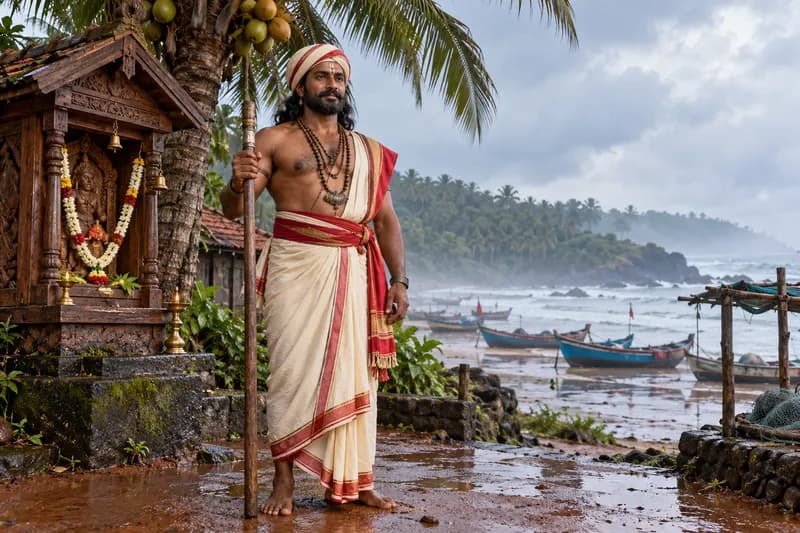
Bobbariya (ಬೊಬ್ಬರಿಯ) is a Bhuta — a deified spirit — from the Tulu Nadu region of coastal Karnataka. He is believed to have been a Muslim saint or seafarer, possibly an Arab or Persian trader, who drowned in the Arabian Sea. After his death, his spirit became one of the most powerful Bhutas (also called Daivas) in the Tulu spirit-worship tradition, a pre-Brahminical animistic system that predates formal Hinduism in the region. What makes Bobbariya extraordinary — and virtually unique in Indian supernatural lore — is that he is worshipped by both Hindus and Muslims. His annual Bhuta Kola ceremonies draw families from both faiths. No conversion is required. No theological compromise is demanded. The dead saint simply transcended the boundary that the living could not.
Bobbariya is a protector spirit. His domain is the sea, the coast, and the fishing communities that depend on it. He guards against storms, ensures safe passage for boats, and punishes those who violate the unwritten codes of the coast — overfishing, greed, disrespect toward the ocean. His danger level is low for those who honor him, but the sea itself is his weapon for those who don't. He is not a horror-entity. He is a covenant — a deal between the living and the dead, sealed across religions.
Why Bobbariya Commands Respect
INSTINCT EXPLOITED: THE SEA DOES NOT FORGIVE
You don't fear Bobbariya the way you fear a ghost in a corridor. You fear him the way a fisherman fears the sea — with respect, with ritual, with the knowledge that something much larger than you is allowing you to survive.
The story they tell in the villages south of Mangalore goes like this: a trawler owner refused to make the offering before the season's first launch. He said it was superstition. He said the sea was the sea. He took his boat out on a clear morning with calm winds and a sky so blue it looked painted.
By afternoon, the sky had closed like a fist. The storm came from nowhere — not from the west where storms usually build, but from the south, as if the sea itself had turned. The trawler came back, but not under its own power. It was towed in by another boat. The engine had died at the worst moment. The nets were shredded. Two crew members had been swept overboard and pulled back only because a rope held.
The trawler owner went to the Bobbariya shrine the next morning. He brought coconuts, incense, flowers, and a chicken. He did not say it was superstition again.
This is the fear Bobbariya holds: not the fear of a monster under the bed, but the fear of a force that keeps you alive and can stop doing so whenever it chooses. The Arabian Sea off the Karnataka coast kills fishermen every year. Bobbariya is the name given to the thing that decides which ones come home.
Origin — How He Came to Exist
The Drowning
The most widely told origin says Bobbariya was a devout Muslim — some accounts say a Sufi saint, others say a wealthy Arab or Persian merchant — who was traveling by sea along the Karnataka coast. His ship was caught in a storm and he drowned. His body washed ashore near a coastal village in Tulu Nadu. The villagers — Hindu fishermen — found the body and, recognizing something sacred in the circumstances of his death, gave him proper burial rites. His spirit, grateful and powerful, became a guardian of the coast.
The Syncretic Transformation
What happened next is the part that no textbook on religious conflict can explain. The Hindu villagers absorbed Bobbariya into their existing Bhuta (Daiva) worship system — a pre-Brahminical tradition of spirit veneration that has its own priesthood, its own rituals, and its own logic entirely separate from temple Hinduism. Muslim communities along the coast, recognizing the saint, also claimed him. Instead of a dispute, both traditions simply agreed: he belongs to everyone. The sea does not distinguish between Hindu and Muslim fishermen, and neither does the spirit that guards them.
The Bhuta Kola System
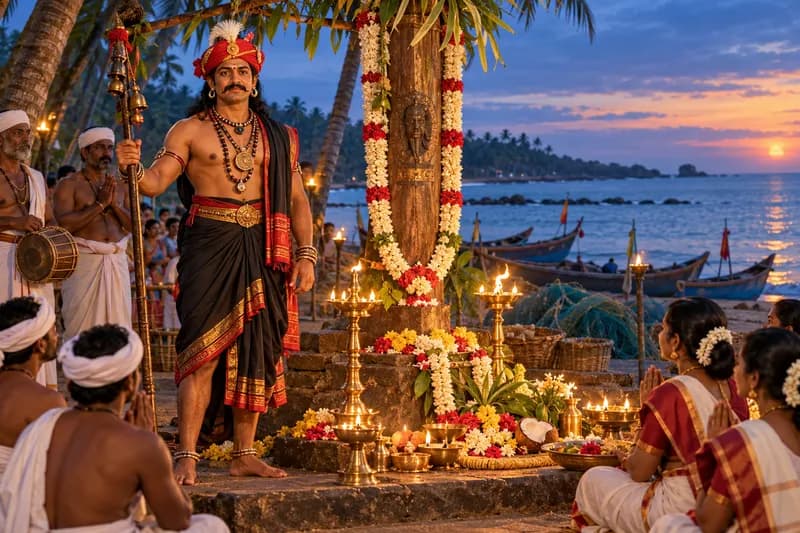
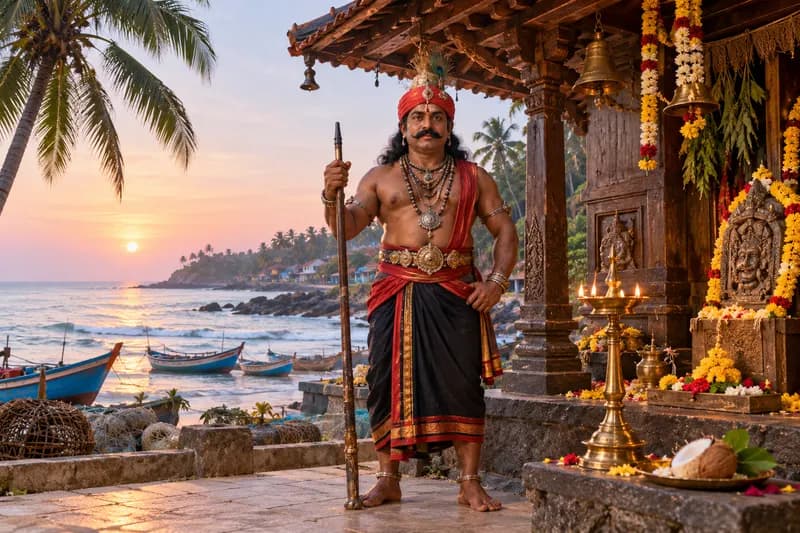
To understand Bobbariya, you must understand Bhuta Kola — the elaborate spirit-possession ritual of Tulu Nadu. In this tradition, certain spirits (Bhutas or Daivas) are invoked through dance, drumming, and offerings. A trained performer (called a Pambada or Parava, from specific communities) becomes possessed by the Bhuta, speaks in its voice, settles disputes, and delivers justice. Bobbariya is one of the most important spirits in this system. During his Kola, the performer dons specific attire, paints his face, and becomes the drowned saint — speaking to Hindu and Muslim families alike, hearing grievances, dispensing wisdom.
Historical Context
Arab and Persian traders have been present on the Karnataka-Kerala coast since at least the 7th century CE. Intermarriage, trade relationships, and cultural exchange created a unique coastal culture where Islamic and Hindu traditions blended in ways impossible inland. Bobbariya is the supernatural expression of this blending — a Muslim holy man absorbed into a Hindu animistic tradition, worshipped by both, owned by neither. Similar syncretic figures exist along the Malabar coast (such as the worship of Mappila saints by Hindu fishermen in Kerala), but Bobbariya's integration into the formal Bhuta Kola system makes him uniquely institutionalized.
What He Represents
Bobbariya represents something that modern India struggles to articulate: that religious boundaries are human inventions, and the supernatural doesn't respect them. The sea kills Hindu and Muslim fishermen with equal indifference. It made sense — practical, survival-level sense — for both communities to worship the same protector. Bobbariya is not a symbol of tolerance. He is a symbol of pragmatism. When your life depends on the ocean, you pray to whatever keeps you alive.
Appearance & Manifestation
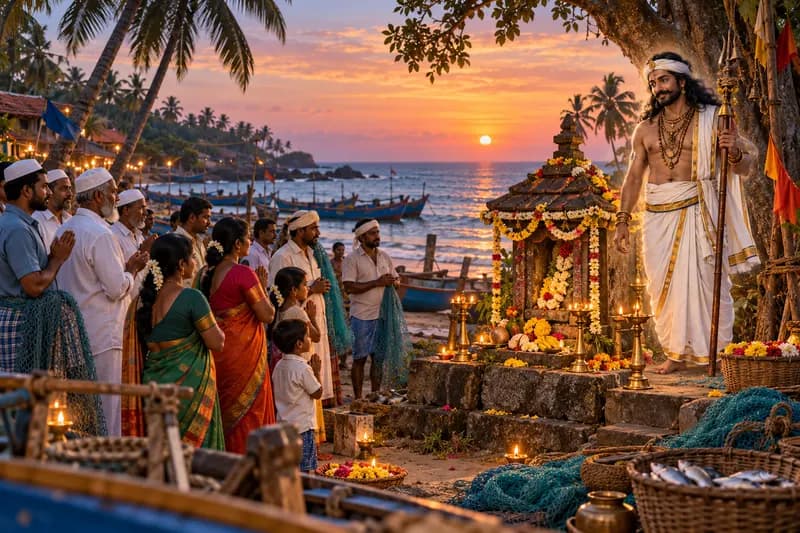
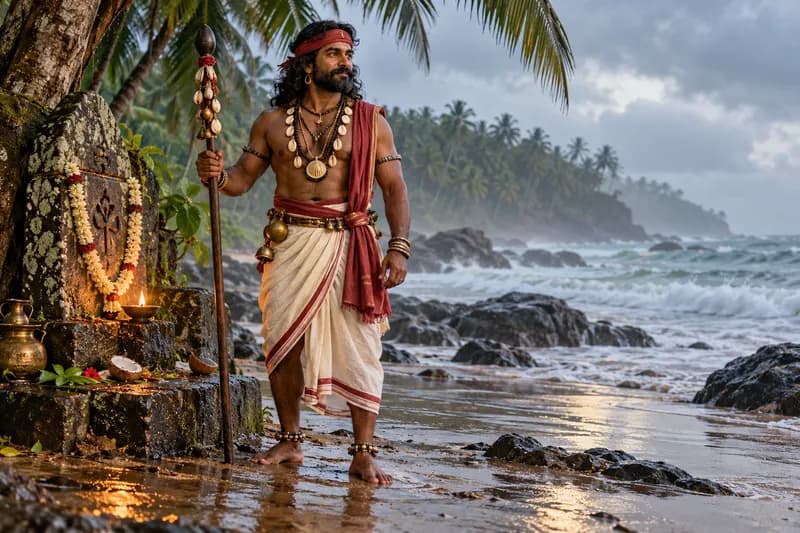
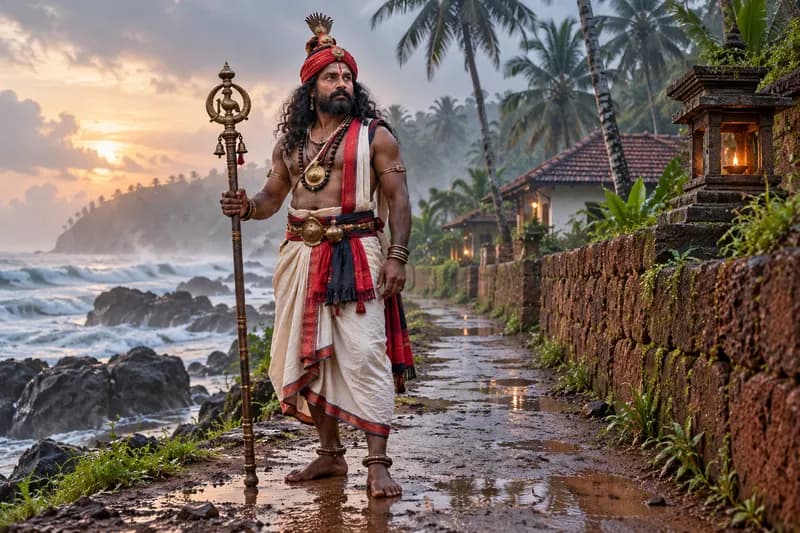
| 👁 Sight | In Bhuta Kola performances, Bobbariya manifests through a performer wearing elaborate face paint — often green and white, symbolizing both Islamic association and the sea. The performer wears a distinctive headdress and carries ritual objects. Outside of Kola, Bobbariya is sometimes described as a tall figure in white robes walking the shoreline at dusk, or as a green luminescence hovering over the water before a storm. |
| 🔊 Sound | The sound of Bobbariya's Kola is unmistakable — deep drumming (the dolu and tase drums of Tulu tradition), chanting that blends Tulu invocations with Arabic phrases, and the voice of the possessed performer shifting into an authority that is not his own. Outside of ritual, fishermen report hearing a voice carried on the wind before sudden weather changes — a warning, never words, just a sound like someone calling from very far away. |
| 🍃 Smell | Incense — specifically loban (frankincense), which is used in both Islamic prayer and Bhuta Kola ceremonies. The smell of salt water and wet sand. During Kola, the air fills with the smoke of coconut oil lamps and the iron-tang of sacrificial offerings. |
| ❄ Temperature | A sudden drop in temperature near the shore, particularly at twilight. Fishermen describe a cold that comes off the sea even on warm evenings — not wind-chill, but a presence-cold, as if the air itself has thickened. During Kola, the performance space grows noticeably cooler when the possession takes hold. |
| 🌑 Time | Most active at twilight and in the pre-dawn hours — the liminal times when the sea changes character. Kola ceremonies are performed at night, often beginning after sunset and continuing until the early hours. Bobbariya's presence is strongest during the monsoon season, when the sea is most dangerous. |
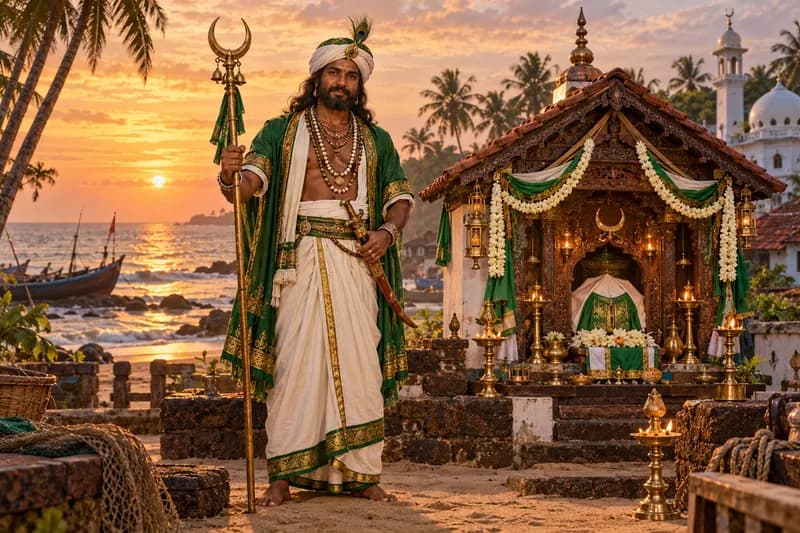
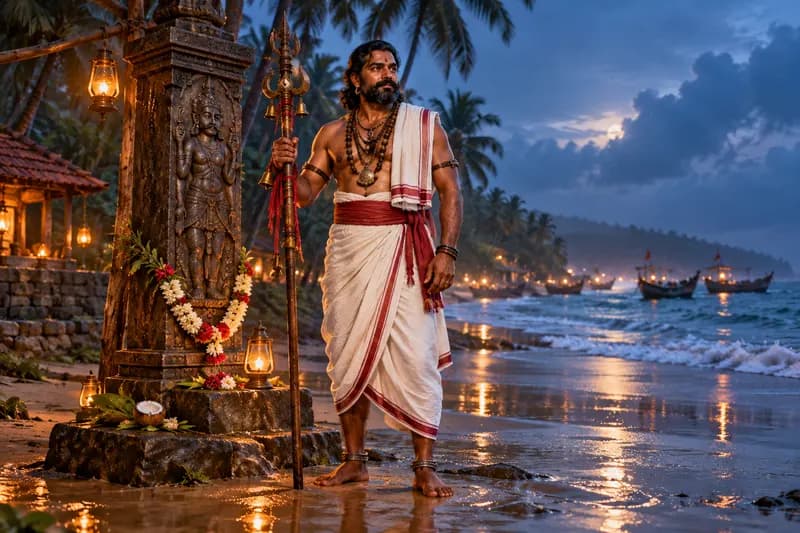
| 🏚 Habitat | The coastline itself — beaches, fishing harbors, the edge where land meets water. His shrines (called Garadi or Stana) are often simple stone structures near the shore, sometimes marked with green cloth. He is also associated with specific rocks, jetties, and stretches of coast where drownings have occurred. |
The Two Brothers of Ullal
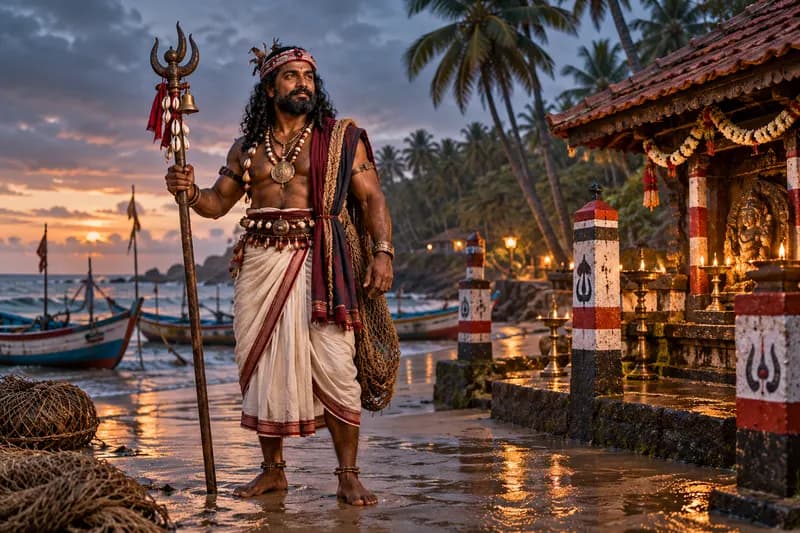
In the fishing village of Ullal, south of Mangalore, there were two brothers. One was named Yusuf and the other was named Ganesh. They were not related by blood — Yusuf was from a Beary Muslim family and Ganesh from a Mogaveera Hindu family — but they had grown up on the same stretch of beach, learned to mend nets from each other's fathers, and shared a boat that they had built together from sal wood and caulked with fish oil.
They went to the Bobbariya shrine together before every fishing trip. It was a small stone platform under a banyan tree, fifty meters from the water's edge. There was a green cloth tied around the tree, faded by salt and sun. The offering was simple: a coconut broken in half, a handful of flowers, and a muttered acknowledgment — Yusuf would say a Fatiha, Ganesh would say a brief prayer to the Daiva. Neither found this strange. Their fathers had done the same.
One November, the mackerel run was late. The village was restless. Boats had been going out and coming back with nearly empty holds. Money was tight. A new trawler owner from Bunder — a man who had made his money in the Gulf and come back to invest in fishing — announced he would take his trawler out past the usual grounds, further into the deep water where the larger shoals moved. He offered daily wages to any crew willing to join.
Ganesh wanted to go. The money was good — better than anything the shared boat had brought in for weeks. Yusuf said nothing at first. Then, the evening before the trawler was set to depart, Yusuf went to the Bobbariya shrine alone. He sat there for a long time. When he came back, he told Ganesh: "Don't go on that boat."
Ganesh asked why. Yusuf could not explain. He said only that he had sat at the shrine and felt something — not a voice, not a vision, but a heaviness in his chest, a certainty that had no words behind it. Ganesh respected his brother but also needed the money. They argued, quietly, the way men argue when they know the stakes are real.
Ganesh did not go on the trawler. He could not say exactly why. Perhaps it was Yusuf's certainty. Perhaps it was something in the air that evening — the sea too calm, the sky too clear, the kind of weather that experienced fishermen distrust precisely because it looks perfect.
The trawler went out the next morning with a crew of eight. It did not come back that evening. It did not come back the next day. On the third day, the Coast Guard found it capsized twelve nautical miles offshore. The engine had failed in a sudden squall. Three of the eight crew drowned. The trawler owner survived but never put a boat in the water again.
Ganesh went to the shrine the next morning. He broke a coconut. He placed flowers. He said nothing, because nothing needed to be said. Yusuf was already there. They sat together in silence for a long time, watching the sea do what the sea does — move, endlessly, indifferently, caring nothing for the living except when something older than the sea itself intervenes.
The people of Ullal did not call this a miracle. They called it what the coast has always called it: Bobbariya doing his work.
The Rules — How to Honor Bobbariya
☠ WARNING ☠
Seven rules for living under Bobbariya's watch
- Never take a boat out without making an offering at his shrine first. — Bobbariya's protection is a contract, not a gift. The offering — coconut, flowers, incense — is the act that activates the contract. Skip it, and you sail unprotected.
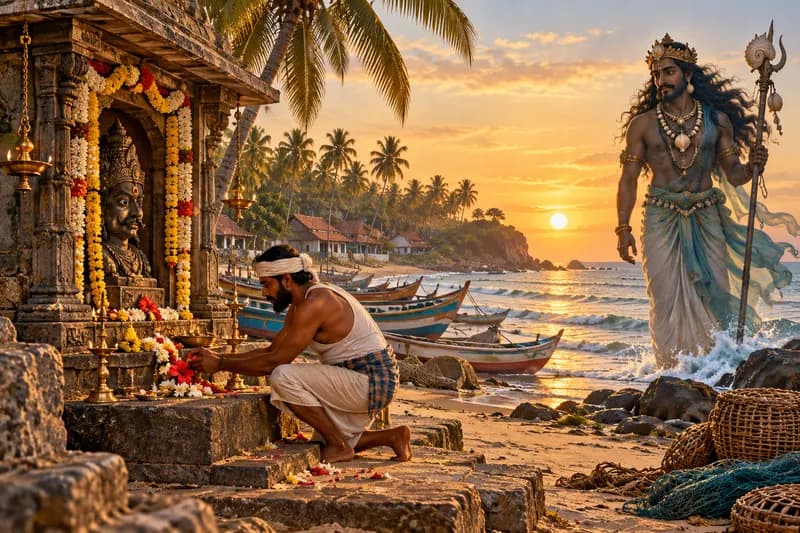
- Do not mock or disrespect the shrine, regardless of your faith. — Bobbariya does not belong to one religion. Disrespecting the shrine — whether you are Hindu, Muslim, Christian, or atheist — is disrespecting the covenant between the coast and its dead. The sea will collect the debt.
- If the sea feels wrong, do not go out. Trust the instinct. — Bobbariya's warnings are not dramatic — no visions, no voices. They come as a feeling: a heaviness, a wrongness, a sense that today is not the day. Fishermen who have survived decades on this coast say the feeling is Bobbariya's way of speaking without words.
- During Bhuta Kola, when the performer is possessed, treat the words as Bobbariya's own. — The possessed performer is not acting. In the Tulu tradition, he has become the Bhuta. His judgments are binding. His warnings are real. Dismissing his words during Kola is dismissing Bobbariya himself.
- Do not take more from the sea than you need. — Bobbariya punishes greed. He is a protector of the coast, not a servant of profit. Overfishing, trawling in sacred waters, taking during the breeding season — these are violations of his code. The punishment is always the same: the sea takes back.
- If you find a body washed ashore, give it proper rites — regardless of religion. — Bobbariya himself was a drowned man given dignity by strangers of a different faith. The cycle must continue. A body denied rites becomes a restless spirit. A body honored may become a protector. This is how the coast works.
- Green cloth at the shrine must be replaced annually before the monsoon. — The green cloth — representing both Islamic tradition and the color of the sea — marks Bobbariya's dwelling. Letting it rot is letting the contract decay. Before the monsoon season, when the sea is most dangerous and Bobbariya's protection most needed, the cloth must be renewed.
What They Don't Tell You
Bobbariya is the proof that India's deepest spiritual traditions are not about theology — they are about survival. The Bhuta Kola system of Tulu Nadu is older than organized Hinduism in the region. It absorbed Bobbariya — a Muslim spirit — without a single doctrinal crisis, because the system was never about doctrine. It was about power, protection, and the relationship between the living and the dead. When scholars study interfaith harmony, they look at conferences and dialogues. They should look at a fishing village in Tulu Nadu where a Hindu performer becomes possessed by a Muslim saint and both communities accept his authority without question. That is not tolerance. That is something deeper — a shared understanding that the sea does not care what name you call God, and neither does the spirit that guards you from it.
What Does Bobbariya Want?
Bobbariya wants what every protector wants: to be remembered and respected.
He does not demand conversion. He does not demand elaborate theology. He demands acknowledgment — a coconut broken at his shrine, a moment of stillness before you push the boat into the water, a recognition that the sea is not yours to command. His contract is simple: honor me, and I will watch over you. Forget me, and you are on your own.
There is something deeply human about this motivation. Bobbariya was, by all accounts, a man who died far from home — a traveler drowned in foreign waters, buried by strangers. What does such a spirit want? To not be forgotten. To matter. To have his death mean something beyond a body washed ashore.
The fishermen of Tulu Nadu gave him that meaning. They made his death into a covenant. And in return, he made their survival his purpose. That is the deal. That has always been the deal.
You're Most at Risk If...
- You are a fisherman or seafarer who neglects the shrine offering before going to sea
- You are a trawler owner who prioritizes profit over coastal traditions
- You disrespect or vandalize a Bobbariya shrine
- You take more from the sea than your community needs — especially during breeding seasons
- You mock the Bhuta Kola ceremony or dismiss the possessed performer's words
- You find a body washed ashore and refuse to help with proper rites
Offerings & Appeasement
| Offering | Purpose |
|---|---|
| Daily Offering (Fishermen) | A coconut broken at the shrine, flowers (jasmine or marigold), and a lit incense stick — ideally loban (frankincense). Done before the first trip of the day. Quick, silent, routine. Not a prayer but a check-in — confirming the contract is active. |
| Seasonal Offering (Pre-Monsoon) | Before the monsoon season begins, a larger offering is made: new green cloth for the shrine, a feast shared between Hindu and Muslim families, and sometimes a sacrificial chicken. This is the annual renewal of the covenant — the community saying: we remember you, protect us through the storms. |
| Bhuta Kola (Annual Ceremony) | The full Bhuta Kola is the most elaborate offering — a night-long ritual involving drumming, dance, face-painting, and spirit possession. The performer becomes Bobbariya, speaks in his voice, delivers judgments, and reaffirms the bond between spirit and community. This is not entertainment. It is governance — the dead administering justice for the living. |
| Emergency Offering | When a storm hits unexpectedly or a boat is in danger, family members on shore go to the shrine and make immediate offerings — coconut, flowers, sometimes just raw turmeric and kumkum smeared on the shrine stone. The offering is a plea: bring them home. |
The Healer
Pambada / Parava (Bhuta Kola Performer) — The hereditary performers who channel Bobbariya during Kola ceremonies. They come from specific communities (Pambada, Parava, Nalke) and undergo years of training. They are not priests in the Brahminical sense — they are mediums, vessels through which the Bhuta speaks and acts.
Local Shrine Keeper — Often an elder from the fishing community — Hindu or Muslim — who maintains the Bobbariya shrine, replaces the green cloth, ensures offerings are made, and serves as the informal intermediary between the community and the spirit. Not a formal religious role but an essential one.
Tulu Astrologer (Daiva Patri) — When something goes wrong — a string of bad catches, an accident at sea, illness in a fishing family — a Tulu astrologer may be consulted to determine if Bobbariya has been offended. The astrologer identifies the offense and prescribes the specific offering or Kola needed to restore the relationship.
The Community Itself — Uniquely, Bobbariya's relationship is not mediated solely by specialists. The entire fishing community — Hindu and Muslim — collectively maintains the covenant. When a family neglects the shrine, neighbors notice. When a Kola is due, the village organizes it together. The healer is the community's memory.
What If You Dream of Bobbariya?
| Symbol | Meaning | |
|---|---|---|
| 🌊 | A Figure Walking on Water | You are being watched over — but you are also being reminded that your safety is not guaranteed by your own skill. Something is protecting you that you have not acknowledged. The dream is asking: what have you taken for granted? |
| 🟢 | A Green Light on the Shore | A warning. Something in your waking life is about to change suddenly — a storm you cannot see yet. The green light is Bobbariya's signal: pay attention, prepare, do not assume the calm will last. |
| ⛵ | A Boat Without a Captain | You are adrift in some area of your life — career, relationship, purpose. The boat represents your livelihood, and it has no one at the helm. The dream is not about fear. It is about the need to seek guidance — from tradition, from community, from something older than yourself. |
| 🤝 | Two People Praying Together at a Shrine | A rare and powerful dream. It means a division in your life — between communities, between parts of yourself, between conflicting loyalties — can be healed. The solution is not choosing one side. It is finding the thing that both sides need. |
Bobbariya in Art & Ritual
Bhuta Kola Performance Art — Ongoing Tradition: The most vivid artistic expression of Bobbariya is the Kola itself — an elaborate performance combining dance, face-painting (similar to but distinct from Kerala's Theyyam), costume, and live drumming. The performer's transformation into Bobbariya is considered one of the most visually striking ritual arts in South India. The face paint uses natural pigments; the costume incorporates elements from both Hindu and Islamic iconography.
Shrine Architecture — Coastal Karnataka: Bobbariya shrines are architecturally distinctive — simple stone platforms or small enclosures, often under trees, marked with green cloth. They lack the elaborate gopurams of Hindu temples or the minarets of mosques. Their simplicity is deliberate: they predate both traditions' formal architecture in the region. Some shrines incorporate both a crescent (Islamic) and a trident (Hindu) — not as syncretism but as dual-belonging.
Yakshagana Depictions — 17th Century Onward: The Yakshagana dance-drama tradition of coastal Karnataka occasionally depicts Bobbariya narratives. These performances — combining elaborate costume, percussion, and dramatic storytelling — present Bobbariya's origin story and his role as coastal guardian. The visual language borrows from both Tulu and Mappila aesthetic traditions.
Modern Documentation: Photographers and ethnographers have documented Bhuta Kola ceremonies extensively since the late 20th century. These images — performers in full Bobbariya regalia, communities gathered in nighttime ceremonies, the green-cloth shrines on the coastline — constitute an important visual record of a living tradition that is not in any museum but on the beaches and in the villages where it has always been.
Cross-Regional Patterns
Kuttichathan · Panjurli · Jumadi · Guliga · Mohini · Naga Spirit · Ody · Pilichamundi
| Dawn as hard limit | No |
| Iron weakness | No |
| Tree-dwelling | Partial — shrines often under trees |
| Counting compulsion | No |
| Backward feet | No |
Global Equivalent: The closest global parallels are the Wali (Muslim saints) venerated at shared shrines across South Asia, and the sea-guardian spirits found in Southeast Asian maritime cultures — the Moken sea spirits of the Andaman coast, the Mazu (Matsu) sea goddess of Chinese coastal tradition. But Bobbariya is uniquely Indian in his mechanism: a Muslim saint absorbed into a pre-Hindu animistic system, worshipped through spirit-possession ritual by communities of both faiths. No other tradition combines these specific elements.
In Culture — Movies, Books, Documentation
| Type | Title | Description |
|---|---|---|
| Film | Kantara (2022) | Rishab Shetty's blockbuster brought Bhuta Kola and the Tulu Nadu spirit tradition to a national audience. While Bobbariya is not the specific Daiva depicted, the film's climactic Kola sequence and its portrayal of the covenant between land, spirit, and community is the closest mainstream cinema has come to depicting the world Bobbariya inhabits. |
| Documentary | Various ethnographic documentaries on Bhuta Kola | Multiple documentary projects — both Indian and international — have filmed Bhuta Kola ceremonies, including those dedicated to Bobbariya. These are the most accurate visual representations, capturing the drumming, possession, face-painting, and community participation without dramatization. |
| Literature | S.K. Pottekkatt — The Malabar Coast | Malayalam literature's documentation of syncretic coastal spirituality, including Muslim saints worshipped by Hindu fishing communities. While focused on Kerala rather than Karnataka, the tradition described is part of the same coastal continuum that produced Bobbariya. |
| Academic | Bhuta Worship: Aspects of Ritualistic Theatre — Dr. K.M. Acharya | Scholarly documentation of the Bhuta Kola system including Bobbariya's place within it. One of the few academic treatments that addresses both the performance-art and the theological dimensions of the tradition. |
| Music | Tulu Paddana (Oral Ballads) | Bobbariya's story is preserved in Paddana — the oral ballad tradition of Tulu Nadu. These sung narratives, passed down through generations, contain the most detailed and emotionally rich accounts of his drowning, his discovery, and his transformation into a guardian spirit. They are performed during Kola ceremonies and are the closest thing to a canonical text for his story. |
ACCURACY RATING: AUTHENTIC IN REGIONAL PRACTICE · UNDERREPRESENTED IN MAINSTREAM MEDIA
Is Bobbariya Still Real?
- Absolutely and actively real. Bobbariya is not a fading folk memory — he is a living, practiced belief system with annual ceremonies, maintained shrines, and community-wide participation across Tulu Nadu.
- Bhuta Kola ceremonies for Bobbariya continue to draw hundreds of participants from both Hindu and Muslim families. These are not cultural performances for tourists. They are binding community events where disputes are settled, blessings are sought, and the covenant between the living and the dead is renewed.
- Fishermen along the Dakshina Kannada and Udupi coast still make daily offerings at Bobbariya shrines before going to sea. This practice is as routine and unremarkable as checking the weather forecast — and considered equally essential.
- The Kantara effect: the 2022 film brought unprecedented national attention to Tulu Nadu's Bhuta Kola tradition. While this has led to increased tourist interest, the core practice remains community-controlled and community-driven. Bobbariya worship has not been commercialized.
- In an era of rising communal tension in India, Bobbariya shrines remain one of the few spaces where Hindu-Muslim shared worship continues uninterrupted, undebated, and unquestioned. The tradition persists not because of interfaith dialogue initiatives but because the sea doesn't care about politics, and neither does the spirit that guards it.
Expert & Academic Context
- Bhuta Worship: Aspects of Ritualistic Theatre — Dr. K.M. Acharya — Comprehensive academic study of the Bhuta Kola system in Tulu Nadu, including documentation of specific Bhutas like Bobbariya, their origin narratives, ritual processes, and community functions.
- Spirit Possession and Modernity in Coastal Karnataka — Dr. Brückner & Dr. Claus — Scholarly examination of how Bhuta worship — including syncretic spirits like Bobbariya — has persisted and adapted in modern contexts. Addresses the intersection of animistic tradition, formal religion, and contemporary social structures.
- Peter J. Claus — Tulu Nadu Fieldwork (Multiple Papers) — Extensive fieldwork documentation from one of the leading Western scholars of Tulu Nadu spirit worship. Includes first-hand accounts of Bhuta Kola ceremonies, analysis of the Paddana oral tradition, and examination of Hindu-Muslim syncretic practices in the region.
- Paddana Oral Tradition (Various Performers) — The primary source for Bobbariya's narrative is not a written text but the Paddana ballad tradition — sung accounts of his life, death, and deification, preserved and transmitted by hereditary performers across generations. Multiple variant versions exist across different villages.
- A.K. Ramanujan — Folktales from India — While focused broadly on Indian folk traditions, Ramanujan's work provides essential context for understanding how regional spirit traditions like Bhuta Kola operate within the larger framework of Indian folk belief, and how syncretic figures like Bobbariya emerge at cultural crossroads.
Bobbariya represents something that academic frameworks struggle to categorize: genuine, unforced, bottom-up religious syncretism born not from theological dialogue but from shared existential risk. The fishing communities of Tulu Nadu did not create Bobbariya as a symbol of interfaith harmony — they created him because they needed a protector, and the most powerful available spirit happened to be Muslim. The Bhuta Kola system's genius is its pragmatism: it evaluates spirits not by their religious origin but by their power and their willingness to protect. Bobbariya passed that test. His faith of origin became an attribute, not a barrier. In a subcontinent where religious identity is increasingly weaponized, Bobbariya's shrine — with its green cloth and coconut offerings, its Hindu performers and Muslim attendees — stands as evidence that coexistence is not a modern invention. It is an ancient survival strategy.
If You Visit Bobbariya's Coast
Frequently Asked Questions
▶What is Bobbariya?
Bobbariya is a Bhuta (deified spirit) from the Tulu Nadu region of coastal Karnataka. He is believed to have been a Muslim saint or seafarer who drowned in the Arabian Sea. His spirit was absorbed into the local Bhuta Kola tradition and is now worshipped by both Hindu and Muslim communities as a protector of fishermen and coastal villages.
▶Why do both Hindus and Muslims worship Bobbariya?
The Bhuta Kola system of Tulu Nadu predates formal Hinduism in the region and operates on a different logic — spirits are evaluated by their power and protective capacity, not their religious origin. Bobbariya was a powerful spirit who happened to be Muslim. Both communities recognized his power, and the tradition simply incorporated both. There was no theological negotiation — just shared need.
▶What is Bhuta Kola?
Bhuta Kola is the elaborate spirit-possession ritual of Tulu Nadu, coastal Karnataka. Trained hereditary performers become possessed by Bhutas (spirits), speak in their voices, settle disputes, deliver judgments, and reaffirm the covenant between the spirit and the community. It involves dance, drumming, face-painting, and offerings, and is one of the most important cultural traditions of the region.
▶Is Bobbariya dangerous?
Bobbariya is a protector, not an aggressor. His danger level is low (2 out of 5) for those who respect the coastal traditions — making offerings, not overfishing, honoring the shrine. He becomes dangerous only to those who violate the covenant: the greedy, the disrespectful, and those who take the sea for granted. His weapon is the sea itself.
▶Is this related to the movie Kantara?
Yes, indirectly. Kantara (2022) depicts the Bhuta Kola tradition of Tulu Nadu — the same tradition that Bobbariya belongs to. While the specific Daiva in Kantara is different (Panjurli and Guliga), the system of spirit worship, the Kola ceremonies, and the covenant between land/sea and community shown in the film are exactly the world Bobbariya inhabits.
▶Can I visit a Bobbariya shrine?
Yes. Bobbariya shrines along the Dakshina Kannada and Udupi coast are open and accessible. They are typically simple stone structures near the shore, marked with green cloth. Visitors should be respectful — remove shoes, do not photograph without permission, and consider leaving a small offering (coconut and flowers). If a Kola ceremony is in progress, observe quietly and do not interrupt the possessed performer.
Explore More
Related Spirits
Kuttichathan · Panjurli · Jumadi · Guliga · Mohini · Naga Spirit · Ody · Pilichamundi
Explore Further
Stories Are Being Summoned
One ghost story per week. Every Tuesday at midnight.