Boba
It never speaks. Not a whisper. Not a moan. It stands in silence so complete that your own heartbeat becomes the loudest thing you have ever heard.

- What Is a Boba?
- Why the Boba Is Terrifying
- Origin — How It Came to Exist
- Appearance & Manifestation
- The Schoolteacher of Gosaba
- The Rules — How to Survive
- What They Don't Tell You
- What Does the Boba Want?
- You're Most at Risk If...
- Offerings & Appeasement
- The Healer
- What If You Dream of a Boba?
- The Boba in Art History
- Cross-Regional Patterns
- In Culture — Movies, Books, Games
- Is the Boba Still Real?
- Expert & Academic Context
- If You Encounter a Boba
- Frequently Asked Questions
- Explore More
| Boba | |
|---|---|
| Also Known As | Boba Bhoot, Boba Pret |
| Script | বোবা (Bengali script) |
| Pronunciation | BOH-ba (বো-বা) |
| Region | Bengal (West Bengal and Bangladesh); strongest in rural deltaic regions and the Sundarbans fringe |
| Category | Mute Ghost / Silent Spirit |
| Danger Level | Low |
| Fear Method | Oppressive silence, psychological dread, absence of all sound |
| Warning Sign | A sudden, unnatural silence — birds stop, insects stop, wind stops. Everything stops except the feeling of being watched. |
| First Documented | Bengali oral folklore tradition; referenced in colonial-era ethnographic collections of Bengal ghost lore (19th century) |
| Still Believed? | Yes — rural Bengal communities still distinguish the Boba from other ghosts by the silence that accompanies it |
| Related | Boba Jinn · Petni · Shakchunni · Mechho Bhoot · Nishi |
What Is a Boba?
The Boba (বোবা) is a mute ghost from Bengali folklore — a spirit that never speaks, never screams, never makes any sound at all. The word 'boba' literally means 'mute' or 'dumb' in Bengali. Unlike virtually every other ghost in the Indian supernatural tradition — entities that wail, shriek, whisper, call your name, or seduce with their voice — the Boba is defined entirely by what it does not do. It is silent. Completely, oppressively, terrifyingly silent.
This is not a ghost that has lost its voice. This is a ghost whose nature is silence itself. The Boba does not need to speak because its presence erases sound from the world around it. When a Boba manifests, the ambient noise of the living world — frogs, crickets, wind through trees, the distant bark of a dog — simply stops. What replaces it is a silence so thick and so wrong that the human body registers it as danger before the mind understands why. The Boba is distinct from the Boba Jinn (a sleep paralysis entity) — this is the general mute ghost of Bengali folk belief, and its horror is elemental: the complete, suffocating absence of sound.
Why the Boba Is Terrifying
INSTINCT EXPLOITED: THE NEED FOR SOUND TO CONFIRM REALITY
You are walking home along the mud path between the rice paddies. It is late — later than you intended. The frogs are loud tonight, a chorus so constant you have stopped hearing it. Insects whine near your ears. Somewhere to your left, water moves in a canal.
Then everything stops.
Not gradually. Not one sound fading after another. All of it. At once. The frogs. The insects. The water. Your own footsteps on the mud make no sound. You open your mouth to call out and nothing comes — not because your voice is gone, but because the air itself has stopped carrying sound.
You turn around. Something is standing on the path behind you. A figure. Human-shaped. Close enough that you should hear it breathing. But there is no breathing. There is no sound at all. The silence is so total that you can hear the blood moving inside your own skull. Your heartbeat is a drum. Your breathing is a roar. But nothing outside your body makes any noise.
The figure does not move toward you. It does not need to. It just stands there, in silence so absolute that every second feels like a minute. You want to scream — not because it is attacking you, but because the silence is unbearable. Because human beings are not built to exist in a world without sound. Because the absence of noise is, somehow, louder than any scream.
That is the Boba. It does not chase. It does not attack. It does not speak. It simply exists — and where it exists, sound dies. And in that dead silence, your mind begins to eat itself.
Origin — How It Came to Exist
The Creation
Bengali folklore holds that a Boba is the spirit of a person who died with something unsaid — a confession never made, a warning never given, a truth swallowed and carried to the grave. The irony is the defining feature: the very thing that created this ghost (unspoken words) becomes its permanent condition. It is mute in death because it was silenced in life. Some traditions say it is the ghost of a person who was murdered before they could cry for help — their voice stolen at the moment of death.
The Silence as Punishment
In some versions of the lore, the Boba is not a victim but a consequence. A person who lied constantly in life, who used words to deceive and destroy, is cursed in death to never speak again. The universe strips them of the weapon they abused. This version frames the Boba not as a tragic figure but as a moral lesson: words matter, and those who misuse them lose them forever.
The Sundarbans Connection
The densest Boba traditions come from the Sundarbans delta and rural Bengal, where the landscape itself amplifies the horror. In the mangrove forests and flooded paddies, ambient sound is constant — insects, birds, water, wind. When all of that stops, the silence is not just noticeable. It is physically disorienting. The Boba found its perfect habitat in a region where silence is genuinely unnatural.
Distinct from Boba Jinn
Bengali folklore distinguishes carefully between the Boba and the Boba Jinn. The Boba Jinn is a sleep paralysis entity — it sits on your chest at night and steals your ability to speak or move. The Boba is something different: a wandering mute spirit whose silence extends outward, swallowing the sounds of the world around it. The Boba Jinn attacks your body. The Boba attacks the environment itself.
What It Represents
The Boba embodies the Bengali folk imagination's understanding of a specific terror: the wrongness of silence. In a culture built on sound — on conversation, on poetry, on the recitation of epics, on the songs of Baul mystics and the call of the azaan and the temple bells — a ghost that brings total silence is an assault on the fabric of Bengali life itself. The Boba is not just a ghost. It is the negation of culture.

Appearance & Manifestation
| 👁 Sight | A vague, human-shaped figure — often described as slightly translucent or shadow-dark. Features are indistinct, as if seen through fog or dirty glass. It does not gesture, does not beckon, does not move its mouth. It simply stands. Some accounts describe it as a silhouette with no distinguishing features at all — a person-shaped hole in the darkness. |
| 🔊 Sound | Nothing. Absolute nothing. This is the defining characteristic. The Boba produces no sound and suppresses all sound in its vicinity. No footsteps, no breathing, no rustling. The silence extends outward like a sphere — within it, even your own voice becomes muffled and strange. The absence of sound is the Boba's only signature. |
| 🍃 Smell | Damp earth and stagnant water — the smell of the Bengal delta. Some accounts mention the faint, sweet smell of decay, like flowers rotting in standing water. The smell arrives before the silence, which is why some Bengali villagers treat a sudden whiff of canal-rot on a dry night as a warning. |
| ❄ Temperature | A subtle, creeping coldness — not dramatic, not bone-deep, but persistent. Like standing in a shadow that should not be there. The cold is gentle enough that you might not notice it consciously, but your body does. Goosebumps. Hair standing. A shiver that has no obvious cause. |
| 🌑 Time | Most active between midnight and 3 AM — the hours Bengali folklore calls the 'bhooter pora' (ghost hours). Appears year-round but encounters spike during the monsoon, when the ambient sounds of rain and flooding make the sudden silence even more jarring and impossible to ignore. |
| 🏚 Habitat | Rural paths between villages, rice paddies, canal banks, the edges of ponds, and the fringes of the Sundarbans mangrove. Anywhere that is normally full of sound — the Boba prefers locations where its silence will be most noticed and most disturbing. Rarely seen in cities or towns. |

The Schoolteacher of Gosaba
There was a schoolteacher in Gosaba, on the edge of the Sundarbans, who walked the same path every evening from the school to his home. The path ran between two rice paddies and crossed a small wooden bridge over a canal. The walk took twenty minutes. He had done it a thousand times.
One evening in October — after the Durga Puja festivities had ended and the village was quiet again — the teacher left the school later than usual. He had been grading papers. The sun was already down, and the sky was the deep blue that comes just before full dark. He was not worried. He knew the path. He could walk it with his eyes closed.
The frogs were deafening that night. The monsoon had left the paddies full of water, and the frogs were celebrating — a wall of sound so loud and so constant that it became a kind of silence itself. The teacher walked with his head down, thinking about the papers he had graded, about the boy who had written 'the river has no memory' in his essay and whether that was plagiarism or poetry.
He was halfway across the bridge when the frogs stopped.
All of them. At the same instant. As if someone had pressed a switch. The insects stopped too. The water below the bridge, which had been gurgling through the canal, went silent. The teacher stopped walking — and realized he could not hear his own feet on the wooden planks.
He stood on the bridge in silence so complete that it pressed against his eardrums like a physical weight. He could hear his own pulse. He could hear the blood in his temples. But nothing else. Nothing outside his body existed as sound.
He looked up. At the far end of the bridge, where the path continued into the paddy, something was standing. A figure. Human-shaped. Not moving. Not speaking. Just standing there, at the place where the bridge met the earth, as if it had been waiting.
The teacher did not move. He could not. Not because he was physically held, but because every instinct in his body told him that making a sound — any sound — would be catastrophic. He did not know why he believed this. He just knew it the way you know fire is hot before you understand combustion.
He stood on that bridge for what felt like an hour. It was probably five minutes. The figure did not approach. It did not gesture. It did not do anything at all. It simply occupied the space at the end of the bridge and made that space completely, impossibly silent.
Then the frogs came back. One first — a single croak from somewhere in the paddy to his left. Then another. Then all of them, all at once, the wall of sound returning like a wave. The teacher blinked. The figure was gone. The bridge was empty. The canal was gurgling again beneath his feet.
He walked home. He did not run. He walked, because he felt that running would acknowledge what had happened, and acknowledging it would make it real in a way he was not prepared for. He told his wife he was fine. He ate his dinner. He went to bed.
He never walked that path after dark again. He never spoke about what he saw on the bridge. His wife noticed that he left school earlier now, always before sunset, and she asked him once why. He said, 'Some questions are better left unanswered.' She did not ask again.
The other villagers knew. They had seen the Boba at that bridge before — always at the same spot, always in October, always in the silence between the monsoon and the winter. They did not talk about it either. Not because they were afraid of the ghost. Because they understood that some things are better met with silence. Even the silence of a Boba.

The Rules — How to Survive
☠ WARNING ☠
Six rules for surviving a Boba encounter
- Do not try to speak to it or make it speak. — The Boba cannot speak and does not respond to speech. Attempting to communicate — calling out, asking questions, reciting mantras aloud — draws its attention without providing any protection. Your voice in its silence marks you.
- Do not run. Walk away slowly and steadily. — Running creates panic, and panic in total silence is disorienting. People who have run from a Boba report losing their sense of direction entirely — without ambient sound, the body cannot orient itself. Walk. Keep moving. Do not stop, but do not sprint.
- Carry iron. A key, a nail, a bangle — anything. — Iron is a near-universal ward against Bengali ghosts, including the Boba. It will not banish the entity, but it creates a boundary. Clutch it in your hand. The Boba will not cross the space around iron.
- Wait for sound to return. Do not move until it does. — If you find yourself in the Boba's silence zone and cannot move away, stand still and wait. The Boba does not stay long. When the ambient sound returns — frogs, insects, wind — the entity has moved on. The return of sound is your signal that it is safe.
- Avoid the path where you encountered it, especially at the same hour. — The Boba is territorial and habitual. It appears at the same locations at roughly the same times. Once you know where it manifests, avoid that spot during the danger hours. The Boba does not follow — it haunts places, not people.
- Do not tell the story of your encounter aloud at night. — Bengali folk belief holds that speaking of a ghost at night can summon it. With the Boba, this is taken especially seriously — since its nature is silence, speaking about it in the dark hours is considered an invitation for it to bring that silence to you.
What They Don't Tell You
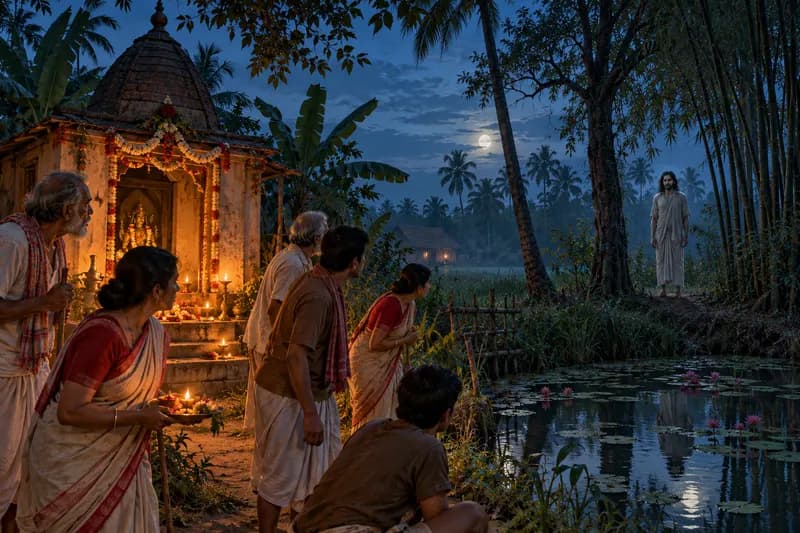
The Boba is not hunting you. It is not malicious. It is not even particularly aware of you. The Boba is a ghost trapped in its own silence — endlessly replaying the moment of its death, the words it never said, the scream that never left its throat. The silence it creates is not a weapon. It is a condition. The Boba does not bring silence to terrorize the living. The silence is simply what it is — the way heat is what fire is. You are not the target. You are just standing too close to something that cannot help what it does. The real horror of the Boba is not that it threatens you. It is that it has no idea you are there. It is alone in a way that no living person can comprehend — locked in permanent, absolute silence, unable to reach across the void to any other being, living or dead. The Boba is not the scariest ghost in Bengal. It is the saddest.
What Does the Boba Want?
The Boba wants to speak. That is all it has ever wanted.
It is the ghost of unspoken words — a confession that was never made, a warning that was never given, a truth that died with the person who carried it. Every manifestation of the Boba is an attempt to say the thing that was left unsaid. But it cannot. It is mute. The words are there, somewhere inside it, but they have no way out. The mouth does not move. The air does not vibrate. The silence holds.
This is why the Boba does not attack, does not chase, does not lure. It has no interest in the living as prey. It stands in the places where it died — or where the unsaid words were swallowed — and it tries, again and again, to break through the silence that defines it. It never succeeds.
If you could give the Boba what it wants — if you could somehow hear the unspoken words, receive the message that was never delivered — Bengali folklore suggests the ghost would dissolve. Not violently. Quietly. The way fog burns off in morning light. But no one has ever managed this, because the Boba cannot communicate what it needs to say. The cure requires the very thing the disease prevents.

You're Most at Risk If...
- You walk rural paths between villages after midnight
- You live near or travel through the Sundarbans fringe
- You are near canals, ponds, or flooded rice paddies at night
- You are in a location that is normally full of ambient sound — the contrast makes the Boba's silence impossible to miss
- You are alone — the Boba almost never appears to groups, only to solitary walkers
- You are carrying an unspoken secret or an undelivered message — folk belief holds the Boba is drawn to those who mirror its own condition
Offerings & Appeasement
| Offering | Purpose |
|---|---|
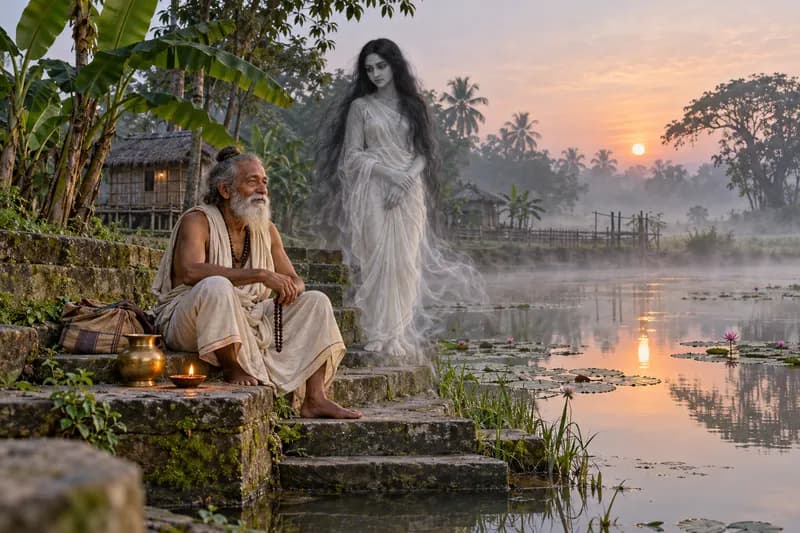
| No Traditional Offering | Unlike many Bengali spirits, the Boba has no established offering tradition. You cannot appease what does not acknowledge you. The Boba is not transactional — it does not bargain, does not accept gifts, does not respond to devotion. This is part of what makes it uniquely unsettling. |
| Speaking for the Dead | Some village traditions hold that if you know the identity of the person who became a Boba, speaking their unspoken truth aloud — confessing on their behalf, delivering their undelivered message — can release the spirit. This is not an offering. It is a completion. |
| Lighting a Lamp in Silence | In parts of rural Bengal, families light an oil lamp at the spot where a Boba has been seen, without speaking a word while doing so. The logic is sympathetic: meet the silence with silence, but add light. The lamp says what words cannot — 'I know you are here. I see you.' |
| The Unwritten Letter | A folk practice from the Nadia district: write a letter to the dead person the Boba once was, fold it, and bury it at the spot of the encounter. The letter should contain whatever you believe the person wanted to say. You give the Boba its voice on paper, since it cannot have one in the air. |

The Healer
Ojha (Bengali Folk Healer) — The village ojha is the first point of contact for any ghost encounter in Bengal. For a Boba, the ojha's role is identification — confirming that the silence was indeed a Boba and not another entity. The ojha may perform a small ritual at the site, but most will admit that the Boba is largely harmless and will advise avoidance rather than confrontation.
Gunin (Mantra Specialist) — A gunin who specializes in ghost-related mantras may be consulted if the Boba is appearing repeatedly at a location that cannot be avoided — a bridge, a well, a path that the village needs to use. The gunin's approach is typically to create a boundary, not to banish the spirit.
The Family Elder — Often the most effective 'healer' for a Boba situation is not a specialist but a village elder who knows the local history — who died at that spot, what they left unsaid, what message was never delivered. If the Boba can be identified, the unsaid thing can sometimes be reconstructed and spoken aloud.
The Honest Truth — Most Bengali folk practitioners will tell you the same thing: the Boba is not dangerous. It is disturbing, it is eerie, and it will frighten you badly. But it will not harm you. The best response to a Boba is the simplest one: walk away, wait for the silence to end, and do not go back to that spot at that hour.
What If You Dream of a Boba?
| Symbol | Meaning | |
|---|---|---|
| 🤐 | A Silent Figure Watching You | Something you need to say but have not said. A conversation you are avoiding, a confession you are postponing, a truth you are sitting on. The Boba in your dream is your own silence — and it is warning you that unspoken words do not disappear. They haunt. |
| 🔇 | A World Without Sound | Emotional isolation. You feel unheard in your waking life — your words are not reaching the people who need to hear them. The silence in the dream is not the ghost's. It is yours. Something is blocking your voice, and the dream is asking you to find out what. |
| 🌾 | Standing on a Path or Bridge in Silence | A transition you are stuck in. The path represents a journey — between one phase of life and another — and the silence means you have stopped moving. The Boba at the end of the bridge is the thing you must walk past to continue. It will not hurt you. But you must move. |
| 👂 | Trying to Hear Something That Is Not There | A message you are waiting for that will never arrive. Someone who owes you an explanation, an apology, a word of love — and who will never give it. The dream is telling you to stop waiting. The silence is the answer. |
The Boba in Art History
Bengali Pata Painting Tradition: The scroll-painting tradition of Bengal (patachitra) occasionally depicts mute spirits as featureless figures standing apart from scenes of village life. Unlike the vivid, expressive ghosts in other panels, the Boba-like figures are deliberately blank — no eyes, no mouth, no distinguishing marks. The absence of detail is the artistic statement.
Colonial-Era Ethnographic Illustrations: British colonial ethnographers in 19th-century Bengal documented ghost typologies that included the 'dumb ghost' or 'silent bhoot.' These accounts, preserved in journals of the Asiatic Society of Bengal, describe the Boba as a recognized category distinct from vocal spirits, though illustrations are rare — the Boba resists visual representation precisely because its defining feature is auditory.
Modern Bengali Literature and Film: The Boba appears as a motif in Bengali horror literature and cinema — most effectively in stories where the horror is built through the absence of a soundtrack rather than its presence. Directors like Anik Dutta and writers in the tradition of Satyajit Ray's ghost stories have used silence as a narrative weapon, drawing directly from Boba folklore.
The Artistic Challenge: The Boba poses a unique problem for visual art: how do you depict silence? Bengali artists have answered this with negative space — empty frames, missing mouths, figures drawn in outline only. The Boba is the ghost that cannot be fully rendered because its essence belongs to a sense that art cannot capture.

Cross-Regional Patterns
Boba Jinn · Petni · Shakchunni · Mechho Bhoot · Nishi
| Dawn as hard limit | Unclear — fades before dawn but no dramatic collapse |
| Iron weakness | Yes |
| Tree-dwelling | No |
| Counting compulsion | No |
| Backward feet | No |
Global Equivalent: The closest parallel is the Silent Monk ghost of English folklore — a spectral figure seen in abbeys and ruins that never speaks and vanishes if addressed. Japanese folklore has the Noppera-bo, the faceless ghost, which shares the Boba's emphasis on absence as horror. But neither has the Boba's signature environmental effect — the silencing of the world around it. The Boba is not just a quiet ghost. It is a ghost that makes the world quiet.
In Culture — Movies, Books, Games
| Type | Title | Description |
|---|---|---|
| Literature | Thakurmar Jhuli (Grandmother's Bag of Stories) | The foundational collection of Bengali folk tales, compiled by Dakshinaranjan Mitra Majumder in 1907. Contains references to various Bengali ghost types, including mute spirits. The Boba lives in the margins of these stories — present in the tradition but rarely given a starring role. |
| Literature | Bengali Ghost Stories — Various Authors | Rabindranath Tagore, Parashuram (Rajshekhar Basu), and later Satyajit Ray all wrote ghost stories that played with silence as a horror device. While none explicitly name the Boba, the tradition of the silent, watching ghost in Bengali literature is directly descended from Boba folklore. |
| Film | Bengali Horror Cinema | Bengali horror films occasionally feature silent ghost encounters that mirror Boba lore — scenes where the soundtrack drops out entirely, leaving the audience in the same oppressive silence the character experiences. This technique is more effective in cinema than any visual effect. |
| Television | Aahat / Fear Files (Hindi TV adaptations) | Anthology horror shows on Indian television have adapted Bengali ghost stories featuring silent spirits. These adaptations often add dialogue and screams to the Boba concept, fundamentally misunderstanding that the silence IS the horror. |
| Oral Tradition | Village Storytelling | The Boba's primary 'medium' remains oral tradition — stories told by grandmothers and village elders, always at night, always ending with a silence that the teller lets hang in the room. The Boba is a ghost that is best experienced in the telling, where the storyteller can weaponize real silence. |
ACCURACY RATING: FAITHFUL IN ORAL TRADITION · OFTEN MISREPRESENTED IN MEDIA

Is the Boba Still Real?
- Rural Bengal communities continue to distinguish the Boba from other ghost types. It is a recognized category — 'boba bhoot' is a phrase that carries specific meaning, not a generic term for any ghost.
- Villagers in the Sundarbans fringe and deltaic regions report encounters with 'silence zones' — spots where all ambient sound suddenly ceases. Whether attributed to the Boba or to natural phenomena, the folk explanation remains active.
- The practice of not speaking about ghosts after dark remains strong in Bengali households. With the Boba, this rule is taken especially seriously — you do not name the silent one in the silence of night.
- Urban Bengalis — in Kolkata, in the diaspora — often dismiss the Boba as superstition but will admit to knowing the rules. The folklore persists even when active belief fades, embedded in cultural memory and family storytelling traditions.
- No mass hysteria events associated with the Boba. Unlike some Bengali spirits, the Boba has never caused collective panic. Its horror is personal, individual, and quiet — which is exactly why it endures.
Expert & Academic Context
- Dakshinaranjan Mitra Majumder — Thakurmar Jhuli (1907) — The foundational compilation of Bengali folk tales, including ghost typologies and spirit classifications that form the basis of documented Bengali supernatural tradition.
- Asiatic Society of Bengal — Ethnographic Journals (19th century) — Colonial-era documentation of Bengali folk beliefs, including classifications of ghost types that distinguish the mute spirit from vocal haunters.
- Ghosts, Monsters and Demons of India — Rakesh Khanna — Modern comprehensive reference documenting regional ghost variants across India, including Bengali spirit taxonomy and the distinction between Boba and Boba Jinn.
- Satyajit Ray — Ghost Stories (various) — While not academic, Ray's stories represent the most sophisticated literary treatment of Bengali supernatural traditions, including the use of silence as a narrative and psychological horror device.
- Bengali Folklore Studies — Dinesh Chandra Sen — Early 20th-century academic documentation of Bengali folk traditions, including spirit beliefs, ritual practices, and regional variations in ghost lore across the Bengal delta.
The Boba occupies a unique position in Bengali ghost taxonomy: it is simultaneously one of the least dangerous and one of the most psychologically disturbing entities. Its low danger level belies its cultural impact — the Boba has shaped how Bengali people relate to silence itself. In a culture defined by verbal richness — by poetry, by song, by the tradition of adda (endless, passionate conversation) — a ghost that brings silence is an existential threat, not a physical one. The Boba challenges the Bengali relationship with language and expression at its root. It asks: what happens when the words stop? What is left when voice is taken away? The answer, according to the folklore, is the most human form of haunting — not violence, not revenge, but the unbearable weight of things left unsaid.
If You Encounter a Boba
Frequently Asked Questions
▶What is a Boba?
A Boba is a mute ghost from Bengali folklore — a spirit that never speaks and creates a zone of complete silence around itself. The word 'boba' means 'mute' in Bengali. It is the ghost of a person who died with something unsaid, and its defining characteristic is the total absence of sound.
▶Is a Boba dangerous?
The Boba has a low danger level. It does not attack, pursue, possess, or physically harm people. Its danger is psychological — the experience of being in total, unnatural silence is deeply disorienting and frightening, and some accounts describe lingering anxiety or sleep disturbances after an encounter. But the Boba itself does not intend harm.
▶What is the difference between a Boba and a Boba Jinn?
The Boba is a wandering mute ghost that silences the environment around it. The Boba Jinn is a sleep paralysis entity that sits on your chest at night and prevents you from speaking or moving. They share the 'mute' concept but are entirely different entities — the Boba haunts outdoor spaces; the Boba Jinn attacks in your bed.
▶How do you protect yourself from a Boba?
Carry iron (a key, a nail, anything metal). Do not try to speak to it. Walk away slowly — do not run. Wait for the ambient sound to return, which signals the Boba has moved on. Avoid the location at the same hour in the future. The Boba haunts places, not people.
▶Where is the Boba found?
Primarily in rural Bengal — West Bengal and Bangladesh. Strongest traditions come from the Sundarbans fringe, the Bengal delta, and rural areas with abundant ambient sound (rice paddies, canals, ponds). Rarely reported in cities or urban areas.
▶Can a Boba be freed?
Bengali folk tradition suggests that if you can discover what the Boba wanted to say in life — the unspoken confession, warning, or truth — and speak it aloud on the ghost's behalf, the spirit will dissolve. But since the Boba cannot communicate, identifying the unsaid words is nearly impossible. The cure requires the very thing the condition prevents.
Explore More
Related Spirits
Boba Jinn · Petni · Shakchunni · Mechho Bhoot · Nishi
Stories Are Being Summoned
One ghost story per week. Every Tuesday at midnight.