Bira
It doesn't haunt. It doesn't threaten. It stands behind your family like a wall — and whatever comes for them hits it first.
- What Is a Bira?
- Why the Bira Is Feared
- Origin — How It Came to Exist
- Appearance & Manifestation
- The Guardian of Majuli
- The Rules — How to Keep the Bira's Protection
- What They Don't Tell You
- What Does the Bira Want?
- You're Most at Risk If...
- Offerings & Renewal
- The Healer
- What If You Dream of a Bira?
- The Bira in Art & Material Culture
- Cross-Regional Patterns
- In Culture — Literature, Performance, Film
- Is the Bira Still Worshipped?
- Expert & Academic Context
- If You Have a Bira in Your Family
- Frequently Asked Questions
- Explore More
| Bira | |
|---|---|
| Also Known As | Bir, Bira Devata, Bir Gosain |
| Script | বীৰ (Assamese script) |
| Pronunciation | BEE-rah (বী-ৰ) |
| Region | Assam and Northeast India; strongest in rural Assamese communities of the Brahmaputra valley |
| Category | Heroic Ancestor Spirit / Protective Deity |
| Danger Level | Low |
| Fear Method | Withdrawal of protection, familial misfortune upon neglect |
| Warning Sign | Unexplained illness in family members, crop failure, livestock dying without cause — signs that the Bira has been offended or forgotten |
| First Documented | Assamese folk oral tradition (pre-literate period); references in colonial-era ethnographic surveys of Assam (19th century CE) |
| Still Believed? | Yes — actively worshipped in rural Assam; offerings made during Bihu festivals and at household shrines; belief integrated into daily agrarian life |
| Related | Pitr (Angry) · Naga Spirit · Thlen · Baak · Churigin · Ghoda Paak |
What Is a Bira?
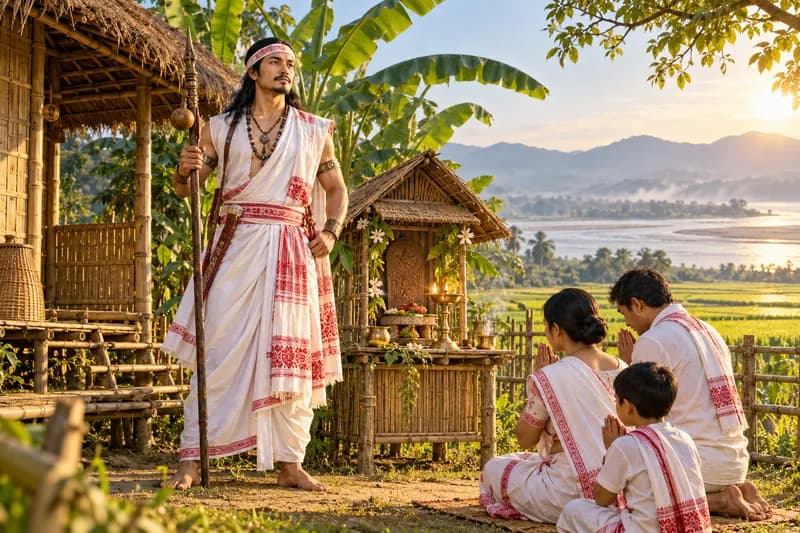
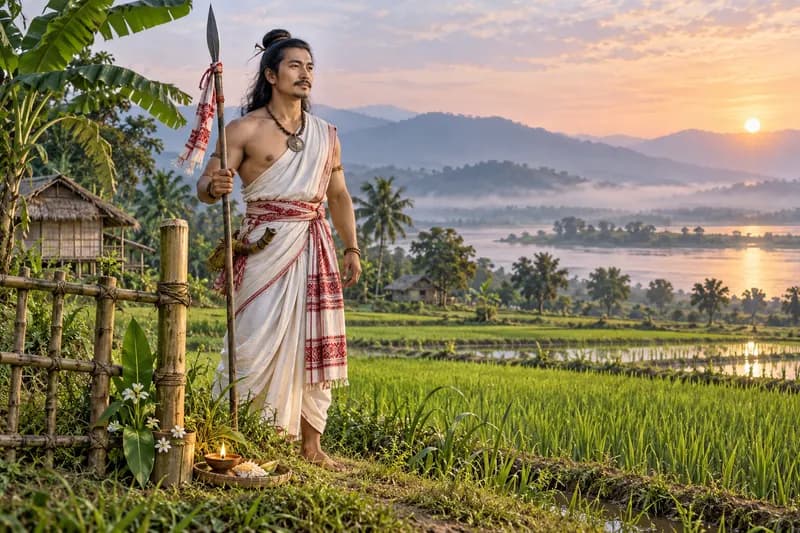
The Bira (বীৰ) is a heroic ancestor spirit from Assamese folk tradition — the elevated soul of a person who died bravely, sacrificially, or in service to their community. Unlike malevolent ghosts or demonic entities, the Bira is not something you fear finding in the dark. It is something you fear losing. It is a protector — a deified ancestor who watches over the family line, the village, the fields, and the livestock. In the folk cosmology of Assam and parts of Northeast India, the Bira occupies a space between the human dead and the divine: not quite a god, not quite a ghost, but something that carries the authority of both.
The Bira tradition is rooted in ancestor veneration — one of the oldest spiritual practices in human civilization. In Assamese villages, certain ancestors who demonstrated extraordinary courage, selflessness, or community service in life are elevated after death to the status of Bira. They are worshipped at household shrines and village altars, given offerings during the three Bihu festivals that mark the Assamese calendar, and consulted — through ritual intermediaries — in times of crisis. The Bira is not a haunting. It is a contract: honor the ancestor, and the ancestor honors you with protection.
Why the Bira Is Feared
INSTINCT EXPLOITED: ABANDONMENT OF THE PROTECTOR
The Bira is not terrifying in the way a Vetala or a Churel is terrifying. There is no corpse speaking riddles, no woman with reversed feet standing at the crossroads. The Bira's fear is quieter — and in some ways, worse.
It is the fear of the shield walking away.
Imagine this: your family has prospered for three generations. The rice grows tall. The cattle are healthy. The children do not sicken in the monsoon season. You have always known why — your grandfather told you, and his mother told him. There is a Bira watching. An ancestor who died defending the village from raiders two hundred years ago. His spirit stayed. He guards.
But you are modern now. You have moved to Guwahati. You have stopped making the offerings. You have not visited the village shrine since your father's funeral. The marigolds have dried. The oil lamp has gone cold. And slowly — so slowly you almost don't notice — things begin to go wrong.
Your sister's child is born weak. Your brother's business fails. Your mother falls ill and the doctors find nothing. It is not dramatic. It is not a horror movie. It is a slow withdrawal of something you never realized was holding your life together.
That is the fear of the Bira. Not that it will come for you — but that it will stop coming for you. That the ancestor who has been standing between your family and misfortune for generations will finally turn away, because you turned away first.
Origin — How It Came to Exist
The Elevation
A Bira is not born — it is made. When a person dies in a way that the community recognizes as heroic — defending the village, sacrificing themselves for family, dying in battle against invaders or wild animals — the community performs specific post-death rituals that elevate the departed soul from an ordinary ancestor to a Bira. This is not automatic. Not every brave death creates a Bira. The community must collectively acknowledge the sacrifice, and a ritual specialist (often a Bez or Deodhani) must perform the consecration that binds the spirit to its protective role.
The Ancestor Tradition
The Bira belongs to the broader ancestor veneration tradition found across Northeast India, Southeast Asia, and East Asia. In Assam, this tradition predates both Hinduism and the Ahom kingdom — it is part of the indigenous animist substrate that survived centuries of religious overlay. The Ahom people, who ruled Assam for 600 years, brought their own ancestor worship traditions from their Tai origins, which merged with existing Assamese practices to create the syncretic Bira tradition that exists today.
The Bihu Connection
The three Bihu festivals — Rongali Bihu (spring/April), Kongali Bihu (autumn/October), and Bhogali Bihu (winter/January) — are the primary occasions for Bira worship. During Bihu, families return to ancestral villages, clean and restore Bira shrines, make offerings of rice beer (laopani), betel nut (tamul), rice cakes (pitha), and fresh produce. The Bihu is not just a harvest festival — it is a renewal of the contract between the living and the protective dead.
What Makes a Bira
The criteria for elevation are consistent across Assamese folk tradition: the person must have died in service to others. A warrior who fell defending the village. A mother who died saving her children from a flood. A farmer who gave his last grain during famine and starved. The common thread is selflessness carried to the point of death. Selfish people, no matter how powerful, do not become Bira. Cowards do not become Bira. Only those whose death was a gift to the living earn the right to continue protecting them.
Regional Variants
Similar heroic ancestor spirits exist across Northeast India under different names — the Naga tribes have their own warrior-ancestor traditions, the Mizo have Thangchhuah spirits, and the Khasi have ancestor guardians in their matrilineal system. The Bira is specifically Assamese, but it belongs to a family of beliefs that spans the entire Northeast and connects to ancestor traditions across mainland Southeast Asia.
Appearance & Manifestation
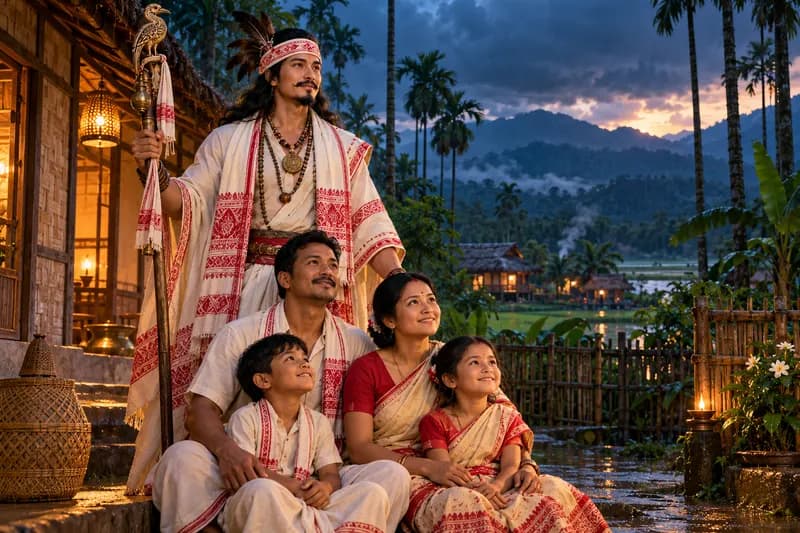
| 👁 Sight | The Bira is rarely seen. When it manifests visually — usually during possession rituals (Deodhani) — it appears as a tall, luminous figure in traditional Assamese warrior garb, sometimes carrying a dao (machete) or a shield. In dreams, it often appears as the specific ancestor it was in life, but younger, stronger, radiating calm authority. |
| 🔊 Sound | Not heard in the conventional sense. The Bira communicates through signs — a sudden gust of wind during prayer, the call of a specific bird at an auspicious moment, or through the voice of a Deodhani medium during trance. When the Bira is pleased, the sounds of the household are harmonious. When it is neglected, an unsettling silence settles over the home. |
| 🍃 Smell | The fragrance of fresh tamul (betel nut) and paan where none has been prepared. The scent of burning dhuna (resin incense) that seems to come from nowhere. In some accounts, the smell of freshly cooked rice — the ancestor remembering and being remembered through the most fundamental Assamese offering. |
| ❄ Temperature | A gentle warmth near the household shrine, even on cold winter mornings. Unlike malevolent entities that bring cold, the Bira's presence is associated with warmth — the warmth of a hearth, of a family gathered, of protection that radiates outward. When the Bira withdraws, that warmth disappears, and the house feels inexplicably cold. |
| 🌑 Time | Not bound to night. The Bira is present at all hours, but its presence is most strongly felt during dawn and dusk — the transitional hours when offerings are traditionally made. Most active during Bihu festival periods and during family crises when protection is needed most. |
| 🏚 Habitat | The household shrine (thaan) is its anchor. Also found at village boundary markers, large old trees (especially the bar tree — the Assamese banyan), and at the edges of rice paddies. The Bira does not haunt cremation grounds — it guards living spaces. |
The Guardian of Majuli
On the island of Majuli — the largest river island in the world, sitting in the middle of the Brahmaputra — there was a family that had farmed the same stretch of land for seven generations. The land was difficult. The Brahmaputra flooded every monsoon, eating away at the island's edges, swallowing fields and homesteads year by year. Majuli is shrinking. Everyone who lives there knows this. But the Borah family stayed.
They stayed because of Keshav Borah.
Keshav Borah died in 1943, during the great flood that took half the island's southern shore. He was not a warrior. He was a rice farmer — small, quiet, unremarkable in every way except one. When the floodwaters came that year, faster and higher than anyone expected, Keshav was the one who went back. Three times he crossed the surging water to pull children from the rooftops of submerging houses. Six children, from three different families. On his fourth crossing, the current took him. His body was found two days later, tangled in the roots of a bar tree downstream.
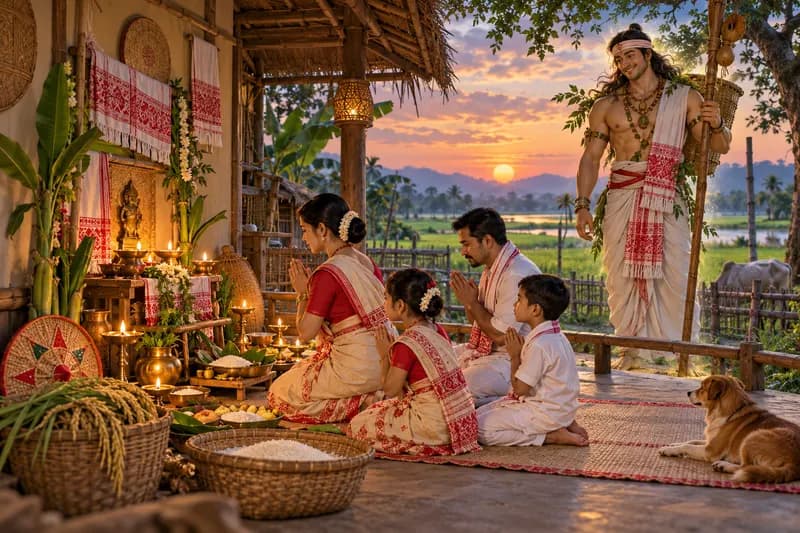
The village performed the rites. The Bez came from across the river and consecrated Keshav's spirit as a Bira. A small stone shrine was built at the edge of the Borah family's paddy, near the very spot where the bar tree had held his body. Marigolds were planted. An oil lamp was lit.
For eighty years, the Borah family tended that shrine. Every morning, Keshav's descendants lit the lamp, placed fresh tamul, and whispered: "Baba, we are here. Watch over us." And the land held. While other families lost fields to the river, while the island shrank around them, the Borah family's stretch of paddy remained. The floodwaters came every year, rose to the very edge of their embankment, and stopped. Every year. For eighty years.
In 2019, Keshav's great-great-grandson Dipankar left for Guwahati to study engineering. He was the first in the family to leave the island. He did not believe in the Bira. He told his mother it was superstition. The shrine was just stones and flowers. The floods stopped at their embankment because of soil composition, not a dead farmer's ghost.
Dipankar's mother said nothing. She continued lighting the lamp.
In 2022, the monsoon was the worst in decades. The Brahmaputra rose higher than anyone in living memory had seen. Fields that had never flooded were underwater. The Borah family's embankment held — barely. The water came to within inches of the top. But it held.
Dipankar came home that monsoon to help his mother. He stood at the embankment and watched the brown water press against it, impossibly close to spilling over, and felt something he could not explain. Not fear. Not relief. Something older. A presence behind him. Warmth on the back of his neck on a cold, rain-soaked day.
He did not turn around. He did not need to. He walked to the shrine, cleaned the mud from the stones, placed fresh marigolds, and lit the lamp. He whispered what his mother had taught him, what her mother had taught her, what seven generations had whispered in that exact spot: "Baba, we are here. Watch over us."
The embankment held.

The Rules — How to Keep the Bira's Protection
⚠ IMPORTANT ⚠
Seven rules for maintaining the ancestral contract
- Tend the shrine. Every day, without exception. — The Bira's protection is not unconditional. It is a relationship, maintained through daily acknowledgment — lighting the lamp, placing the offering, speaking the words. Neglect the shrine, and you signal that the contract is void.
- Return for Bihu. Always. — The three Bihu festivals are the renewal points. Missing Bihu offerings at the ancestral shrine is the single most serious breach of the Bira contract. No matter where you live, no matter how far you have gone — return for Bihu, or send someone who can make the offering in your name.
- Never speak disrespectfully of the ancestor. — The Bira was once human. It remembers. Mocking the ancestor's sacrifice, dismissing their death as meaningless, or speaking ill of them in the presence of the shrine is a direct insult that can cause the Bira to withdraw protection.
- Name your children after the ancestor. — In Assamese Bira tradition, naming a child after the deified ancestor is a way of strengthening the bond between the living and the protective dead. The name carries the connection forward. It tells the Bira: your line continues, your sacrifice is remembered.
- Share your harvest. The Bira protects communities, not hoarders. — The Bira became what it is through selflessness. If the family it protects becomes selfish — hoarding grain while neighbors starve, refusing hospitality — the Bira's values are violated. Generosity maintains the contract. Greed dissolves it.
- When illness or misfortune strikes, consult the Bez before a doctor. — Not because the Bez replaces medicine — but because unexplained illness in a family with a Bira tradition may signal that the ancestor is displeased. The Bez can identify what has been neglected and prescribe the ritual correction. Treat the spiritual breach and the medical condition simultaneously.
- If you leave the ancestral village, take a stone from the shrine. — Migration is the greatest threat to Bira traditions. When families leave for cities, the shrine is abandoned. Taking a consecrated stone from the shrine and establishing a small altar in your new home maintains the connection. The Bira follows the stone. The protection travels with you.
What They Don't Tell You
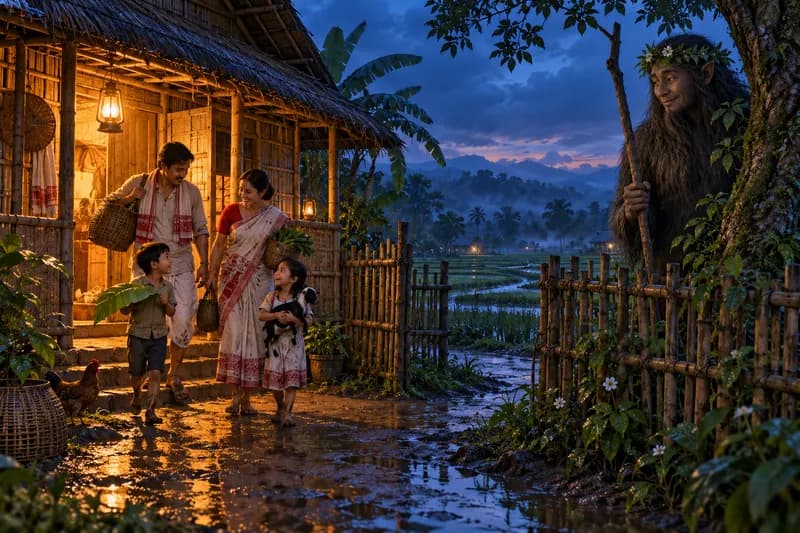
The Bira is not a ghost. It never was. It is the Assamese answer to the oldest question in human civilization: what do we owe the dead who gave everything for us? The answer, in Assam, is simple and profound — we owe them memory. We owe them the lamp and the flower and the whispered name. We owe them the knowledge that their sacrifice was not wasted. The Bira is not supernatural protection. It is the weight of obligation made sacred — the understanding that a family that remembers its heroes will behave like people worth protecting. The shrine does not keep the floodwaters out. The shrine keeps the family together. And a family that stays together weathers every flood.
What Does the Bira Want?
The Bira wants to be remembered. That is all. That is everything.
It does not want blood. It does not want fear. It does not want elaborate rituals or expensive offerings. It wants a lamp lit every morning. It wants marigolds that are replaced before they brown. It wants its name spoken aloud by the people it died for — or by their children, or their children's children.
The Bira's motivation is the most human thing in this entire database: it wants its sacrifice to have meant something. It gave its life for the community, and in return, it asks only that the community not forget. The offerings are not payment. They are proof that the story is still being told.
When the Bira withdraws its protection — when the crops fail, when the children sicken, when the livestock die — it is not punishment. It is grief. The ancestor, forgotten, has no reason to stay. And without the Bira's watchful presence, the family is exposed to the ordinary cruelties of the world that the ancestor had been absorbing on their behalf.
You're Most at Risk If...
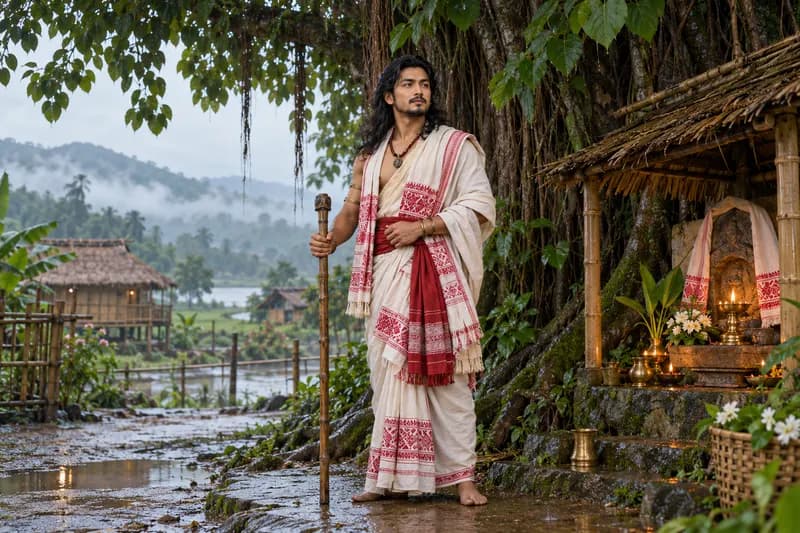
- You have stopped tending the ancestral shrine
- You have missed Bihu offerings for more than one year
- You have spoken dismissively about the ancestor or their sacrifice
- You have migrated to a city without bringing a stone from the shrine
- You have refused hospitality or hoarded resources while neighbors suffered
- You are the last living member of the family line — if the name dies, the Bira has no one left to protect
Offerings & Renewal
| Offering | Purpose |
|---|---|
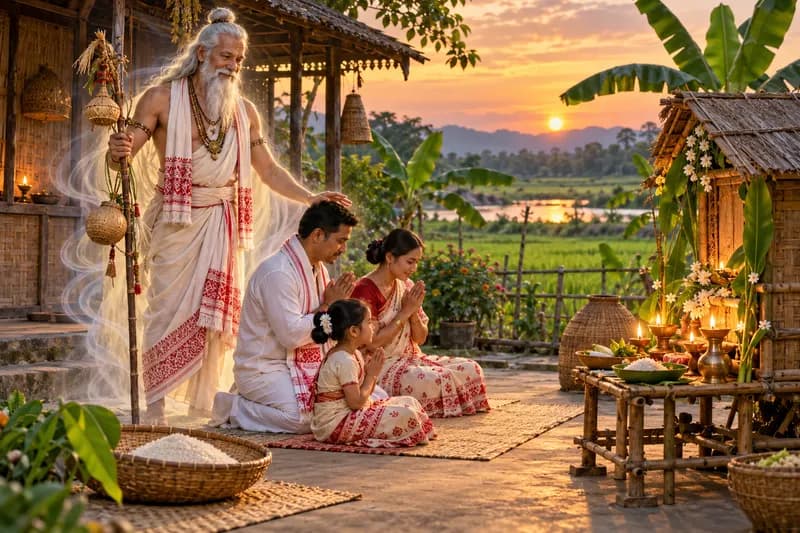
| Daily Offering | An oil lamp (saki) and fresh tamul-paan (betel nut and leaf) placed at the household shrine every morning at dawn. This is the minimum — the daily renewal of the contract. Some families add a small portion of the morning rice. |
| Bihu Offering | During each Bihu festival: laopani (rice beer), pitha (rice cakes), fresh seasonal fruits, new marigolds, and a freshly woven gamosa (traditional Assamese cloth) draped over the shrine. The gamosa is key — it is a symbol of respect in Assamese culture, and offering one to the Bira is the highest honor. |
| Crisis Offering | When illness or misfortune strikes and the Bez determines the Bira is displeased: a special ceremony involving the sacrifice of a pigeon or chicken, preparation of a feast that is shared with the entire community, and a night-long vigil at the shrine with continuous lamp-burning and recitation of the ancestor's story. |
| The Name Offering | The most powerful offering requires no materials at all. It is the act of speaking the ancestor's name and story to the next generation. Telling the children who the Bira was, what they did, how they died. The story is the offering. Memory is the currency. |
The Healer
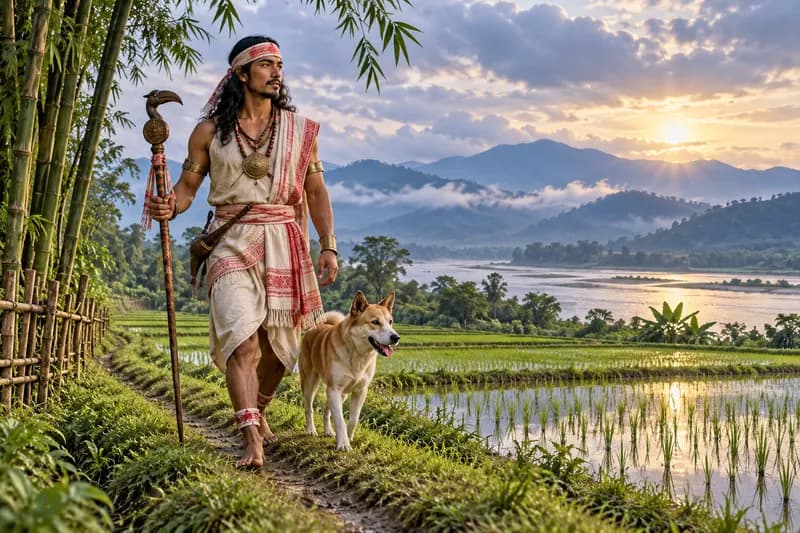
Bez (Traditional Assamese Healer) — The Bez is the primary ritual specialist for Bira-related matters. They diagnose whether unexplained misfortune is connected to an offended ancestor, prescribe the specific offerings needed, and perform the rituals to re-establish the protective bond. The Bez works with herbs, mantras, and direct communication with the spirit world.
Deodhani (Spirit Medium) — The Deodhani enters a trance state during which the Bira speaks through them. This is the most direct form of communication with the ancestor — the Deodhani becomes the vessel through which the Bira's grievances, instructions, or warnings are transmitted to the family. Deodhani rituals are often performed during Bihu or during crises.
Ojha (Folk Exorcist) — Called only when the situation has deteriorated badly — when the family has been neglectful for years and the Bira's withdrawal has invited other, malevolent entities to fill the vacuum. The Ojha clears the malevolent presences first, then the Bez restores the Bira connection. They work in sequence, not in conflict.
The Elder — In many cases, the best healer is the oldest living family member who still remembers the rituals. Grandmothers who kept the lamp burning. Uncles who know the ancestor's story by heart. The knowledge is in the family. The specialist is called when the family's own memory has failed.
What If You Dream of a Bira?
| Symbol | Meaning | |
|---|---|---|
| 🛡 | An Ancestor Standing Guard | Reassurance. The Bira is telling you it is present and active. This dream often comes during times of anxiety or transition — a new job, a move, a health scare. The ancestor is saying: I am still here. You are not alone. |
| 😔 | An Ancestor Turning Away | A warning. Something has been neglected — the shrine, the offerings, the family bonds. The Bira is showing you what happens if you continue on this path. This dream demands action: return to the shrine, make the offerings, restore what has been broken. |
| 🔥 | A Lamp Going Out | The connection is weakening. The contract between the living and the protective dead is fraying. This dream is urgent — it means the Bira's protection is fading. Light a real lamp. Make a real offering. Do it soon. |
| 🌾 | An Ancestor in a Rice Field | Prosperity is coming — or prosperity needs to be protected. The rice field is the center of Assamese life, and the Bira standing in it means the foundation is secure. But it also means: tend your foundations. Do not take the harvest for granted. |
The Bira in Art & Material Culture
Pre-Ahom Period — Stone Shrines: The oldest Bira shrines are simple arrangements of river stones at the edges of paddy fields or at village boundaries. Uncarved, undecorated — their power comes not from artistry but from the generations of offerings that have consecrated them. Some surviving shrines in Upper Assam are estimated to be several hundred years old.
Ahom Period (13th–19th Century) — Syncretic Icons: As the Ahom dynasty integrated with Assamese culture, Bira representations absorbed elements of both Tai ancestor worship and Hindu iconography. Some Bira shrines from this period feature carved stone figures in warrior poses, blending Ahom military aesthetic with Hindu devotional forms.
Bihu Festival Art — Living Tradition: During Bihu celebrations, temporary art installations honoring Bira ancestors appear across rural Assam — decorated bamboo structures, painted clay figures, and elaborate floral arrangements at village shrines. These are not preserved in museums. They are made, used, and remade every season.
Deodhani Dance — Performance as Art: The Deodhani dance, performed during possession rituals where the Bira speaks through a medium, is itself a form of embodied art — one of the oldest performance traditions in Assam. The dancer's movements, costumes, and vocalizations are the Bira made visible. This tradition has been recognized by cultural preservation bodies as an endangered intangible heritage.
Cross-Regional Patterns
Pitr (Angry) · Naga Spirit · Thlen · Baak · Churigin · Ghoda Paak · Jokhini · Khongjaom War Ghosts
| Dawn as hard limit | No — present at all hours |
| Iron weakness | No |
| Tree-dwelling | Sometimes — bar trees near shrines |
| Counting compulsion | No |
| Backward feet | No |
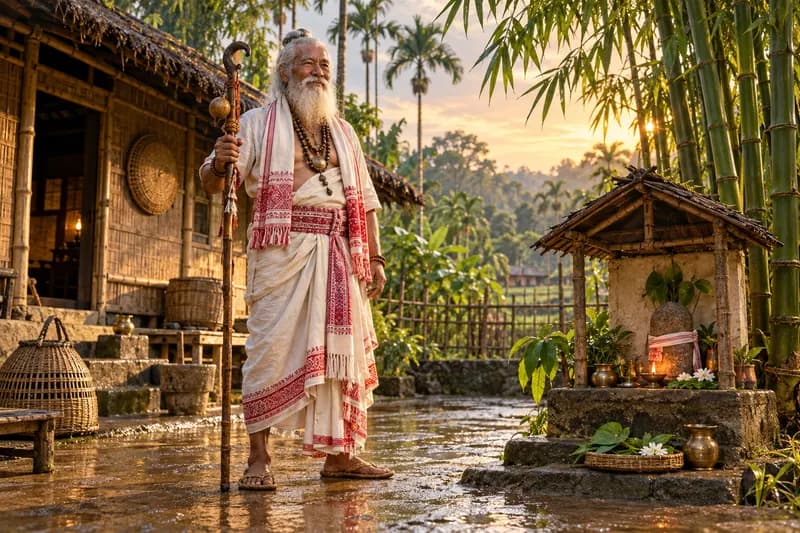
Global Equivalent: The closest global parallel is the Roman Lares — household guardian spirits of deified ancestors who protected the family and home. Like the Bira, Lares required daily offerings at a household shrine (lararium), were honored during specific festivals, and would withdraw protection if neglected. The Japanese concept of ancestral kami in Shinto also closely parallels the Bira tradition — ancestors elevated to protective spiritual status through proper ritual and sustained remembrance.
In Culture — Literature, Performance, Film
| Type | Title | Description |
|---|---|---|
| Literature | Assamese Folk Tales (various collections) | Multiple collections of Assamese folk stories feature Bira ancestors intervening to save families from floods, tiger attacks, and enemy raids. These are told as true accounts, not fiction — the storyteller often names the specific village and family involved. |
| Performance | Deodhani Nritya (Possession Dance) | The Deodhani dance tradition, performed at the Manasa temple in Assam and at village ceremonies, includes sequences where the dancer is possessed by a Bira spirit. This is simultaneously religious ritual, theatrical performance, and community healing. |
| Film | Assamese Art Cinema | Several Assamese art films have explored the tension between urban migration and ancestral obligation — characters who leave the village and lose the Bira's protection, only to return and rediscover faith. Directors like Jahnu Barua and Bhabendranath Saikia have touched on these themes. |
| Music | Bihu Songs (Bihu Geet) | Traditional Bihu songs frequently reference ancestral protection and the obligation to remember the dead. The Bira tradition is woven into the musical fabric of Assam's most important cultural celebration. |
| Reference | Ethnographic Surveys of Assam (Colonial & Post-colonial) | British colonial officers and later Indian anthropologists documented Bira worship as part of broader surveys of Assamese folk religion. These accounts provide the earliest written records of a tradition that had existed in oral form for centuries. |
ACCURACY RATING: FAITHFUL IN ETHNOGRAPHIC SOURCES · UNDERREPRESENTED IN MAINSTREAM MEDIA
Is the Bira Still Worshipped?
- Actively worshipped across rural Assam. Bira shrines are maintained at household compounds and village boundaries throughout the Brahmaputra valley. This is not a dying tradition — in many communities, it is as integral as temple worship.
- Bihu festivals remain the primary occasion for Bira veneration. Families who have migrated to cities often return specifically to make ancestral offerings — the shrine is a gravitational center that pulls the diaspora home.
- The Deodhani tradition — spirit possession by Bira ancestors — continues to be practiced, though it faces pressure from both modernization and organized Hindu reform movements that view it as superstition.
- Urban Assamese families increasingly maintain small Bira altars in their city apartments — a consecrated stone from the ancestral shrine, a lamp, a photograph of the elder who maintained the tradition. The practice adapts to survive.
- Climate change and the Brahmaputra's increasing flood severity have, paradoxically, strengthened Bira belief in some communities. As the river takes more land, the families whose fields survive attribute their fortune to ancestral protection. The worse things get, the more the Bira matters.
Expert & Academic Context
- Assamese Folk Religion — Ethnographic Studies — Academic surveys of Assamese folk religious practices document the Bira tradition as a living example of ancestor veneration integrated with agrarian life cycles. These studies distinguish Bira worship from both mainstream Hinduism and tribal animism, placing it in a syncretic category.
- Colonial-era Surveys of Assam (19th Century) — British administrators and ethnographers recorded Bira worship as part of broader documentation of Assamese society. These accounts, while filtered through colonial perspectives, provide the earliest written descriptions of shrine practices, Bihu offerings, and the role of the Bez.
- Ahom Chronicles (Buranjis) — The Ahom historical chronicles contain references to ancestor veneration practices that parallel and predate the Assamese Bira tradition, suggesting a convergence of indigenous Assamese and Tai-Ahom ancestor worship traditions.
- Studies on Northeast Indian Folk Traditions — Comparative studies of ancestor worship across Northeast India — including Naga, Mizo, Khasi, and Assamese traditions — reveal a shared substrate of heroic ancestor veneration that predates the arrival of organized religion in the region.
- Bihu Festival Documentation — Cultural documentation of the three Bihu festivals includes detailed descriptions of the ancestral worship components — offerings, shrine rituals, Deodhani performances — that constitute the primary framework for Bira veneration in contemporary Assam.
The Bira represents something fundamentally different from most entities in the Indian supernatural tradition. Where the Churel, Vetala, and Pishacha embody fears — of death, of injustice, of the unknown — the Bira embodies gratitude. It is the spiritual infrastructure of a community that refuses to forget its heroes. In a region defined by the Brahmaputra's unpredictable floods, where entire villages can be swept away in a single monsoon, the Bira tradition serves a crucial social function: it binds families to land, binds generations to each other, and transforms the terrifying randomness of natural disaster into a narrative of protection and reciprocity. The Bira does not explain why bad things happen. It explains why your family survived when others did not — and reminds you that survival comes with obligations.
If You Have a Bira in Your Family
Frequently Asked Questions
▶What is a Bira?
A Bira is a heroic ancestor spirit in Assamese folk tradition — the deified soul of a person who died bravely or selflessly in service to their family or community. Unlike malevolent ghosts, the Bira is a protector. It watches over the family line, guards the homestead, and shields the community from misfortune. It is worshipped at household shrines and village altars, especially during Bihu festivals.
▶Is the Bira dangerous?
The Bira itself is not dangerous — it is a guardian. The danger comes from neglecting it. When a family stops making offerings, abandons the ancestral shrine, or forgets the ancestor's sacrifice, the Bira withdraws its protection. Without that protection, the family becomes vulnerable to ordinary misfortune — illness, crop failure, financial ruin. The Bira does not attack. It simply stops defending.
▶How do you worship a Bira?
Daily offerings of an oil lamp and betel nut at the household shrine. During Bihu festivals, more elaborate offerings: rice beer, rice cakes, seasonal fruits, and a fresh gamosa draped over the shrine. The most important offering is the act of remembrance — telling the ancestor's story to the next generation, speaking their name, keeping their sacrifice alive in family memory.
▶Can anyone become a Bira after death?
No. Only those who die heroically or selflessly — in defense of family, in service to community, in sacrifice for others. The community must collectively acknowledge the sacrifice, and a ritual specialist (Bez or Deodhani) must perform the consecration that elevates the spirit to Bira status. Ordinary deaths, no matter how mourned, do not create Bira.
▶What is the connection between Bira and Bihu?
The three Bihu festivals are the primary occasions for Bira worship. Bihu marks the agricultural cycle — planting, growing, harvesting — and the Bira is intimately connected to the land's fertility and the family's prosperity. Bihu offerings at the Bira shrine renew the protective contract for another season. Missing Bihu is the most serious breach of the ancestral bond.
▶Do people still believe in Bira?
Yes, actively. Bira shrines are maintained across rural Assam. Urban migrants maintain small altars in their apartments. The Deodhani possession tradition continues. Climate pressures on the Brahmaputra valley have in some communities strengthened Bira belief, as families attribute their survival to ancestral protection.
Explore More
Related Spirits
Pitr (Angry) · Naga Spirit · Thlen · Baak · Churigin · Ghoda Paak · Jokhini · Khongjaom War Ghosts
Stories Are Being Summoned
One ghost story per week. Every Tuesday at midnight.