Baak
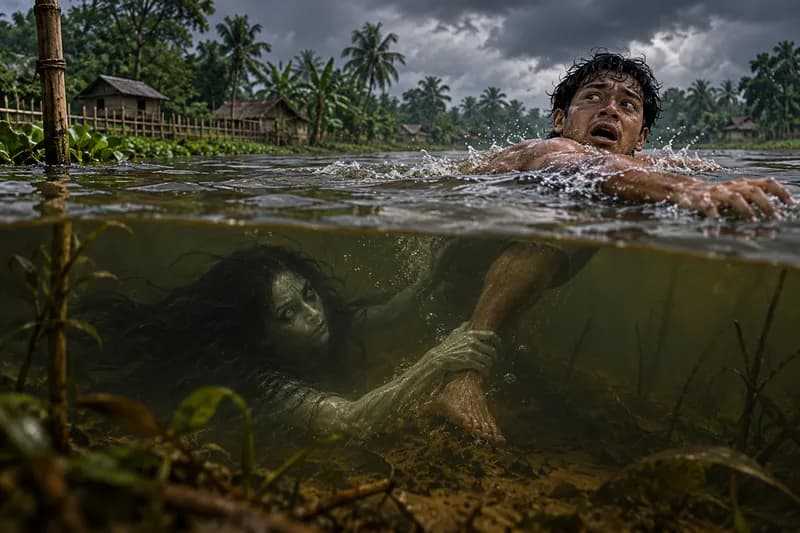
It doesn't chase you on land. It waits where the water is deepest — and when you swim out far enough, something wraps around your ankle and pulls you under.
- What Is a Baak?
- Why the Baak Is Terrifying
- Origin — How It Came to Exist
- Appearance & Manifestation
- The Pond Behind Rupahi's House
- The Rules — How to Survive
- What They Don't Tell You
- What Does the Baak Want?
- You're Most at Risk If...
- Offerings & Appeasement
- The Healer
- What If You Dream of a Baak?
- The Baak in Art History
- Cross-Regional Patterns
- In Culture — Movies, Books, Games
- Is the Baak Still Real?
- Expert & Academic Context
- If You Encounter a Baak
- Frequently Asked Questions
- Explore More
| Baak | |
|---|---|
| Also Known As | Bak, Baak Bhoot, Jol Bhoot (Water Ghost) |
| Script | বাক (Assamese script) |
| Pronunciation | BAAK (বাক) — rhymes with 'dark' |
| Region | Assam; concentrated along the Brahmaputra river system, floodplain wetlands, and monsoon-fed ponds |
| Category | Water Spirit / Drowning Entity |
| Danger Level | Dangerous |
| Fear Method | Drowning by ambush, underwater entrapment, current manipulation |
| Warning Sign | Unexplained ripples in still water; a sudden cold current around your legs; the sound of splashing where no one is swimming |
| First Documented | Assamese oral tradition (pre-colonial); referenced in Buranjis (Ahom-era chronicles) and regional folk compilations |
| Still Believed? | Yes — fishermen along the Brahmaputra still avoid certain river bends after dark; monsoon drownings are frequently attributed to the Baak in rural Assam |
| Related | Pari · Bira · Pishaach · Kichkandi · Thlen · Churigin |
What Is a Baak?
The Baak (বাক) is a water spirit from Assamese folklore that lurks in rivers, ponds, marshes, and flooded fields across the Brahmaputra river system. It is the ghost of a person who drowned — and it remains trapped in the water where it died, unable to leave until it claims another life to take its place. The Baak is not a wandering spirit. It is anchored. It belongs to a specific body of water, and that body of water becomes its territory, its hunting ground, and its prison.
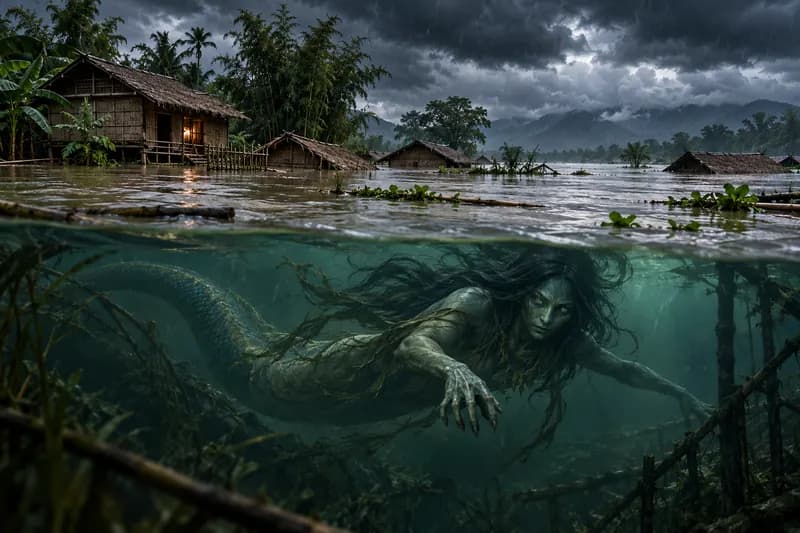
What makes the Baak uniquely terrifying among Indian water entities is its method: it does not lure, seduce, or trick. It simply grabs. A swimmer enters water that looks calm, wades out past their depth, and feels something seize their leg — a grip from below, cold and absolute. The Baak pulls its victim under with a force that no amount of thrashing can overcome. In a land defined by the Brahmaputra's annual floods, where water is everywhere and unavoidable, the Baak represents the ever-present danger that lives just beneath the surface.
Why the Baak Is Terrifying
INSTINCT EXPLOITED: THE HELPLESSNESS OF WATER
You know how to swim. You've swum in this pond a hundred times. The monsoon has raised the water level — it's deeper than usual, murkier, the color of tea — but it's the same pond. You wade in. The water reaches your chest. You push off and start swimming toward the far bank.
Halfway across, something touches your foot.
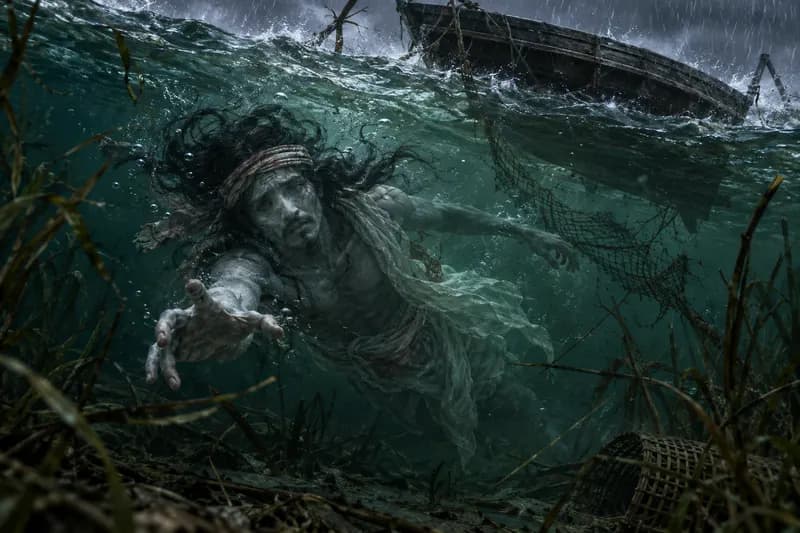
Not a fish. Not a weed. A hand. Five fingers closing around your ankle with a grip that feels like iron wrapped in cold flesh. You kick. The grip tightens. You try to swim forward. The pull comes from below — straight down, not sideways, not with any current. Down.
Your head goes under. You surface, gasping, thrashing. For one second you see the bank — twenty feet away, close enough to shout to, close enough that someone standing there could almost reach you with a bamboo pole. Then the pull comes again. Harder. Your mouth fills with water the color of rust.
The people on the bank see you go under. They see you come up once. They see you go under again. They do not see you come up a second time. Later, they will say what their grandparents said and their grandparents before them: the Baak took another one.
This is the horror of the Baak. There is no negotiation, no riddle, no warning voice in the dark. There is water, and something in it that wants you to drown — because the only way it can leave is if you take its place.
Origin — How It Came to Exist
The Creation
A Baak is created every time a person drowns. The spirit of the drowned person does not pass on — it remains trapped in the exact body of water where death occurred. It cannot leave. It cannot move to another river or pond. It is bound to the site of its drowning, condemned to exist in the cold dark below the surface until it can find a replacement. This is not a punishment for sin or a consequence of karma. It is simply the rule: drowning creates a Baak, and a Baak must drown someone else to be released.
The Replacement Cycle
The central mechanic of Baak mythology is replacement. When a Baak successfully drowns a new victim, the Baak's spirit is released — it can finally move on, leave the water, find whatever afterlife awaits. But the newly drowned person now becomes the Baak. The cycle never ends. Every body of water where someone has drowned contains a Baak waiting for its replacement. This creates a grim arithmetic: every drowning in Assam both frees one spirit and traps another.
The Brahmaputra Connection
The Brahmaputra — one of the world's largest rivers — floods catastrophically every monsoon season, swallowing villages, fields, and roads. Historically, dozens to hundreds of people drown each monsoon. In Assamese folk belief, every one of those drownings creates a new Baak. The river is not just geographically central to Assam — it is the single largest source of Baak in the folklore. The Brahmaputra is, in this tradition, a river full of the trapped dead.
Why Water Holds Spirits
Across Assamese folk belief, water is understood as a liminal substance — neither fully of this world nor fully of the next. Bodies consigned to water (rather than properly cremated or buried) remain in transition. The Baak tradition reflects a deeper cultural logic: that water death is incomplete death. Without fire (cremation) or earth (burial), the spirit has no passage. It stays where it fell, in the water, between worlds.
Monsoon as Catalyst
The Baak is most dangerous during the monsoon — June through September — when the Brahmaputra and its tributaries swell, floodwaters cover the plains, and the boundary between safe ground and deadly water becomes impossible to see. Submerged ditches, hidden currents, flooded ponds that were ankle-deep a week ago and are now fifteen feet deep — monsoon Assam is a landscape where the Baak's territory expands by the hour. The folklore is, in this sense, a survival map: every Baak story is a warning about where the water will kill you.

Appearance & Manifestation
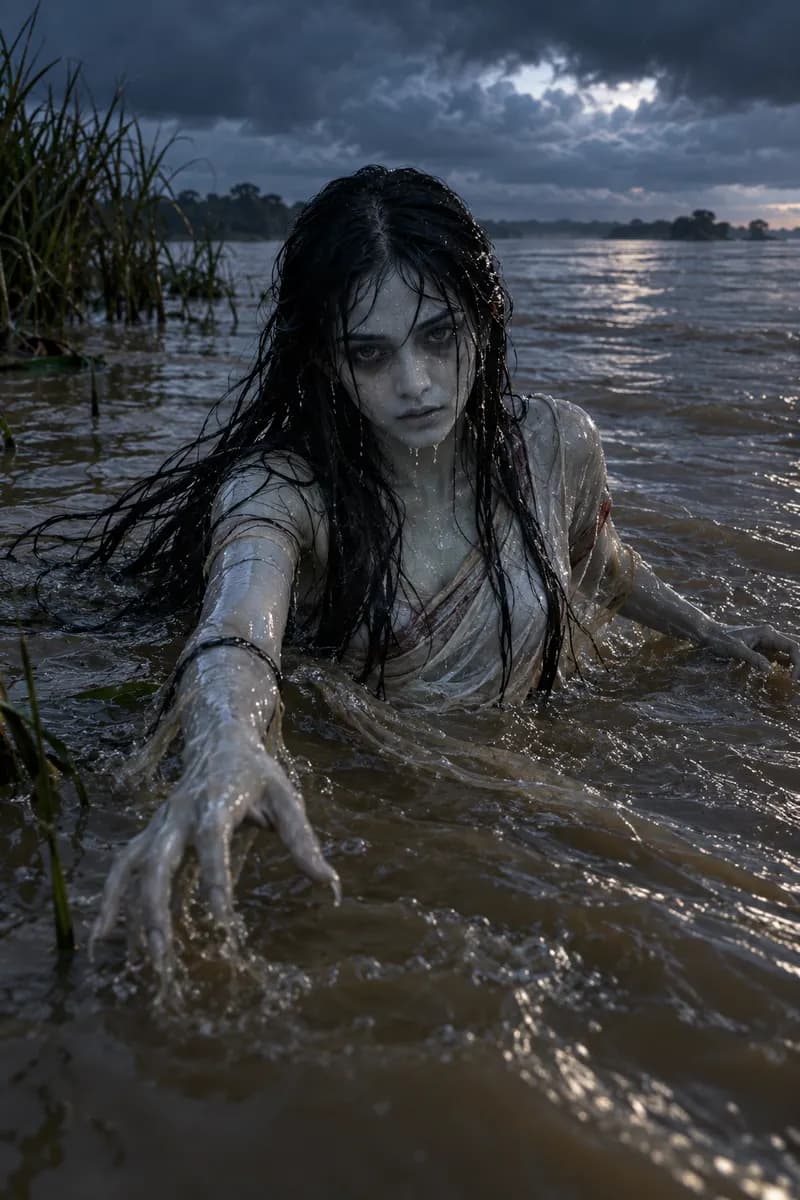
| 👁 Sight | The Baak is rarely seen clearly. In some accounts, a dark shape is visible just below the surface — humanoid, bloated, with limbs that move against the current. Occasionally, a face is glimpsed in murky water, pale and distorted, with eyes that are open but vacant. Most victims never see it at all. They only feel the grip. |
| 🔊 Sound | The sound of splashing where no one is swimming. A gurgling noise from beneath the surface, like someone trying to speak underwater. Some accounts describe a voice calling from the water — a familiar voice, a name spoken once — but this may be confusion with other Assamese spirits. The Baak's primary sound is silence: the sudden, terrible quiet after a swimmer goes under and does not come back up. |
| 🍃 Smell | Stagnant water, river mud, decomposing vegetation. The specific smell of Brahmaputra floodwater — silty, organic, carrying the scent of a hundred miles of riverbank. Near a Baak's territory, the water smells heavier than it should, as if something organic is dissolving in it. |
| ❄ Temperature | The defining sensory marker. A sudden, sharp cold around the legs or feet — even in warm monsoon water. The cold comes from below, from the exact spot where the Baak waits. Fishermen describe it as a cold current that wraps around the ankle like a bracelet, distinct and localized, not a general chill. |
| 🌑 Time | Most dangerous during monsoon season (June–September) when water levels are highest and visibility is zero. Active at all hours, but attacks peak at dusk and dawn when light on the water makes depth impossible to judge. Also dangerous during the full moon, when the reflected light tempts swimmers into water they would otherwise avoid. |
| 🏚 Habitat | Rivers (especially the Brahmaputra and its tributaries), monsoon-flooded ponds, beels (oxbow lakes), marshes, submerged rice paddies, and any body of water where a drowning has occurred. The Baak does not move between water bodies. It stays where it died. A pond that has taken a life is a pond that has a Baak — permanently, until the cycle completes. |
The Pond Behind Rupahi's House
There was a pond behind Rupahi's house in a village near Nagaon, on the south bank of the Brahmaputra. The pond had been there longer than the house, longer than the village road, longer than anyone's memory. It was fed by monsoon runoff and never fully dried — even in winter, it held four or five feet of dark water, thick with lotus stems and water hyacinth.
Rupahi's grandmother called it the quiet pond. Not because it was peaceful, but because it was the kind of quiet that meant something was listening. She told Rupahi three things about the pond: never swim in it alone, never swim in it after dark, and never swim in it during monsoon. Rupahi's grandmother did not explain why. She did not need to. Everyone in the village knew about the boy who had drowned there in 1987.
The boy — Bhaskar, the mason's son — had been twelve years old. He had jumped into the pond on a July afternoon, the way boys did every summer. The water was high from two weeks of rain. He went under and did not come up. Three men went in after him. They found his body at the bottom, tangled in lotus roots, his face turned downward into the mud. The roots, they said later, were wrapped around his ankles. Not loosely, the way plants drift. Tightly. As if something had held him there.
After Bhaskar drowned, the pond changed — or the village's relationship with the pond changed. Women stopped washing clothes at its edge during monsoon. Children were forbidden from going near it without an adult. The fisherman who used to net small fish from it stopped going. Nobody said the word Baak. They said "the quiet pond" and left the rest unsaid.
Rupahi was nineteen when she came home from Guwahati for the Bihu holidays. It was mid-June. The monsoon had started early — the pond was swollen, lapping at the bamboo fence her father had built to keep goats out. She was sitting on the veranda in the afternoon heat when she saw something that made her stop breathing.
A ripple. Not a fish ripple — fish ripples come and go. This was a single, slow, deliberate ripple that started at the center of the pond and moved outward in a perfect circle. As if someone had surfaced, just for a moment, and then sunk back down. The water hyacinth around the edges trembled.
Rupahi watched for ten minutes. The ripple did not come again. The pond was still — the kind of still that her grandmother had warned her about. She went inside and closed the door. That night, lying in her old room with the window open, she heard it: a single splash from the direction of the pond. Not loud. Not repeated. Just one splash, as if a hand had broken the surface and pulled back under.
She did not go near the pond for the rest of her visit. When she left for Guwahati, her father was standing at the bus stop. She asked him, for the first time, about Bhaskar. Her father looked at the ground and said, quietly, that Bhaskar was not the first. There had been a woman before him — a grandmother, years earlier, who had slipped on the bank during a flood. And before her, a farmer's boy from the British time.
"How many?" Rupahi asked. Her father shook his head. "The pond has always been here," he said. "It has always been quiet." He did not say more. He did not need to. The Baak was patient. The Baak had always been patient. It was still down there, in the dark water, in the lotus roots, waiting for the next person who forgot the rules.
The Rules — How to Survive
☠ WARNING ☠
Seven rules for surviving a Baak encounter
- Never swim alone in any natural body of water where a drowning has occurred. — The Baak is anchored to the site of its death. A history of drowning is the only warning you will ever get. If someone has drowned there before, a Baak is waiting.
- Avoid rivers and ponds during monsoon, especially at dusk and dawn. — The Baak is strongest when water levels are high and visibility is low. Monsoon floodwater is its element — murky, deep, and impossible to read. Dusk and dawn rob you of the ability to judge depth.
- If you feel a sudden cold grip around your ankle or foot — do not thrash. Go limp. — Thrashing drives you deeper. Folk tradition holds that the Baak's grip weakens when the victim stops struggling — it feeds on panic, on the energy of fear. Going limp may give you a moment to surface.
- Carry iron when crossing water. A nail, a key, a blade. — Iron is the universal repellent across Assamese folk belief. A piece of iron on your person — even a small nail in your pocket — is said to weaken the Baak's grip. Fishermen on the Brahmaputra keep iron hooks on their boats for this reason.
- Do not answer if you hear your name called from the water. — Some Baak are said to mimic familiar voices — calling a name from the surface of a pond or river. Answering acknowledges the Baak and draws you closer. Silence is safety.
- If someone drowns, recover the body and perform proper rites immediately. — The Baak is created when a drowned person is not given proper funeral rites. Recovering the body and cremating it according to tradition can prevent a new Baak from forming — or release an existing one.
- Trust the village memory. If elders say a body of water is dangerous, it is dangerous. — Every Baak warning is a record of a past drowning. Village memory is the most reliable map of where the Baak dwells. The elders are not being superstitious. They are being precise.
What They Don't Tell You
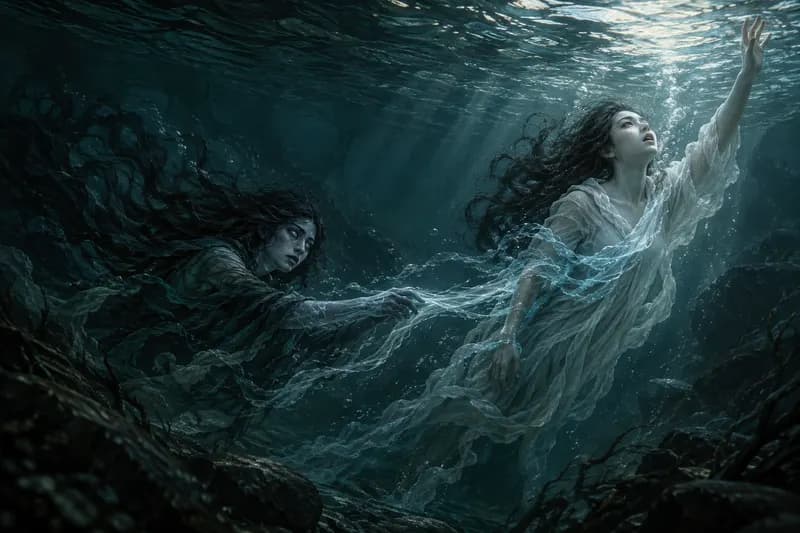
The Baak is not malicious. It is desperate. It does not hate you — it needs you. Every Baak is a person who drowned and could not leave, trapped in cold dark water for years, decades, sometimes centuries, waiting for a single chance at release. The horror of the Baak is not that it kills without mercy — it is that it kills because there is no other way out. The replacement cycle is not cruelty. It is a prison system with only one key: another life. When a Baak pulls you under, it is not attacking you. It is trying, with everything it has, to finally leave. The tragedy is that its freedom requires your death. And when you drown, you become what it was — and you will be just as desperate.
What Does the Baak Want?
The Baak wants one thing: to leave the water.
It does not want to kill. Killing is the mechanism, not the motive. The Baak is a trapped spirit — bound to a specific body of water, unable to move, unable to rest, unable to reach whatever comes after death. It exists in a state of permanent drowning — the cold, the dark, the pressure, the inability to breathe even though it no longer has lungs. Every moment of its existence is the moment of its death, replayed without end.
The only escape is replacement. If the Baak can drown another person in the same water, that person's spirit takes its place, and the Baak is released. This is not a choice the Baak makes. It is a law — as mechanical and indifferent as gravity. The Baak does not select its victims with malice. It grabs whoever enters the water. The farmer's child. The woman washing clothes. The teenager swimming on a dare. It does not matter who. It only matters that someone drowns.
This makes the Baak the most pitiable entity in the entire Assamese folklore tradition. It is simultaneously predator and prisoner. The thing that kills you is also the thing that suffers most. And when it finally escapes — when your death buys its freedom — you inherit its sentence. You become the next Baak. You wait in the dark water. You feel the cold. And when someone swims too close, you reach up — not because you want to, but because you have to.
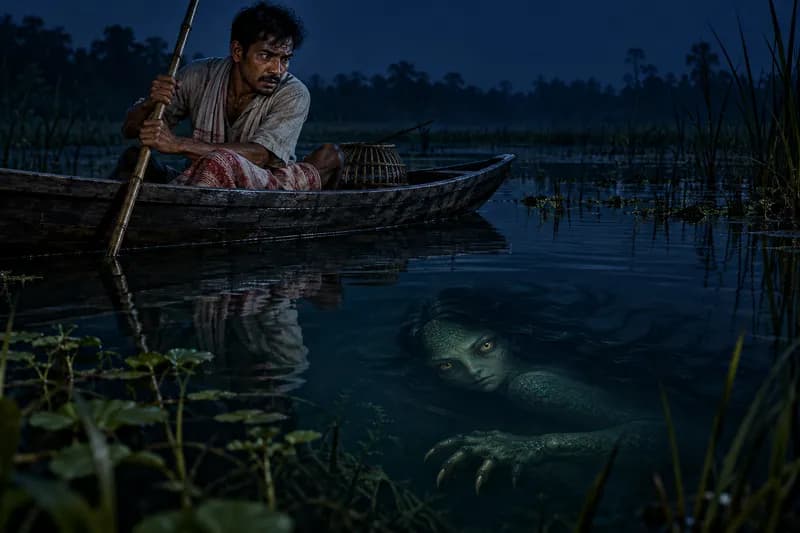
You're Most at Risk If...
- You swim in rivers, ponds, or flooded areas where drownings have occurred
- You are in Assam during monsoon season (June–September)
- You swim alone, especially at dusk or dawn
- You ignore local warnings about specific bodies of water
- You enter floodwater without knowing its depth or current
- You are a child or a non-swimmer near unguarded water during the monsoon
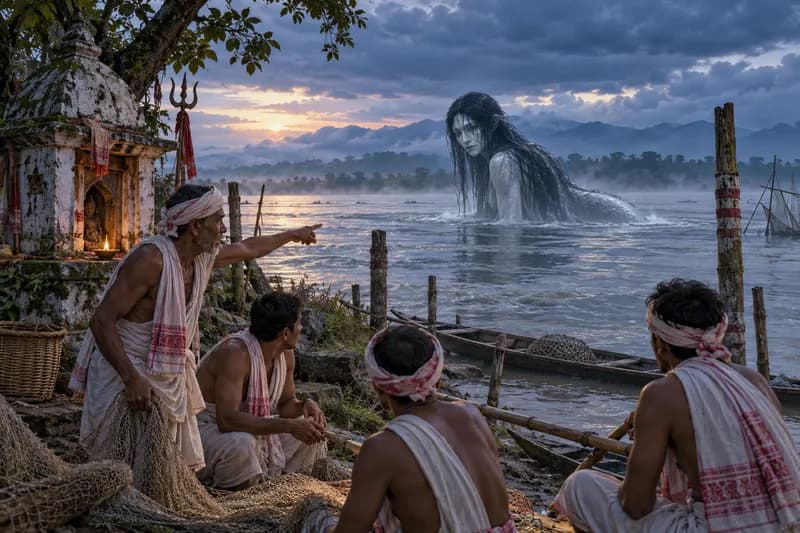
Offerings & Appeasement
| Offering | Purpose |
|---|---|
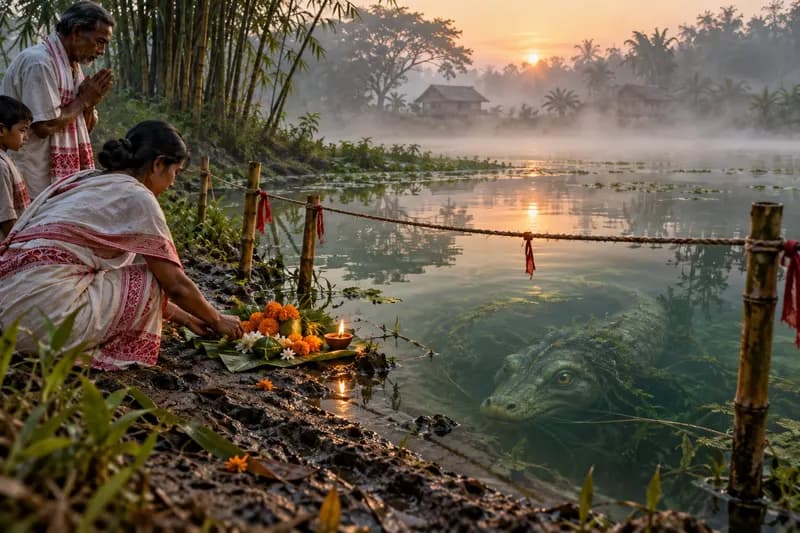
| Flowers and Betel Nut | Before crossing a river or entering a pond known to harbor a Baak, villagers place flowers and betel nut (tamul-paan) at the water's edge. This is not worship — it is acknowledgment. The offering says: I know you are here. I am not ignoring you. Let me pass. |
| Rice and Milk | In some villages, cooked rice and milk are offered to the water on Amavasya (new moon) nights. The logic is appeasement — feeding the hungry spirit so it does not hunger for a living body. The offering is placed in a banana leaf and floated on the surface. |
| Funeral Rites for the Original Victim | The most powerful act is not an offering but a ritual: performing proper cremation rites for the person whose drowning created the Baak. If the original body was never recovered, a symbolic cremation — using the person's belongings or an effigy — can sometimes release the spirit. This is the only method that breaks the replacement cycle entirely. |
| Iron Offerings | Iron nails or tools are sometimes thrown into the water to weaken the Baak. This is not appeasement — it is suppression. The iron does not free the Baak. It pins it down, weakens its grip, makes the water temporarily safer. Fishermen drop iron hooks into problem areas of the river before setting nets. |
The Healer
Bej (Assamese Folk Healer) — The Bej is the traditional healer-priest of Assamese villages, trained in mantras, herbal remedies, and spirit negotiation. For a Baak-related drowning or near-drowning, the Bej performs rituals at the water's edge to either calm the spirit or perform symbolic rites to break the cycle.
Ojha (Spirit Specialist) — The Ojha specializes in hostile spirits and possessions. When a body of water is believed to contain a particularly aggressive Baak — multiple drownings in a short period — the Ojha is called to perform binding rituals, often involving iron stakes driven into the bank and mantras recited over the water at midnight.
Village Elders / Nam-Ghar Committee — In many Assamese villages, the Nam-Ghar (community prayer hall) committee maintains an informal record of dangerous water bodies. They are not healers in the spiritual sense, but they are the institutional memory of who drowned where — and that knowledge is the most effective protection against the Baak.
The Key Difference — You don't exorcise a Baak. You either appease it, avoid it, or break the cycle by giving the original victim proper rites. The Baak is not invading — it is trapped. The healer's job is not to fight it, but to find a way to release it without sacrificing another life.
What If You Dream of a Baak?
| Symbol | Meaning | |
|---|---|---|
| 🌊 | Being Pulled Underwater | Something in your waking life is dragging you down — a debt, a relationship, a situation you cannot escape. The water is the trap. The grip on your ankle is the obligation you cannot shake. The dream is telling you: you are drowning slowly, and you have not yet realized it. |
| 👁 | Seeing a Face in the Water | An unresolved grief. Someone you lost — not necessarily to drowning, but to any sudden absence — is still present in your subconscious. The face in the water is the person you never properly mourned. The dream asks: have you let them go? |
| 🏊 | Swimming in Murky Water | You are moving through a situation without being able to see what is below you. The murkiness is uncertainty — a decision you are making without full information. Something is hidden beneath the surface of your life, and the dream warns you: do not go deeper until you can see. |
| 🔗 | Being Trapped in a Body of Water | You feel stuck — in a job, a place, a pattern. The Baak's prison is your prison. You are waiting for something to change, but the dream tells you that nothing will change unless someone or something breaks the cycle. The question is whether you break it, or whether it breaks you. |
The Baak in Art History
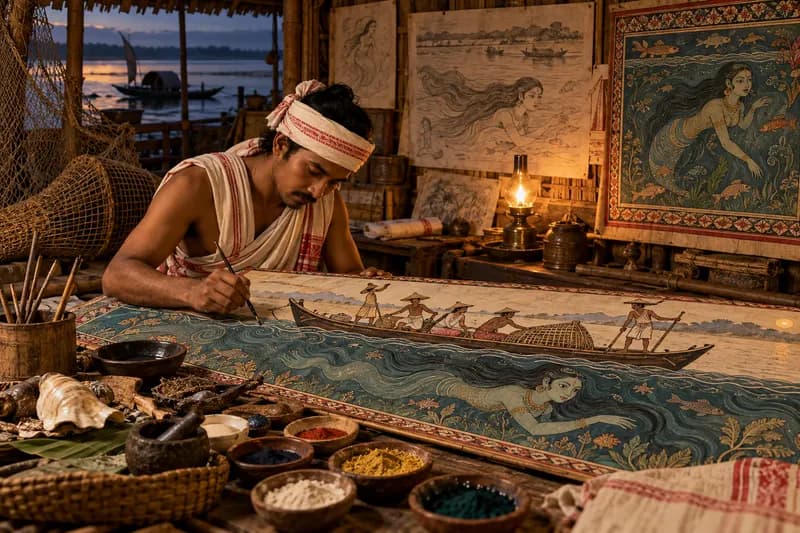
Assamese Manuscript Tradition — Sanchipat Manuscripts: Traditional Assamese manuscripts written on sanchipat (bark of the agar tree) occasionally depict water spirits in their illuminated margins. While the Baak is primarily an oral tradition, some manuscripts from the Ahom period include illustrations of river spirits — dark figures submerged in stylized water, arms reaching upward.
Terracotta Traditions — Brahmaputra Valley: Terracotta plaques and figurines from the Brahmaputra valley occasionally feature aquatic spirit motifs — humanoid forms emerging from or submerged in water. While not exclusively Baak imagery, these reflect the broader Assamese tradition of water as a zone of spiritual danger.
Folk Art — Jaapi and Textile Motifs: Assamese folk art, including the iconic jaapi (bamboo hat) and traditional textiles, features river and water motifs that carry protective symbolism. Certain weaving patterns on gamosa (traditional towels) are said to invoke protection from water spirits when the gamosa is carried near rivers.
Contemporary Assamese Art: Modern Assamese artists — particularly those working in the wake of recurring Brahmaputra floods — have drawn on Baak imagery to represent the relationship between Assamese communities and the river. The Baak appears in contemporary painting and installation art as a metaphor for the river's duality: life-giver and life-taker.
Cross-Regional Patterns
Pari · Bira · Pishaach · Kichkandi · Thlen · Churigin · Ghoda Paak · Jokhini
| Dawn as hard limit | No — active at all hours |
| Iron weakness | Yes |
| Tree-dwelling | No — water-bound |
| Counting compulsion | No |
| Backward feet | No |
Global Equivalent: The closest global parallel is the Kappa of Japanese folklore — a water entity that drowns swimmers by pulling them under. The Scandinavian Nykk (Neck/Nixie) also inhabits freshwater and drowns the unwary. But the Baak is distinct in its replacement mechanic: it is not a permanent creature of the water but a trapped human spirit that must drown another to escape. The Kappa kills by nature. The Baak kills by necessity.
In Culture — Movies, Books, Games
| Type | Title | Description |
|---|---|---|
| Literature | Assamese Folk Tales (various compilations) | Multiple collections of Assamese folk tales include Baak stories — typically cautionary narratives about children or travelers who ignore warnings about specific ponds or river bends. Lakshminath Bezbaroa's folk compilations include water-spirit narratives that align with Baak traditions. |
| Film | Assamese Regional Cinema | Assamese horror and folk-horror films have drawn on the Baak tradition, using the Brahmaputra and its flood landscape as settings. The visual language — murky water, sudden drownings, submerged figures — translates powerfully to screen, though dedicated Baak-focused films remain niche. |
| Theatre | Bhaona and Mobile Theatre | Assam's vibrant mobile theatre tradition (Bhraymaman Theatre) has staged productions featuring water spirits and Baak-adjacent entities. The theatrical format — traveling troupes performing in villages across the Brahmaputra valley — keeps these narratives alive in communities where they originated. |
| Music | Bihu and Folk Songs | Traditional Bihu songs and Assamese folk music occasionally reference the dangers of the river and the spirits within it. These are not horror songs — they are woven into the broader fabric of Brahmaputra-centric life, acknowledging the water as both sustainer and threat. |
| Digital Media | Assamese Horror Content Creators | A growing wave of Assamese-language YouTube and social media creators produce horror content rooted in regional folklore. The Baak features prominently — its simplicity (water + drowning + replacement) makes it one of the most frequently retold entities in Assamese digital horror. |
ACCURACY RATING: HIGH IN REGIONAL FOLKLORE · LIMITED MAINSTREAM MEDIA PRESENCE
Is the Baak Still Real?
- Actively believed across rural Assam — particularly in villages along the Brahmaputra and its tributaries. Drowning deaths during monsoon season are routinely attributed to the Baak by communities who have lost members to the same bodies of water across generations.
- Fishermen on the Brahmaputra carry iron implements and avoid specific stretches of the river after dark. This is not performed as ritual — it is practical safety behavior, indistinguishable from checking weather or tying ropes.
- After every major flood event, reports circulate in Assamese media and social networks about Baak sightings — unexplained drownings, bodies found in positions suggesting they were held down, survivors describing a grip on their legs. These accounts are reported seriously, not as curiosity.
- Village ponds and beels (oxbow lakes) with histories of drowning are marked — informally, through community memory — as Baak territory. Children are taught the specific names and locations of dangerous water bodies before they are taught to swim.
- The belief has survived urbanization. Even in Guwahati, Assam's largest city, stories circulate about Baak in the Deepor Beel wetland and in the Brahmaputra ghats. The belief adapts to the city but does not disappear.
Expert & Academic Context
- Lakshminath Bezbaroa — Burhi Aair Sadhu (Grandmother's Tales) — The foundational collection of Assamese folk tales, first published in the early 20th century. Contains water-spirit narratives and cautionary tales about rivers and ponds that align with the Baak tradition. The most widely read folk compilation in Assamese literature.
- Assamese Buranjis (Ahom-era Historical Chronicles) — The Buranjis — court chronicles of the Ahom kingdom (13th–19th century) — contain references to river spirits and water-related folk beliefs, providing historical context for the Baak tradition within the broader framework of Ahom-era Assamese society.
- Birinchi Kumar Barua — Assamese Folk Beliefs — Academic documentation of Assamese folk beliefs including water spirits, drowning mythology, and the replacement cycle that defines the Baak. Barua's work contextualizes these beliefs within the larger pattern of Brahmaputra-centric Assamese culture.
- Praphulladatta Goswami — Folk Literature of Assam — Comprehensive scholarly treatment of Assamese folk literature including spirit narratives, water mythology, and the relationship between landscape, flood, and supernatural belief in the Brahmaputra valley.
- Drowning statistics — National Crime Records Bureau / Assam State Disaster Management Authority — Contemporary drowning data from the Brahmaputra system provides the factual substrate on which Baak belief rests. Assam consistently reports among the highest drowning rates in India, overwhelmingly during monsoon season — a statistical reality that sustains and validates the folk tradition.
The Baak is inseparable from the Brahmaputra. It is, at its core, a folklore of flood — a culture's attempt to process the annual reality that the river which sustains their agriculture, their fisheries, their transport, and their identity also kills their children. The replacement cycle is not just a supernatural mechanic — it is a metaphor for the river's indifference. The Brahmaputra does not hate the people who live along its banks. It simply floods, and people drown, and the water does not care. The Baak gives that indifference a face, a motive, a set of rules. It transforms random tragedy into a system that can be understood, predicted, and — through offerings, iron, and avoidance — partially controlled. In a region where the annual flood is the defining event of the calendar, the Baak is the folklore's way of saying: the water is alive, and it remembers everyone it has taken.
If You Encounter a Baak
Frequently Asked Questions
▶What is a Baak?
A Baak is a water spirit from Assamese folklore — the ghost of a person who drowned, trapped in the body of water where they died. It grabs swimmers by the legs and pulls them under, drowning them so that the new victim's spirit replaces it in the water, freeing the original Baak.
▶Is the Baak real?
The Baak is actively believed across rural Assam, particularly along the Brahmaputra river system. Drowning deaths during monsoon season are routinely attributed to Baak activity. Fishermen carry iron and avoid specific river stretches after dark. The belief is practical, integrated, and current.
▶How does the Baak kill?
The Baak grabs swimmers from below — typically by the ankle or leg — and pulls them underwater with overwhelming force. The victim drowns. The Baak's grip is described as cold, iron-strong, and inescapable. Most victims never see the Baak. They only feel the pull.
▶Can you escape a Baak?
Folk tradition says going limp — ceasing to struggle — can weaken the Baak's grip momentarily. Carrying iron (a nail, a key, a hook) is believed to repel or weaken the spirit. The safest protection is avoidance: do not swim in water bodies where drownings have occurred, especially during monsoon.
▶What happens after a Baak drowns someone?
The Baak is released — its spirit is freed from the water and can move on. But the newly drowned person becomes the next Baak, trapped in the same body of water, waiting for their own replacement. The cycle continues indefinitely.
▶Where are Baak most common?
Along the Brahmaputra river and its tributaries, in monsoon-flooded ponds, beels (oxbow lakes), and marshes across Assam. Any body of water where a drowning has occurred is believed to harbor a Baak.
Explore More
Explore Further
Spirits of Northeast IndiaAll Water Spirits & Marsh Entities
Stories Are Being Summoned
One ghost story per week. Every Tuesday at midnight.