Bhootni
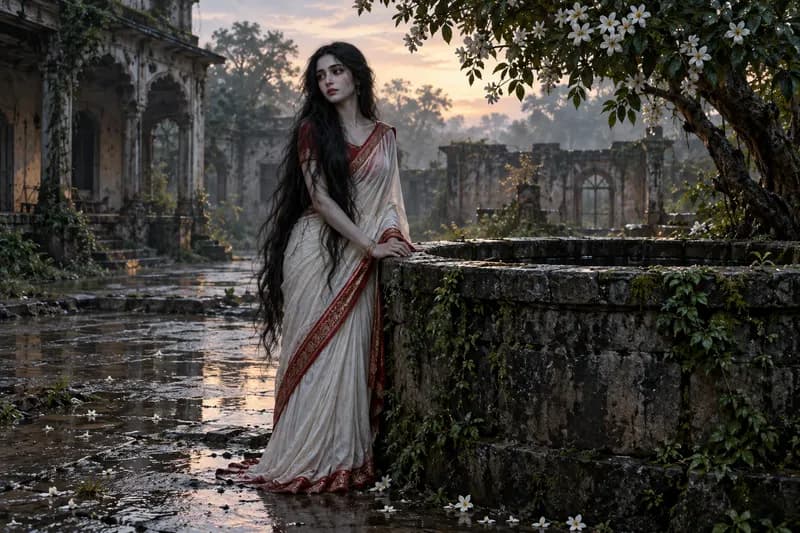
She stands at the edge of the well, hair touching the water. By the time you see her face, she has already seen yours.
- What Is a Bhootni?
- Why the Bhootni Is Terrifying
- Origin — How It Came to Exist
- Appearance & Manifestation
- The Well at Rampur
- The Rules — How to Survive
- What They Don't Tell You
- What Does the Bhootni Want?
- You're Most at Risk If...
- Offerings & Appeasement
- The Healer
- What If You Dream of a Bhootni?
- The Bhootni in Art History
- Cross-Regional Patterns
- In Culture — Movies, Books, Games
- Is the Bhootni Still Real?
- Expert & Academic Context
- If You Encounter a Bhootni
- Frequently Asked Questions
- Explore More
| Bhootni | |
|---|---|
| Also Known As | Bhutni, Bhutini, Stree Bhoot, Female Bhoot |
| Script | भूतनी (Devanagari) |
| Pronunciation | BHOOT-nee (भूत-नी) |
| Region | North India — Uttar Pradesh, Bihar, Madhya Pradesh, Rajasthan, Haryana, Punjab |
| Category | Female Ghost / Feminine Spirit |
| Danger Level | Dangerous |
| Fear Method | Luring near water, mimicry, emotional manipulation, drowning |
| Warning Sign | Unexplained sobbing near wells or rivers at night; a woman in white seen from behind who never turns around |
| First Documented | Oral traditions of North Indian villages; references in regional Bhoot-lore collections dating to the 18th–19th centuries |
| Still Believed? | Yes — rural North India, particularly in villages with old wells, rivers, and abandoned structures; reported sightings are routine and taken seriously |
| Related | Churel · Chudail · Bhut (Gond) · Daayan · Pichal Peri |
What Is a Bhootni?
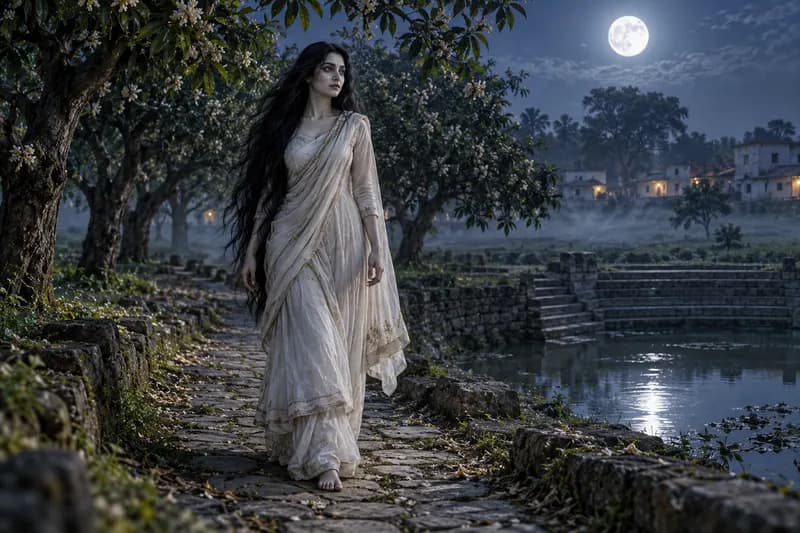
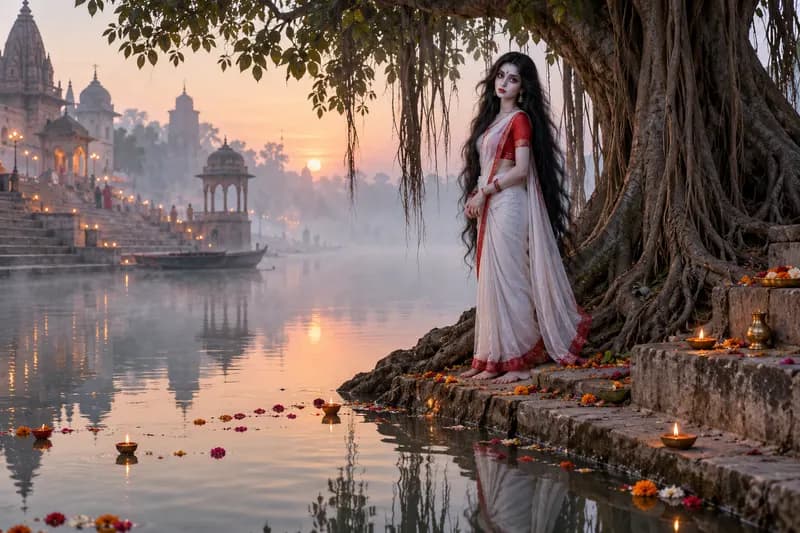
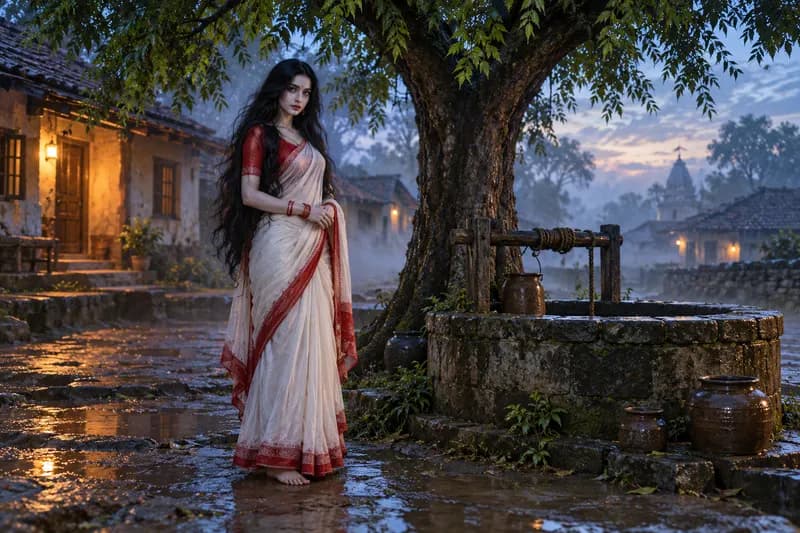
The Bhootni (भूतनी) is the feminine form of the Bhoot — the most common category of ghost in North Indian folklore. While the male Bhoot is a general-purpose restless spirit, the Bhootni carries a distinct set of behaviors, visual markers, and territorial patterns that set her apart as a specific entity. She is almost always described the same way: long unbound hair, a white sari, bare feet, and a presence concentrated around water sources — wells, rivers, ponds, and abandoned stepwells. She appears at night, especially near structures that have fallen into disuse.
The Bhootni is not a singular legendary figure. She is a type — a classification that encompasses thousands of local stories across Uttar Pradesh, Bihar, Rajasthan, Madhya Pradesh, Haryana, and Punjab. Every village with an old well has a Bhootni story. Every river bend where someone drowned carries whispers of one. She represents the most widespread female ghost archetype in North India, distinct from the Churel (who is specifically tied to death in childbirth) and the Chudail (who targets men through seduction). The Bhootni's domain is grief, abandonment, and the places the living have left behind.
Why the Bhootni Is Terrifying
INSTINCT EXPLOITED: COMPASSION FOR A WOMAN IN DISTRESS
You are walking back to the village after dark. The path takes you past the old well — the one nobody uses anymore, the one your grandmother told you to avoid after sunset. You walk faster. You keep your eyes on the road.
Then you hear it. Crying. Not loud, not dramatic — soft, broken sobbing, the kind that sounds like someone who has been weeping for hours and has no strength left. A woman's voice. Coming from the well.
Every instinct says help her. A woman alone, crying, at night — she could be hurt, she could be lost, she could have fallen. You take a step toward the well. Then another. The crying gets louder. Closer. You lean over the edge and look down.
There is nothing in the well. The water is still and black. But the crying is now behind you.
You turn. She is there. White sari. Hair hanging past her waist, covering her face entirely. Bare feet on the dust. She is close — closer than any person could have moved in silence. And she is not crying anymore. She is watching — through the curtain of hair, you can feel it, even if you cannot see it.
The Bhootni does not chase you. She does not need to. She used the one thing you could not ignore — another person's pain — to bring you to her. That is what makes her terrible. She weaponizes your decency.
Origin — How It Came to Exist
The Becoming
A Bhootni is created when a woman dies with unresolved grief, unfulfilled desires, or under circumstances of neglect and abandonment. She does not need to have died violently — though many do. What matters is that something was left incomplete: a love unreturned, a child she could not raise, a life cut short by illness or accident in a place where no one found her in time. The incompleteness is the engine. She cannot move on because there is something she never finished.
The Water Connection
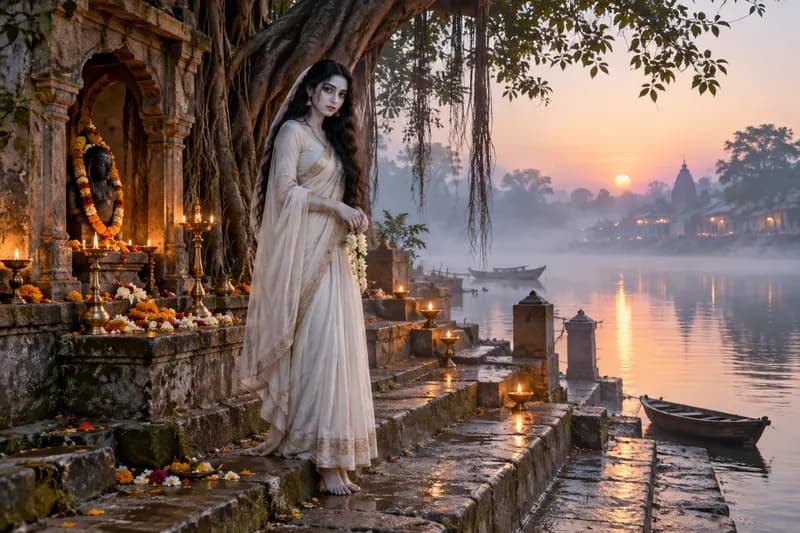
The overwhelming association between Bhootni and water has deep roots. In rural North India, wells and rivers were historically the most dangerous places for women — drowning (accidental and otherwise) was common, and women who died in or near water were believed to remain tethered to it. The well, in particular, became a symbol: it is deep, dark, enclosed, and the water at the bottom reflects back a distorted image. The Bhootni haunts the well because the well is where she ended — and endings that happen in water do not resolve cleanly.
The White Sari
In Hindu tradition, white is the color of mourning, of widowhood, of the absence of all other colors. The Bhootni wears white because she exists in a state of permanent mourning — mourning her own life, her own death, her own unfinished business. The white sari is not a choice. It is a condition. It marks her as someone who has been stripped of everything — color, life, identity — and has only grief left.
The Hair
Unbound hair in Indian tradition signals a woman outside social control — unmarried, widowed, mad, or dead. A married woman binds her hair; a woman in mourning lets it fall. The Bhootni's hair is always loose, always long, always covering her face. The hair is both a veil and a warning. It says: I am no longer part of your world. I am no longer bound by your rules. And it hides the face — because what the face looks like, according to every village storyteller, is something you do not want to see.
Not Churel, Not Chudail
The Bhootni is often confused with the Churel and the Chudail, but she is distinct. The Churel is specifically the ghost of a woman who died during childbirth or pregnancy — her fury is targeted and her backward feet are her signature. The Chudail is a seductress who lures men to their deaths. The Bhootni is neither. She is grief without a specific target, sorrow without a clear enemy. She does not seduce or punish — she lingers, she weeps, and she pulls the curious toward her. She is the generic female ghost, but 'generic' does not mean 'less dangerous.' It means she is everywhere.
Appearance & Manifestation
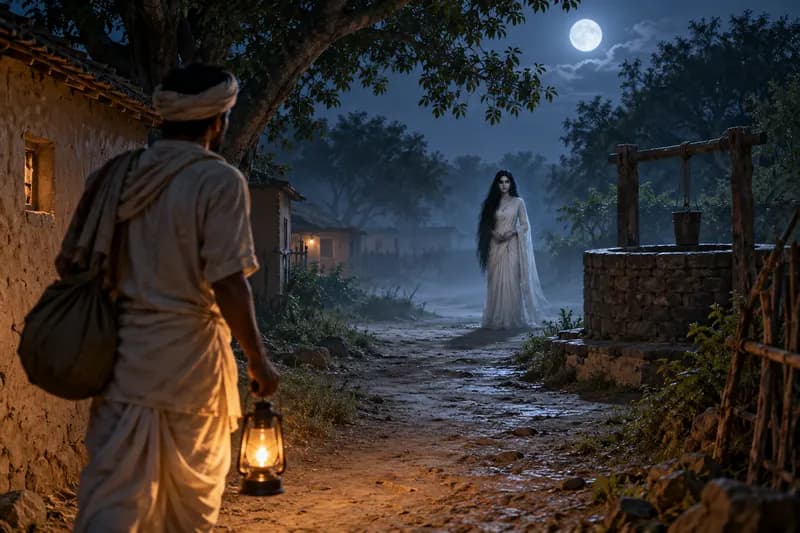
| 👁 Sight | A woman in a white sari, seen from behind or at a distance. Hair unbound, reaching past the waist, often covering the face entirely. Bare feet, pale skin that seems to glow faintly in moonlight. She is always still when first spotted — standing at the edge of a well, sitting by a riverbank, or positioned in the doorway of an abandoned structure. She does not approach. She waits. |
| 🔊 Sound | Soft, persistent weeping — not theatrical wailing but the exhausted sobbing of someone who has been crying for a very long time. Occasionally, humming — old lullabies or folk songs that nobody alive remembers. Sometimes a whisper that sounds like your name, spoken from a direction you cannot identify. |
| 🍃 Smell | Wet earth and jasmine — the smell of a village well after rain, mixed with the faint sweetness of night-blooming flowers. Some accounts describe the smell of stagnant water, of a pond that has not been cleaned, of something organic and decaying beneath the floral notes. |
| ❄ Temperature | A sudden, localized chill — not the cold of winter but the cold of a well shaft, that damp underground cold that does not belong on the surface. The temperature drops within a few feet of her presence. Your breath does not mist, but your skin prickles. |
| 🌑 Time | Active from sunset to the hour before dawn. Most sightings occur between 10 PM and 2 AM. Particularly active on Amavasya (new moon) nights, during the monsoon season when water levels rise, and on anniversaries that only she remembers. |
| 🏚 Habitat | Wells (especially abandoned ones), riverbanks, ponds, stepwells, and the ruins of old houses near water. Also found in abandoned structures — crumbling havelis, disused rooms, roofless buildings where families once lived. She gravitates toward places that were once full and are now empty. |
The Well at Rampur
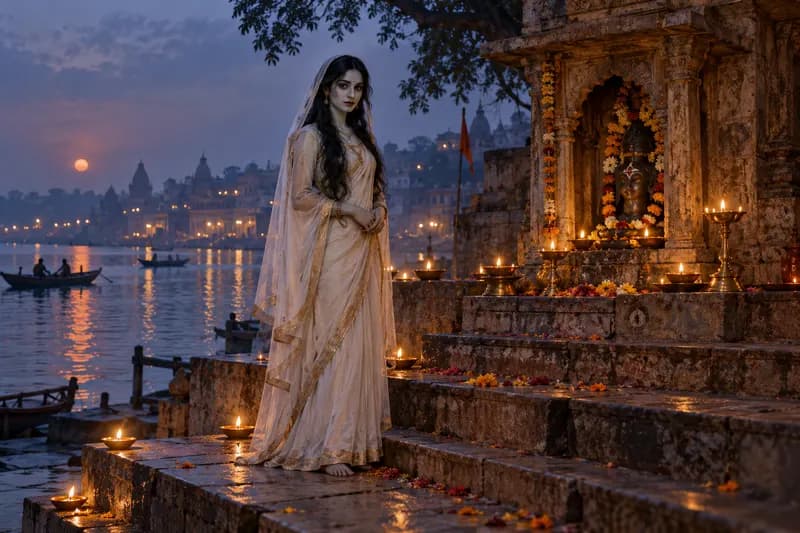
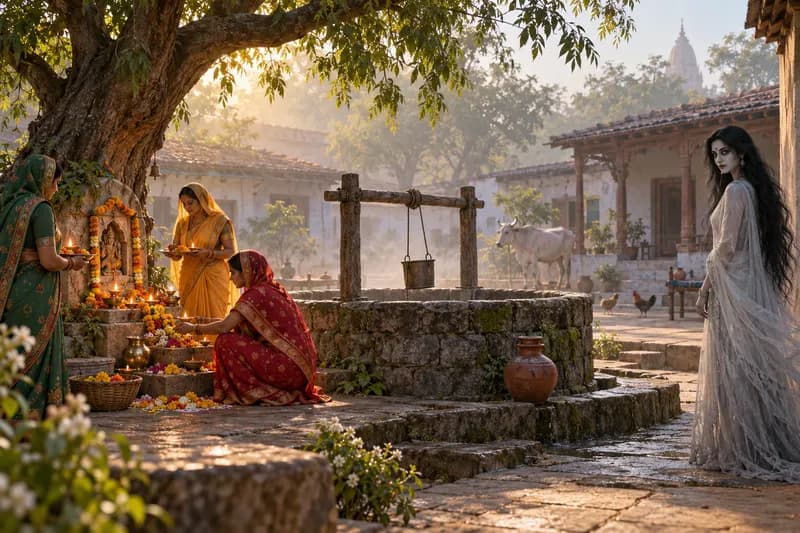
In a village outside Jaunpur, in eastern Uttar Pradesh, there was a well that nobody used after 1987. The well was old — hand-dug, brick-lined, with a wooden frame that had rotted to black. It sat at the edge of the village, behind the last row of houses, near a neem tree that had grown so large its roots had cracked the stone platform around the well's mouth.
The well had been abandoned after a young woman drowned in it. Her name was Savitri, and she was nineteen years old. The drowning was ruled accidental — she had gone to draw water at dusk, the wooden frame was slippery from the evening's rain, and she had fallen. Her body was recovered the next morning. The village performed the rites. Her family grieved. Life continued.
But the well did not continue as it was.
Within a month, people walking past the well at night began hearing sounds. Crying — soft, almost inaudible, the kind you would dismiss as wind in the neem tree except that it stopped when you stopped walking. Two women from the neighboring house reported seeing a figure in white sitting on the well's stone edge at around midnight. They saw her from behind. Long hair, white cloth. They assumed it was a person and called out. The figure did not move. When they walked closer, there was no one there.
The village elders did what village elders do. They consulted the local ojha — a healer who dealt with such matters. The ojha came to the well at night, performed a small ritual with camphor and turmeric, and confirmed what everyone already suspected: Savitri had not left. She was a Bhootni now, tethered to the water that had taken her, unable to cross because something in her life had been left incomplete.
The ojha could not say what was incomplete. That knowledge belonged to her alone.
Over the years, the well became the village's most reliable ghost story. Children were warned away from it. The neem tree grew larger. The brick lining began to crumble. And at night, if you walked that path — which most people no longer did — you might hear it. That quiet crying. Not angry, not vengeful. Just sad. Endlessly, impossibly sad.
An older woman in the village, who had known Savitri's mother, said once: "She was supposed to be married that winter. The boy's family had already sent the clothes. She was happy. She was so happy." The woman paused. "Maybe that is why she cannot leave. She was too close to the life she wanted."
The well still stands. No one has filled it in. The village built a new well on the opposite side, and the old one was left to the neem tree, the rain, and whatever remains of a girl who was nineteen and happy and fell.
The Rules — How to Survive
☠ WARNING ☠
Seven rules for surviving a Bhootni encounter
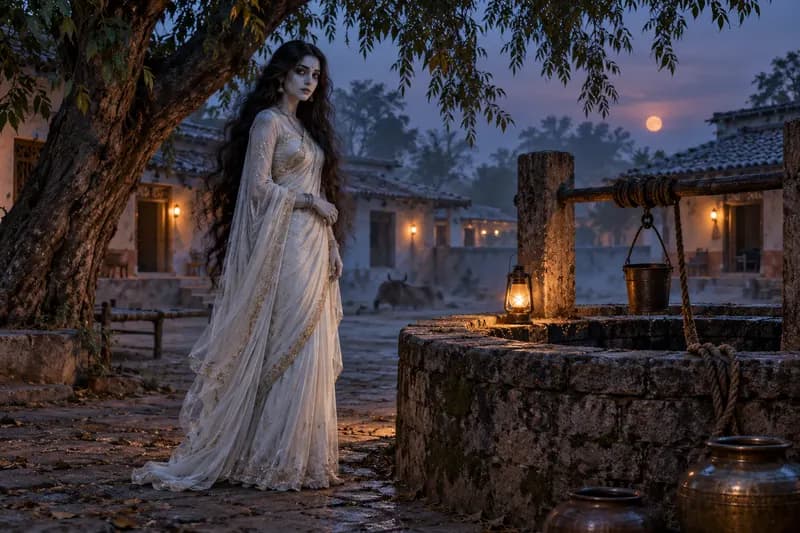
- Never approach a well or river at night if you hear crying. — The Bhootni uses distress sounds to lure the compassionate. The crying is real — it is her grief — but approaching it places you within her reach.
- Do not look into abandoned wells after sunset. — The well is her domain. Looking into it is an invitation. The surface of still water in darkness can show things that are not reflections.
- If you see a woman in white from behind, do not call out to her. — Calling out acknowledges her presence. She cannot interact with those who do not acknowledge her. Silence is not rudeness — it is survival.
- Carry iron — a key, a nail, a small blade. — Iron disrupts the Bhootni's manifestation. She is among the entities most affected by iron. A simple iron object in your pocket creates a barrier she finds difficult to cross.
- Burn camphor or light a mustard oil lamp if you sense her presence. — Camphor purifies the air she inhabits. Mustard oil lamps are the traditional village protection — the smoke and light together create a zone she cannot enter.
- Do not respond if you hear your name whispered near water at night. — Responding to a name-call from an unseen source binds you to the caller. The Bhootni learns names from the wind, from conversations she overhears. Your name in her mouth is a hook.
- If she appears before you, recite the Hanuman Chalisa or any prayer without stopping. — Continuous recitation creates a protective sound-field. The Bhootni feeds on silence and emotional response. Prayer replaces both with something she cannot consume.
What They Don't Tell You
The Bhootni is not hunting you. She is not angry. She is not vengeful. She is stuck — trapped in the last emotion she felt before dying, replaying the last moments on an endless loop. The crying you hear is not a trick. It is genuine grief that has outlasted the body that produced it. Village elders who have dealt with Bhootni for generations know this: the most effective way to end a haunting is not exorcism but completion. Find out what she left unfinished. Complete it. Give her what she was denied — a final rite performed properly, a message delivered to someone she loved, an acknowledgment that she existed and mattered. The Bhootni does not want to haunt. She wants to stop.
What Does the Bhootni Want?
She wants what was taken from her. A life.
Not your life — not specifically. The Bhootni is not a predator in the way the Churel or the Vetala is. She does not target victims or plan attacks. She exists in a state of perpetual incompleteness — a woman who died before something important could happen, and now she cannot stop reaching for it.
The crying at the well is not bait. It is a symptom. She weeps because weeping is the last thing she did while alive, and death froze her in that moment. The luring — if it can be called that — is not intentional malice. It is the gravity of grief. Sorrow that intense pulls things toward it. People who approach the well are not being hunted. They are being drawn in by an emotional field so powerful it has survived death.
This is what makes the Bhootni both less and more dangerous than other entities. Less, because she has no plan, no malice, no scheme. More, because her danger is indiscriminate and uncontrollable — a drowning person pulls down anyone who tries to help, not because they want to kill but because they are drowning.
You're Most at Risk If...
- You live near an abandoned well, river, or old water source
- You walk alone near water after dark
- You are a woman — the Bhootni is more likely to manifest to women, possibly seeking connection or recognition
- You are emotionally vulnerable — grieving, heartbroken, lonely; the Bhootni resonates with similar emotional states
- You are new to a village and do not know which places are avoided after dark
- You respond to sounds or voices you cannot identify at night
Offerings & Appeasement
| Offering | Purpose |
|---|---|
| At the Well | White flowers — jasmine or champa — placed at the edge of the well during daylight hours. A small clay lamp filled with mustard oil, lit at dusk. This is not worship. It is acknowledgment. The offering says: we know you are here, we have not forgotten. |
| On Amavasya | On new moon nights, some villages leave a plate of food near the haunted well or water source — usually rice and dal, simple food, the kind a young woman would have eaten. The plate is left at sunset and collected (empty or not) at dawn. It is a gesture of care for someone no longer alive to receive it. |
| The Completion Offering | The most powerful offering is specific to the individual Bhootni: whatever she was denied in life. If she died before her wedding, a symbolic wedding ceremony performed at the well. If she died without proper last rites, a full cremation ritual performed in her name. This is the offering that ends the haunting. |
| Turmeric and Camphor | A paste of turmeric smeared on the stones around the well, with camphor burned at each of the four directions. This is a purification ritual — not to destroy the Bhootni but to ease her suffering. Villages that perform this regularly report fewer disturbances. |
The Healer
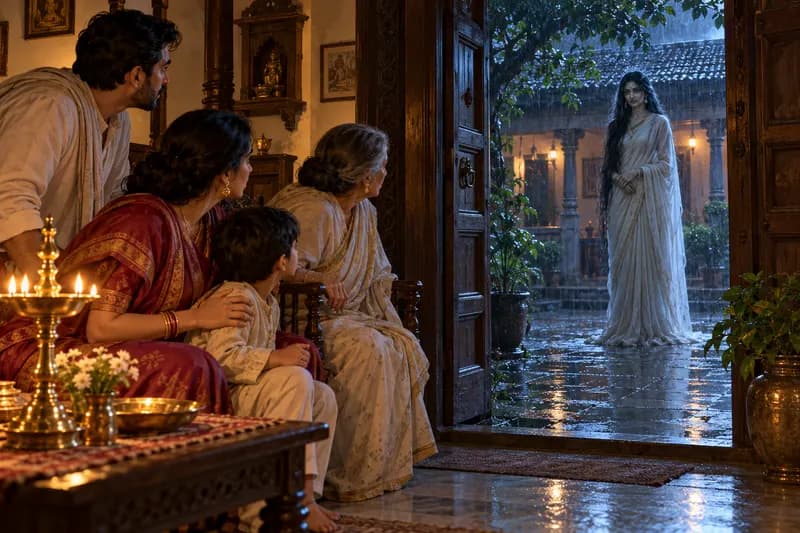
Ojha (Village Healer) — The first responder in any Bhootni encounter. The ojha is a folk healer who uses a combination of mantras, herbs (neem, turmeric), and diagnostic rituals to confirm the presence and identify the source. Most ojhas in North India have dealt with Bhootni cases — it is the most common haunting they encounter.
Pandit (Brahmin Priest) — Called in for the completion rituals — performing last rites, conducting symbolic ceremonies for the deceased. The pandit provides the religious framework that the ojha's folk methods cannot. For hauntings rooted in incomplete funeral rites, the pandit is essential.
Tantrik (Severe Cases Only) — If the Bhootni has become aggressive — pulling people toward the well, causing illness in the household, manifesting visibly and frequently — a tantrik may be called. This is a last resort. Tantric intervention binds or banishes the spirit, which solves the haunting but does not help the Bhootni. Most village elders prefer resolution over banishment.
The Grandmother — In practice, the most effective first responder is often the oldest woman in the family or village — someone who knows the local history, who remembers who died where and why, and who can identify the Bhootni by matching the haunting's location and pattern to a specific death. Grandmothers diagnose. Healers treat.
What If You Dream of a Bhootni?
| Symbol | Meaning | |
|---|---|---|
| 💧 | A Woman by a Well | Unresolved grief — yours or someone close to you. Something has been lost and not properly mourned. The well represents depth of feeling you have not looked into. The woman is the part of you that knows what you are avoiding. |
| 👻 | A Face Behind Hair | A truth you are hiding from yourself. The hair that covers the Bhootni's face in your dream is the story you tell to avoid seeing what is underneath. Something about your own identity or past that you have draped in comfortable narratives. |
| 🌊 | Being Pulled into Water | You are being drawn into someone else's emotional crisis. The dream warns: helping is noble, but drowning alongside someone is not help. You need boundaries. The water is not yours to enter. |
| 🕯 | Lighting a Lamp Near a Well | You are ready to illuminate something dark — a memory, a loss, a conversation you have been postponing. The lamp is your willingness. The well is what you are finally ready to look into. |
The Bhootni in Art History
18th–19th Century — North Indian Folk Paintings: The Bhootni appears in Pahari and Rajasthani folk art as a white-clad figure near water, often rendered with flowing hair that merges with the landscape. These paintings were not meant as entertainment — they were cautionary illustrations used to teach children about places to avoid after dark.
Colonial-Era Accounts — British District Gazetteers: British administrators in Uttar Pradesh and Bihar documented Bhootni beliefs in district gazetteers and ethnographic reports. These accounts describe abandoned wells marked with vermilion, village women refusing to draw water after sunset, and local healers called to 'settle' disturbed wells. The colonial lens was dismissive, but the documentation is invaluable.
20th Century — Hindi Cinema's White-Sari Ghost: The Bhootni is the origin of Bollywood's most iconic ghost image: the woman in white with long hair. From the Ramsay Brothers horror films of the 1970s–80s to modern productions, this visual has been reproduced thousands of times. Every Hindi horror film that shows a woman in white by a well or on a road at night is drawing — consciously or not — from the Bhootni tradition.
Village Murals and Warning Signs: In parts of rural Rajasthan and Madhya Pradesh, abandoned wells are sometimes marked with crude paintings or symbols warning of a resident Bhootni. These are not art in the formal sense — they are functional markers, the equivalent of a 'danger' sign, painted by villagers who take the presence seriously.
Cross-Regional Patterns
Churel · Chudail · Bhut (Gond) · Daayan · Pichal Peri
| Dawn as hard limit | Yes |
| Iron weakness | Yes — strong |
| Tree-dwelling | Sometimes (neem, peepal) |
| Counting compulsion | No |
| Backward feet | No (that is Churel) |
Global Equivalent: The closest global parallel is the White Lady (La Llorona in Latin American tradition, the Dame Blanche of French folklore, and the Woman in White of British ghost stories). All share the same core: a woman in white, near water, weeping for what she lost. The Bhootni is India's entry in this universal archetype — the grieving female spirit who lingers where her story ended.
In Culture — Movies, Books, Games
| Type | Title | Description |
|---|---|---|
| Cinema | Stree (2018) | The breakout Hindi horror-comedy featuring a female spirit who abducts men from a small town. While the entity in Stree is not called a Bhootni explicitly, her visual design — white sari, long hair, appearing at night — draws directly from the archetype. The film became a massive hit and spawned a franchise. |
| Cinema | Ramsay Brothers Films (1970s–1980s) | The Ramsay Brothers built an entire horror-film empire on the white-sari ghost. Films like Purana Mandir and Veerana feature Bhootni-derived entities as central threats. These films defined the visual grammar of Indian horror and cemented the Bhootni's image in popular culture. |
| Television | Aahat / Ssshhhh...Koi Hai (Star Plus, 2000s) | Indian horror television shows that featured Bhootni-type entities in dozens of episodes. The well-dwelling, white-sari-wearing female ghost was the single most common villain type across both series. |
| Literature | Regional Folk Collections | The Bhootni appears in virtually every collection of North Indian folk tales — from colonial-era compilations by William Crooke and R.C. Temple to modern collections by Indian folklorists. She is the most frequently documented female ghost type in Hindi-speaking India. |
| Oral Tradition | Village Ghost Stories | The Bhootni's most important cultural presence is not in media but in oral tradition. Every village in North India has at least one Bhootni story — a specific well, a specific woman, a specific death. These are not fiction. They are local history, passed from grandmother to grandchild, and they are still being told. |
ACCURACY RATING: HIGHLY ACCURATE IN FOLK TRADITION · VISUALLY DOMINANT IN MEDIA
Is the Bhootni Still Real?
- The Bhootni is the most commonly reported female ghost in North India. Village-level reports of sightings — a woman in white near a well, crying heard at night near water — are routine across Uttar Pradesh, Bihar, Rajasthan, and Madhya Pradesh.
- Abandoned wells in rural areas are still treated with genuine caution after dark. This is not superstition performed for show — it is a deeply internalized practice. Children are warned. Adults avoid. The well is left alone.
- Ojhas and folk healers in North India report that Bhootni-related cases are their most common type of consultation. Families approach them when unexplained sounds, sightings, or illnesses coincide with proximity to an old water source.
- The belief has survived urbanization. In small towns and semi-urban areas, stories of Bhootni sightings near old wells, abandoned houses, and dried-up ponds continue to circulate on social media and local news outlets.
- The Bhootni is not a fading belief. She is the baseline female ghost of North Indian culture — so embedded that most people do not think of her as folklore. She is simply a fact of the landscape, as real as the well she inhabits.
Expert & Academic Context
- William Crooke — Religion and Folklore of Northern India (1926) — Comprehensive colonial-era documentation of North Indian ghost beliefs, including detailed entries on the Bhootni, her association with water, and village-level protective practices.
- R.C. Temple — The Legends of the Punjab (1884–1900) — Multi-volume folk collection documenting ghost beliefs in Punjab and surrounding regions. Contains firsthand accounts of Bhootni sightings and the rituals used to manage them.
- Ghosts, Monsters and Demons of India — Rakesh Khanna — Modern comprehensive guide distinguishing the Bhootni from the Churel, Chudail, and other female ghosts. Includes regional variations and analysis of the white-sari archetype across Indian folklore.
- Sadhana Naithani — In Quest of Indian Folktales (2006) — Academic study of Indian folk narrative traditions, including analysis of how female ghost stories function as social commentary on women's lives, deaths, and the anxieties surrounding both.
- District Gazetteers of Uttar Pradesh and Bihar — Colonial and post-colonial administrative records that incidentally document Bhootni beliefs — abandoned wells marked as haunted, village requests for official intervention in 'ghost disturbances,' and ethnographic notes on local practices.
The Bhootni is, at her core, a story about what happens to women who are forgotten. She haunts wells because wells are where women went — to draw water, to work, to gather, and sometimes to die. She wears white because white is what is left when everything else is taken away. She cries because crying was often the only expression of pain available to women in the social structures that produced these stories. The Bhootni is not just a ghost. She is a cultural memory of every woman whose death was ruled accidental, whose grief was dismissed, whose life was cut short and then tidied away. The haunting is what happens when the tidying fails.
If You Encounter a Bhootni
Frequently Asked Questions
▶What is a Bhootni?
A Bhootni is the female form of the Bhoot — the most common ghost type in North Indian folklore. She is typically described as a woman in a white sari with long unbound hair, haunting wells, rivers, and abandoned structures. She is associated with grief, incomplete lives, and death near water.
▶What is the difference between a Bhootni and a Churel?
The Churel is specifically the ghost of a woman who died during childbirth or pregnancy, and she is identified by her backward-facing feet. The Bhootni is a broader category — any woman who dies with unresolved grief or incomplete life business can become one. The Churel is vengeful and targeted; the Bhootni is sorrowful and indiscriminate.
▶Why are Bhootnis always near wells?
Wells were central to women's daily lives in rural North India — they were where women gathered, worked, and socialized. Deaths near wells (accidental drownings, suicides) created a strong folklore association. The well also symbolizes depth, darkness, and hidden things — a natural habitat for an entity born from buried grief.
▶Is the Bhootni dangerous?
She is rated danger level 3 — dangerous but not typically lethal with intent. The danger is situational: she can lure people toward wells or water in darkness, and the physical danger of falling or drowning is real. She does not attack in the way a Vetala or Churel might, but her presence near hazardous locations makes encounters risky.
▶How do you get rid of a Bhootni?
The most effective method is completion — identifying what the Bhootni left unfinished in life and addressing it through ritual, prayer, or symbolic action. Proper last rites performed in her name, if they were not done correctly at the time of death, can release her. For immediate protection, iron objects, camphor smoke, and mustard oil lamps are effective.
▶Can a Bhootni possess someone?
In some folk traditions, yes — particularly if the living person is emotionally similar to the Bhootni (grieving, lonely, near water at night). Possession by a Bhootni typically manifests as uncontrollable weeping, withdrawal from family, and a compulsion to visit water sources after dark. An ojha can diagnose and treat this.
Explore More
Related Spirits
Churel · Chudail · Bhut (Gond) · Daayan · Pichal Peri
Stories Are Being Summoned
One ghost story per week. Every Tuesday at midnight.