Annappa
He died fighting. He never stopped protecting. In Tulu Nadu, the dead don't rest — they stand guard.
- What Is Annappa?
- Why Annappa Commands Fear
- Origin — How He Came to Be
- Appearance & Manifestation
- The Landlord's Fence
- The Rules — How to Live Right
- What They Don't Tell You
- What Does Annappa Want?
- You're Most at Risk If...
- Offerings & Appeasement
- The Healer
- What If You Dream of Annappa?
- Annappa in Art & Ritual
- Cross-Regional Patterns
- In Culture — Movies, Books, Research
- Is Annappa Still Real?
- Expert & Academic Context
- If You Encounter Annappa
- Frequently Asked Questions
- Explore More
| Annappa | |
|---|---|
| Also Known As | Annappa Panjurli, Annappa Daiva, Annappa Swami |
| Script | ಅಣ್ಣಪ್ಪ (Kannada) |
| Pronunciation | AHN-nah-pah (ಅಣ್ಣಪ್ಪ) |
| Region | Karnataka — Tulu Nadu (Dakshina Kannada, Udupi districts); parts of northern Kerala |
| Category | Hero Spirit / Deified Warrior (Daiva) |
| Danger Level | Guardian |
| Fear Method | Righteous wrath against oath-breakers and the unjust; possession during Kola rituals |
| Warning Sign | Unexplained illness or misfortune in a family that has neglected its ancestral daiva obligations |
| First Documented | Oral Tulu Paddanas (hero ballads), estimated pre-15th century CE; living tradition in Bhuta Kola rituals |
| Still Believed? | Yes — actively worshipped across Tulu Nadu; annual Bhuta Kola ceremonies held in thousands of households and village shrines |
| Related | Panjurli · Jumadi · Kalkuda-Kallurti · Bobbariya · Koragajja |
What Is Annappa?
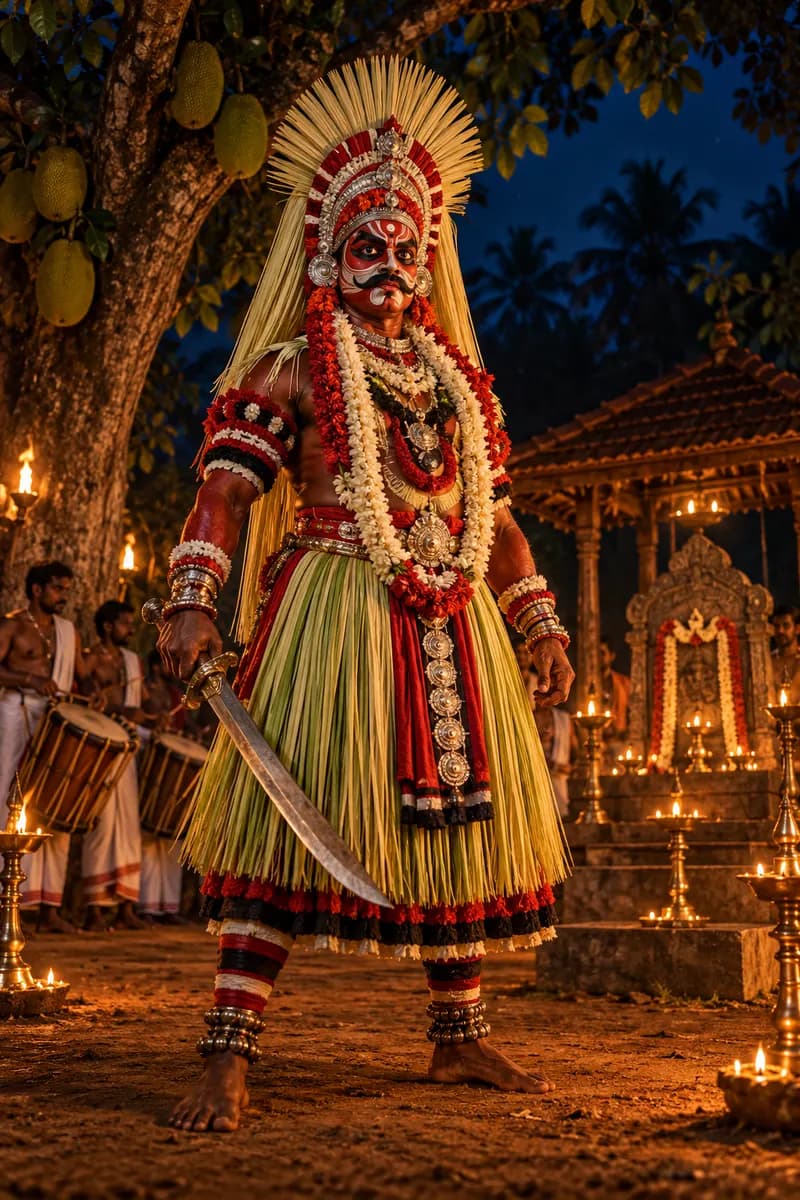
Annappa (ಅಣ್ಣಪ್ಪ) is a daiva — a deified hero spirit — from the Tulu Nadu region of coastal Karnataka. He is not a ghost, not a demon, not a god in the Sanskritic sense. He occupies a category unique to Tulu culture: the Bhuta or Daiva, a powerful spirit of a historical or legendary person who died heroically and was elevated through community worship into a protective guardian. Annappa was, in life, a warrior — a man who fought and died defending his people, his land, or a principle of justice. In death, the community did not forget him. They elevated him.
In the Tulu belief system, Daivas like Annappa exist in a tier between humans and the Sanskritic gods. They are more accessible, more immediate, more involved in daily human affairs than distant deities like Vishnu or Shiva. Annappa does not sit in a heaven. He walks the boundaries of the villages that worship him. He enforces oaths. He punishes those who cheat the weak. He protects land, livestock, and family honor. He is, in every meaningful sense, still present — summoned annually in the Bhuta Kola ritual where a dancer becomes his living vessel.
Why Annappa Commands Fear
INSTINCT EXPLOITED: THE WEIGHT OF BROKEN PROMISES
Annappa is not terrifying the way a predatory spirit is terrifying. He does not lurk in shadows or drag you into rivers. His fear is different — it is the fear of accountability.
Imagine you inherited land from your grandfather. With that land came an obligation: an annual Kola ceremony for the family daiva, Annappa. Your grandfather performed it every year without fail. Your father performed it, though with less devotion. You — modern, educated, skeptical — stopped. You let the shrine grow over with weeds. You sold a portion of the ancestral land to a developer. You told yourself these were old superstitions.
Then things begin to go wrong. Not dramatically — not overnight. A business deal falls through. Your child develops an illness that doctors cannot quite explain. Your sleep becomes restless, troubled by dreams of a man in warrior's dress standing at your threshold, saying nothing, simply waiting.
You tell yourself it is coincidence. But your mother knows. Your grandmother knows. The neighbors know. They say it quietly: Annappa is displeased. The daiva has not forgotten, even if you have.
This is the fear Annappa represents. Not the horror of the unknown, but the horror of the known — obligations you inherited, promises your ancestors made, contracts between the living and the heroic dead that you cannot simply walk away from because you have a degree and a car and a flat in Bangalore.
Annappa does not chase you. He waits. And the waiting is worse than any attack, because it means the debt is accumulating.
Origin — How He Came to Be
The Historical Warrior
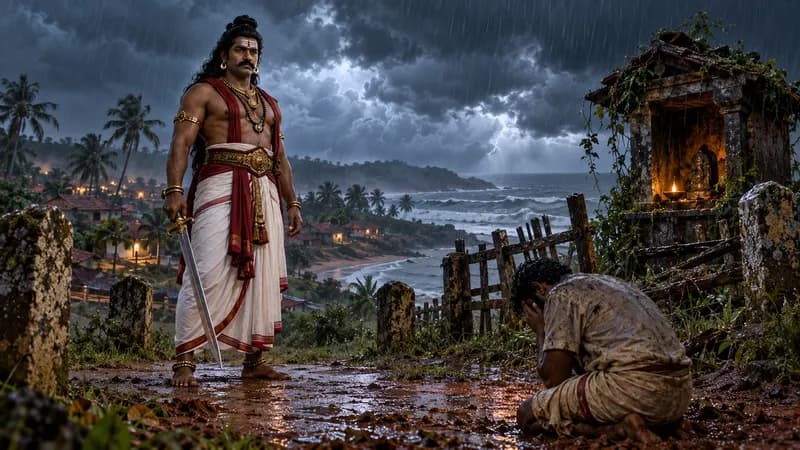
The precise historical identity of Annappa is debated — oral traditions in Tulu Nadu describe him as a warrior of exceptional courage who lived centuries ago. Some paddanas (Tulu narrative ballads) describe him as a local chieftain who defended his village against invasion. Others describe him as a common man who stood against injustice — refusing to let a powerful landlord seize the land of poor farmers — and was killed for it. What is consistent across all versions is the core narrative: a man who chose to fight when he could have submitted, and who died rather than compromise.
The Deification
In Tulu Nadu, heroic death does not end a person's story — it begins a new chapter. When a warrior died defending the community, the community recognized the death as a sacrifice. Rituals were performed. A shrine was established — often a simple stone or a small structure at the edge of the village. The spirit of the dead warrior was invoked, offered food and blood sacrifice, and asked to continue protecting the community from the other side of death. Over generations, this local hero became Annappa the Daiva — no longer a memory, but a living spiritual force.
The Paddana Tradition
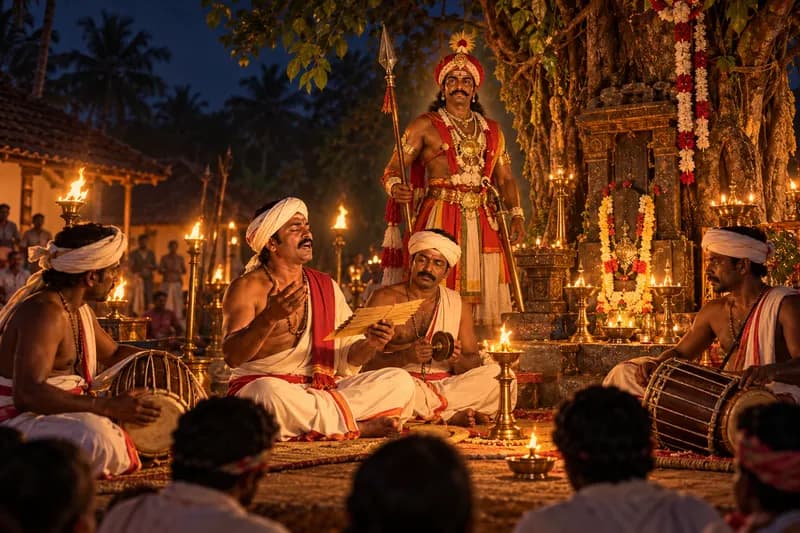
Annappa's story is preserved in the paddanas — the oral ballad tradition of Tulu Nadu. These are not scriptures. They are sung narratives, performed during Bhuta Kola ceremonies by specific families who have inherited the right to tell them. The paddana of Annappa recounts his life, his battles, his death, and his transformation into a guardian spirit. Each telling is both a history lesson and an invocation — by reciting the story, the community re-activates the daiva's presence.
The Daiva System
Annappa is part of a vast network of daivas in Tulu Nadu — hundreds of deified spirits, each with specific jurisdictions, territories, and family allegiances. This system predates the arrival of Brahminical Hinduism in the region and represents one of India's oldest surviving folk-religious traditions. The daivas are not subordinate to the Sanskritic gods — they operate in a parallel system, closer to the earth, closer to the people, more immediately responsive to human need and human failure.
What He Represents
Annappa embodies the Tulu Nadu belief that courage does not end with death. That a person who sacrificed their life for the community continues to have a stake in that community's welfare. He represents the idea that the heroic dead are not gone — they are promoted. From mortal defender to immortal guardian. The relationship is reciprocal: the community provides worship, and Annappa provides protection. Break the reciprocity, and the protection is withdrawn.
Appearance & Manifestation
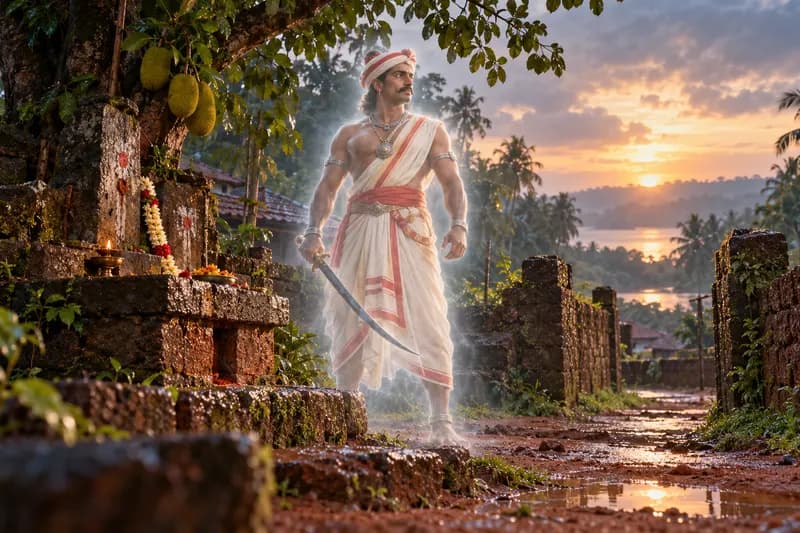
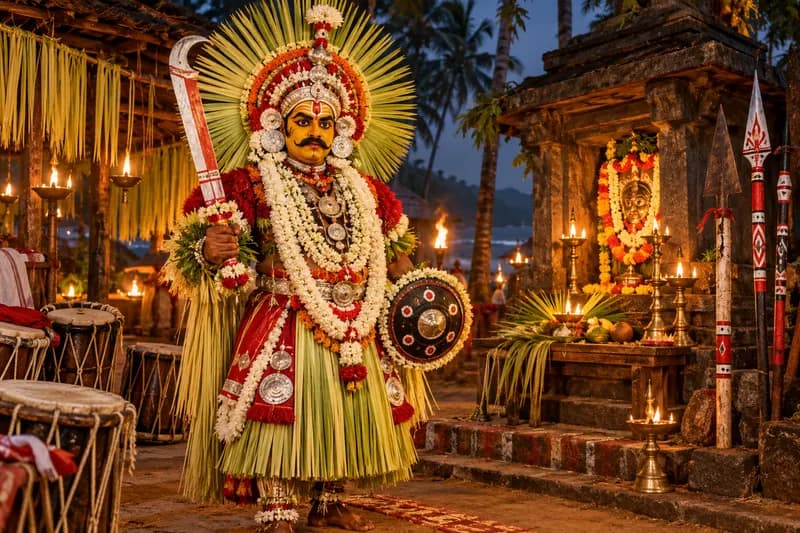
| 👁 Sight | During Bhuta Kola, Annappa manifests through the body of a trained performer (the Daiva Patri or Daiva Nartaka). The performer wears elaborate face paint — fierce geometric patterns in red, black, and white — a towering headdress of palm fronds and metal, and carries weapons: a sword or a trident. The transformation is total. The community does not see a dancer — they see Annappa himself, returned. |
| 🔊 Sound | The sound of the chende drums — deep, rhythmic, accelerating. The performer speaks in a voice that is not his own — deeper, commanding, sometimes archaic Tulu that modern speakers struggle to understand. Annappa's voice during Kola is oracular: he pronounces judgments, answers questions, delivers warnings. The drums never stop while he speaks. |
| 🍃 Smell | Frankincense, camphor, and the iron-sweet smell of animal sacrifice. Toddy (palm wine) offered at the shrine. The smoke from oil lamps burning through the night. During Kola, the air is thick with these smells — they mark the boundary between ordinary space and the daiva's territory. |
| ❄ Temperature | The Kola ground becomes charged — witnesses describe a heaviness in the air, a prickling sensation on the skin. Not cold in the conventional sense, but a feeling of *pressure* — as though the space has become smaller, denser, occupied by more than what is visible. |
| 🌑 Time | Bhuta Kola rituals begin at nightfall and continue until dawn. Annappa's presence is strongest in the deep hours — between midnight and 3 AM — when the performer's trance reaches its peak and the boundary between the human vessel and the daiva dissolves entirely. |
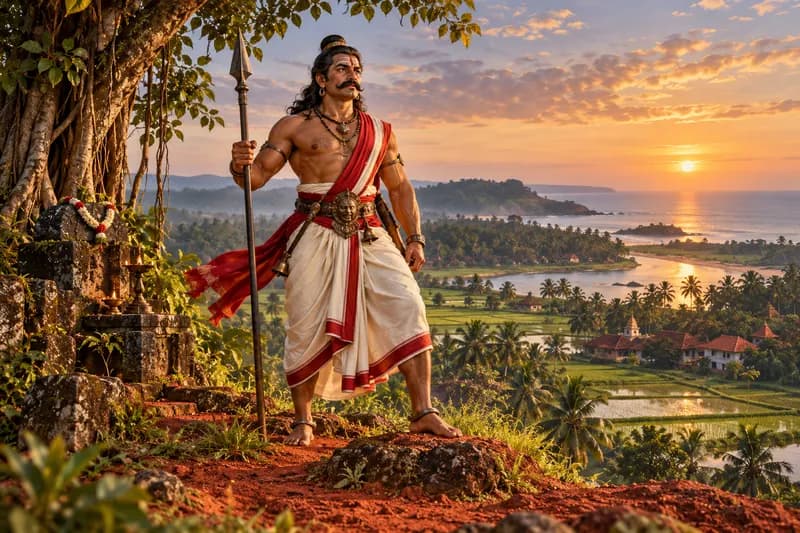
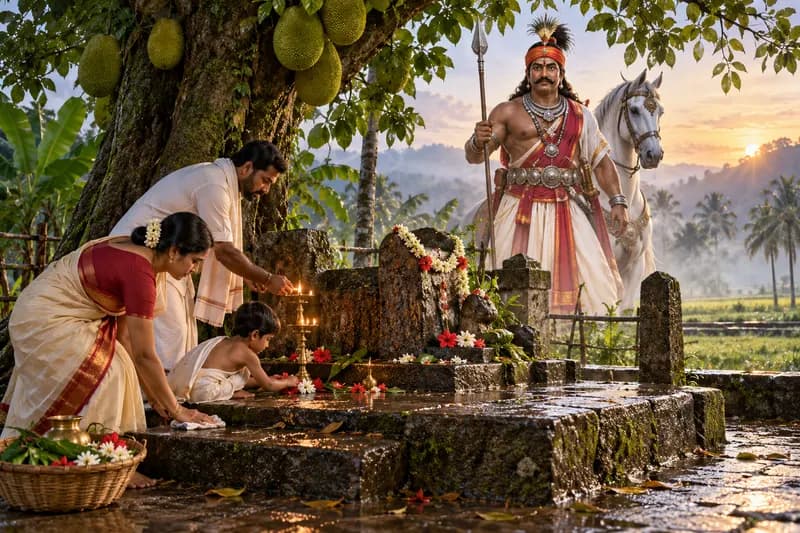
| 🏚 Habitat | Village shrines (Daiva Sthana) — often simple open-air structures with a stone platform, situated at village boundaries or near ancestral family homes. Specific trees (especially the sacred fig and the jackfruit) mark his territory. The shrine is not a temple — it is a threshold. |
The Landlord's Fence
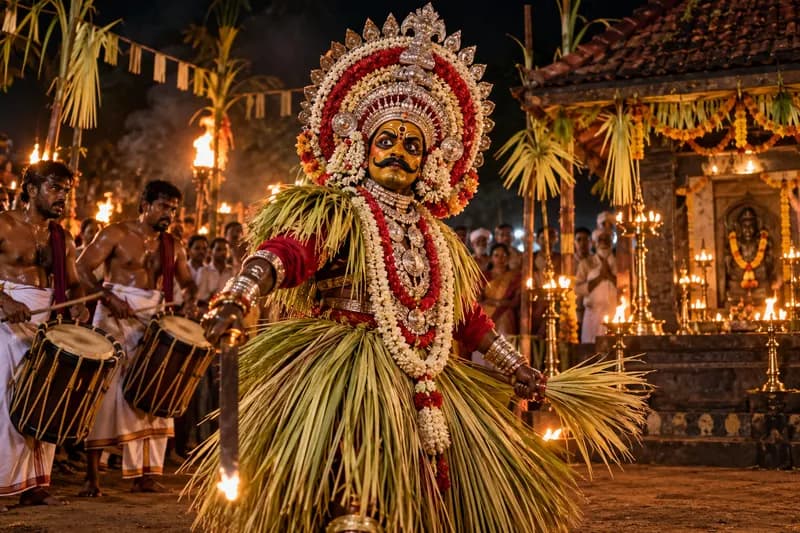
In a village between Mangalore and Udupi, there was a family that had worshipped Annappa for seven generations. The shrine was a small stone platform under a jackfruit tree at the edge of their ancestral property — nothing grand, but well-maintained. Every year, without fail, the family held the Kola. The drummer came. The performer came. The paddana was sung. Annappa arrived, spoke through the dancer, settled disputes among the family, blessed the children, and departed at dawn.
The family's eldest son, Raghuveer, moved to Bangalore for work. He did well — software, then management, then a flat in Whitefield. He married a woman from Delhi who had never heard of Bhuta Kola. He visited the village once a year, then once every two years, then not at all. The Kola continued, organized by his mother and his uncle. Raghuveer sent money sometimes.
When Raghuveer's mother died, things changed. His uncle was old, and the younger cousins had scattered to Mumbai and Dubai. The Kola did not happen that year. Or the next. The shrine under the jackfruit tree went untended. Moss covered the stone. The oil lamp sat empty.
A neighboring landlord — a man named Shetty who had long coveted the family's property — saw an opportunity. He began encroaching. First a fence, then a shed, then a claim filed at the taluk office. Raghuveer, distracted and distant, did not notice until a cousin called him: Shetty was claiming the land under the jackfruit tree as his own.
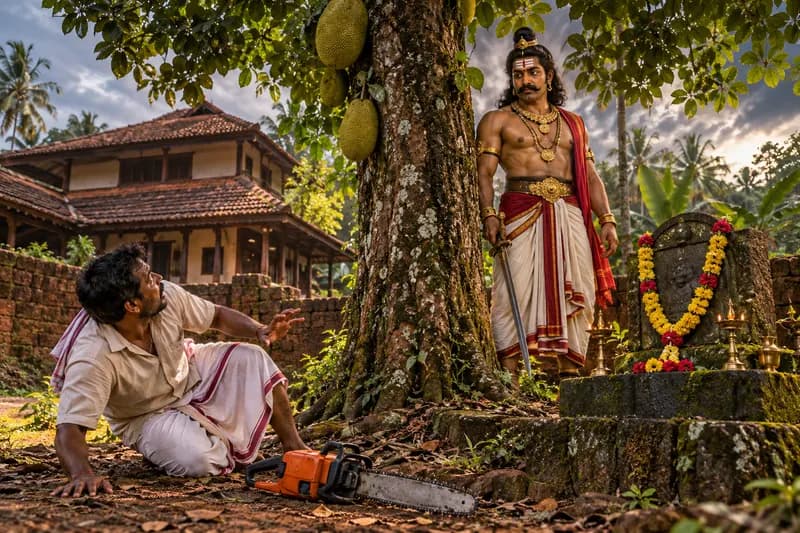
Raghuveer hired a lawyer. The case dragged. Meanwhile, Shetty's workers came to uproot the jackfruit tree to build a boundary wall. Three workers came on a Tuesday morning with axes.
The first worker's axe handle snapped on the first swing. The second worker slipped on dry ground and broke his ankle. The third worker — the foreman — looked at the stone platform beneath the tree, at the empty lamp and the faded vermilion, and refused to continue. He told Shetty: "There is something here. I will not touch this tree."
Shetty, a modern man, dismissed this as superstition. He came himself the next day with a chainsaw. The chainsaw started, ran for four seconds, and died. He pulled the cord again. Nothing. A mechanic examined it later and found nothing wrong with it. It started on the first pull in the mechanic's shop.
That night, Shetty could not sleep. He described later — reluctantly, only to his wife — a dream in which a man in warrior's dress stood at the foot of his bed. The man held a sword. He did not speak. He simply stood and stared. Shetty woke drenched in sweat.
Within the week, Shetty withdrew his land claim. He did not explain why. He told the taluk office he had made an error in the survey. The fence came down. The shed was removed.
Raghuveer flew down from Bangalore that month. He cleaned the shrine. He relit the lamp. He hired a drummer and a performer and held the Kola for the first time in four years. When the performer entered trance and Annappa spoke, the first thing the daiva said was: "You were late. Do not be late again."
The jackfruit tree still stands. The lamp still burns. Raghuveer comes every year now.
The Rules — How to Live Right
☠ WARNING ☠
Seven rules for maintaining Annappa's protection
- Never neglect the annual Kola ceremony. — The Kola is the contract renewal between family and daiva. Skip it, and you signal that you no longer want protection. Annappa will not force himself on those who reject him — but he will withdraw, and what follows is your responsibility.
- Do not sell or desecrate ancestral land tied to the daiva shrine. — The shrine is Annappa's anchor to the physical world. Destroy it, and you sever the relationship. The land is not just property — it is the daiva's jurisdiction.
- Keep your promises. Especially oaths made at the shrine. — Annappa was a man who died rather than break his word. He holds oath-breakers in contempt. Promises made at his shrine carry the weight of a spiritual contract.
- Do not cheat the weak or seize what is not yours. — Annappa's origin story is rooted in justice — defending the powerless against the powerful. Those who exploit the vulnerable invite his active displeasure.
- When the daiva speaks during Kola, listen. — The pronouncements made during Kola are not theatrical performances. They are judicial. Annappa settles disputes, assigns obligations, and delivers warnings. Ignoring them is not an option.
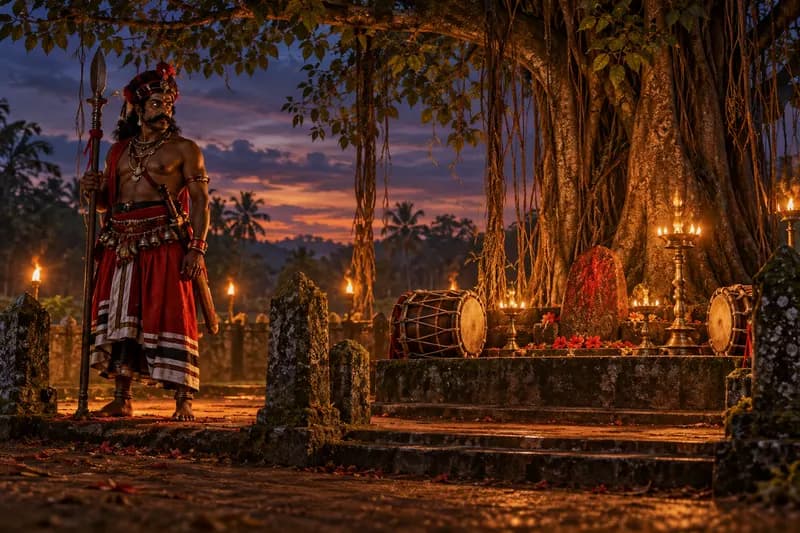
- Maintain the shrine — the lamp, the vermilion, the offerings. — The shrine is the daiva's home. A neglected shrine is an insult. It does not need to be grand — it needs to be cared for.
- Respect the performer during Kola — he is not himself. — When the Kola performer enters trance, the community treats him as Annappa. Any disrespect to the performer during trance is disrespect to the daiva. This is not metaphor.
What They Don't Tell You
Annappa is not something you appease out of fear. He is something you maintain out of relationship. The Tulu daiva system is not about terror — it is about reciprocity. Annappa gave his life for the community. In return, the community keeps his memory alive. This is not worship in the Sanskritic sense — there is no cosmic theology, no moksha, no heaven-and-hell calculus. It is a contract between the living and the heroic dead. You remember him. He protects you. You forget him. He withdraws. The consequences of withdrawal are not punishment — they are simply the absence of protection in a world that was never safe to begin with.
What Does Annappa Want?
Annappa wants to be remembered. Not worshipped — remembered.
He was a man who sacrificed his life for something larger than himself. The worst thing that can happen to such a sacrifice is being forgotten. Every Kola ceremony, every lit lamp, every recitation of the paddana is an act of remembrance — a community saying to its heroic dead: we know what you did, and it still matters.
Beyond memory, Annappa wants justice. The same justice he fought for in life — protection of the weak, punishment of the exploitative, maintenance of social contracts. He is not interested in devotion for its own sake. He is interested in whether the people he protects are living rightly.
This is what makes the daiva system so psychologically powerful. It is not abstract theology. It is a dead warrior standing at the edge of your village, watching whether you keep your promises. The question is never "Do you believe in Annappa?" The question is "Are you living in a way that Annappa would approve of?"
You're Most at Risk If...
- You are a member of a family with ancestral daiva obligations that have been neglected
- You have sold or allowed the desecration of land tied to a daiva shrine
- You broke an oath or promise made at a daiva shrine
- You are exploiting or cheating someone weaker than you — especially over land or inheritance
- You disrupted or disrespected a Bhuta Kola ceremony
- You are the eldest family member who inherited daiva responsibilities and chose to ignore them
Offerings & Appeasement
| Offering | Purpose |
|---|---|
| The Daily Offering | An oil lamp lit at the shrine at dusk. A pinch of vermilion on the stone. This is the minimum — the daily acknowledgment that the relationship exists. Even families that can afford nothing else do this. |
| The Annual Kola | The Bhuta Kola ceremony — the full ritual with drummer, performer, paddana recitation, animal sacrifice (or substitute), and community gathering. This is the centerpiece of the relationship. It is when Annappa physically returns, speaks, judges, and blesses. Missing it is the most significant failure a family can commit. |
| Blood Offering | Traditionally, a rooster sacrifice at the shrine. In modern practice, some families substitute with coconut and turmeric water. The blood offering is the oldest element — the logic is direct: Annappa shed his blood for the community, so the community offers blood in return. |
| Restoration Offering | If the relationship has been neglected for years, a special restoration Kola is performed — larger, more elaborate, with specific rituals to re-establish the broken connection. This is not a simple ceremony. It requires a knowledgeable Kola performer and can last an entire night. |
The Healer
Daiva Patri (Kola Performer) — The hereditary performer who channels the daiva during Bhuta Kola. This is not a role anyone can assume — it is inherited through specific families (usually from the Nalike, Parava, or Pambada communities). The Patri undergoes years of training in dance, trance techniques, and paddana recitation.
Mannedale (Village Oracle) — A person recognized by the community as having a natural sensitivity to daiva communication. They can diagnose whether a family's problems stem from daiva displeasure and prescribe the appropriate ritual response.
Astrologer (Jyotishi) — Often consulted as a first step — the astrologer examines the family's horoscope and history to determine if daiva-related issues are the cause of misfortune. They do not perform the remedy but identify the problem and direct the family to the appropriate Kola performer.
The Key Difference — You do not exorcise Annappa. You do not banish him. You re-establish the relationship. The healer's role is not to remove the daiva but to repair the contract. Annappa is not the disease — the neglect is.
What If You Dream of Annappa?
| Symbol | Meaning | |
|---|---|---|
| ⚔ | A Warrior Standing Silently | An ancestral obligation you have been ignoring. The warrior does not speak because the message has already been delivered — through the shrine, through the family, through tradition. He is waiting for you to act on what you already know. |
| 🪔 | An Unlit Lamp at a Shrine | A relationship — spiritual or human — that you have allowed to go dark through neglect. The lamp represents the minimum effort required to maintain a bond. The dream is telling you: light it before it is too late. |
| 🌳 | A Tree You Cannot Cut Down | Something in your life that is rooted deeper than your modern rational mind wants to acknowledge. An inheritance — cultural, familial, spiritual — that resists your attempts to discard it. The tree is older than your objections. |
| 🥁 | Drums in the Distance | A summoning. Something is calling you back — to a place, a tradition, a responsibility. The drums are the sound of the Kola you have not attended. They grow louder the longer you delay. |
Annappa in Art & Ritual
Bhuta Kola Performance Art — Living Tradition: The Bhuta Kola itself is one of India's most visually stunning ritual art forms. The performer's costume — towering headdress (ani), elaborate face paint, body armor of palm fronds and brass — transforms a human being into a divine warrior. This is not theater. There is no audience in the Western sense. Every person present is a participant. The art is the ritual; the ritual is the art.
Daiva Sthana Architecture — Village Shrines: Annappa's shrines range from simple stone platforms under sacred trees to elaborate structures with carved wooden pillars and bronze icons. The architectural style is distinct from Hindu temple architecture — lower, more open, more connected to the earth. Many shrines feature carved representations of the daiva on horseback or bearing weapons.
Tulu Paddana — Oral Literature: The paddanas sung during Kola are a literary art form in their own right — narrative ballads in Old Tulu, combining historical account, moral instruction, and spiritual invocation. They are performed in a specific melodic style that has been transmitted orally for centuries without written notation.
Bronze and Stone Hero Stones (Virgal): Hero stones — carved stone slabs depicting the warrior's death and apotheosis — are found across Tulu Nadu. These show the hero in battle in the lower panel, being carried to heaven in the middle, and seated in divine glory at the top. Physical evidence of the deification process, some dating to the 10th century CE and earlier.
Cross-Regional Patterns
Panjurli · Jumadi · Kalkuda-Kallurti · Bobbariya · Koragajja
| Dawn as hard limit | No — active day and night |
| Iron weakness | No |
| Tree-dwelling | Associated with specific trees |
| Counting compulsion | No |
| Backward feet | No |
Global Equivalent: The closest global parallel is the cult of hero-ancestors found across cultures — the Roman Lares (household guardian spirits of ancestors), the Japanese Goryō (vengeful spirits of the wronged dead who are pacified into protectors), and the West African ancestor veneration traditions. But Annappa's system is more structured and more reciprocal than most: it operates on a clear contract with specific obligations, annual renewal, and a living ritual (Kola) that physically summons the spirit into a human vessel. Few traditions match this level of direct, embodied ancestor interaction.
In Culture — Movies, Books, Research
| Type | Title | Description |
|---|---|---|
| Film | Kantara (2022) | Rishab Shetty's blockbuster brought Bhuta Kola and daiva worship to a national audience for the first time. While not specifically about Annappa, the film's climactic Kola sequence — and its portrayal of the daiva as protector of land and community — is drawn directly from the tradition Annappa belongs to. The film made millions of non-Tulu Indians aware of this belief system. |
| Documentary | Various ethnographic documentaries on Bhuta Kola | Several documentaries have captured the Kola ritual — the most notable being ethnographic works by scholars from the Karnataka Folklore University. These document the trance, the performance, the community dynamics, and the continued vitality of the practice. |
| Literature | S.A. Krishnaiah & Tulu Folklore Studies | Academic collections and analyses of Tulu paddanas, including narratives of hero-daivas like Annappa. These represent the most systematic attempt to document an oral tradition that is still primarily transmitted through performance rather than text. |
| Academic | Peter J. Claus — Tulu Ethnography | American anthropologist Peter J. Claus spent decades studying Tulu spirit possession and Bhuta Kola rituals. His work remains the most comprehensive English-language academic treatment of the daiva system, including hero spirits like Annappa. |
| Cultural Revival | Post-Kantara Bhuta Kola Tourism | After Kantara's success, Bhuta Kola ceremonies began attracting visitors from across India — a development that has created both pride and tension in Tulu Nadu communities, who navigate between welcoming recognition and protecting the sacred nature of the ritual. |
ACCURACY RATING: HIGH — KANTARA BROUGHT VISIBILITY · ACADEMIC DOCUMENTATION GROWING
Is Annappa Still Real?
- Annappa is not a relic. He is actively worshipped today — thousands of Bhuta Kola ceremonies are performed across Tulu Nadu every year between November and May. Families budget for the Kola the way other families budget for weddings.
- The belief system cuts across class and education levels. Software engineers in Bangalore fly home for the annual Kola. Doctors, lawyers, and professors maintain their family shrines. This is not a belief confined to rural communities — it is a living tradition that migrates with its people.
- The 2022 film Kantara created a national conversation about Bhuta Kola, but for Tulu Nadu families, nothing changed — they had been doing this for centuries. The film validated externally what was never in doubt internally.
- Land disputes in Tulu Nadu are still sometimes settled by daiva pronouncement during Kola. This is not legally binding, but community compliance is near-total. The daiva's word carries more weight than a court order in many villages.
- Young Tulu speakers are increasingly documenting paddanas and Kola ceremonies on social media and YouTube — creating a new archive of a tradition that has survived for centuries through purely oral transmission. The tradition is not dying. It is adapting.
Expert & Academic Context
- Peter J. Claus — Spirit Possession and Mediumship in Coastal Karnataka — The foundational English-language ethnographic study of Tulu Bhuta Kola, covering hero-worship, daiva taxonomy, and the ritual mechanics of spirit possession. Based on decades of fieldwork in Dakshina Kannada.
- Tulu Paddana Collections — Karnataka Folklore University — Systematic documentation of Tulu oral ballads, including hero-narratives of daivas like Annappa. Represents the most comprehensive written record of a tradition that is primarily performed, not read.
- A.V. Navada & Susheela Upadhyaya — Studies on Tulu Culture — Regional scholars whose work on Tulu folk religion, including the daiva system and its social functions, provides the most culturally embedded academic perspective on hero-spirit worship.
- Hero Stones of Karnataka — Archaeological Survey of India — Documentation of virgal (hero stones) across Karnataka, including Tulu Nadu, providing physical archaeological evidence of the hero-deification tradition dating back over a millennium.
- Brückner, Heidrun — On an Auspicious Day, at Dawn: Studies in Tulu Culture — German Indologist's detailed study of Tulu performative traditions, including the role of paddana singing and ritual dance in maintaining community identity and spiritual relationships with daivas.
The Annappa tradition — and the broader Tulu daiva system — represents one of the purest surviving examples of pre-Brahminical Indian folk religion. It predates the arrival of Sanskritic Hinduism in coastal Karnataka and has resisted absorption into the mainstream Hindu framework more successfully than almost any other regional tradition. The daiva system is fundamentally democratic: hero spirits can come from any caste, any class. What earns deification is not birth but action — specifically, sacrificial action in defense of the community. This creates a moral framework independent of Vedic authority: you are judged not by your ritual purity but by whether you kept your promises and protected the vulnerable. In an India increasingly homogenized by national media and Sanskritic religious movements, the Tulu daiva system stands as a powerful reminder that Indian spirituality was never singular — it was always local, always plural, always rooted in the specific land and the specific dead who gave their lives for it.
If You Encounter Annappa
Frequently Asked Questions
▶What is Annappa?
Annappa is a daiva — a deified hero spirit — from the Tulu Nadu region of coastal Karnataka. He was a historical warrior who died defending his community and was elevated through worship into a protective guardian spirit. He is worshipped through the Bhuta Kola ritual, where a trained performer channels his spirit.
▶Is Annappa a god?
Not in the Sanskritic sense. Annappa occupies a category unique to Tulu culture — the Daiva or Bhuta — which sits between humans and the high gods. He is more accessible and more involved in daily human affairs than Sanskritic deities. He does not offer cosmic salvation; he offers local protection in exchange for remembrance and ritual.
▶What is Bhuta Kola?
Bhuta Kola is the annual ritual ceremony in which a trained performer enters trance and channels the daiva. It involves elaborate costume, face paint, drumming, paddana recitation, and community participation. During the Kola, the daiva speaks through the performer — settling disputes, delivering warnings, and blessing the family or village. It is performed across Tulu Nadu between November and May.
▶Is Annappa dangerous?
Annappa's danger level is low (2 out of 10) because he is fundamentally a protector, not a predator. However, he can cause misfortune if neglected — unexplained illness, business failure, family discord. This is not seen as malice but as the natural consequence of breaking a reciprocal relationship.
▶What happens if you stop worshipping Annappa?
The protection is withdrawn. In Tulu belief, this can manifest as a gradual accumulation of misfortune — health problems, financial losses, family conflicts, land disputes. The remedy is not exorcism but restoration: re-establishing the Kola ceremony and repairing the shrine.
▶How is Annappa related to the movie Kantara?
Kantara (2022) depicts the Bhuta Kola tradition and daiva worship of Tulu Nadu. While not specifically about Annappa, the film's central daiva — a protector of land and community — draws directly from the same tradition. The film brought national attention to a practice that had been largely unknown outside coastal Karnataka.
Explore More
Related Spirits
Panjurli · Jumadi · Kalkuda-Kallurti · Bobbariya · Koragajja
Stories Are Being Summoned
One ghost story per week. Every Tuesday at midnight.