Aatma
It doesn't want to hurt you. It doesn't even know you're there. It's looking for a door that closed a long time ago.
- What Is an Aatma?
- Why the Aatma Is Unsettling
- Origin — How It Came to Exist
- Appearance & Manifestation
- The Woman at the Window
- The Rules — How to Coexist
- What They Don't Tell You
- What Does the Aatma Want?
- You're Most at Risk If...
- Offerings & Appeasement
- The Healer
- What If You Dream of an Aatma?
- The Aatma in Art History
- Cross-Regional Patterns
- In Culture — Movies, Books, Games
- Is the Aatma Still Real?
- Expert & Academic Context
- If You Encounter an Aatma
- Frequently Asked Questions
- Explore More
| Aatma | |
|---|---|
| Also Known As | Atma, Aatman, Roaming Spirit, Bhatakti Aatma |
| Script | आत्मा (Devanagari) |
| Pronunciation | AAT-maa (आत्-मा) |
| Region | Pan-India; referenced in every regional folklore tradition from Kashmir to Kerala |
| Category | Wandering Soul / Lost Spirit |
| Danger Level | Low |
| Fear Method | Unintentional confusion, emotional disturbance, ambient dread |
| Warning Sign | A feeling of being watched in empty rooms; unexplained sadness that lifts when you leave a specific location |
| First Documented | Upanishads (c. 800–500 BCE); Garuda Purana (medieval period); pan-Indian oral traditions |
| Still Believed? | Yes — universally across India. The concept of a wandering soul that hasn't found peace is one of the most widely held beliefs in Indian culture |
| Related | Bhut (Gond) · Pret · Chudail · Nishi · Daayan |
What Is an Aatma?
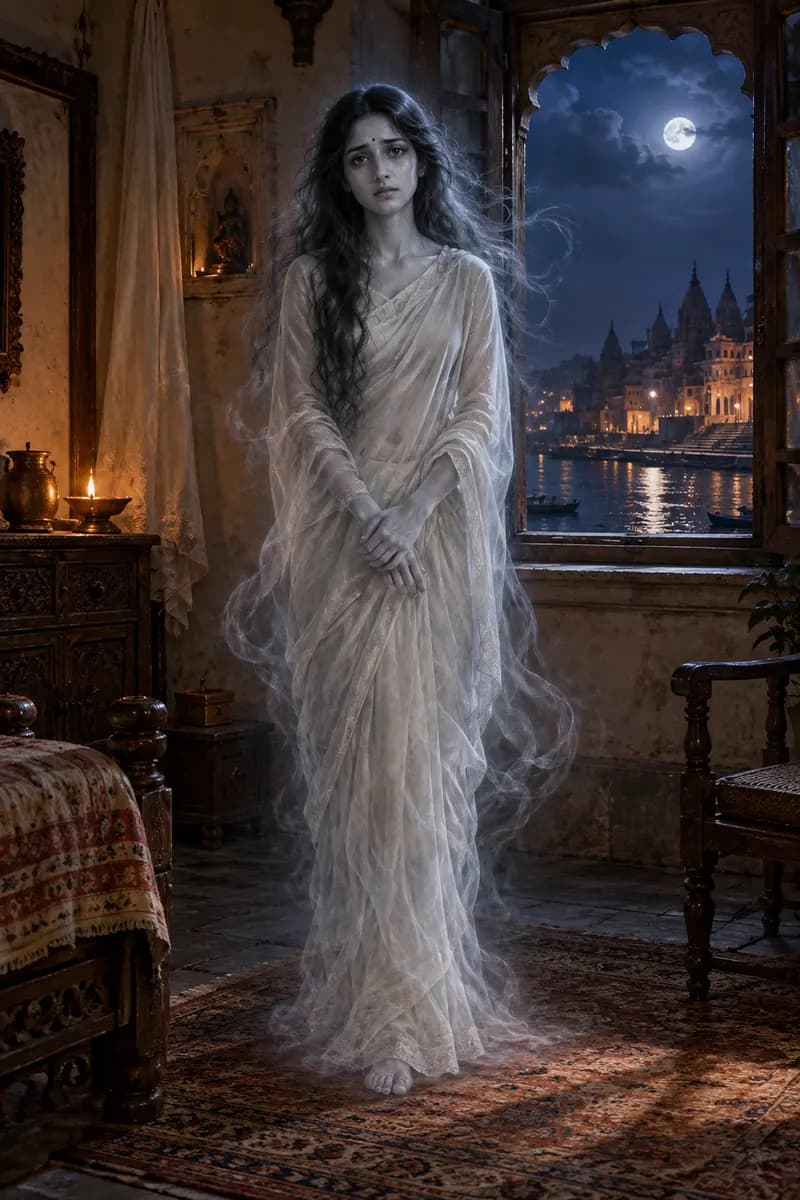
The Aatma (आत्मा) is the simplest and most universal supernatural concept in Indian folklore — a human soul that, after death, has failed to move on. It is not a demon, not a monster, not a cursed being. It is a person who died and got lost. The word 'aatma' literally means 'soul' or 'self' in Sanskrit, and in the context of Indian ghost lore, a Bhatakti Aatma (wandering soul) refers specifically to a spirit that remains earthbound due to incomplete last rites, sudden death, unfulfilled desires, or emotional attachment to the living world.
What separates the Aatma from every other entity in Indian supernatural tradition is the absence of malice. A Churel is vengeful. A Vetala is calculating. A Pishacha is predatory. The Aatma is simply confused — trapped between the world of the living and whatever comes after, unable to find the exit. It is the ghost equivalent of someone standing in a hallway, opening door after door, finding none of them right. This makes it the least dangerous entity in the database — but also, arguably, the saddest.
Why the Aatma Is Unsettling
INSTINCT EXPLOITED: THE FEAR OF BEING FORGOTTEN
You wake up at 3 AM. Nothing woke you — no sound, no movement. But something is different. The room feels heavier, like the air has thickened. You lie still and listen. Nothing. Absolute silence.
Then you feel it. Not a presence exactly — more like an absence that has weight. A sadness that isn't yours. It sits on your chest like a stone, and you can't explain it because nothing in your life justifies this depth of grief. It's borrowed sorrow. Someone else's loss, leaking through the walls.
You get up. You walk through your house. Every room feels normal except one — the corner near the old window, the spot by the staircase, the chair nobody sits in. There, the air is cooler. Not cold — just cooler. And if you stand still long enough, you might catch the faintest suggestion of movement in your peripheral vision. Not a shape. Not a figure. Just the sense that the emptiness has a direction — that it's looking for something.
The Aatma doesn't chase you. It doesn't threaten you. It doesn't even notice you most of the time. It is stuck in a loop, replaying the last moments of a life that ended too suddenly, searching for a resolution that doesn't exist anymore. The terror isn't what it might do to you. The terror is that one day, you might become one.
Every culture has a word for this. The Indians call it Bhatakti Aatma. The West calls it a ghost. But the Indian version carries a specific weight — because in a culture where the afterlife is not a destination but a transition, a soul that cannot transition is not just sad. It is a system failure. Something went wrong in the cosmic machinery, and this soul is the evidence.
Origin — How It Came to Exist
The Philosophical Root
The concept of the Aatma is rooted in the oldest Indian philosophical traditions. The Upanishads describe the atman as the eternal self — the indestructible core of every being that survives death and either merges with Brahman (the universal consciousness) or is reborn into a new body. A 'wandering aatma' is a soul for whom this process has stalled. The machinery of death and rebirth has jammed, and the soul is stuck in the gap.
Why Souls Get Stuck
Indian tradition identifies several reasons a soul might fail to move on: sudden or violent death (the soul didn't have time to prepare), incomplete funeral rites (the rituals that guide the soul forward were not performed), unfulfilled desires (the soul is anchored by something it wanted and never received), or intense emotional attachment to a living person or place (the soul cannot let go). Each of these creates a different flavor of wandering, but the result is the same — a spirit caught between worlds.
The Garuda Purana Connection
The Garuda Purana — the Hindu text most directly concerned with death, dying, and the afterlife — describes in elaborate detail the journey of the soul after death. It specifies the 13-day mourning period, the rituals required at each stage, and the consequences of failure. A soul whose rites are not completed is described as wandering in a painful intermediate state, unable to reach Yamaloka (the realm of the dead) or return to the living world. The Bhatakti Aatma is this soul.
The Difference from Bhoot
In casual Indian conversation, 'aatma' and 'bhoot' are often used interchangeably — but they are fundamentally different. A Bhoot is a ghost that has developed characteristics — it can become territorial, aggressive, or malicious over time. An Aatma is the raw state — a freshly lost soul before it hardens into something else. Think of the Aatma as the precursor: left alone long enough, a wandering Aatma can become a Bhoot, a Pret, or worse. But in its initial state, it is simply lost.
Universal but Unique
Every culture on Earth has a concept of the wandering dead. What makes the Indian Aatma distinct is its place in a systematic cosmology — it is not random or mysterious but a specific failure in a specific process. The rituals exist to prevent it. The prayers exist to cure it. The belief is not just that souls wander, but that we know exactly why they wander and exactly what to do about it. This makes the Aatma simultaneously the most common and most solvable supernatural problem in Indian tradition.
Appearance & Manifestation
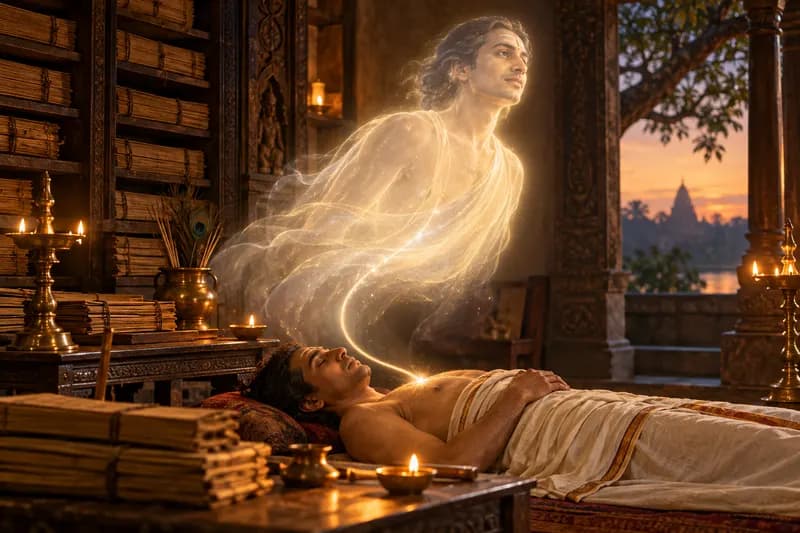
| 👁 Sight | Rarely seen directly. Most commonly appears as a flicker of movement in peripheral vision — a shape that vanishes when you look at it. In some traditions, a faint white or grey form, vaguely human-shaped, translucent. No distinct features. No face you can remember afterward. |
| 🔊 Sound | Soft sounds — a sigh, a whisper that contains no words, footsteps in empty rooms. The Aatma is not trying to communicate. These are residual sounds, echoes of a life that hasn't fully ended. You hear them the way you hear a television left on in another room. |
| 🍃 Smell | Sometimes a faint scent associated with the person who died — a perfume, incense, cooking spice, or flowers. These are not deliberate. They are memory-traces, fragments of a life bleeding through the boundary between worlds. |
| ❄ Temperature | A localized coolness, not extreme cold. One corner of a room will be noticeably cooler than the rest. Not freezing — just enough to make you pull your shawl tighter. The temperature difference marks where the Aatma is standing, waiting, looking for its door. |
| 🌑 Time | No strict time preference, unlike most Indian entities. The Aatma can be present at any hour, though activity is more noticeable at night when the house is quiet and the living are still. The pre-dawn hours (Brahma Muhurta, 4–6 AM) are sometimes noted as peak times. |
| 🏚 Habitat | The place where the person died, the home they lived in, or locations of deep emotional significance. Hospitals, old family homes, accident sites, and places where sudden death occurred. The Aatma doesn't choose where to haunt — it is anchored where its life ended or where its heart still is. |
The Woman at the Window
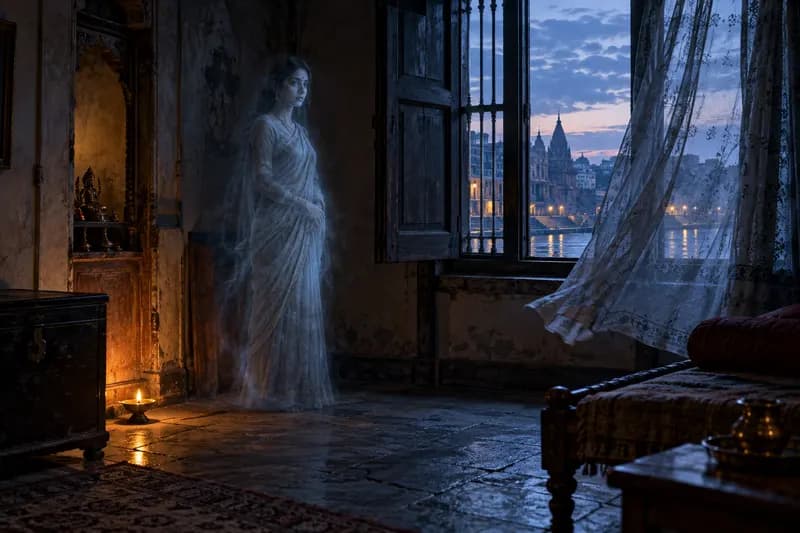
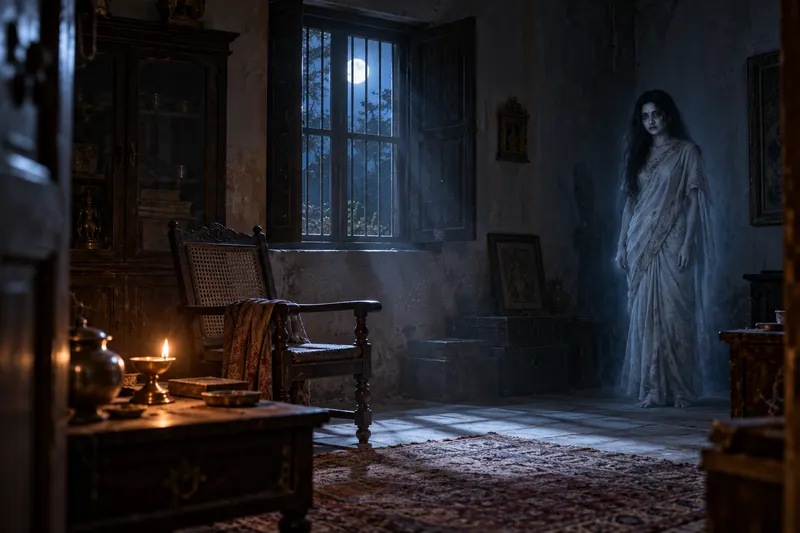
In a village near Varanasi, there was a house that had been empty for eleven years. The family who owned it had moved to Lucknow after the grandmother died — natural causes, old age, nothing dramatic. The house was locked. The neighbors had the key. Every Diwali, someone would go in, sweep the floors, light a lamp, and leave.
The trouble started when a new family bought the house. They were from Delhi — young couple, two children, looking for a quieter life. They renovated everything. New paint, new floors, new furniture. The house looked nothing like it had before.
Within the first week, the wife noticed that the window in the upstairs bedroom would not stay closed. Not broken — the latch worked fine. But every morning, she would find it open. She closed it. It opened. She locked it. It opened. She had the latch replaced. It opened.
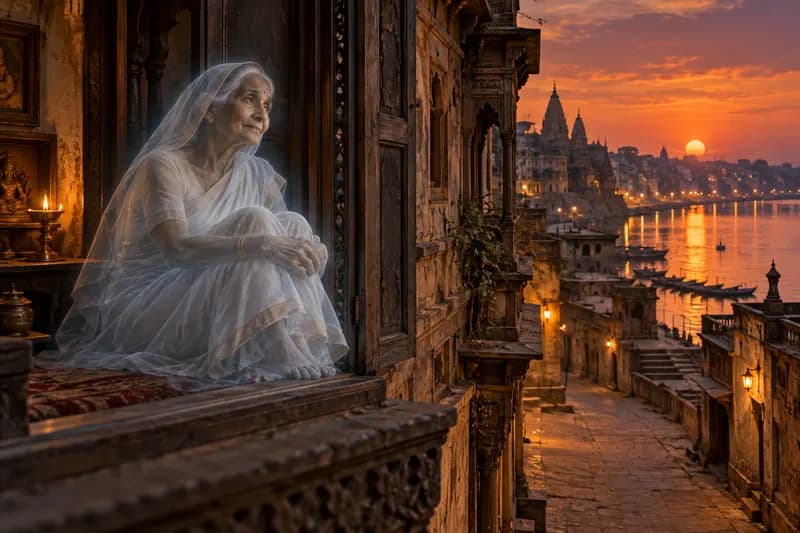
The children started talking about a 'nani' — a grandmother — who sat by the window in the evenings. They described her perfectly: thin, white sari, silver hair, always looking out the window toward the east. The parents saw nothing. But the children spoke about her the way children speak about a neighbor they see every day — casual, unbothered, factual.
The wife asked the neighbors. They went quiet. Then one of them — an old man who had lived there for decades — said: 'That was Kamla-ji's window. She sat there every evening for forty years, watching for her son to come home from the fields. Her son died in 1987. She kept watching until she died in 2013. She's still watching.'
The family called a pandit. He came, performed a small puja, recited prayers from the Garuda Purana, and asked the family to keep the window open for thirteen days. 'She is not angry,' he told them. 'She is not dangerous. She is waiting for someone who will never come. Let her look. After thirteen days, we will show her the door.'
They did as he said. On the fourteenth day, the window stayed closed on its own. The children stopped mentioning the nani. The upstairs bedroom lost its coolness.
The old neighbor came by that evening. 'The pandit did his work?' he asked. The wife nodded. The old man looked up at the window — closed now, curtains drawn — and said quietly, 'Good. She waited long enough.'
The Rules — How to Coexist
⚠ NOTICE ⚠
Six guidelines for living with an Aatma presence
- Do not panic. The Aatma is not hunting you. — Fear escalates energy. The Aatma is confused enough already — your fear adds to the noise and can make the haunting worse, not because the spirit becomes aggressive but because the emotional environment becomes more turbulent.
- Complete the funeral rites if they were left undone. — The most common reason for a wandering Aatma is incomplete shraddha (funeral ceremonies). If you can identify whose soul is lingering and perform the missing rites, the Aatma will move on. This is the cure, not a workaround.
- Light a diya (oil lamp) in the room where the presence is strongest. — Light in Indian tradition represents consciousness and guidance. A diya is not a weapon against the Aatma — it is a lamp to help it find its way. You are lighting the path, not driving it away.
- Speak to it calmly if you feel its presence. — In many traditions, simply telling the Aatma that it has died — gently, clearly — can help it understand its situation. It may not know it is dead. This sounds absurd, but it is one of the most consistently reported folk remedies across India.
- Do not try to bind, trap, or exorcise it with force. — The Aatma is not a demon. Aggressive rituals designed for malevolent entities will either fail or traumatize the spirit further, potentially converting a harmless wanderer into something hostile.
- Call a pandit for Garuda Purana recitation and guided rituals. — A trained priest can perform the specific rites that guide the soul forward — prayers, offerings to Yama (the god of death), and rituals that open the path the Aatma cannot find on its own.
What They Don't Tell You
The Aatma is the most democratic ghost in India. It doesn't care about caste, wealth, gender, or piety — anyone can become one. A billionaire who dies in a plane crash with no last rites. A child who drowns before anyone can perform the ceremonies. A perfectly good person whose family simply forgot to complete the thirteenth-day ritual. The Aatma is proof that in the Indian system, death is not automatic. It requires paperwork. It requires process. And if the process fails, you don't move on. You just stand there, in the hallway between worlds, opening doors that don't lead anywhere.
What Does the Aatma Want?
The Aatma wants to leave. That is the entire motivation — it wants to complete its journey, to move on to whatever comes next, whether that is rebirth, merging with the universal consciousness, or reaching Yamaloka. It is not staying by choice.
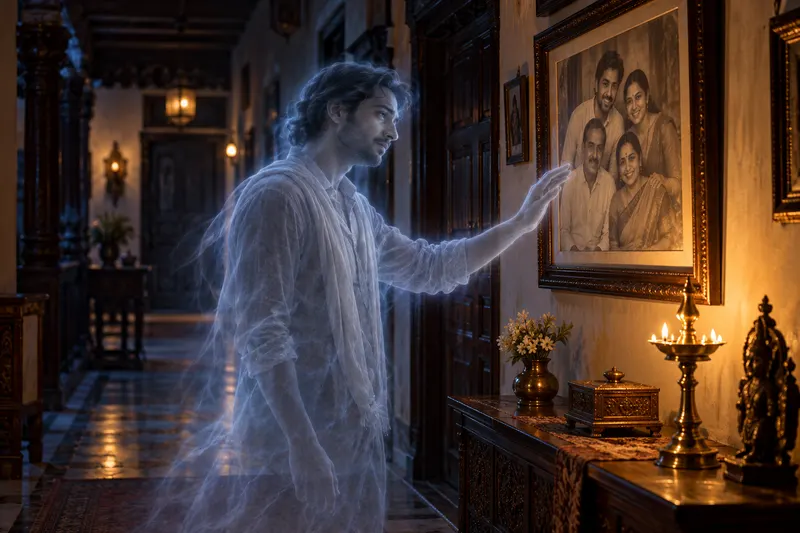
Some Aatmas are anchored by love — they cannot leave a person they were deeply attached to. A mother watching over her children. A husband who cannot accept that his wife has moved on. These are not malicious hauntings. They are acts of devotion that have outlasted the body.
Others are anchored by confusion — they died so suddenly that they don't understand what happened. Accident victims, people who died in their sleep, those taken by disease before they could prepare. These Aatmas replay their final moments endlessly, trying to understand the transition that happened too fast to process.
The rarest and saddest are those anchored by regret — something left unsaid, a wrong never corrected, a promise never kept. These Aatmas linger not because they can't leave but because they feel they haven't earned the right to go. They are serving a sentence they imposed on themselves.
You're Most at Risk If...
- You live in a house where someone died and the funeral rites were not completed
- You are emotionally sensitive or empathic — the Aatma's sadness can bleed into your own emotions
- You recently lost someone and are in a state of active grief — your grief can act as a beacon
- You moved into a very old house with a long history of residents
- You are near a site of sudden death — accident locations, hospitals, disaster zones
- You are a child — children in Indian tradition are believed to be more perceptive to wandering souls
Offerings & Appeasement
| Offering | Purpose |
|---|---|
| Shraddha Ceremony | The proper funeral rites — specifically the shraddha performed on the 13th day after death. This is the primary mechanism for releasing a wandering Aatma. If it was not done at the time of death, it can be performed later. Many families perform belated shraddha at Varanasi or Gaya specifically for souls that may be wandering. |
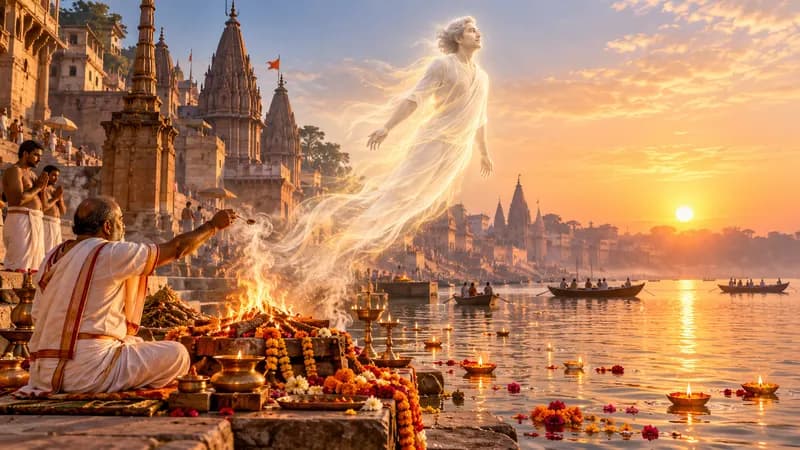
| Pind Daan at Gaya | Gaya in Bihar is the holiest site for rites for the dead. Pind daan — the offering of rice balls representing the deceased — is performed here specifically to release wandering souls. Thousands travel to Gaya annually for this purpose. |
| Daily Diya | Lighting an oil lamp daily in the room or area where the presence is felt. Not as worship — as guidance. The lamp represents the light the Aatma cannot find on its own. Simple, daily, and reportedly effective. |
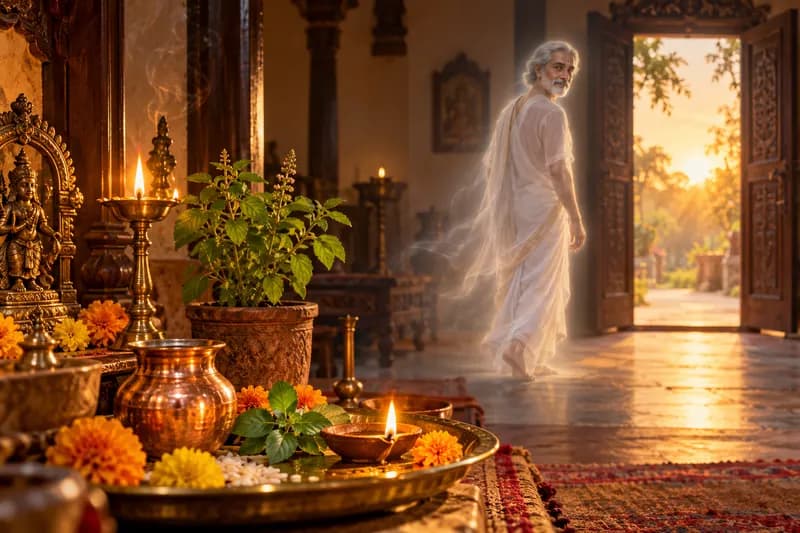
| Water and Tulsi | Offering water mixed with tulsi (holy basil) leaves. In many traditions, this is the most basic offering to a wandering soul — cooling, purifying, and symbolically representing the peace the Aatma is searching for. |
The Healer
Family Pandit / Purohit — The family priest who performs shraddha and other death rites. This is the first and most appropriate person to call. The Aatma is not a demonic entity — it does not require an exorcist. It requires a priest who can complete the rituals that were left undone.
Gaya Pandit — Priests at Gaya who specialize in pind daan for the departed. If the family cannot identify which soul is wandering, a general pind daan at Gaya is believed to cover all ancestors and lost souls in the family line.
Varanasi Priest — Priests at the ghats of Varanasi who perform death rites and final prayers. Varanasi is considered the city where the cycle of birth and death can be broken — performing rites here is believed to be especially effective for releasing stuck souls.
The Key Difference — You are not fighting the Aatma. You are helping it. Every healer, every ritual, every offering is designed to complete a journey that was interrupted — to finish the process of dying that was left half-done. This is not exorcism. This is hospice care for the dead.
What If You Dream of an Aatma?
| Symbol | Meaning | |
|---|---|---|
| 🚪 | A Figure Standing in a Doorway | Something in your life is in transition — unfinished, unresolved. The figure in the doorway is the part of you that hasn't moved through yet. Look at what you're avoiding completing. |
| 📞 | A Dead Relative Calling You | Not necessarily supernatural. In Indian dream tradition, a deceased family member appearing in a dream often means their rites need attention — an anniversary shraddha was missed, or they are asking for prayers. Perform a small puja and offer water. |
| 🏠 | An Empty House with Someone Inside | You are holding onto something — a memory, a relationship, a version of yourself — that no longer has a living presence but still occupies space in your mind. The empty house is your attachment. The someone inside is what you refuse to let go. |
| 😢 | Unexplained Crying in a Dream | Borrowed grief. You may be absorbing sadness from your environment — an old place, a family history, the emotional residue of people who came before you. The dream is not yours. It belongs to someone who left it behind. |
The Aatma in Art History
Vedic Period — Upanishadic Philosophy: The concept of the atman as eternal self is one of the foundational ideas of Indian philosophy. While not depicted visually, it is the conceptual root of every ghost, spirit, and wandering soul in the Indian tradition. The Upanishads gave India its framework for understanding death — and what happens when death goes wrong.
Medieval Period — Garuda Purana Illustrations: Illustrated manuscripts of the Garuda Purana depict the journey of the soul after death — being led by Yama's messengers, crossing rivers, facing judgment. The wandering Aatma is the soul that falls off this path, depicted in some manuscripts as a pale figure standing at the edge of the frame, outside the procession.
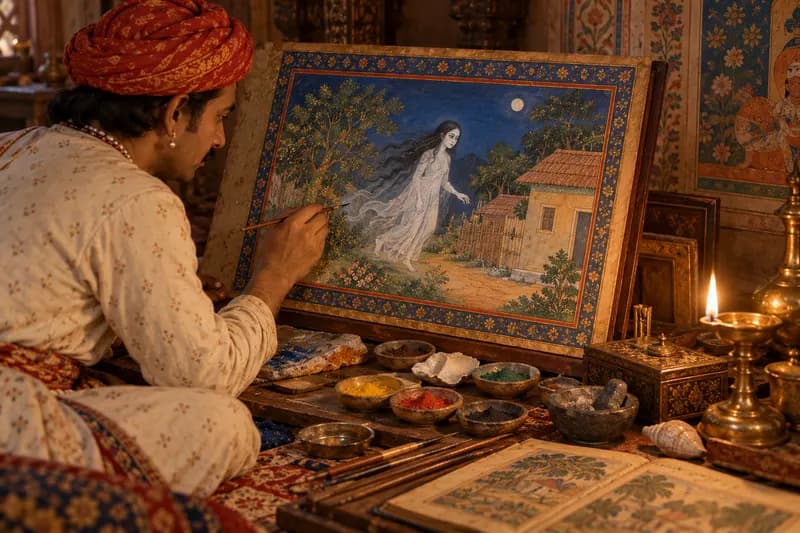
Colonial Period — Ghost Paintings: The Kalighat painting tradition of 19th-century Calcutta includes depictions of ghosts and spirits — pale figures, often female, hovering near houses or trees. These popular artworks made the concept of the wandering Aatma visual and accessible to the urban middle class.
Modern India — Cinema: The Aatma is the default ghost of Indian cinema. From the gentle spirits of Paheli and Stree to the terrifying ones in horror films, the wandering soul that can't move on is the most frequently depicted supernatural entity in Bollywood and regional cinema. The visual language — white sari, translucent form, sad eyes — comes directly from folk tradition.

Cross-Regional Patterns
Bhut (Gond) · Pret · Chudail · Nishi · Daayan
| Dawn as hard limit | No — can appear anytime |
| Iron weakness | No |
| Tree-dwelling | Rarely |
| Counting compulsion | No |
| Backward feet | No |
Global Equivalent: The closest global parallel is the Western concept of a ghost — specifically the 'unfinished business' ghost seen in traditions from Europe to Japan. The Japanese Yurei, the Chinese Gui, and the Western revenant all share the same core idea: a soul that hasn't moved on. What makes the Indian Aatma distinct is the systematic framework around it — specific rituals exist to diagnose and resolve the problem, making it less a horror and more a spiritual bureaucracy failure.
In Culture — Movies, Books, Games
| Type | Title | Description |
|---|---|---|
| Film | Paheli (2005) | Shah Rukh Khan plays a ghost who takes over a living man's form — but the underlying entity is an Aatma, a wandering soul driven by love and longing. One of the rare Bollywood films that treats the ghost with empathy rather than horror. |
| Film | Stree (2018) | The 'spirit of a woman wronged' terrorizes a town — but at its core, the entity is a wandering Aatma whose death rites were never completed and whose injustice was never addressed. The film blends comedy with genuine folk belief. |
| Film | Aatma (2013) | A father's spirit refuses to leave his daughter. The film directly explores the concept of an Aatma tethered by love — the ghost is not evil, just unable to let go. A literal depiction of the folk belief. |
| Literature | Garuda Purana (medieval text) | The primary Hindu scriptural source for understanding what happens after death. Describes the soul's journey, the rituals required, and the consequences of failure — the textual foundation for every wandering Aatma story in India. |
| Television | Aahat / Fear Files (Various) | Long-running Indian horror anthology shows that feature Aatma-type hauntings in nearly every episode. These shows shaped an entire generation's visual understanding of what a wandering soul looks and acts like. |
ACCURACY RATING: HIGH IN FOLK TRADITION · VARIABLE IN CINEMA
Is the Aatma Still Real?
- The Aatma is the most universally believed supernatural concept in India. Across every state, religion, language, and caste, the idea that a dead person's soul can get stuck and wander is almost universally accepted — even by people who consider themselves rational and modern.
- Shraddha ceremonies and death rites are performed by millions of families every year specifically to prevent the soul from wandering. The entire ritual infrastructure of Hindu death ceremonies exists because of this belief.
- Gaya receives hundreds of thousands of pilgrims annually, many specifically to perform pind daan for ancestors they believe may be wandering. This is not fringe — it is mainstream religious practice.
- Hospital workers, mortuary staff, and cremation ground workers across India report experiences consistent with Aatma beliefs — unexplained presences, cold spots, the sense of someone waiting. These are not dramatic hauntings but quiet, persistent feelings.
- The belief has survived urbanization, education, and modernity without any decrease. If anything, real estate agents in Indian cities report that properties where deaths occurred are still harder to sell — not because of superstition but because of a deep, culturally embedded certainty that souls can linger.
Expert & Academic Context
- Upanishads (c. 800–500 BCE) — The philosophical foundation for the concept of atman — the eternal self that survives death. The Brihadaranyaka and Chandogya Upanishads contain the earliest systematic discussions of what happens to the soul after death.
- Garuda Purana (medieval period) — The most detailed Hindu text on death, dying, and the afterlife. Describes the soul's journey after death, the rituals required at each stage, and the consequences of incomplete rites — the direct scriptural basis for the Bhatakti Aatma concept.
- Ghosts, Monsters and Demons of India — Rakesh Khanna — Modern documentation of Indian supernatural entities including the distinction between Aatma, Bhoot, Pret, and other categories of wandering dead.
- Death and Afterlife in Hinduism — various academic studies — Academic analysis of Hindu death rites, the shraddha system, and the belief infrastructure surrounding the soul's transition — including what happens when that transition fails.
- Folklore studies — regional Aatma traditions — Ethnographic documentation of Aatma beliefs across Indian regions, showing remarkable consistency in core belief (soul gets stuck) with regional variation in specifics (how it manifests, what fixes it).
The Aatma represents Indian culture's deepest belief about death: that it is not an event but a process, and that process can fail. Unlike Western ghost traditions, where the cause of haunting is often mysterious or supernatural, the Indian framework treats the wandering soul as a procedural problem — rituals were not completed, attachments were not released, transitions were not managed. This makes the Aatma simultaneously more mundane and more universal than any other ghost concept. It is not a curse or a punishment. It is a paperwork error in the cosmic bureaucracy of death — and like all bureaucratic errors, it has a solution if you know the right office to visit.
If You Encounter an Aatma
Frequently Asked Questions
▶What is the difference between an Aatma and a Bhoot?
An Aatma is a freshly wandering soul — confused, lost, and non-malicious. A Bhoot is what an Aatma can become if left unresolved for too long: a ghost that has developed territorial behavior, aggression, or specific haunting patterns. Think of the Aatma as the raw material and the Bhoot as the finished product.
▶Can an Aatma hurt you?
Almost never intentionally. The Aatma has a danger level of 1 — it is the least dangerous entity in Indian folklore. However, prolonged exposure to a wandering Aatma can cause emotional disturbance, sleep problems, and a persistent feeling of sadness that is not your own. It's not harm — it's contagion of grief.
▶How do you help a wandering Aatma move on?
Complete the funeral rites that were left undone — shraddha ceremony, pind daan, Garuda Purana recitation. If you don't know whose soul is lingering, a general pind daan at Gaya or Varanasi covers all ancestors. Light a diya daily in the space where the presence is felt. Speak to it calmly and tell it that it has died and it is okay to move on.
▶Is the Aatma concept only Hindu?
The word is Sanskrit, but the concept is pan-Indian and cross-religious. Muslim communities in India have parallel beliefs about rooh (soul) that can wander. Christian communities in Goa and Kerala have similar folk beliefs about restless spirits. The specific rituals differ, but the core belief — that a soul can get stuck — is universal across Indian religions.
▶Why do children see Aatmas more often than adults?
Indian folk tradition holds that children, especially those under seven, have thinner boundaries between the seen and unseen worlds. They haven't yet learned to filter out what adults have trained themselves to ignore. Whether this is genuine perception or imaginative interpretation, the consistency of children's reports across regions is striking.
▶Can you become an Aatma after death?
Yes — and this is what makes the concept so powerful. Anyone can become a wandering Aatma if their death rites are not completed, if they die suddenly, or if they cannot release their attachment to the living world. It is the most democratic afterlife failure in Indian belief — no one is immune.
Explore More
Related Spirits
Bhut (Gond) · Pret · Chudail · Nishi · Daayan
Stories Are Being Summoned
One ghost story per week. Every Tuesday at midnight.