Apsara
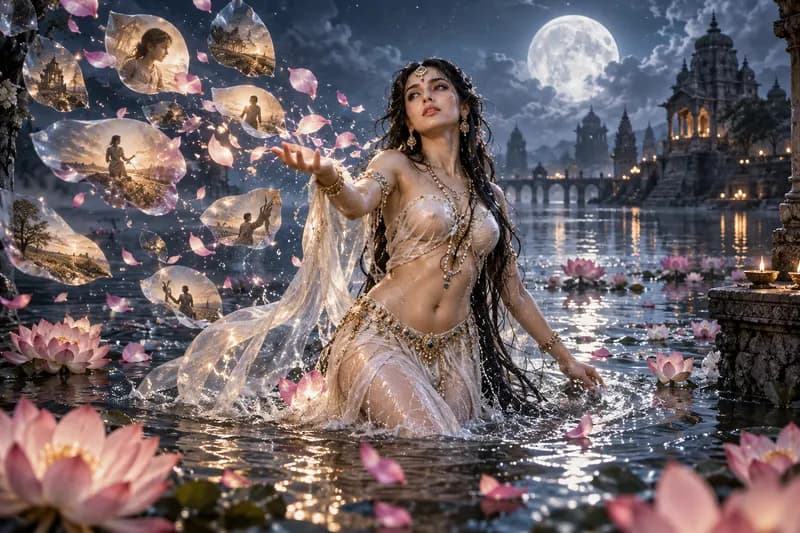
She rises from the water like a prayer you never finished. By the time you remember your own name, you have already forgotten everyone else's.
- What Is an Apsara?
- Why the Apsara Is Terrifying
- Origin — How They Came to Exist
- Appearance & Manifestation
- The Musician of the Narmada
- The Rules — How to Survive
- What They Don't Tell You
- What Does the Apsara Want?
- You're Most at Risk If...
- Offerings & Appeasement
- The Healer
- What If You Dream of an Apsara?
- The Apsara in Art History
- Cross-Regional Patterns
- In Culture — Movies, Books, Games
- Is the Apsara Still Real?
- Expert & Academic Context
- If You Encounter an Apsara
- Frequently Asked Questions
- Explore More
| Apsara | |
|---|---|
| Also Known As | Urvashi, Menaka, Rambha, Tilottama, Acchara (Pali), Apsaras (plural) |
| Script | अप्सरा (Devanagari) |
| Pronunciation | UP-suh-raa (अप्-स-रा) |
| Region | Pan-India; Southeast Asia (Cambodia, Indonesia, Thailand); Buddhist regions (Sri Lanka, Myanmar) |
| Category | Celestial Spirit / Water Nymph / Enchanting Entity |
| Danger Level | Dangerous |
| Fear Method | Enchantment, seduction, memory erasure, madness through beauty |
| Warning Sign | Inexplicable music near a lake at dusk; the scent of night-blooming flowers where none grow; an urge to walk toward water you cannot explain |
| First Documented | Rig Veda (c. 1500–1200 BCE); Atharva Veda; Mahabharata; Kalidasa's Vikramorvashiyam (4th–5th century CE) |
| Still Believed? | Yes — folk belief persists near sacred lakes, rivers, and temple tanks across India and Southeast Asia; Apsara imagery remains central to Hindu, Buddhist, and Jain temple art |
| Related | Yakshini · Naga Spirit · Mohini · Gandharva · Kinnara |
What Is an Apsara?
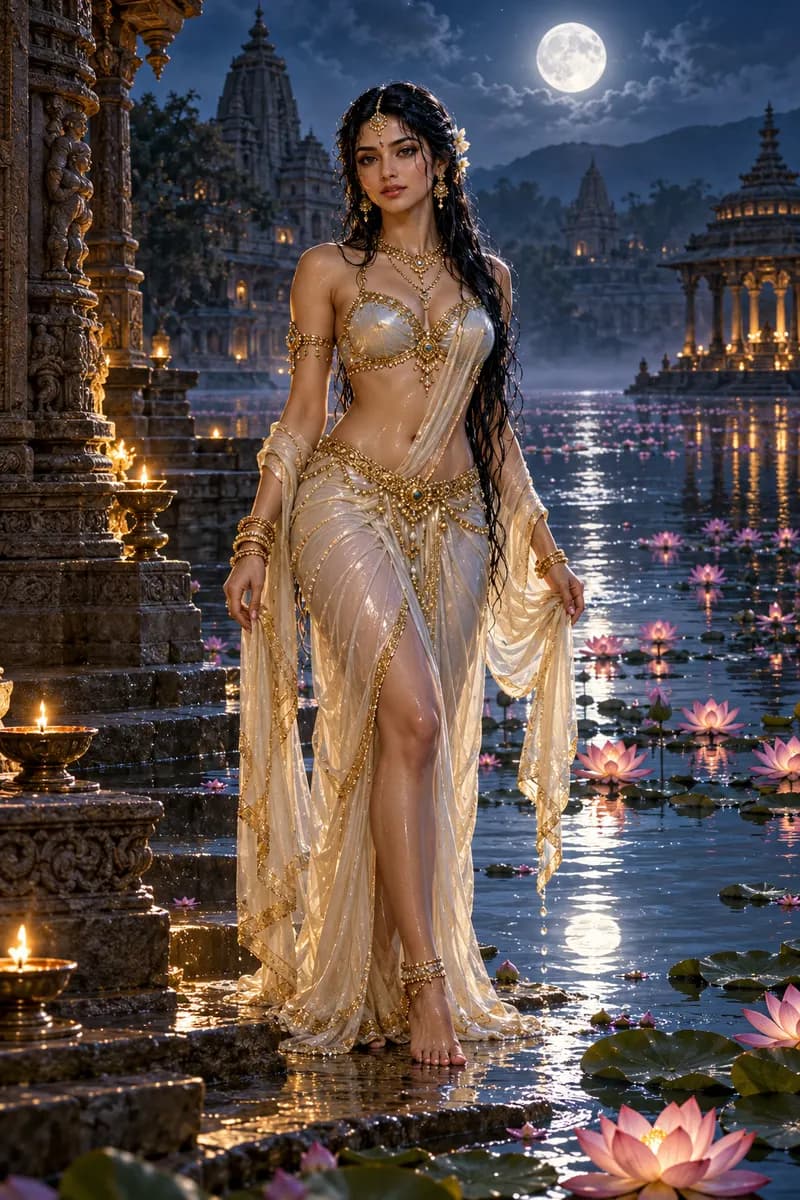
The Apsara (अप्सरा) is a celestial nymph from Indian and Southeast Asian mythology — a being of supernatural beauty who inhabits the liminal space between divine courts and earthly water bodies. The word itself derives from Sanskrit: ap (water) and saras (to flow), meaning "one who moves in the waters" or "one who emerges from the waters." In their celestial form, Apsaras are dancers and musicians in the court of Indra, king of the gods. In their ghost form — the one that concerns us here — they haunt lakes, rivers, waterfalls, and temple tanks, enchanting men who wander too close after dark.
The most famous Apsaras — Urvashi, Menaka, Rambha, and Tilottama — are not anonymous spirits. They are named, storied, and feared. Menaka was sent to seduce the sage Vishwamitra and break his meditation. She succeeded. Urvashi fell in love with the mortal king Pururavas, and when she left, he went mad searching for her along the banks of every river in the kingdom. Rambha was cursed by Vishwamitra after she tried to seduce him on Indra's orders. Tilottama was so beautiful that Shiva grew four additional faces so he could look at her from every direction simultaneously. These are not minor folklore figures. They are central to the oldest stories in Indian civilization.
Why the Apsara Is Terrifying
INSTINCT EXPLOITED: DESIRE AS DISSOLUTION
You are walking along the edge of a lake at dusk. The water is perfectly still. There is no wind. The trees are silent. And then you hear it — not a sound, exactly, but a vibration. Like someone is playing an instrument just below the threshold of hearing. Your chest tightens. Not in fear. In longing.
She is standing at the water's edge. Or maybe she is standing in the water — it is hard to tell because the surface doesn't break around her ankles. She is looking at you. She has always been looking at you. The feeling that hits you is not lust. It is recognition. As though you have been searching for this face your entire life and have only now found it.
You walk closer. You don't decide to walk closer. Your legs simply carry you. The water is at your feet now, warm, and the music is louder — a veena, or something older than a veena. She speaks your name. Not the name your parents gave you. A different name. A truer name. One you didn't know you had.
By morning, the villagers will find your clothes folded neatly on the bank. Your footprints lead to the water's edge and do not return. They will not search the lake. They know what lives there. They have always known.
The Apsara does not chase. She does not grab. She does not threaten. She removes the desire to leave. That is the horror. Not that you are taken — but that you go willingly, joyfully, gratefully. And you never come back.
Origin — How They Came to Exist
The Churning of the Ocean
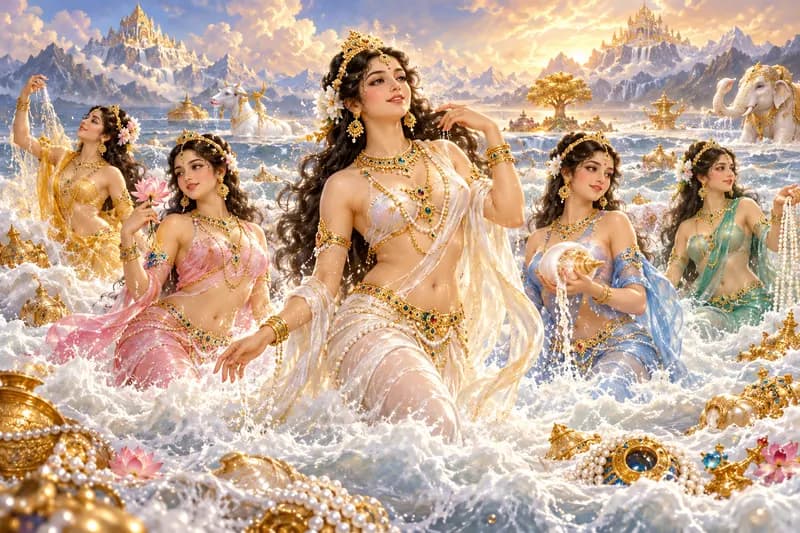
In the most widely told origin, the Apsaras emerged during the Samudra Manthan — the churning of the cosmic ocean by the Devas and Asuras. As divine treasures rose from the milk ocean one by one (Lakshmi, the moon, the wish-fulfilling tree), the Apsaras also emerged — thousands of impossibly beautiful women rising from the foam. Neither the gods nor the demons claimed them. They belonged to no one. They belonged to the water.
Celestial Dancers of Indra's Court
In their primary role, Apsaras serve as dancers, musicians, and companions in the court of Indra (Swarga). They entertain the gods. They welcome warriors who die in battle (paralleling the Valkyries of Norse tradition). But their most feared function is as weapons — Indra sends them to Earth to seduce sages whose accumulated spiritual power (tapas) threatens to rival the gods. The Apsara is Indra's most reliable weapon: beauty deployed against wisdom.
Menaka and Vishwamitra
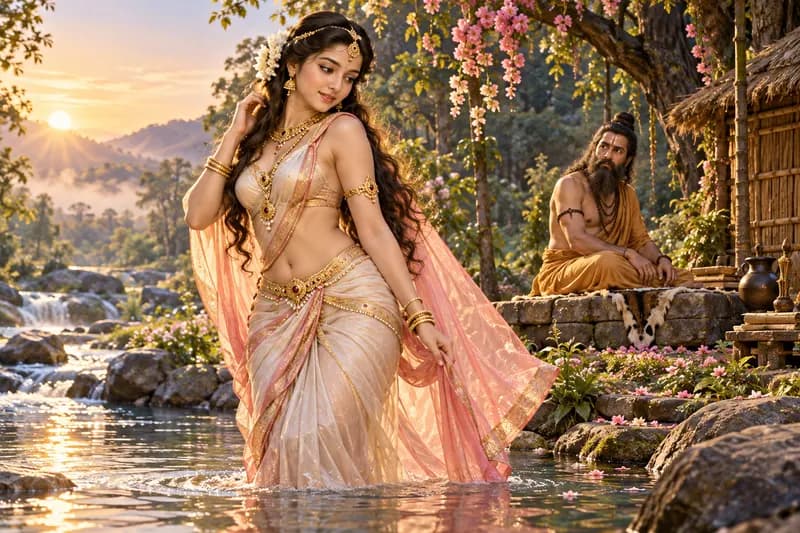
The defining Apsara story. The sage Vishwamitra had accumulated such fierce tapas through meditation that the heavens themselves trembled. Indra, threatened, sent the Apsara Menaka to break his concentration. She descended to the forest where Vishwamitra meditated, and as she bathed in the river nearby, a wind blew away her garments. Vishwamitra looked. His thousands of years of accumulated spiritual power shattered in a single glance. He and Menaka had a daughter — Shakuntala — and Vishwamitra lost everything he had built. This is the template: the Apsara as the undoing of the disciplined mind.
Urvashi and Pururavas
Urvashi, the most celebrated Apsara, fell in love with the mortal king Pururavas. She agreed to live with him on conditions — he must never appear naked before her, and two pet lambs must never be taken from her side. The Gandharvas (celestial musicians) conspired to violate both conditions. Urvashi vanished. Pururavas wandered riverbanks for years, driven to the edge of madness, searching for her. Kalidasa's play Vikramorvashiyam immortalized this — the earliest love tragedy in Sanskrit literature.
The Ghost Form
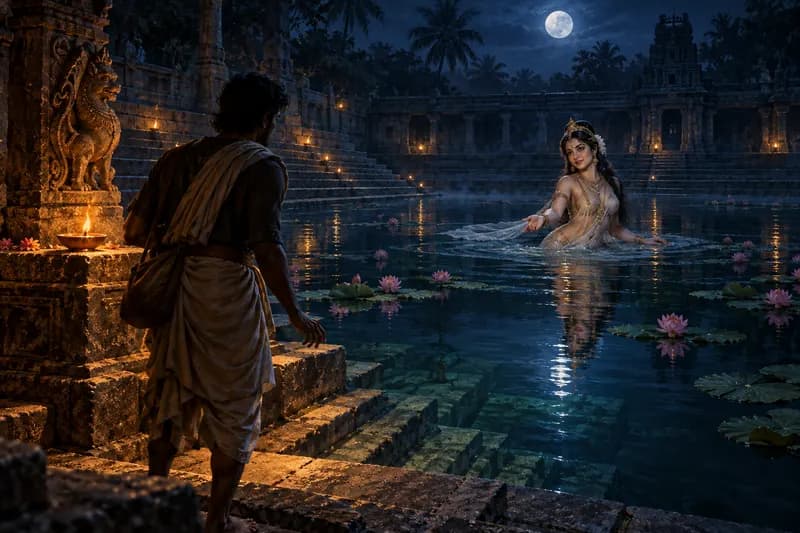
In folk belief — distinct from the high mythology — Apsaras are not just celestial beings who occasionally visit Earth. They haunt specific water bodies. Lakes, rivers, waterfalls, and temple tanks in rural India are identified as Apsara-haunted. Men who bathe alone after dark, who linger near water at twilight, who hear music from empty riverbanks — these are the ones who do not return. The folk Apsara has shed the celestial court entirely. She is a water spirit. A lake ghost. Beautiful, patient, and permanent.
Appearance & Manifestation
| 👁 Sight | Impossibly beautiful — the kind of beauty that does not trigger attraction but paralysis. Features that shift slightly depending on what the viewer desires most: sometimes fair, sometimes dark, always perfect. Adorned in silk and gold, dripping with water. Long black hair, unbound, often wet. In folk descriptions, her feet do not touch the ground — she hovers just above the water's surface. |
| 🔊 Sound | Music. Always music. The sound of anklets (ghungroo), or a veena playing a raga that does not exist in any classical tradition. Singing that sounds like it comes from inside your own head rather than from outside. Laughter that carries across water — light, inviting, and impossible to ignore. |
| 🍃 Smell | Night-blooming jasmine. Wet lotus. The sweet green scent of river moss. The fragrance arrives before she does and lingers for hours after she has gone. Fishermen on the Narmada say you can smell an Apsara from a hundred yards — and once you do, your feet start moving. |
| ❄ Temperature | Warm. Unlike most Indian supernatural entities that bring cold, the Apsara brings warmth — the water near her feels like a heated bath. The air softens. This is part of the trap: everything about the encounter feels safe, comforting, welcoming. You do not feel threatened because there is no threat. Only invitation. |
| 🌑 Time | Twilight and moonlit nights. The Apsara is not bound to darkness the way a Vetala or Bhoot is — she can manifest in the silver hour between day and night, in full moonlight, in the pre-dawn mist over a river. The most dangerous time is Purnima (full moon), when the water reflects enough light to see her clearly. |
| 🏚 Habitat | Lakes, rivers, waterfalls, temple tanks, sacred pools, and lotus ponds. Any body of still or slow-moving water in a remote location. In Southeast Asia: the moats of Angkor Wat, the sacred cenotes, the rivers near ancient temples. Water is her element. She does not exist apart from it. |
The Musician of the Narmada
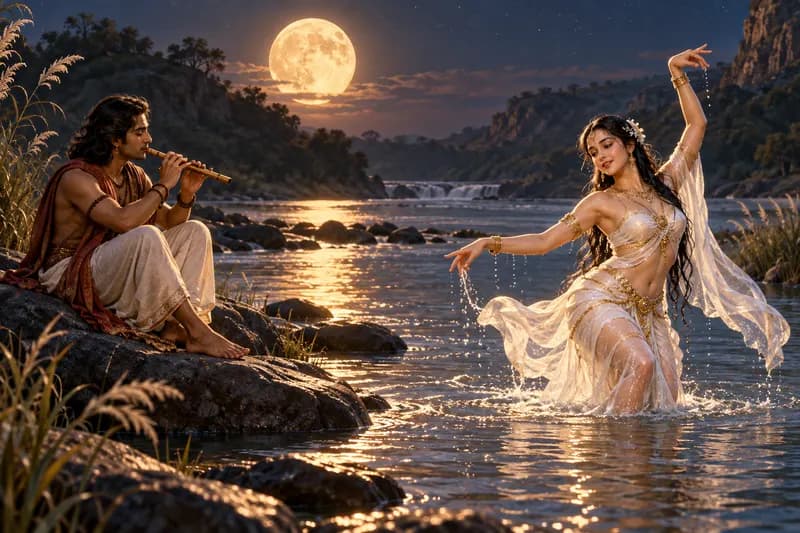
There was a young musician in a village along the Narmada who played the bansuri better than anyone within a hundred miles. His name was Keshav. He played at weddings, at temples, at harvest festivals — but his favorite place to play was the riverbank at dusk, alone, where the acoustics of the water and the valley turned his bamboo flute into something that sounded like it belonged to a god.
His mother warned him. The older women of the village warned him. They said the river was not empty at twilight. They said things lived in the Narmada that had been there since before the village, before the temples, before the language they spoke. Keshav listened politely and went to the river anyway. He was twenty-two and talented and did not believe in things that could not be seen.
One evening in the month of Kartik, as the full moon rose fat and copper-colored over the eastern hills, Keshav sat on his usual rock at the river's edge and began to play. He played Raga Yaman — the evening raga, the one that sounds like longing given a melody. The river was glassy. The air was warm for the season. He closed his eyes.
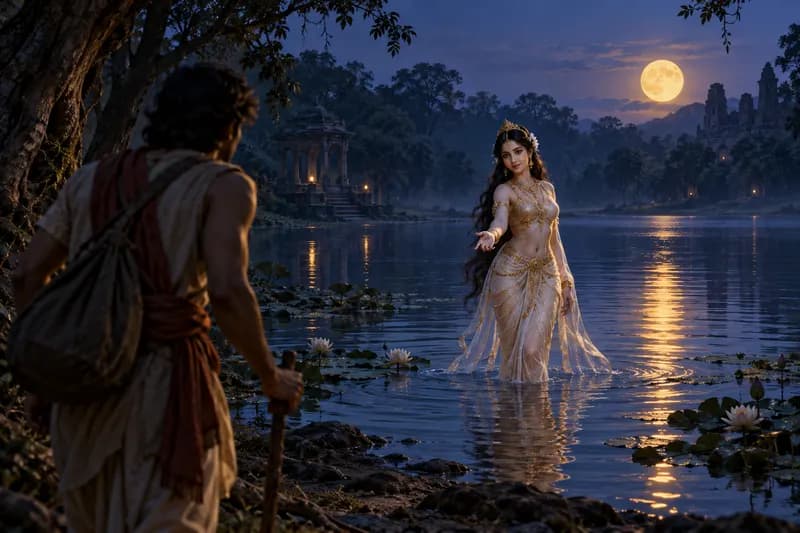
When he opened them, there was a woman standing in the river. Not on the bank. In the river. The water came to her ankles but did not move around her feet — it was as though the current simply went around her, or through her, or did not exist where she stood. She was watching him with an expression he had never seen on a human face: not desire, not curiosity, but recognition. As though she had been waiting for exactly this raga, played by exactly these hands, on exactly this night.
She was the most beautiful thing he had ever seen. He knew this the way you know that fire is hot — not as an opinion but as a physical fact that required no evaluation. She wore white silk that was somehow dry despite standing in the river. Her hair was black and unbound and reached past her waist. Gold ornaments at her wrists and ankles caught the moonlight.
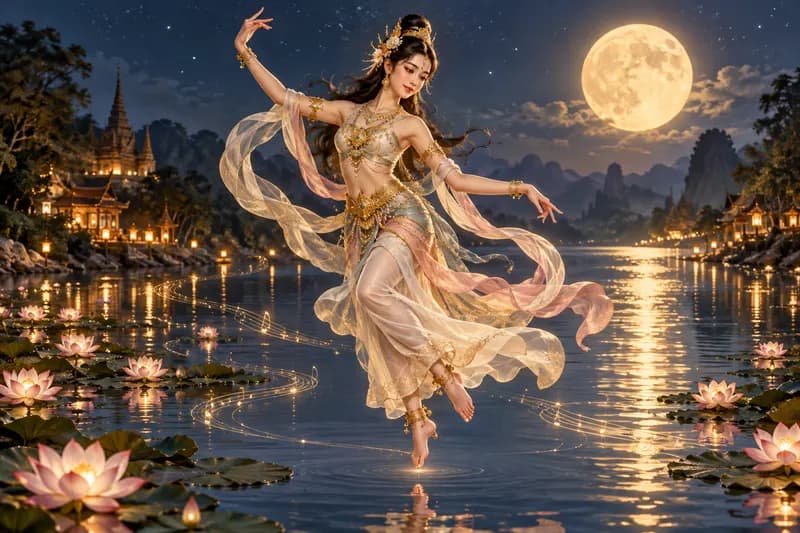
She said nothing. She began to dance.
Keshav played. He did not decide to keep playing. His fingers moved on the bansuri as though they had been playing for her his entire life and every performance before this had been practice. The raga shifted — no longer Yaman, but something older, something he did not recognize but his fingers knew. She danced in the river without disturbing the water, and the music and the movement were one thing, and the moon climbed higher, and the night grew deeper.
He played until dawn. When the first gray light touched the eastern hills, the woman stopped. She looked at him — and for the first time, her expression changed. Something like sadness. Something like hunger. She stepped backward into deeper water, and the river closed over her head without a ripple.
Keshav walked home in the morning light with his bansuri under his arm. His mother saw his face and began to cry. She knew. Every woman in the village knew what that expression meant — the slack jaw, the empty eyes, the half-smile of someone who has seen something too beautiful to survive.
He went back the next night. And the next. And the next. Each night he played, and each night she danced, and each night the music grew stranger and more beautiful and less like anything that belonged to the human world. He stopped eating properly. He stopped playing at weddings. He stopped speaking to anyone in the village.
On the seventh night, he walked into the river. Not to his ankles. To his waist. To his chest. Playing the bansuri even as the water reached his chin. The last thing the village heard was a melody so beautiful that three women wept without knowing why — and then silence.
They found the bansuri the next morning, floating in the shallows. They never found Keshav. The older women of the village performed a small puja at the riverbank and did not speak his name again. The river flowed on. At dusk, if you listened carefully, you could hear music.
The Rules — How to Survive
☠ WARNING ☠
Seven rules for surviving an Apsara encounter
- Never go to a lake or river alone after twilight. — The Apsara manifests at the boundary between day and night. Solitude is essential to the enchantment — it does not work on groups, only on the isolated. A companion breaks the spell before it begins.
- If you hear music near water and cannot identify the source — leave immediately. — The music is the first stage of enchantment. Once you stop to listen, the second stage begins. The longer you listen, the harder it becomes to leave. Walk away while your legs still obey you.
- Do not play musical instruments near water bodies after dark. — Music attracts Apsaras the way blood attracts sharks. Your art is the lure. The more skilled the musician, the stronger the attraction. Folk tradition is explicit: never play the bansuri, veena, or sing near a river at night.
- Carry a piece of iron or steel on your person near sacred water bodies. — Iron disrupts enchantment. A nail, a key, a knife — anything made of iron serves as a grounding element that weakens the Apsara's ability to cloud your judgment. Grip it when the longing starts.
- If you see her — do not look at her face. Look at her feet. — The enchantment enters through the eyes. If you look at her face, the desire to stay becomes overwhelming. Her feet reveal the truth — they do not touch the ground, or they point backward, or they leave no impression. The feet break the illusion.
- Invoke Saraswati, not Indra. — Indra *commands* Apsaras — he is their lord, but he also deploys them as weapons. Invoking Indra is asking the general to recall his soldier, which he may or may not do. Saraswati, goddess of knowledge and music, represents the disciplined counterpart to the Apsara's enchantment. Her name is the antidote to beauty without wisdom.
- If someone you know has been going to the river alone every evening — intervene before the seventh night. — Folk tradition across multiple regions agrees: the enchantment completes on the seventh night. Before that, the person can still be pulled back. After that, they belong to the water.
What They Don't Tell You
The Apsara is not a predator. She is a consequence. In the deepest layer of the tradition, the Apsara does not choose her victims — she responds to something already broken in them. The man who walks to the river at dusk is already lonely. Already searching. Already incomplete. The Apsara gives him what he was looking for — beauty, recognition, the feeling of being truly seen — and the price is that he can never go back to a world where those things are imperfect and partial. The Apsara is not the disease. She is the symptom. The disease is the unbearable gap between what humans want from love and what human love can actually deliver.
What Does the Apsara Want?
The Apsara doesn't want to drown you. She wants an audience.
In the celestial court, she dances for gods who are immortal, who have seen everything, who are incapable of genuine wonder. For millennia, she has performed for beings who cannot be moved. Then she descends to Earth — to a riverbank, to a lake — and a mortal man watches her dance, and he weeps. He is moved. He is shattered by beauty. He experiences something the gods, in their infinite satiation, never can.
The Apsara is drawn to human vulnerability because vulnerability is what makes beauty matter. A god sees beauty and nods. A mortal sees beauty and is destroyed. The destruction is the point. It is the only evidence that what she does means anything at all.
This is the tragedy of the Apsara: she is the most beautiful being in existence, and the only creatures capable of appreciating that beauty are the ones who cannot survive it. She does not kill out of malice. She kills because her audience is too fragile for the performance.
You're Most at Risk If...
- You spend time alone near water bodies at twilight or during full moon nights
- You are a musician, artist, or poet — creative sensitivity attracts Apsaras
- You are in a state of emotional longing, heartbreak, or romantic obsession
- You have recently lost a lover or are searching for something you cannot name
- You are a practitioner of intense meditation or tapas near a river or lake
- You are a young man who dismisses folk warnings as superstition
Offerings & Appeasement
| Offering | Purpose |
|---|---|
| Flowers and Lamps on Water | Floating offerings of marigold, lotus, and small oil lamps (diyas) on the surface of the water body. This is common practice during Kartik Purnima and other full-moon observances near rivers and lakes. The offering is not appeasement — it is acknowledgment. You see the water. You respect what lives in it. |
| Milk and Honey | In some North Indian traditions, milk mixed with honey is poured into the water at dawn as a protective ritual. The sweetness is meant to satisfy the Apsara's desire for sensation — give her the offering so she does not take the person. |
| Dance and Music Offerings | In temple traditions, particularly in Odissi and Bharatanatyam lineages, certain dance compositions are dedicated to the Apsaras — acknowledging their mastery of the art. This is respect between practitioners. The human dancer says: I know you are the original. I am only the echo. |
| The Simplest Protection | Married men traditionally wear their wedding rings or mangalsutra visibly when near water. The binding of human love — imperfect, partial, but real — is the one thing the Apsara's enchantment cannot fully override. The folk logic is clear: if you are already claimed by human love, the divine version has less purchase on your heart. |
The Healer
Village Ojha or Bhagat — The traditional folk healer who recognizes the signs of Apsara enchantment: the distant gaze, the refusal to eat, the nightly pull toward water. Treatment involves iron bangles, specific mantras invoking Saraswati, and — critically — keeping the person away from water for forty days.
Temple Priest (River Temples) — Priests at riverside temples, particularly along the Narmada, Godavari, and Kaveri, maintain traditions for dealing with water-spirit enchantment. Pujas are performed at dawn, the safest hour, and the affected person is bathed in water drawn from the river but blessed on land — the water is sanctified and separated from whatever inhabits it.
Devadasi Lineage Holders (Historical) — In historical temple traditions, the Devadasis — temple dancers — understood Apsara enchantment because their own art descended from it. They could recognize and counter the enchantment because they had been trained in the same aesthetic tradition. This lineage is largely broken, but the knowledge persists in some Odissi and Bharatanatyam guru-shishya chains.
The Key Difference — You don't fight an Apsara. You don't exorcise her. You redirect the person's longing — from the impossible perfection of the celestial to the imperfect reality of the human. The cure for divine beauty is human love. Flawed, ordinary, and survivable.
What If You Dream of an Apsara?
| Symbol | Meaning | |
|---|---|---|
| 💧 | A Woman Emerging from Water | Something beautiful and dangerous is surfacing in your unconscious. A desire you have buried — not necessarily romantic — is rising. The water is your own emotional depth. What emerges from it is something you have been refusing to look at. |
| 🎵 | Music You Cannot Identify | A calling you haven't answered. A creative impulse, a passion, a path you abandoned because it was impractical or frightening. The music is the part of yourself that still wants what you stopped wanting. It is playing whether you listen or not. |
| 🌊 | Walking into Water Willingly | Surrender. Not necessarily negative — this can mean you are ready to let go of control, to immerse yourself in something larger than your rational mind. But it can also mean you are moving toward something consuming without adequate awareness. Ask: am I choosing this, or is it choosing me? |
| 💃 | A Dance You Cannot Look Away From | You are in the grip of something mesmerizing — a person, an idea, a project — that has stopped being healthy and started being obsessive. The beauty of the dance is real, but the inability to look away is the warning. Fascination without the freedom to disengage is enchantment, not appreciation. |
The Apsara in Art History
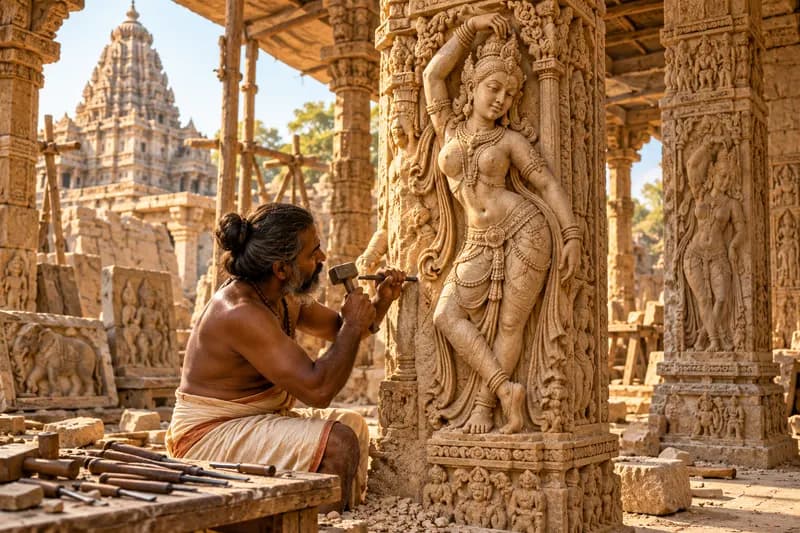
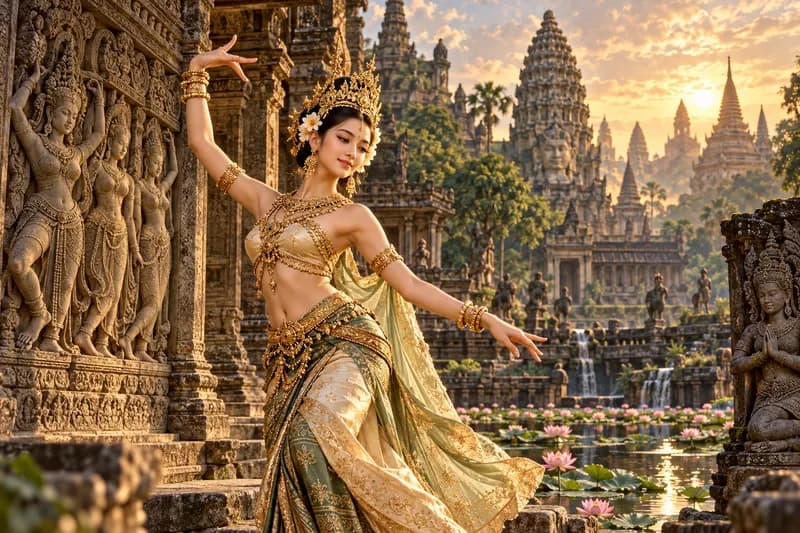
12th Century — Angkor Wat, Cambodia: The most famous Apsara carvings in existence. Over 1,800 individual Apsara figures carved into the walls of Angkor Wat — no two identical. Each has a distinct hairstyle, expression, and posture. These are not decorative flourishes. They are a theological statement: the celestial realm made visible in stone. Scholars have spent decades cataloguing and analyzing them.
10th–13th Century — Khajuraho Temples, Madhya Pradesh: The Apsara figures at Khajuraho are among the most celebrated sculptures in Indian art history. Depicted in dance poses (tribhanga — the three-bend posture), removing thorns from their feet, wringing water from their hair, applying cosmetics. Sensual but never crude. These carvings define the Indian ideal of beauty in stone.
8th Century — Ellora Caves, Maharashtra: The Kailasanatha temple at Ellora (Cave 16) features Apsara figures in flight — celestial nymphs descending from heaven, carved in high relief on the temple walls. These figures appear weightless despite being carved from solid basalt. The sculptors understood something about the Apsara that most modern depictions miss: she is not standing. She is arriving.
5th–6th Century — Ajanta Caves, Maharashtra: The painted Apsaras of Ajanta are among the earliest surviving depictions. These are not carvings but murals — painted in mineral pigments on cave walls. The flying Apsara from Cave 17, scattering flowers, is one of the most reproduced images in Indian art history and has been identified as a direct ancestor of similar figures in Chinese and Japanese Buddhist art.
Cross-Regional Patterns
Yakshini · Naga Spirit · Mohini · Gandharva · Kinnara
| Dawn as hard limit | No |
| Iron weakness | Partial |
| Tree-dwelling | No — water-dwelling |
| Counting compulsion | No |
| Backward feet | No |
Global Equivalent: The closest parallels are the Sirens of Greek mythology (beautiful voices luring men to watery death), the Rusalki of Slavic tradition (drowned women haunting rivers), the Huldra of Norse folklore (enchanting forest spirits), and the Nymphs of Greek tradition (water-dwelling female spirits). But the Apsara is unique in one critical respect: she is not fallen, not cursed, not a victim. She is celestial. Her beauty is not a punishment — it is her nature. The destruction she causes is not revenge. It is simply what happens when the divine and the mortal collide.
In Culture — Movies, Books, Games
| Type | Title | Description |
|---|---|---|
| Classical Literature | Vikramorvashiyam by Kalidasa (4th–5th century CE) | The definitive Apsara love story. Kalidasa's Sanskrit play tells of king Pururavas and the Apsara Urvashi — their impossible love, her disappearance, his madness. Considered one of the greatest works of Sanskrit literature and the template for every mortal-immortal love story that followed. |
| Epic | Mahabharata — The Seduction of Vishwamitra | The story of Menaka breaking the sage Vishwamitra's tapas is one of the most retold episodes in Indian literature. It appears in the Adi Parva and has been adapted into every Indian language. The moral is universal and devastating: no amount of discipline can protect you from beauty. |
| Dance | Apsara Dance Tradition (Cambodia) | The Royal Ballet of Cambodia preserves the Apsara dance tradition — a living art form directly descended from the carved figures at Angkor Wat. Nearly destroyed during the Khmer Rouge genocide, it was painstakingly rebuilt by surviving dancers. UNESCO Intangible Cultural Heritage since 2003. |
| Film | Urvashi (Multiple Indian films) | The Urvashi-Pururavas story has been adapted into Telugu, Tamil, and Hindi cinema multiple times. Most notable is the 1941 Tamil film Urvashi, one of the earliest mythological films in Indian cinema. |
| Video Game | Shin Megami Tensei series | Apsaras appear as recruitable demons/personas across the Megami Tensei franchise — depicted as water spirits with enchantment abilities. One of the most recognizable representations of the Apsara in global gaming culture. |
ACCURACY RATING: HIGH IN CLASSICAL ART · MODERATE IN MODERN ADAPTATIONS
Is the Apsara Still Real?
- Folk belief in water spirits matching the Apsara description persists across rural India — particularly along the Narmada, Godavari, Kaveri, and Brahmaputra rivers. Villagers in these regions observe specific rules about solitary visits to water after dark.
- In Cambodia, the Apsara is a national symbol. The Royal Ballet's Apsara dance is a living religious and cultural practice, not a museum piece. Cambodians do not treat the Apsara as folklore — she is part of national identity, appearing on currency, official seals, and the national airline's logo.
- Temple tank traditions across South India include warnings about bathing alone at twilight — warnings that map precisely onto Apsara folk belief even when the word 'Apsara' is not used. The belief has outlived its own name in many regions.
- Musicians in classical Indian traditions — particularly bansuri and veena players — maintain an informal awareness of the Apsara tradition. The idea that music near water attracts something is not treated as superstition in these circles. It is treated as knowledge.
- Angkor Wat receives over two million visitors annually. Many Cambodian visitors make offerings at the Apsara carvings — not as tourism, but as devotion. The stone Apsaras are treated as living presences within the temple complex.
Expert & Academic Context
- Rig Veda (c. 1500–1200 BCE) — Contains the earliest references to Apsaras as celestial beings associated with water and fertility. The Urvashi-Pururavas dialogue in the Rig Veda (10.95) is one of the oldest dramatic compositions in any Indo-European language.
- Kalidasa, Vikramorvashiyam (4th–5th century CE) — The most celebrated literary treatment of the Apsara-mortal relationship. A Sanskrit play in five acts that established the template for impossible love in Indian literature.
- Mahabharata and Ramayana — Both epics contain extensive Apsara narratives — the seduction of Vishwamitra, the stories of Rambha and Tilottama, and descriptions of Apsaras in Indra's court. These are the primary sources for named Apsaras and their individual stories.
- Devangana — Vidya Dehejia — Academic study of celestial women in Indian art, including extensive analysis of Apsara iconography across temple traditions from the 5th to 13th centuries. Essential for understanding how the Apsara was depicted in stone.
- Angkor Wat Archaeological Studies — Multiple archaeological surveys of the 1,800+ Apsara carvings at Angkor Wat, including the Apsara Conservation Project's documentation of individual figures. The most comprehensive visual record of Apsara representation in any single site.
- Ghosts, Monsters and Demons of India — Rakesh Khanna — Documents the folk-belief dimension of the Apsara — the water-spirit version distinct from the celestial court version. Regional variants, folk stories, and the relationship between classical Apsara mythology and village-level water-spirit beliefs.
The Apsara occupies a unique position in Indian supernatural taxonomy: she is simultaneously the highest (a celestial being, a divine artist) and the most dangerous (an enchantress who dissolves mortal identity). Unlike the Churel or the Bhoot, the Apsara's danger is not rooted in injustice or trauma — it is rooted in the fundamental incompatibility between divine beauty and human fragility. The gendered dimension is complex: the Apsara is a weapon wielded by a male god (Indra) against male sages, making her simultaneously powerful and instrumentalized. She has agency within the narrative — Urvashi chooses Pururavas, Menaka feels genuine remorse — but her fundamental role is to test the limits of male spiritual discipline. The Southeast Asian evolution is remarkable: in Cambodia, the Apsara transcended mythology entirely to become a symbol of national survival, her dance tradition rebuilt from near-extinction as an act of cultural resistance against genocide.
If You Encounter an Apsara
Frequently Asked Questions
▶What is an Apsara?
An Apsara is a celestial nymph from Indian and Southeast Asian mythology. In her celestial form, she is a dancer in the court of the gods. In her folk/ghost form, she haunts water bodies — lakes, rivers, waterfalls — and enchants men who come too close after dark. The most famous Apsaras are Urvashi, Menaka, Rambha, and Tilottama.
▶Are Apsaras dangerous?
Yes, in the folk tradition. The Apsara's danger is enchantment — she does not attack, threaten, or pursue. She attracts. Men who encounter her near water become obsessed, returning night after night until they walk into the water and do not return. The danger is not violence. It is the removal of the desire to leave.
▶What is the difference between an Apsara and a Yakshi?
Both are beautiful supernatural women, but they differ in origin and habitat. The Apsara is celestial (born from the cosmic ocean, dwelling in Indra's court) and haunts water. The Yakshi is terrestrial (a nature spirit associated with trees and fertility). The Apsara enchants through beauty and music. The Yakshi can be both benevolent (granting fertility) and violent (crushing men against her tree).
▶Why are the Angkor Wat Apsaras famous?
Angkor Wat in Cambodia contains over 1,800 individual Apsara carvings — the largest collection anywhere in the world. No two are identical. Each has a unique hairstyle, expression, and dance posture. They represent the celestial realm made visible in stone and are considered among the greatest achievements of medieval sculpture.
▶Can women be affected by Apsaras?
In the classical tradition, Apsaras specifically target men — particularly sages, musicians, and ascetics. There are no canonical stories of Apsaras enchanting women. However, the male counterparts of Apsaras are the Gandharvas — celestial musicians who can enchant women in similar ways.
▶How do you protect yourself from an Apsara?
Do not visit water bodies alone after twilight. If you hear unexplained music near a lake or river, leave immediately. Carry iron. Do not play musical instruments near water at night. If someone you know is being drawn to the river every evening, intervene before the seventh night. Invoke Saraswati. Human love and connection are the strongest protections.
Explore More
Related Spirits
Yakshini · Naga Spirit · Mohini · Gandharva · Kinnara
Explore Further
Stories Are Being Summoned
One ghost story per week. Every Tuesday at midnight.