Agwel
It does not attack. It does not curse. It simply watches from the trees — and if you take what is not yours, the forest takes you.
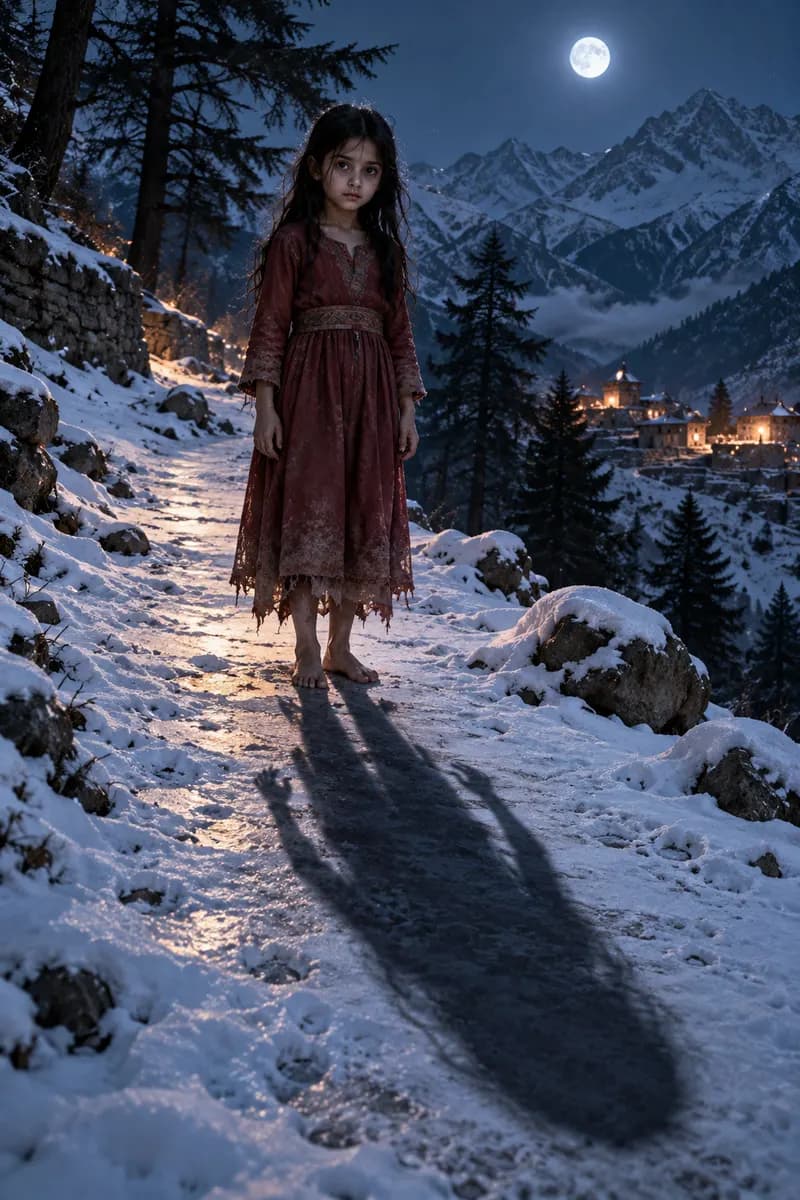
- What Is an Agwel?
- Why the Agwel Is Unsettling
- Origin — How It Came to Exist
- Appearance & Manifestation
- The Woodcutter of Sattari
- The Rules — How to Stay Safe
- What They Don't Tell You
- What Does the Agwel Want?
- You're Most at Risk If...
- Offerings & Appeasement
- The Healer
- What If You Dream of an Agwel?
- The Agwel in Art & Material Culture
- Cross-Regional Patterns
- In Culture — Movies, Books, Games
- Is the Agwel Still Real?
- Expert & Academic Context
- If You Encounter an Agwel
- Frequently Asked Questions
- Explore More
| Agwel | |
|---|---|
| Also Known As | Agvel, Agwell, Agwelo |
| Script | आगवेल (Devanagari / Konkani) |
| Pronunciation | AHG-well (आग-वेल) |
| Region | Goa; Western Ghats foothills; Konkan hinterland |
| Category | Nature Spirit / Forest-hill entity |
| Danger Level | Low |
| Fear Method | Territorial disorientation, ecological retribution, silent presence |
| Warning Sign | Unexplained loss of direction in familiar forest; sudden silence of birds and insects |
| First Documented | Pre-Portuguese Goan oral tradition (pre-1510 CE); no single written source — transmitted through Kunbi and Gauda tribal communities |
| Still Believed? | Yes — in forested villages of Sattari, Sanguem, and Canacona talukas; belief strongest among indigenous Goan communities |
| Related | Vandevta · Vetala · Yaksha · Bayangi · Samandha · Devchar (Goan) |
What Is an Agwel?
The Agwel (आगवेल) is a nature spirit from pre-colonial Goan folklore — a being of the forest and the hill, tied to the Western Ghats landscape long before Portuguese colonizers arrived on the Malabar Coast in 1510. It belongs to the oldest layer of Goan belief, the indigenous animist traditions of the Kunbi, Gauda, and Velip communities who inhabited Goa's interior forests before Brahminical Hinduism, Islam, or Christianity reshaped the region's spiritual landscape. The Agwel is not a ghost. It was never human. It is the forest's own intelligence — a guardian entity that embodies the ecological balance of the Western Ghats.
Unlike the aggressive spirits of Indian folklore — the Vetala, the Churel, the Pishacha — the Agwel is not predatory. Its danger level is low, rated 2 out of 10. It does not seek out humans. It does not haunt homes or cremation grounds. It exists in the deep green spaces of Goa's hinterland — the laterite plateaus, the dense moist deciduous forests, the valleys where rivers begin — and its hostility, when it appears, is purely territorial. Harm the forest, and the Agwel responds. Leave the forest alone, and the Agwel is invisible.
Why the Agwel Is Unsettling
INSTINCT EXPLOITED: LOSS OF ORIENTATION IN FAMILIAR SPACE
You know this path. You have walked it a hundred times — from the village to the river crossing, through the sal trees, past the termite mound shaped like a hand. Twenty minutes, no more. You have done it in monsoon rain, in pre-dawn dark, in the flat heat of April. You know this path the way you know your own name.
But today the path is wrong.
Not blocked. Not overgrown. Wrong. The termite mound is on the left instead of the right. The sal trees are thicker than you remember. The river sounds farther away than it should. You stop. You turn around. The way back looks exactly like the way forward.
There is no wind. The birds have stopped. The insects — the constant background hum of a Goan forest — have gone completely silent. And in that silence, you feel it: something watching. Not with malice. Not with hunger. With attention. The way a landlord watches someone who has entered his property without permission.
You are not lost. You are being shown that you do not belong here. The forest has rearranged itself around you — not to trap you, but to make a point. You are a guest. You have been a guest all along. And now the host wants you to remember that.
The fear of the Agwel is not the fear of being attacked. It is the fear of realizing that the natural world you walk through every day has an owner — and you are not it.
Origin — How It Came to Exist
The Pre-Colonial Layer
The Agwel belongs to Goa's oldest spiritual stratum — the animist beliefs of its indigenous communities. Before the Kadamba dynasty brought Brahminical Hinduism, before the Bahmani Sultanate brought Islam, before Afonso de Albuquerque brought Portuguese Catholicism, Goa's interior was home to tribal communities whose religion was the forest itself. Every hill had a spirit. Every grove had a guardian. Every river bend had an intelligence that watched. The Agwel is a surviving fragment of this worldview — a nature spirit from before organized religion arrived.
The Ecology Behind the Spirit
The Western Ghats are one of the world's eight hottest biodiversity hotspots. Goa sits at the northern end of this chain, where the Ghats descend toward the coast through dense forest, laterite plateaus, and river valleys. The Agwel is inseparable from this ecology. It is the spirit of a specific landscape — not a generic forest spirit but one shaped by sal, teak, and bamboo groves, by the red laterite soil, by the monsoon that drops 3,000 millimeters of rain in four months. The Agwel is what happens when a community watches the same forest for a thousand years and concludes it is alive.
The Colonial Erasure
Portuguese colonization nearly destroyed the Agwel tradition. The Inquisition in Goa (1561–1812) targeted indigenous beliefs with particular ferocity. Forest shrines were demolished. Tribal rituals were banned. Communities were forcibly converted. The Agwel survived only because it lived in the places the Portuguese could not fully control — the deep interior forests of Sattari, Sanguem, and Canacona, where tribal communities maintained their practices in secret, far from the churches and tribunals of Old Goa.
What It Represents
The Agwel represents an ecological consciousness encoded as folklore. It is not simply a scary story — it is a land-management system. Communities that believed in the Agwel did not clear-cut forests. They did not hunt beyond what was needed. They did not build where the spirit lived. The Agwel was the Western Ghats' immune system, expressed in the only language available to pre-literate societies: the language of the sacred and the forbidden.
Survival into the Present
Despite centuries of colonial suppression and post-independence modernization, the Agwel persists in Goa's forested interior. It persists not as formal religion but as felt knowledge — the sense among older village residents that certain groves should not be entered, certain hills should not be built upon, certain trees should not be felled. This is not superstition. It is the residue of a belief system that kept one of the world's most biodiverse landscapes intact for millennia.
Appearance & Manifestation
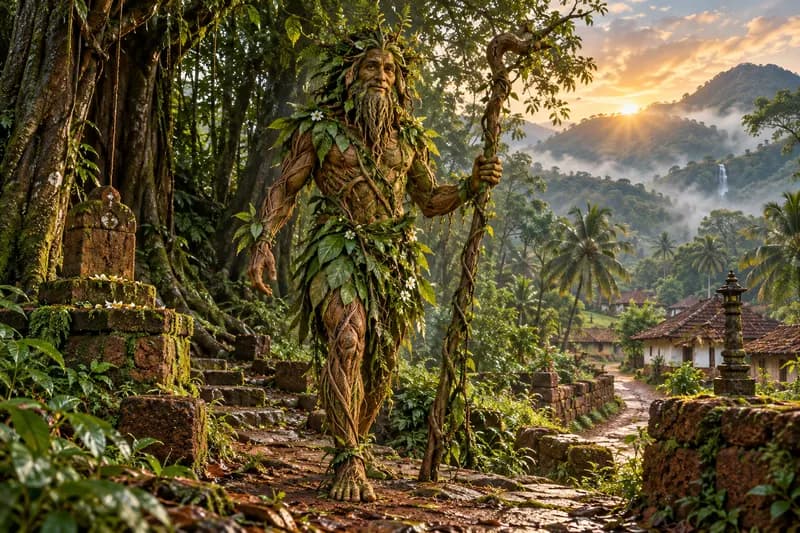
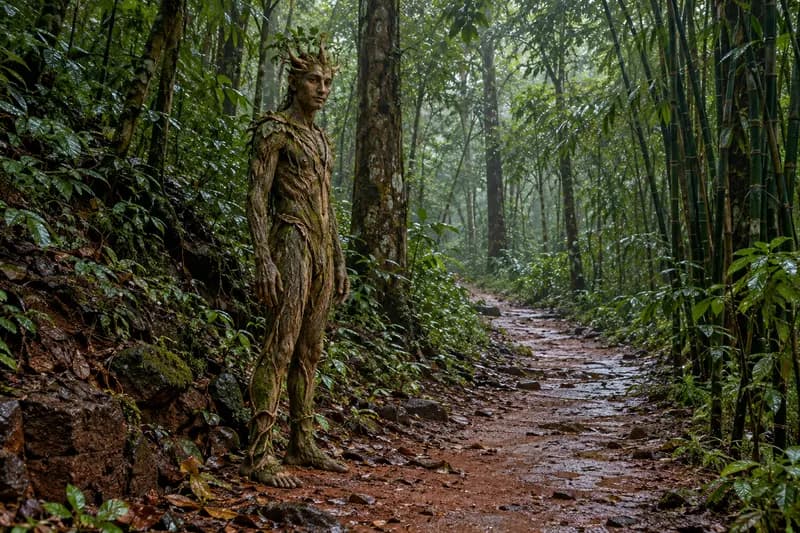
| 👁 Sight | The Agwel is rarely seen directly. When glimpsed, it appears as a shadow that moves against the direction of light — a dark shape between trees that is gone when you turn to face it. Some accounts describe a figure the color of laterite earth, blending so completely with the forest that it is visible only in peripheral vision. It has no fixed form. It is the forest looking back at you. |
| 🔊 Sound | The primary sign of the Agwel is silence — the sudden, total absence of forest sound. Birds stop. Insects stop. The wind drops. In a Western Ghats forest that normally hums with life, this silence is deafening. Some accounts describe a low, resonant sound like a distant waterfall that comes from no identifiable direction. |
| 🍃 Smell | Damp earth and crushed leaves — the smell of deep forest floor. Laterite clay after rain. The rich, loamy scent of decomposition that is not death but transformation — the smell of the forest recycling itself. It intensifies when you have strayed into territory the Agwel guards. |
| ❄ Temperature | A sudden coolness in the air, even in Goa's tropical heat. Not cold — cool. The temperature drop you feel when you step from sunlight into deep canopy shade, except it happens when there is no canopy above you. A microclimate that follows you, not the landscape. |
| 🌑 Time | The Agwel is not strictly nocturnal. It manifests most during the transitional hours — dawn, dusk, and the deep midday stillness when the forest rests. It is most active during the monsoon months (June–September) when the forest is at peak vitality and the boundaries between paths dissolve under growth and water. |
| 🏚 Habitat | Dense forest of the Western Ghats interior — specifically the sal and teak forests of Sattari and Sanguem talukas, the laterite plateaus of Canacona, and the sacred groves (devrai) that dot Goa's hinterland. Never found near the coast, near cities, or near churches. It belongs entirely to the green interior. |
The Woodcutter of Sattari
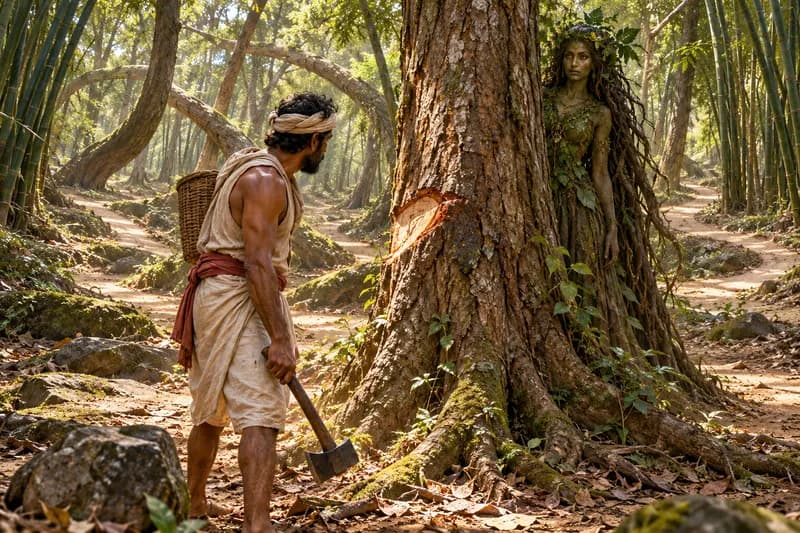
In a village in Sattari taluka, on the eastern edge of Goa where the Western Ghats rise like a green wall, there lived a man named Vithu. He was a Kunbi — one of the original people of Goa, whose families had farmed the foothills for longer than anyone could count. Vithu knew the forest the way a fisherman knows the sea: by instinct, by season, by the behavior of birds.
Vithu's family had always taken from the forest carefully. His father had taught him the rules: never cut a living tree when a fallen one will do. Never take from the same grove twice in one season. Never enter the deep forest on Amavasya. And above all — never cut from the old grove on the hill behind the village. That grove belonged to the Agwel.
But Vithu had four daughters, and the youngest was to be married. He needed timber for the wedding structure — good timber, straight and strong, not the scrubby wood from the village edge. The old grove had teak trees a hundred years old, their trunks as straight as temple columns. One tree. That was all he needed. One tree from a grove with fifty.
He went at midday, when the forest was still and hot, reasoning that the Agwel — if it existed at all — would be sleeping. He carried his axe and a coconut to offer, just in case. He told himself he was being practical, not disrespectful. One tree. The grove would not miss it.
He found the teak he wanted — a tall specimen at the grove's edge, leaning slightly toward a clearing. He placed the coconut at its base. He whispered an apology he half-believed. Then he swung the axe.
The first blow landed true, biting deep into the bark. The second blow went wide, the axe handle twisting in his grip as though someone had nudged it. The third blow — there was no third blow. Because between the second swing and the third, the forest went silent.
Not quiet. Silent. The cicadas stopped. The mynahs stopped. The wind, which had been rustling the canopy, dropped to nothing. Vithu stood with his axe raised and felt the silence press against his ears like water.
He lowered the axe. He looked around. The grove looked different — not changed, exactly, but rearranged. The clearing he had walked through was now behind a thicket of bamboo he did not remember. The path back to the village — the path he had walked a thousand times — was not where it should have been.
Vithu was not a man who frightened easily. But he set the axe down. He sat on the ground beside the wounded teak tree. And he waited. He did not try to find the path. He did not call out. He waited, because his father had told him: if the Agwel takes your direction, do not fight it. Sit. Be still. Show that you understand.
He sat for what felt like an hour. The silence continued. Then, slowly, the cicadas returned — first one, then three, then the full chorus. A mynah called from the canopy. The wind moved again. And when Vithu looked up, the clearing was back where it had always been, the path to the village visible and obvious, as though it had never been hidden.
He left the axe. He left the coconut. He walked home on the path that had returned to him, and he did not look back. The teak tree, he noticed later that week, had healed around the axe wound with a speed that should have been impossible.
Vithu's daughter was married under a structure built from fallen wood gathered at the village edge. It took him three extra days to find enough. Nobody asked why he did not use the grove timber. He did not explain.
The Rules — How to Stay Safe
⚠ ADVISORY ⚠
Five rules for coexisting with an Agwel
- Do not take living wood from sacred groves. — The Agwel is the grove's guardian. Cutting a living tree is a direct provocation. Use only fallen timber. The forest provides what it discards — take that and nothing more.
- If the forest goes silent, stop moving immediately. — Silence is the Agwel's first warning. It means you have been noticed and your presence is being evaluated. Movement after the warning is interpreted as defiance.
- If you lose your path, sit down and wait. — The Agwel disorients intruders by rearranging spatial perception. Fighting the disorientation only deepens it. Sitting still signals submission — acknowledgment that you are on its territory, not yours.
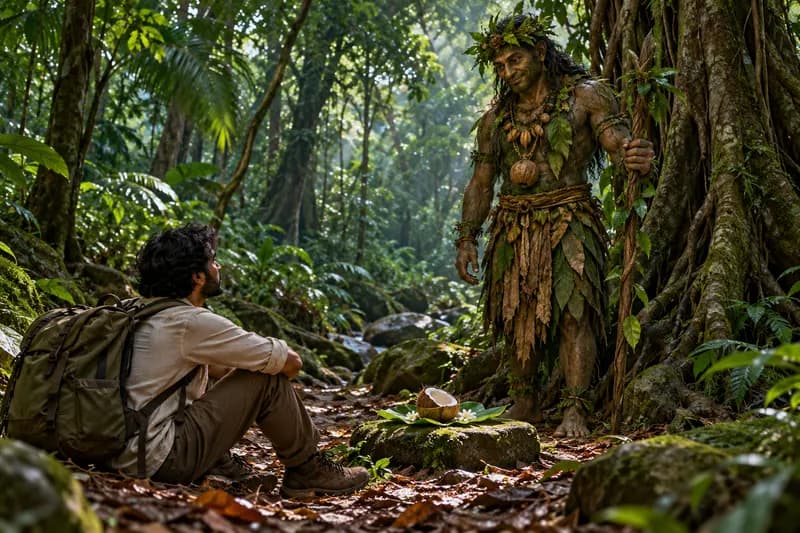
- Leave an offering when you enter deep forest. — A coconut, flowers, or a handful of rice placed at the forest's edge. Not worship — courtesy. The offering says: I recognize this is your space. I am asking permission to pass through.
- Never enter the deep forest on Amavasya (new moon). — The darkest night belongs entirely to the forest and its spirits. Human presence on Amavasya is considered maximum trespass. Even experienced woodsmen avoid the interior on moonless nights.
What They Don't Tell You
The Agwel is not a punishment. It is a boundary. Every culture that lives close to wilderness develops guardian spirits for the places humans should not go — and the Agwel is Goa's version. The sacred groves it protects are not sacred because of the Agwel. The Agwel is sacred because of the groves. The belief system works backward from what outsiders assume: the forest came first, the spirit came second, and the rules came last. The communities that created the Agwel were not frightened of the forest. They were frightened of what would happen to the forest without a protector. And they were right — the groves where Agwel belief has faded are the groves that have been logged, mined, and cleared. The ones where belief persists are still standing.
What Does the Agwel Want?
The Agwel does not want anything from humans. It wants humans to want less from the forest.
It is not a spirit with desires, ambitions, or grudges. It does not hoard treasure. It does not demand worship. It does not seek vengeance for past wrongs. It simply enforces a boundary — the line between sustainable use and extraction, between walking through a forest and owning it.
In this sense, the Agwel is the least anthropomorphic entity in Indian folklore. It does not think like a human, feel like a human, or act like a human. It acts like an ecosystem. When the ecosystem is balanced, the Agwel is invisible. When the balance is threatened, the Agwel appears. It is feedback, not personality.
This is what makes it so quietly radical: in a folklore tradition full of spirits motivated by rage, desire, betrayal, and hunger, the Agwel is motivated by equilibrium. It is the only entity in the database that wants nothing except for things to remain as they are.
You're Most at Risk If...
- You are logging, mining, or clearing forest in Goa's interior talukas
- You enter a sacred grove (devrai) without knowledge of local customs
- You are a developer or surveyor mapping forested land for construction
- You ignore the forest's silence and continue deeper after the warning
- You take living wood, medicinal plants, or animals beyond subsistence need
- You are an outsider with no relationship to the land or its communities

Offerings & Appeasement
| Offering | Purpose |
|---|---|
| Forest-Edge Offering | A coconut broken at the boundary where village land meets forest. Flowers if available — hibiscus or marigold. A handful of raw rice scattered at the base of the largest tree. This is the standard acknowledgment before entering deep forest in Goan tribal tradition. |
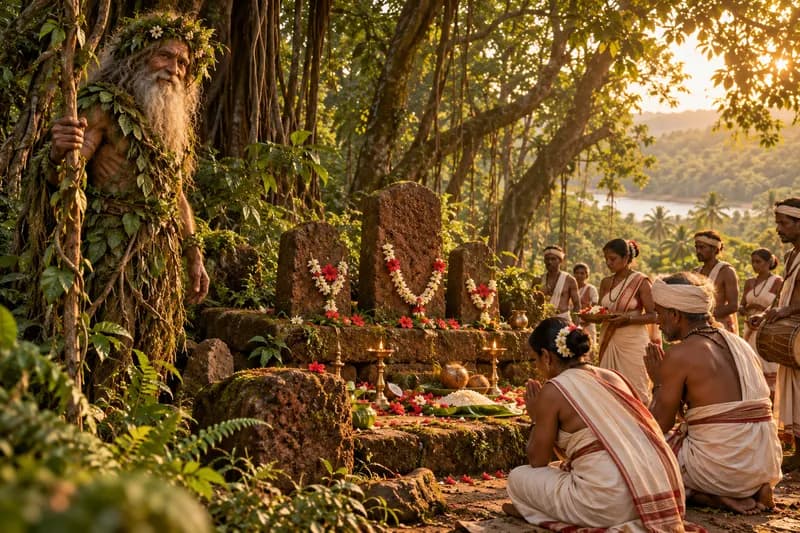
| Seasonal Offering | At the start of monsoon (June) and after harvest (November), community offerings are made at sacred groves — larger ceremonies involving the entire village. These mark the seasonal contract: the forest provides, the community respects. |
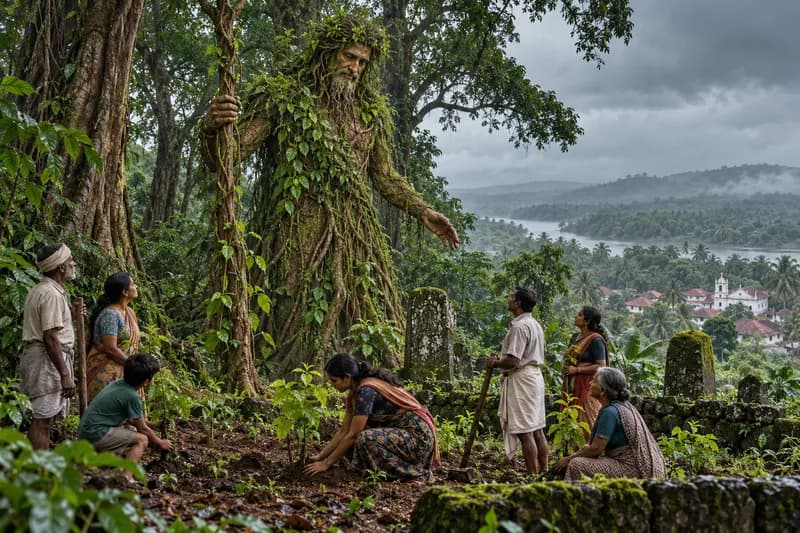
| After Transgression | If a tree has been cut or a grove disturbed, the offending party is expected to plant three trees for every one taken. This is enforced by community pressure, not ritual — but the logic is attributed to the Agwel. The spirit demands restoration, not just apology. |
| The Simplest Offering | Silence. The Agwel does not need flowers or coconuts. It needs humans to be quiet in the forest — to stop, to listen, to move through without domination. Respectful passage is itself an offering. |

The Healer
Bhat (Tribal Priest) — The indigenous Kunbi and Gauda communities have their own ritual specialists — the Bhat — who maintain the relationship between village and forest spirits. The Bhat knows which groves are protected, which paths are safe, and how to restore balance after a transgression.
Devli Dancer — In some Goan tribal traditions, the Devli is a ritual dancer who embodies forest spirits during ceremonies. The Devli does not exorcise the Agwel — the Agwel is not a problem to be solved. The Devli communicates with it, interprets its warnings, and relays its requirements to the village.
Village Elder — In practice, the most common mediator with the Agwel is not a priest but an elder — someone who has lived beside the forest for decades and knows its patterns. Elders adjudicate disputes about forest use, decide when groves can be accessed, and maintain the oral traditions that encode the Agwel's rules.
The Key Difference — There is no exorcism for the Agwel because the Agwel is not an affliction. It is a feature of the landscape. You do not remove it. You adjust your behavior to accommodate it — or you leave the forest.
What If You Dream of an Agwel?
| Symbol | Meaning | |
|---|---|---|
| 🌿 | A Forest That Rearranges Itself | You are trying to control something that cannot be controlled. A situation in your life has its own logic, its own trajectory, and your attempts to direct it are being gently refused. The dream is telling you: stop pushing. Let the path reveal itself. |
| 🤫 | A Forest Gone Silent | You have crossed a boundary — in a relationship, in your work, in your life. Something is watching and waiting to see what you do next. The silence is not hostile. It is a pause, an invitation to reconsider before you go further. |
| 🌳 | A Tree That Heals Its Own Wound | Something you damaged is repairing itself without your help. A relationship, a community, a natural process. The dream suggests that the best thing you can do is step back and let the healing happen on its own terms. |
| 🥥 | Leaving an Offering at a Forest Edge | You are preparing to enter unfamiliar territory — a new job, a new city, a new relationship. The dream is about readiness and humility. You are acknowledging that you do not own what comes next. |
The Agwel in Art & Material Culture
Pre-Portuguese Sacred Groves — Living Installations: The most important 'art' of the Agwel tradition is not carved or painted — it is the sacred groves themselves. These devrai groves are living installations maintained for centuries, their boundaries marked by cairns and specific tree species. They are simultaneously ecological preserves and spiritual architecture.
Laterite Stone Markers — Forest Boundaries: Rough-hewn laterite stones placed at the edges of sacred groves, marking the Agwel's territory. These are not sculptures — they are boundary markers, functional objects that also carry spiritual weight. Some bear simple carved symbols: a leaf, a tree, a circle.
Kunbi Folk Painting — Seasonal Murals: During harvest festivals, Kunbi homes are decorated with wall paintings that include representations of forest spirits — stylized trees with eyes, green figures emerging from foliage. These are temporary, repainted each year, and almost never photographed or documented by outside scholars.
Absence as Evidence: The scarcity of formal Agwel art is itself significant. The Portuguese Inquisition destroyed indigenous religious imagery across Goa for 250 years. What survives — the groves, the stones, the oral tradition — survived because it was too dispersed, too embedded in the landscape, and too far from colonial centers to be efficiently eradicated.
Cross-Regional Patterns
Vandevta · Vetala · Yaksha · Bayangi · Samandha · Devchar (Goan) · Muinacho Zhelo
| Dawn as hard limit | No |
| Iron weakness | No |
| Tree-dwelling | Yes — grove-bound |
| Counting compulsion | No |
| Backward feet | No |
Global Equivalent: The closest global parallel is the Kodama of Japanese folklore — tree spirits that inhabit old-growth forests and cause disorientation to those who harm their trees. The Nordic Huldra (forest guardian), the Celtic Green Man (embodiment of forest vitality), and the Filipino Diwata (nature spirit requiring permission for passage) all share the Agwel's core logic: the forest has consciousness, and that consciousness enforces boundaries.
In Culture — Movies, Books, Games
| Type | Title | Description |
|---|---|---|
| Literature | The Ants Among the Grass — Damodar Mauzo | Goan literature in Konkani frequently references forest spirits in the hinterland. Mauzo's work, rooted in Goa's villages, captures the felt presence of the landscape's intelligence — not naming the Agwel directly but depicting the relationship between people and forest that produced it. |
| Documentary | The Sacred Groves of the Western Ghats (Various) | Multiple documentary projects have explored the devrai tradition of the Western Ghats — sacred groves protected by spiritual belief. These films document the ecological reality behind spirits like the Agwel: forests that survived because communities believed something lived in them. |
| Academic | Madhav Gadgil — Western Ghats Ecology Panel | Gadgil's landmark ecological work on the Western Ghats explicitly connects sacred grove traditions to biodiversity preservation. The Agwel and spirits like it are, in Gadgil's analysis, community-enforced conservation systems expressed as belief. |
| Theater | Goan Folk Theater (Jagar, Dashavatar) | Traditional Goan theater forms include forest-spirit characters in their performances — beings that emerge from the landscape to enforce natural law. These performances, held in village clearings, keep the Agwel tradition alive in communities that might otherwise lose it to urbanization. |
ACCURACY RATING: ORAL TRADITION · LIMITED DOCUMENTATION · ECOLOGICAL EVIDENCE STRONG
Is the Agwel Still Real?
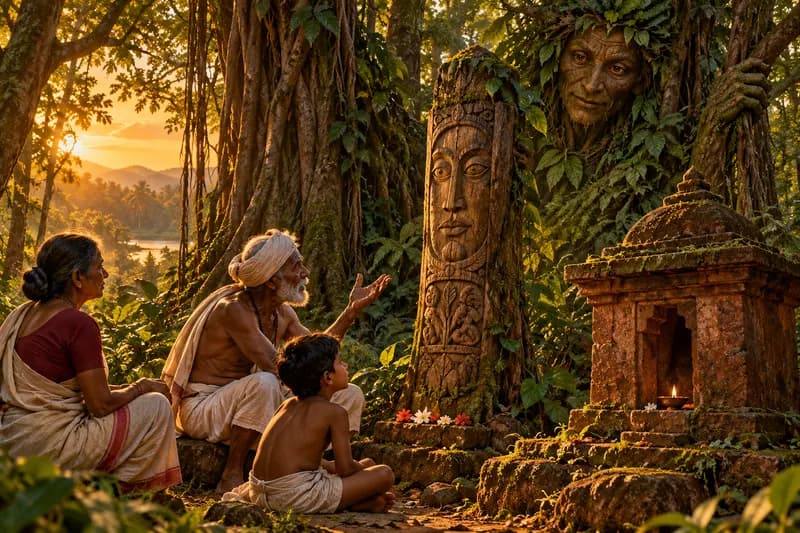
- Belief in the Agwel persists in Goa's interior talukas — Sattari, Sanguem, Canacona — among indigenous Kunbi, Gauda, and Velip communities. It is not performed for tourists or preserved as heritage. It is lived.
- Sacred groves protected by Agwel belief still stand in the Western Ghats foothills of Goa, while surrounding unprotected forest has been logged, mined, or converted to plantation. The ecological evidence for the Agwel's effectiveness as a conservation mechanism is visible from satellite imagery.
- Development conflicts in Goa's interior frequently surface Agwel-adjacent beliefs — communities resisting mining or construction projects cite not just environmental concerns but spiritual ones. The forest has a guardian. The guardian does not permit this.
- Younger generations in urbanized Goa have largely lost the Agwel tradition. But in forested villages, children still learn the rules: which groves to avoid, when to enter the forest, what silence means. The transmission continues, even if the explicit name is fading.
- The Agwel has no formal temple, no organized priesthood, no scripture. It survives entirely through practice and oral tradition — the most fragile and the most authentic form of belief. It has survived the Inquisition, colonialism, and modernization. Whether it survives mining and real estate remains to be seen.
Expert & Academic Context
- Madhav Gadgil & Ramachandra Guha — This Fissured Land: An Ecological History of India — Documents the relationship between sacred grove traditions and forest preservation across the Western Ghats, providing the ecological framework within which the Agwel tradition operates.
- Rui Gomes Pereira — Goa: Hindu Temples and Deities — Documents pre-Portuguese religious practices in Goa, including animist traditions of the interior tribal communities. One of the few written sources that approaches the indigenous belief layer beneath Goa's more visible Hindu and Catholic traditions.
- Pratima Kamat — Farar Far: Local Resistance to Colonial Hegemony in Goa — Explores how indigenous communities in Goa's interior maintained cultural and spiritual practices despite Portuguese colonial suppression, providing historical context for the survival of beliefs like the Agwel.
- Western Ghats Ecology Expert Panel Report (Gadgil Report, 2011) — The landmark environmental report that classified Western Ghats zones by ecological sensitivity. Sacred groves — the Agwel's territory — fall within the highest sensitivity classifications.
- Oral tradition — Kunbi and Gauda communities of Sattari and Sanguem — The primary source for Agwel knowledge is the living oral tradition of Goa's indigenous communities. No single text captures this. It exists in the memories of elders, the practices of villages, and the standing groves that are its most tangible evidence.
The Agwel represents something rare in Indian folklore: an entity that is not about human drama at all. Most Indian spirits — the Churel, the Vetala, the Pishacha — arise from human suffering, human desire, or human transgression. The Agwel precedes the human. It is not interested in justice, revenge, or moral instruction. It is interested in the forest remaining a forest. This makes it both the most ecologically sophisticated and the most philosophically alien entity in the Indian supernatural tradition. It suggests that before humans invented gods who cared about human behavior, they recognized intelligences that did not care about humans at all — intelligences that simply wanted to be left alone.
If You Encounter an Agwel
Frequently Asked Questions
▶What is an Agwel?
An Agwel is a nature spirit from pre-colonial Goan folklore — a guardian entity of the forests and hills of the Western Ghats. It belongs to the indigenous animist traditions of Goa's Kunbi and Gauda communities, predating Portuguese colonization. It is not a ghost or a demon — it is the forest's own intelligence, enforcing ecological boundaries.
▶Is the Agwel dangerous?
The Agwel has a danger level of 2 out of 10 — low. It does not attack, possess, or kill. Its primary manifestation is disorientation: causing intruders to lose their way in familiar forest. It is a boundary enforcer, not a predator. Harm comes only to those who ignore repeated warnings and continue to damage its territory.
▶Where is the Agwel found?
In the forested interior of Goa — specifically the Western Ghats foothills of Sattari, Sanguem, and Canacona talukas. It is associated with sacred groves (devrai) and deep forest. It is never found near the coast, in cities, or in developed areas.
▶How is the Agwel different from other Indian spirits?
Most Indian spirits are anthropomorphic — they were once human, or they interact with humans through recognizable emotions like rage, desire, or grief. The Agwel is not anthropomorphic. It is ecological. It does not care about human morality or justice. It cares about the forest. This makes it unique in the Indian supernatural tradition.
▶Did the Portuguese try to suppress Agwel belief?
Yes. The Goan Inquisition (1561–1812) targeted indigenous beliefs across the territory. Forest shrines were destroyed, tribal rituals were banned, and communities were forcibly converted. The Agwel survived because it existed in the deep interior forests beyond effective colonial control.
▶What should I do if I experience an Agwel encounter?
Stop moving. Sit down. Do not try to find your way — wait for the forest to restore your orientation, which it will once the Agwel determines you are not a threat. Do not cut, take, or damage anything. If possible, leave a small offering — a coconut, flowers, or rice — at the base of the nearest large tree.
Explore More
Related Spirits
Vandevta · Vetala · Yaksha · Bayangi · Samandha · Devchar (Goan) · Muinacho Zhelo
Stories Are Being Summoned
One ghost story per week. Every Tuesday at midnight.